Delta SkyMiles is the simplest elite programme among the three big US airlines, and that simplicity is the whole story. There are no segments to count, no second currency to model and no partner multiplier to decode: one number decides your tier, and Delta publishes it. For 2027 that number is Medallion Qualification Dollars, and the four thresholds have not moved since 2024.
Short version: Silver takes $5,000 of qualifying spend, Gold $10,000, Platinum $15,000 and Diamond $28,000. Four eligible co-brand cards deposit $10,000 of MQDs before you board anything, so Gold is now reachable with no flying at all. Buying Diamond the same way costs between $180,000 and $510,000 of card spending. Fly it rather than buy it, and treat Gold as the only tier where the arithmetic works for an ordinary traveller.

How qualification works in the 2026 year
Since the 2024 revamp, Delta has qualified Medallion members on Medallion Qualification Dollars alone. Medallion Qualification Miles and Medallion Qualification Segments are gone. There is no equivalent of American’s single points total or United’s old flight-count path; there is one running total, and it is denominated in dollars. How American’s version of that total compares, tier by tier, is set out in the Delta vs American comparison.
The year labels are where most guides go wrong. Delta names status by the year you use it, not the year you earn it. On 25 November 2026 you are spending towards 2027 status, and Delta’s qualification page states it plainly: 2027 status is earned on calendar-2026 activity, runs from the day you reach the threshold, and expires on 31 January 2028. A 2027 tier is therefore not a 2027 purchase. It is a 2026 purchase with a long shelf life. Miles run on the opposite logic and have no shelf life at all, which is its own risk: whether SkyMiles can be lost is a question about the account, not the calendar.
Two consequences follow. Every MQD balance resets on 1 January, and dollars above a threshold do not carry into the next year, so there is no prize for overshooting by $6,000 in December. And because status starts the moment you cross the line rather than on 1 February, a member who hits Diamond in August flies the rest of that year as a Diamond.
The thresholds for 2028 status, earned on 2027 activity, were confirmed on 22 October 2026 as unchanged — the third consecutive year without an increase. That is worth pausing on. United is removing its flight-count path for 2027 and lifting Premier 1K from 28,000 to 32,000 Premier Qualifying Points, and it still requires four United-operated flights even for members who qualify on card spend. Delta has done the opposite of tightening: it has left a single number in place for three years, and it imposes no minimum flight count at all. A SkyMiles member can reach Gold without setting foot on an aircraft. United’s members cannot.
The four thresholds
| Tier | MQDs required | Step up from the tier below | What that step buys |
|---|---|---|---|
| Silver Medallion | $5,000 | $5,000 from zero | A free checked bag, preferred seats, Zone 5 boarding, 7 miles per $1 |
| Gold Medallion | $10,000 | +$5,000 | Sky Priority, SkyTeam Elite Plus, 72-hour upgrade window, 8 miles per $1 |
| Platinum Medallion | $15,000 | +$5,000 | One Choice Benefit, Comfort upgrades at ticketing, 120-hour window, 9 miles per $1 |
| Diamond Medallion | $28,000 | +$13,000 | Three Choice Benefits, Zone 2 boarding, the Diamond desk, 11 miles per $1 |
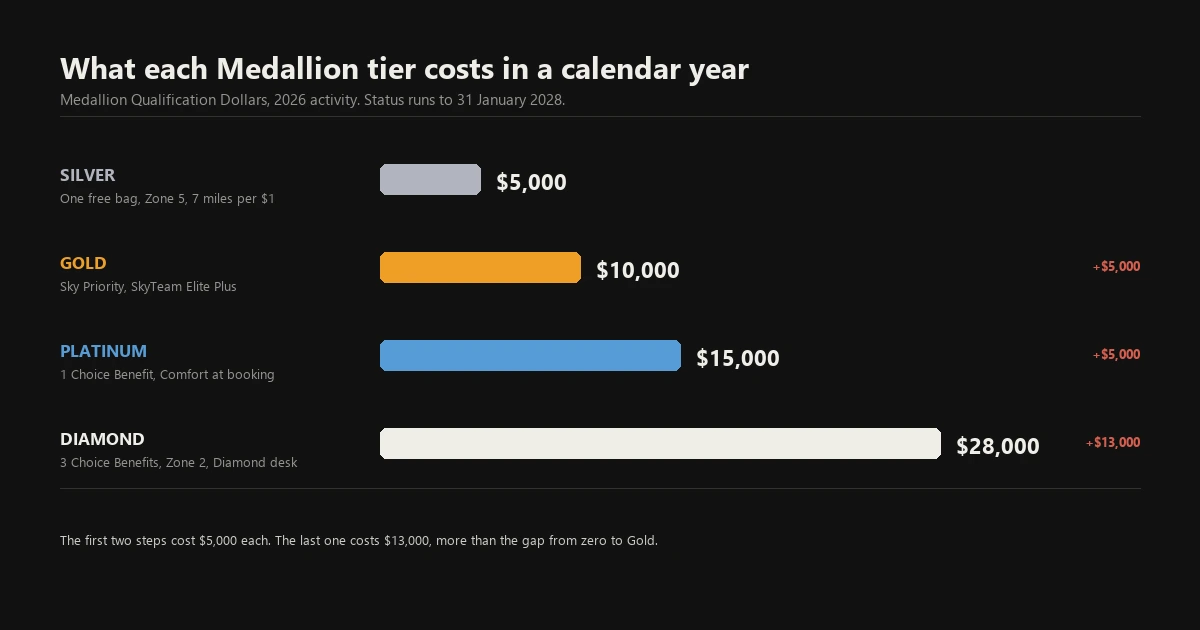
The shape of the ladder matters more than any single rung. The two steps from zero to Platinum cost $5,000 each. The step from Platinum to Diamond costs $13,000, which is more than the entire climb from nothing to Gold. Whatever Delta is selling at the top, it is not selling it at a linear price.
What counts as an MQD, and what does not
Delta publishes three earn categories, and only one of them involves an aircraft. The mile side of the same question, twelve sources ranked by cost, is in the guide to earning SkyMiles. The distinction decides whether a status plan is realistic.
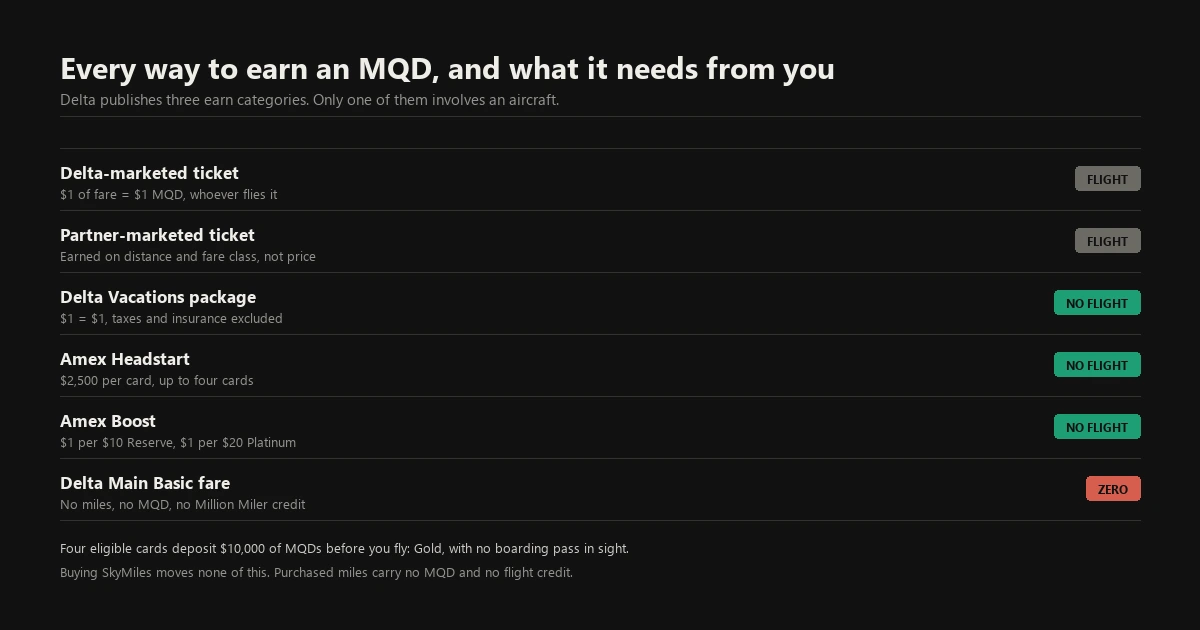
Delta-marketed flights. One dollar of ticket price is one MQD, and it does not matter who operates the aircraft. A Delta-ticketed flight flown by Air France, KLM or Virgin Atlantic earns at the same rate as a Delta-operated one. This is the single most useful fact in the programme and the one most often missed: buying the Delta flight number is what makes a partner flight count at par. Flying Blue runs the equivalent ladder on XP rather than dollars — the thresholds, and what each one actually buys.
Partner-marketed flights. A ticket sold under another airline’s flight number is a different animal. It earns on a distance-and-fare-class formula rather than on the price you paid, so a short partner hop returns less MQD than its dollar value, while a cheap long-haul premium fare can return more than the fare itself. If status is the goal, the flight number you book decides the outcome before the fare does.
Delta Vacations. Packages earn one MQD per dollar of the total package value, with taxes, government fees, gratuities, room service, booking charges and insurance excluded, and the MQDs apportioned between the lead booker and the other travellers on the itinerary. It is the only remaining way to earn MQDs on a hotel bed, now that the mid-2026 hotel and car rental MQD campaign has closed; our Delta promotions hub tracks what is live on that side of the programme.
Delta Main Basic. Basic Economy earns no SkyMiles, no MQD and no Million Miler credit. A year of Main Basic flying is a year of zero progress, which is a sharper penalty than most fare-comparison sites admit.
Two exclusions do quiet damage. Government taxes and fees on a ticket are not qualifying spend, so a $5,000 fare total leaves you short of $5,000 MQD; the number to watch is the fare, not the amount charged to your card. And buying SkyMiles earns nothing at all — purchased miles carry no MQD and no flight credit, which is why the buying route cannot be used to shortcut status.
The Headstart: $10,000 of status from four cards
Four Delta co-brand cards — SkyMiles Platinum, Platinum Business, Reserve and Reserve Business — each deposit $2,500 MQDs into your account every qualification year, with no spending required. Each card type deposits separately, and Delta caps the programme at four deposits, so the ceiling is $10,000 of MQDs before you spend a dollar or board a flight. That is Gold Medallion, for the price of holding four cards.
The Gold card is not on the list, which surprises people who assume every Delta card carries the benefit. Only the two Platinum-tier cards and the two Reserve-tier cards do.
Now the part the headlines skip. Those four cards cost $350, $350, $650 and $650 a year in fees, or $2,000. So the honest price of a bought Gold is $2,000 a year, plus whatever you give up by running $2,000 of card fees through your wallet. Gold’s measurable airport benefits — a second checked bag, Sky Priority, Elite Plus — are worth a few hundred dollars to most travellers. If you were going to hold those cards anyway for their companion certificates, statement credits and lounge visits, the Headstart is free status on top. If you were not, it is the most expensive way to buy a mid-tier airline card. The four cards that stack Headstart, and what each one costs, are set out separately.
The Boost rate is a published price for status
The second card mechanism is spend-based. Platinum and Platinum Business cards convert $20 of eligible purchases into $1 MQD. Reserve and Reserve Business convert $10 into $1. Delta does not present this as a price, but that is exactly what it is: a published exchange rate between cash and status, and the only such rate in the programme.
| Tier | With one Reserve card | With one Platinum card | With all four eligible cards |
|---|---|---|---|
| Silver, $5,000 | $25,000 of spending | $50,000 | Nothing — covered by the Headstart |
| Gold, $10,000 | $75,000 | $150,000 | Nothing — covered by the Headstart |
| Platinum, $15,000 | $125,000 | $250,000 | $50,000 |
| Diamond, $28,000 | $255,000 | $510,000 | $180,000 |
Read the last row twice. A member with no flights at all needs a quarter of a million dollars of Reserve spending for Diamond, or half a million on the Platinum card. The Headstart shaves $25,000 off the Reserve route and $50,000 off the Platinum route, which is real money and still nowhere near a sensible plan.
What Diamond costs four different ways
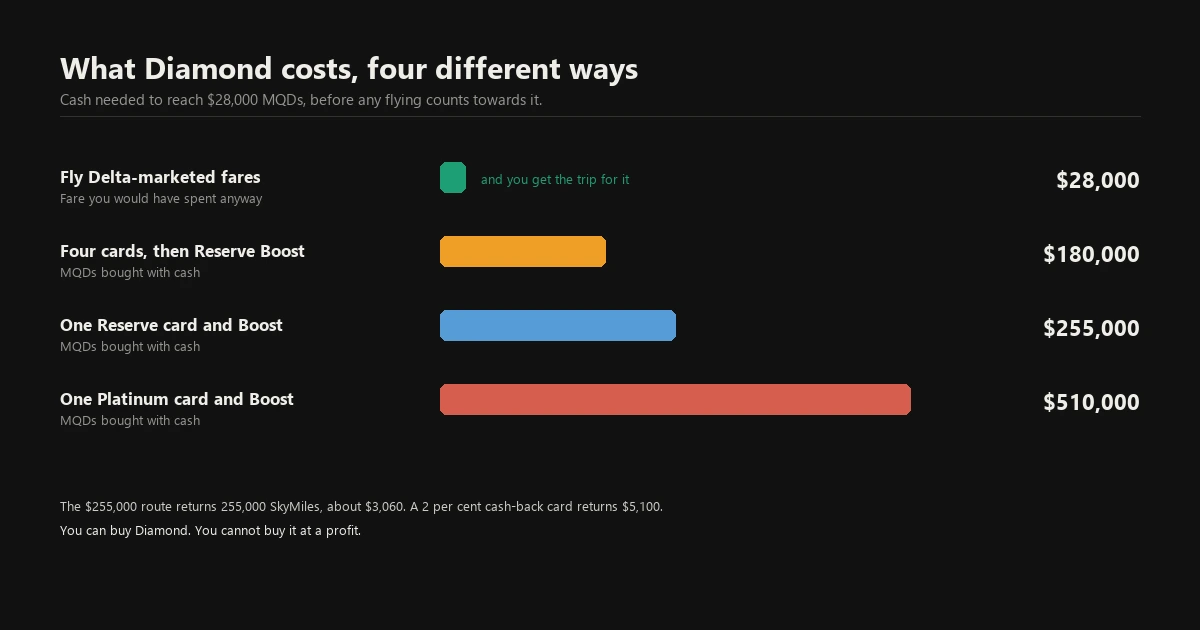
The card routes are not a pure loss, and pretending otherwise would be dishonest. The Reserve earns one SkyMile per dollar on non-Delta purchases, so $255,000 of spending produces 255,000 miles, worth roughly $3,060 at our 1.2 cent valuation, a median rather than a promise, as our Delta SkyMiles valuation guide explains. What makes the route a bad trade is the comparison: the same $255,000 on a 2 per cent cash-back card returns $5,100. The spread is about $2,040, and $2,040 is roughly what Diamond’s three Choice Benefits and its boarding position are worth in hard value.
Which is the cleanest way to say it: you can buy Diamond, but you cannot buy it at a profit. Spending $255,000 to obtain a set of benefits worth $2,000 is a hobby, not a strategy. The flying route costs $28,000 and hands you $28,000 of travel in return, plus 11 miles per dollar at Diamond rates. Cash buys the badge; flying buys the badge and the trip.
What each tier actually gives you
Delta publishes the full comparison on its Medallion benefits page, which is worth reading once in full because the footnotes carry the exclusions that the headline table drops.
| Benefit | Silver | Gold | Platinum | Diamond |
|---|---|---|---|---|
| Miles per $1 | 7 | 8 | 9 | 11 |
| First and Premium Select upgrades open | 24 hours before | 72 hours before | 120 hours before | 120 hours before, with priority |
| Comfort upgrades open | 24 hours before | 72 hours before | At ticketing | At ticketing |
| Boarding zone | Zone 5 | Zone 4 | Zone 4 | Zone 2 |
| Sky Priority check-in | No | Yes | Yes | Yes |
| SkyTeam status | Elite | Elite Plus | Elite Plus | Elite Plus |
| Choice Benefits | None | None | 1 | 3 |
| CLEAR+ discount | $40 off | $40 off | $40 off | $90 off |
| Sky Club access from status | No | No | No | Only by spending Choice Benefits |
Two rows carry most of the value. Elite Plus is the difference between a status card that works abroad and one that does not: it unlocks SkyTeam priority services and lounge access on international itineraries across 18 member airlines, which is the subject of our airline alliance comparison. The Club itself runs on a different set of rules, collected in the Delta Sky Club access guide. It starts at Gold, not Silver, and that single row is why Gold is the tier worth wanting.
The upgrade window is the second. The mechanics — who clears first, and what counts as an eligible ticket — are set out on Delta’s complimentary upgrade page, and the answer changes with fare class as well as with tier. Silver’s 24 hours is barely a window at all — by then the upgrade list has usually sorted itself. Gold’s 72 hours is when domestic first cabins start clearing, and Platinum’s 120 hours is when the process begins before most travellers have packed. Diamond gets the same 120 hours with priority inside it, which matters in a queue rather than in a calendar.
The marginal case for each step up
Zero to Silver, $5,000. Worth it if you check a bag more than a handful of times a year and value preferred seats. Marginal if you hold a co-brand card that already waives the bag fee, which most Delta cards do. This is the tier most often bought by accident and the one least often worth chasing on purpose.
Silver to Gold, $5,000. The best $5,000 in the programme. Sky Priority transforms the airport day, Elite Plus is what a status card is for when you leave the country, and the 72-hour window is the first one that reliably clears. If you are choosing one tier to aim at, aim here.
Gold to Platinum, $5,000. You get one Choice Benefit, Comfort upgrades from the moment you book, and a 120-hour window. In hard value that is roughly $350 to $500 of Choice Benefit plus earlier seat selection. Defensible if you fly long domestic routes in Main and want the window; forgettable otherwise.
Platinum to Diamond, $13,000. Three Choice Benefits, Zone 2, the Diamond desk and the top of the upgrade queue. The hard value is perhaps $1,200 to $1,500. For $13,000 of your own money that is a poor return; for $13,000 of an employer’s travel budget it is the best seat in economy and a phone line that answers.
Choice Benefits, and which ones to take
Platinum members choose one benefit and Diamond members choose three, from a menu Delta republishes each year and lists on its Choice Benefits page. The 2026 menu, which is what Delta currently shows, is the one to plan against until the next revision.
| Option | Platinum | Diamond | Our read |
|---|---|---|---|
| Upgrade certificates | 4 regional | 4 global, 8 regional, or 2 global plus 4 regional | Best pick if your routes have upgrade space |
| Bonus SkyMiles | 35,000 | 40,000 | The safe choice, and they never expire |
| Amex statement credit | $250 | $500 | Requires a Delta Platinum or Reserve card |
| Delta travel voucher | $350 | $550 | Cash-like, expires 12 months after issue |
| Gift Medallion status | Silver for 4 people | Gold for 4 people | Only useful if you have four people to gift |
| MQD Accelerator | 1,000 MQDs | 2,000 MQDs | Worthless unless it tips you into the next tier |
| Sky Club membership | Not offered | Individual uses 2 selections, Executive uses 3 | Worse value than a Reserve card |
| Delta Vacations savings | $400 | $500 | Good if you already book packages |
Three rules govern the choice. Selections for the 2027 Medallion year must be made by 31 January 2028, so the deadline is not the calendar year end. Upgrade certificates expire at the end of the Medallion year and the flight must be flown, not merely booked, before that date. And a benefit cannot be exchanged once selected, which means the certificates should be picked after you know which trips you are taking, not in a hurry in January.
Four things status does not give you
It does not give you Sky Club access
No Medallion tier includes lounge access. Sky Club entry comes from a Reserve card, an American Express Platinum card, a premium-cabin ticket on the day, or a Diamond member spending two Choice Benefits on an individual membership. A Diamond who flies Main and holds no premium card stands outside the same door as everyone else.
It does not give you free CLEAR+
Diamond used to come with a complimentary CLEAR+ membership. It now comes with $90 off, and the other tiers get $40 off. The change is small in dollars and large in kind: it is the clearest example of Delta moving a benefit from status into the card portfolio.
It does not give you confirmed business-class upgrades
Complimentary upgrades reach Delta First, Delta Comfort and, within the 50 US states, Delta One — and the Delta One window is the day of departure for every tier. International Delta One and international Premium Select are not complimentary upgrade cabins at any status level. Global Upgrade Certificates reach them, which is why they are the most contested item on the Diamond menu, and why Delta now confirms economy certificates into Premium Select first rather than straight into Delta One.
It does not survive a Basic Economy ticket
Delta Basic fares are excluded from upgrades, preferred seats and same-day changes regardless of status, and Main Basic earns no miles, no MQD and no Million Miler credit. A Diamond on a Basic ticket has a better boarding group and very little else.
The one new benefit worth knowing
Delta has added something genuinely new rather than taking something away: Reclaim My Status lets current and former Medallion members apply to fly with three months of complimentary status at the tier they applied for, and then earn that status back across the following Medallion year. For anyone whose travel paused for a year or two, it is a cheaper route back than starting from zero, and it is the only status mechanism Delta has introduced that does not involve MQDs.
Million Miler and Delta 360
The lifetime track is separate from the annual one and runs on flight miles, not on spending; Delta’s Million Miler page is the only authoritative table for it. Card spending does not count, Basic Economy does not count, and the totals never reset. One million lifetime flight miles brings annual complimentary Gold Medallion status, two million brings Platinum, three million brings Diamond, and five million brings an annual invitation to Delta 360, the invitation-only tier above Diamond.
Two details are worth pinning down because they are widely misreported. Complimentary status from Million Miler generates no MQDs, so it does not help you qualify for anything else. And it comes with the benefits of that tier only: a member receiving complimentary Diamond does not also receive Platinum’s Choice Benefits. Membership in the Million Miler programme also runs on the Medallion year, February to January, rather than the calendar year.
If you are short a tier before 31 December 2026
Five weeks remain in the qualification year, and only a few levers still move the number.
Check your real balance first. The Fly Delta app shows year-to-date MQDs, and it is the only figure that matters. Third-party dashboards lag, and the number in your head is usually the number you spent rather than the number that qualified.
Book Delta flight numbers, not partner flight numbers. A December trip on Air France metal bought as a Delta-marketed ticket earns one MQD per dollar. The same seats bought under an Air France flight number earn on distance and fare class, which for a discounted economy fare is usually much less. Same aircraft, materially different status outcome.
Use Delta Vacations if a holiday is already planned. Package value earns at par, and the December holidays are the one time of year when a package is a normal purchase rather than a manufactured one.
Time card spending to the statement, not the purchase. MQD Boost credits when the purchase posts, and a purchase made on 30 December that posts in January counts in January. If you are close to a threshold, move the spending earlier rather than hoping.
Do not buy miles to close the gap. Purchased SkyMiles carry no MQD. The maths on that is in our promotions hub and it does not change in December.
And ask whether the tier is worth the fare difference. Paying $800 extra for a December round trip to clear Silver is $800 to obtain a bag waiver and a 24-hour upgrade window. Paying it to clear Gold — where Sky Priority and Elite Plus begin — is a different calculation, and the only one of the four that usually closes in your favour.
Last updated: 25 November 2026.
FAQ
What are the MQD thresholds for Delta Medallion status in 2027?
Silver requires $5,000 MQDs, Gold $10,000, Platinum $15,000 and Diamond $28,000. Those are earned on calendar-2026 spending and produce status that runs from the day it is earned until 31 January 2028. Delta confirmed on 22 October 2026 that the thresholds for the following year are unchanged as well.
Can I earn Delta Medallion status without flying?
Yes, up to Gold. Four eligible co-brand cards each deposit $2,500 MQDs per qualification year and Delta caps the programme at four deposits, so $10,000 of MQDs arrives with no flights at all. Beyond Gold you need either flying or the MQD Boost, which converts $10 of Reserve spending into $1 MQD.
Does Delta Medallion status include Sky Club access?
No. No tier includes lounge access. Entry comes from a Reserve card, an American Express Platinum card, a premium-cabin ticket on the day of travel, or a Diamond member trading two Choice Benefits for an individual membership.
Do MQDs roll over to the next year?
No. The balance resets on 1 January and any dollars above the threshold you reached are forfeited. There is no rollover, no head start carried forward and no benefit to overshooting in December.
Is it worth spending money to reach the next Delta tier?
Only for Gold. The $5,000 between Silver and Gold buys Sky Priority, SkyTeam Elite Plus and a 72-hour upgrade window, which are the benefits that change a travel year. The $13,000 between Platinum and Diamond buys roughly $1,200 to $1,500 of measurable value, and the card-spending routes to Diamond cost between $180,000 and $510,000.
How long does Delta Medallion status last?
Status earned on 2026 activity begins the day you cross the threshold and runs until 31 January 2028. Status earned on 2027 activity runs to 31 January 2029. Because Delta names status by the year of use rather than the year of earning, a status labelled 2027 is earned in 2026.