JetBlue fare tiers are picked in two steps, and most travellers only notice the first. Since 29 July 2026 you choose an experience — Main, EvenMore, BlueFirst or Mint — and then a fare level inside that experience: Base, Standard or Flex. The cabin decides how the flight feels. The fare level decides what you can do when plans move, whether you can sit with the people you are travelling with, and on a long-haul route whether a checked bag is included at all.
That second choice is where the money goes. A Base fare and a Standard fare on the same flight can sit US$30 apart, and the cheaper one carries a US$150 change fee, a paid seat and, across the Atlantic, a US$75 bag that the other fare includes. This guide sets out what each of the twelve boxes actually buys, where Base stops being the cheap option, and how the three ways of paying with points interact with the level you booked.
On this page
The grid, in one table
Three fare levels run across all four experiences, which is why JetBlue can describe the structure as two clicks. The level, not the cabin, sets the flexibility terms and the earning rate.
| Fare level | Changes | If you cancel | Seat selection | Same-day switch | Points per US$1, booked direct |
|---|---|---|---|---|---|
| Base | US$150 per person, plus fare difference | Travel credit, minus US$150 | Paid; auto-assigned within 24 hours if you skip it | US$100 | 2 |
| Standard | No fee; fare difference applies | Travel credit, no fee | Free at booking | US$100 | 6 |
| Flex | No fee; fare difference applies | Refund to the original payment method | Free at booking | Free | 6 |
Two details sit outside the table. Base is not sold in every cabin on every route — JetBlue’s own fee schedule prices a Mint Base, but it is the least consistently available box on the grid. And every fare, including Base, comes with a carry-on and a personal item, which is not true of basic economy at American, Delta or United.
The 24-hour rule sits above all of this. If you booked at least seven days before departure, you can cancel the whole reservation within 24 hours of booking for a full refund, on any fare level. After that window closes, the level you chose is the level you live with.
The four experiences
The cabin is the part of the purchase people understand, so it needs less explanation than the fare level. What is worth pinning down is what each one includes that a cheaper cabin does not.
| Experience | Seat | Checked bags, domestic | Airport | What it adds |
|---|---|---|---|---|
| Main | Standard seat, free wifi, seatback TV, snacks | None | General boarding | The base product, and the one most fares are sold in |
| EvenMore | Extra legroom, seat towards the front | None | Group 2 boarding, dedicated bin space, priority security where offered | Space and boarding order, bought separately from the cabin |
| BlueFirst | 2-2 recliner, up to 7 inches more legroom, 5 inches of recline, 13.3-inch screen | 2 on Standard and Flex, 1 on Base | Group 1, priority check-in and security | Meal service on flights of 899 miles or more; 12 seats on the A220 and A320, 16 on the A321 |
| Mint | Lie-flat seat; the A321neo version adds a door and direct aisle access | 2 on Standard and Flex, 1 on Base | Priority check-in and security | Full dining service, and BlueHouse lounge access on standard Mint at JFK and Boston |
BlueFirst is the newest of the four, and it changed the shape of the ladder. The first revenue flight was 8 December 2026, Boston to Fort Lauderdale, and the retrofit runs across the non-Mint fleet through 2027 with completion planned for late 2028. That matters for two reasons: it gives domestic routes a recliner cabin that previously had none, and it takes space from the cabin behind it.
Mint remains the only lie-flat product, and the only cabin where Base removes a lounge rather than a bag. A Mint Base fare includes one checked bag instead of two and does not carry BlueHouse access; the standard Mint fare includes both.
The three fare levels
Base is the price-first option, and it is priced to be chosen by people who will not use the flexibility. No advance seat selection, a change or cancellation fee of US$150 per person on top of any fare difference, and a travel credit rather than a refund when you cancel. JetBlue assigns a seat within 24 hours of departure if you have not paid for one, which works for a solo traveller on a short hop and works badly for a family of four who wanted to sit together.
Standard is the fare most people should book. Seat selection is free at the time of booking, changes and cancellations carry no fee beyond any difference in fare, and a cancellation returns the value as a travel credit valid for twelve months from the original ticketing date. The same-day switch fee of US$100 still applies, and it is waived for Mosaic members.
Flex is the refundable version. Cancellations go back to the original form of payment rather than into a credit, and same-day switches and standby are free. It is the right buy for anyone whose trip is being paid for by an employer that needs the money back rather than a credit, and the wrong buy for a leisure trip where a credit would be used within a year anyway.
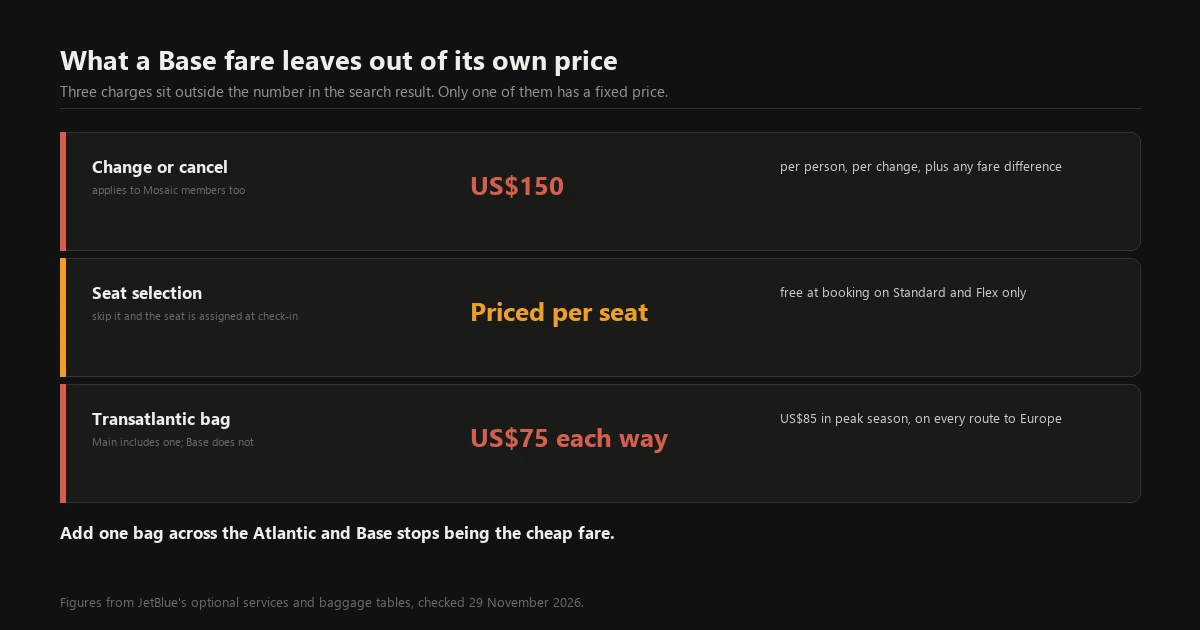
The fee structure has one oddity worth knowing: the US$150 on Base applies to Mosaic members too. Status gives you free bags and better boarding on a Base fare, but it does not remove the change fee. That is the one place where the cheapest ticket is cheap for everybody.
The three costs inside Base
Base is not a trap, but three costs sit inside it that the headline price does not show.
The change fee. US$150 per person, plus the fare difference, charged again on the next change. A return trip for two that moves once costs US$300 before any difference in fare. If the gap between Base and Standard on your flight is under US$150, Standard has already paid for itself the first time your plans move — and it usually is under US$150.
The seat. Base customers can buy a seat at any time, and the fee varies by seat and route, which means the real comparison is not Base against Standard but Base-plus-seat against Standard. On a long flight where you care where you sit, that gap narrows to almost nothing. On a 90-minute hop where any seat will do, it stays wide.
The bag, on long-haul. This is the cost that decides the question, and it deserves its own section.
Where Base breaks
Within the United States, no Main or EvenMore fare includes a checked bag at any level, so Base and Standard are equal on baggage and the comparison rests on the seat and the fee. Across the Atlantic the equality disappears: Main, Main Flex, EvenMore and EvenMore Flex include one checked bag, and Base does not.
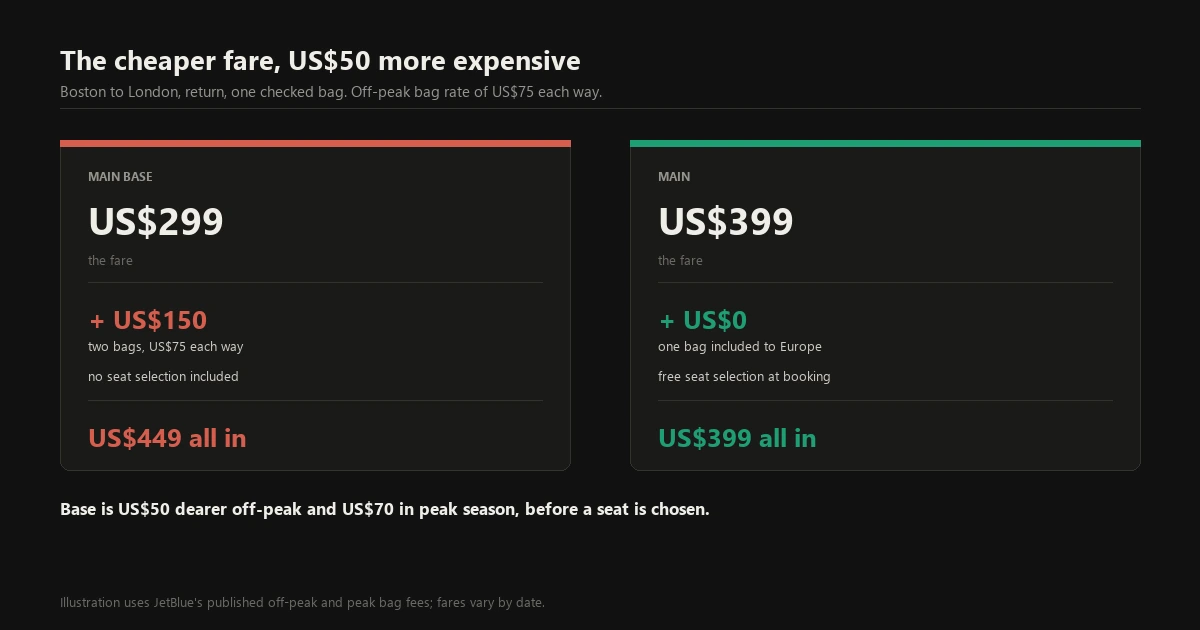
Take a Boston to London flight where Base is US$299 and Main is US$399. Add one bag each way at the off-peak rate of US$75 and Base costs US$449 for the round trip against US$399 with the bag included on Main. In peak season the bag is US$85 each way, which puts Base at US$469. The cheaper fare is US$50 to US$70 more expensive, before anyone has paid for a seat.
JetBlue includes the first bag on all transatlantic routes and on flights to and from Cartagena, Guayaquil, Medellín, Port-au-Prince, Georgetown, Barranquilla and Cali, which is worth checking before dismissing a Main fare as the expensive option on a Latin America route.
The alternative to a US$469 cash fare is a points booking, and a short balance can be topped up rather than paid around — the current purchase tiers decide whether that beats the fare.
The same logic runs in the other direction at the top of the ladder. A BlueFirst Base fare includes one bag where standard BlueFirst includes two, and a Mint Base includes one where standard Mint includes two and adds the lounge. On a two-bag trip the Base fare in a premium cabin is frequently the most expensive way to buy that cabin.
Same-day switches, and the cancel-and-rebook trick
A same-day switch moves you to a different departure on the same day between the same cities, with no fare difference charged. It costs US$100 on Base and Standard, is free on Flex, and is waived entirely for Mosaic members, who can also make the change up to 24 hours before departure rather than from midnight on the day.
There is a legitimate way around the US$100 on a Standard fare. If the difference in fare to the flight you want is less than US$100, cancel the booking — free on Standard, with the value returned as a travel credit — and book the new flight with that credit. You pay the fare difference instead of the switch fee. On a US$89 fare difference that saves US$11; on a US$20 difference it saves US$80. JetBlue’s own fare FAQ points this out, which tells you it is a feature rather than a loophole.
Two limits are worth stating. A no-show forfeits the entire value of the reservation, including ancillaries such as EvenMore seat fees and extra bags, so cancel rather than simply not turning up. And the switch has to be to a different departure time on the same calendar day; a switch to tomorrow is a change, and a change on Base is US$150.
What the fare level does to your points
The fare level sets the earning rate, and the gap is wider than most people assume. Base pays 1 TrueBlue point per dollar, plus 1 more for booking on jetblue.com or the app. Standard and Flex pay 3, plus 3 for booking direct. On a US$300 fare that is 600 points against 1,800 — a difference of 1,200 points, worth about US$16 at 1.34 cents each.
Points alone rarely justify the upgrade. The US$150 fee does. Put the two together and the arithmetic is blunt: Standard costs a little more at booking and removes a US$150 charge, adds free seat selection and pays triple the points. That is why the default answer for a trip with any uncertainty in it is Standard, and why the Mosaic tiers do not change it — status does not remove the Base fee.
The rate is also the reason buying points rarely closes the gap. At the top purchase tier a bought point costs about 1.43 cents and is worth about 1.34 when redeemed, so a purchase funding a fare upgrade starts behind. The current tiers are on the TrueBlue points purchase page, and the break-even maths is in the guide to buying TrueBlue points.
Three ways to pay with points
The fare level also changes what a points booking can do afterwards, which is the part most guides leave out.
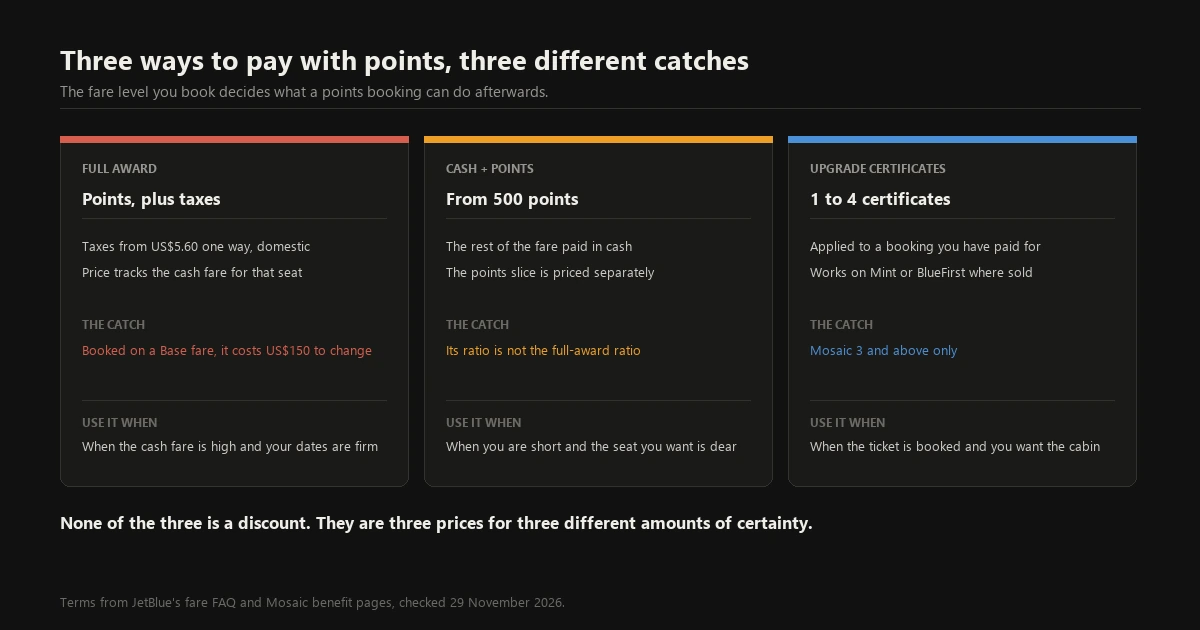
A full award. You pay points plus taxes, which start at about US$5.60 one way domestically. The points price tracks the cash fare for that seat rather than a published chart, so the same cabin costs more on a busy date. A full award booked on a Base fare inherits the Base rules: changing or cancelling it costs US$150 per person, paid by card, with the points returned afterwards. The same award on a Standard fare changes without a fee. The ranked list of TrueBlue redemptions covers which awards are worth the points.
Cash + Points. You can part-pay with as few as 500 points and cover the rest in cash. The ratio on the points portion is not always the same as on a full award, so value the two components separately rather than trusting the blended total — the method is set out in what a TrueBlue point is worth. Buying the missing points outright is a different trade, and the buy-points index lists what each programme charges.
Premium Upgrade Certificates. Mosaic 3 receives four at 150 tiles and Mosaic 4 another four at 250, plus two for every 100 tiles after that. A single upgrade can take between one and four certificates depending on route and cabin, and they work on Mint or BlueFirst where those cabins are sold.
One interaction is easy to miss. Main Base and EvenMore Base bookings are excluded from the complimentary BlueFirst standby upgrades that Mosaic members otherwise get, so the cheapest fare also gives up the free upgrade path. If you are chasing a premium seat, the fare level you book decides whether you are in the queue at all.
Which fare for which trip
Five rules cover most bookings.
Solo, no bag, fixed dates, under three hours: Main Base. Nothing in Standard is worth the difference if none of the flexibility will be used.
Anything across the Atlantic: Main or above, never Base. The included bag alone closes the gap and the US$150 fee makes the rest of the case.
Dates that might move, or a family that wants to sit together: Standard. Free seat selection is the part people underestimate; four Base passengers who skip it are four passengers assigned separately.
Long domestic, daytime, and you want the space: EvenMore on a Standard fare. Extra legroom and Group 2 boarding, without paying for a cabin you do not need on a four-hour flight.
Money that has to come back to a card: Flex, and only then. A travel credit is worth face value to anyone who will fly JetBlue again within twelve months.
The one fare to avoid on principle is a Base booking in a premium cabin with two bags. You pay for the cabin and then pay again for the second bag, and the lounge goes with it on Mint.
Verdict
The structure is simpler than it looks once you accept that the cabin sells comfort and the fare level sells options. Base is a legitimate product for a solo traveller with fixed dates and no checked bag, and it is the wrong product for almost everyone else, because the US$150 fee and the transatlantic bag turn a saving of US$30 into a cost of US$70.
Standard is the fare to book by default. It removes the fee, frees the seat, triples the points and, on long-haul, includes the bag. Flex is for money that needs to be refundable rather than reusable, and it is worth the premium only in that case.
Everything else on this page is detail hanging off that one decision. Book the experience for the flight you are taking, book Standard unless you are certain, and treat Base as a discount you have to earn by being sure.
Last updated: 29 November 2026. Fare rules, fees, bag allowances and points rates verified against JetBlue’s fare, fee and baggage pages, and against the airline’s 27 July and 15 October 2026 announcements.
Questions
What are the JetBlue fare tiers?
There are two layers. Four experiences — Main, EvenMore, BlueFirst and Mint — set the seat and the onboard service. Three fare levels — Base, Standard and Flex — set the flexibility terms and the earning rate. The combinations produce up to twelve fare options, though Base is not sold in every cabin on every route.
Is Main Base the same as basic economy?
In restrictions, largely yes, with one difference that matters: every JetBlue fare, Main Base included, comes with a carry-on bag and a personal item. Basic economy at American, Delta and United generally does not. What Base removes is free seat selection, free changes and the higher earning rate.
What does it cost to change a Base fare?
US$150 per person, plus any difference in fare, charged again on each subsequent change. The fee applies to Main Base, EvenMore Base, BlueFirst Base and Mint Base, to Base award bookings and to travel certificates, and it applies to Mosaic members as well.
Does Main include a checked bag?
Not within the United States, Latin America, the Caribbean or Canada, where no Main or EvenMore fare includes one. Main, Main Flex, EvenMore and EvenMore Flex do include one checked bag on transatlantic routes and on flights to and from Cartagena, Guayaquil, Medellín, Port-au-Prince, Georgetown, Barranquilla and Cali.
Can I book a Base fare with TrueBlue points?
Yes, and the points price is the same as booking any other award, but the Base rules follow the booking. Changing or cancelling a Base award costs US$150 per person, paid by card before the points are returned. A Standard award changes without a fee.
Which fare level earns the most points?
Standard and Flex earn 3 TrueBlue points per dollar plus 3 more for booking direct, against 1 plus 1 on Base. On a US$300 fare that is 1,800 points against 600. The cabin does not change the rate; the level does.
More guides
- JetBlue TrueBlue promotions: what is live, and what is worth it
- How to earn TrueBlue points: every route, and which ones reach the tile counter
- JetBlue Mosaic status: the four tile tiers and what each one now returns
- What a TrueBlue point is worth, and why Mint is not the sweet spot
- The best ways to redeem TrueBlue points, ranked by what you can undo
- Buying TrueBlue points: the four bonus tiers and the break-even maths
- Do TrueBlue points expire? The points do not, and the status clock is not the one you expect
- Transfer partners: what a TrueBlue point costs to manufacture
- JetBlue credit cards: which card covers the bag on a Base fare
- JetBlue Mint and BlueFirst: the fare tiers inside the premium cabins
Before you commit to a Base fare, price the same trip one level up and add the US$150 fee and the bag. If you are short of points for the award you actually want, check what a bought point costs at your tier before you pay cash for the ticket instead.