1. Short version
To buy Delta SkyMiles you pay $0.035 a mile plus tax, which works out to 3.76 cents for a mile that redeems for about 1.2 cents. That gap is not a hidden fee or a temporary condition — it is the published price, and no bonus Delta has run in 2026 closed it. Buying miles is therefore not a way to build a balance. It is an emergency tool for one narrow situation: you have already found a specific award seat, you are short a defined number of miles, and the cash fare for that same seat is higher than the total cost of buying the miles and paying the award taxes. Everything else about the programme — the annual cap, the transfer option, the 2026 sale — only matters because it changes how much that one transaction costs.
2. What Delta charges, exactly
Delta sells miles through three separate programmes, and they are priced completely differently. This is the first thing most guides get wrong: they quote one number for “buying Delta miles” when in fact the cheapest way to add miles to an account is not the Buy Miles programme at all. Earning them costs less still, and the guide to earning SkyMiles ranks the sources by what each one actually costs.
| Programme | Price | Annual cap | What it is for |
|---|---|---|---|
| Buy Miles | $0.035 a mile + tax | 60,000 miles into your own account per calendar year | Topping up your own balance |
| Gift Miles | $0.035 a mile + tax | 60,000 miles to others per calendar year | Buying miles for somebody else’s account |
| Transfer Miles | $0.01 a mile + $30 per transaction + tax | 150,000 miles out, 300,000 miles in | Moving miles between two existing accounts |
The tax line is real and it is not small. Delta adds the 7.5% United States federal excise tax on the purchase, which takes $0.035 to $0.037625, or 3.76 cents a mile. Canadian residents also pay 5% GST. The full terms sit on Delta’s buy, gift and transfer page, including the two eligibility rules that catch people out at checkout: your account must be at least ten days old, and it must have earned at least one mile since it was opened. A brand-new account cannot buy its way to an award on day one.
Purchases go in 2,000-mile steps with a 2,000-mile minimum, so the numbers on the slider are never round in the way you expect. Ten thousand miles costs $376.25. Sixty thousand — the annual maximum — costs $2,257.50.
3. The 60,000 cap, and what lands in the account
The cap is the single most misunderstood number in this programme, because it counts the miles you buy, not the miles you receive. Bonus miles from a promotion sit outside the limit. That is why the ceiling is more useful than it looks: in the 2026 sale, buying the full 60,000 triggered a 50% bonus of 30,000, so the account received 90,000 miles for $2,257.50 while only 60,000 counted against the cap.
Two consequences follow. First, the practical maximum in a single year is 90,000 miles, not 60,000, but only when a bonus is running. Second, buying in several small transactions to stay under the cap does not work — the cap is annual and per account, not per transaction.
What you get for the money is ordinary SkyMiles, usable for anything in the programme: award travel on Delta and its partners, seat upgrades, and Sky Club memberships for Medallion members. What you do not get is any credit toward status. Delta is explicit that dollars spent buying miles do not count as Medallion Qualification Dollars, and the same applies to gift and transfer fees. Miles bought with cash are a redemption balance, nothing more. Cards are the cheaper way into that balance, and the annual-fee side of the ledger shows which tier repays its fee and which does not.
4. What a bought mile is worth
The comparison that matters is not Delta’s price against other airlines’ prices. It is Delta’s price against the value of a Delta award, and there the numbers are not close.
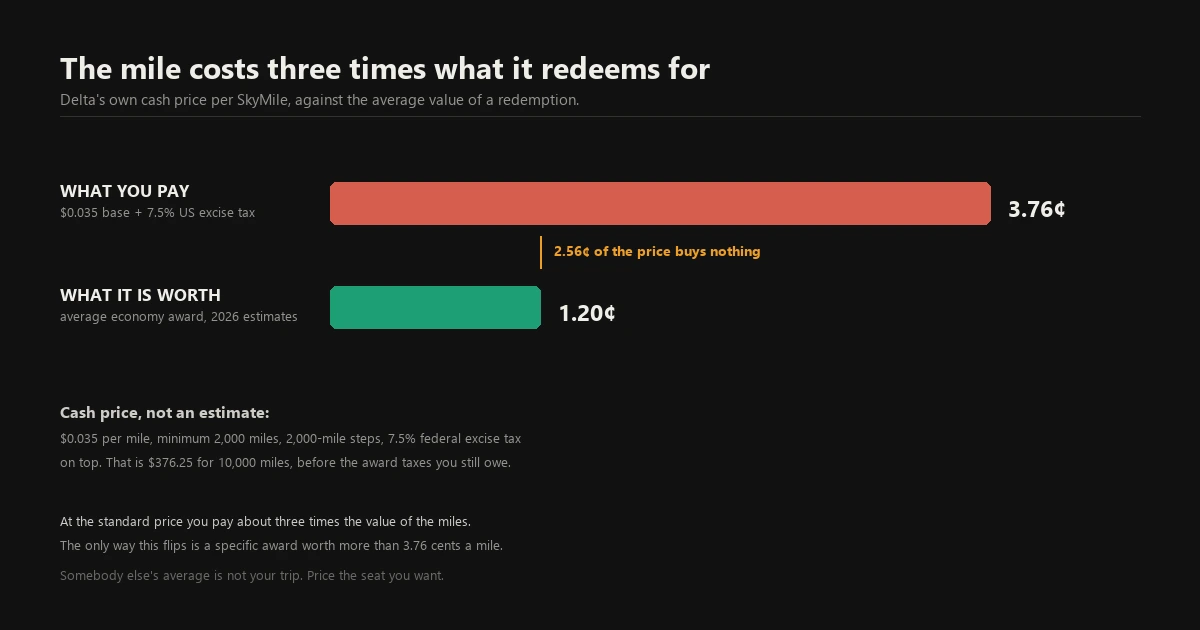
Independent valuations put a SkyMile at about 1.1 to 1.2 cents across 2026, which matches what the SkyMiles valuation guide works through in detail. Pay 3.76 cents and redeem at 1.2 and you have lost 2.56 cents on every mile before you have booked anything. Ten thousand miles bought at the standard price return about $120 of value for $376.25 of cash.
This is not an argument that miles are worthless. It is an argument about which miles you should be spending. Miles earned by flying, by credit card spend or by transferring from a partner cost you nothing close to 3.76 cents, so they are worth redeeming generously. Miles bought at the standard price are the most expensive miles in the programme, and they should be the last ones you touch.
The one thing that genuinely rescues the maths is the award, not the price. A transatlantic Delta One seat that would cost $3,200 in cash can be had for 90,000 miles and about $300 in taxes, which is 3.2 cents a mile of value — below the 3.76 you paid, but close enough that a sale tier or a higher cash fare flips it. That is the whole game: buying miles only works when the specific award is expensive in cash and cheap in miles.
5. The 2026 sale, and why it did not fix the maths
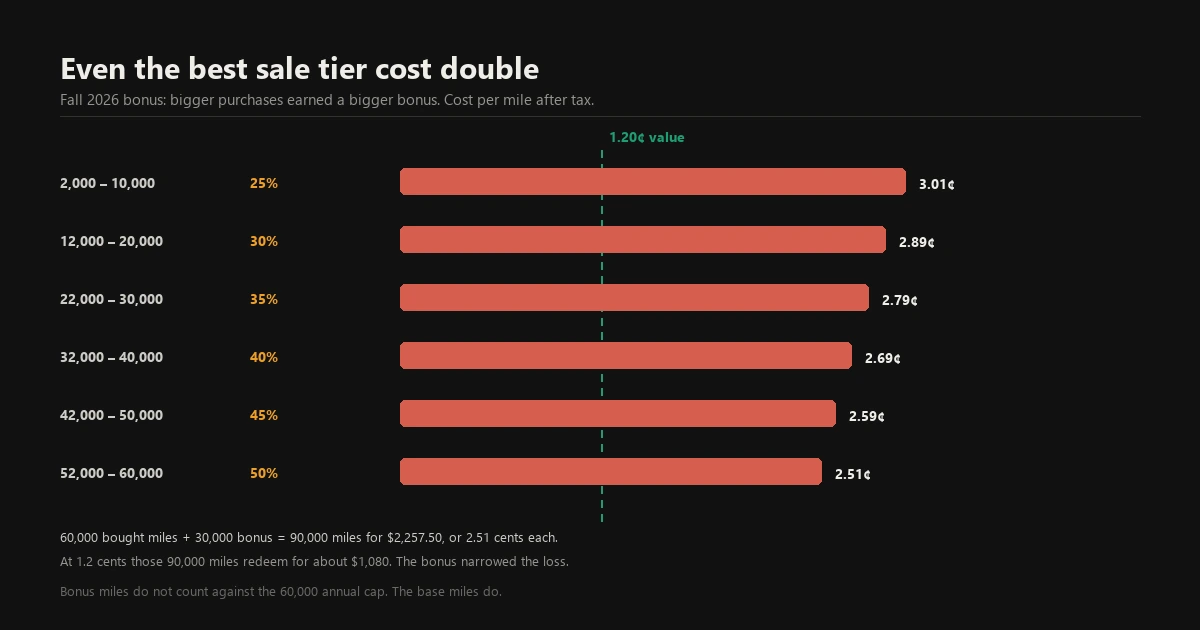
Delta ran a purchase bonus in autumn 2026, tiered so that bigger purchases earned a bigger percentage. It was unusual: apart from a targeted offer in late July and August 2026 that some accounts received, Delta had not run a public buy-miles bonus in 2024 or 2025. It has now ended — and even the trackers disagree on when, with the end date reported as either 30 September or 31 October 2026. As of 26 November 2026 no public bonus is live, so the standard price applies.
| Miles bought | Bonus | Cost per mile after tax | Against a 1.2 cent redemption |
|---|---|---|---|
| 2,000 – 10,000 | 25% | 3.01 cents | Still 2.5x the value |
| 12,000 – 20,000 | 30% | 2.89 cents | Still 2.4x |
| 22,000 – 30,000 | 35% | 2.79 cents | Still 2.3x |
| 32,000 – 40,000 | 40% | 2.69 cents | Still 2.2x |
| 42,000 – 50,000 | 45% | 2.59 cents | Still 2.2x |
| 52,000 – 60,000 | 50% | 2.51 cents | Still 2.1x |
The best tier still left you paying about twice what the miles redeem for. Sixty thousand bought miles plus 30,000 bonus came to 90,000 miles for $2,257.50, which at 1.2 cents is roughly $1,080 of redemption value. The bonus reduced the loss from about $2,300 to about $1,180. That is a real improvement and it is still a loss.
So treat a bonus as a discount on an emergency purchase, not as an invitation to stock up. A 50% bonus turns a terrible price into a bad one. It does not turn it into a good one, and the correct reaction to a sale you have no trip for is to do nothing.
6. Three cheaper routes to the same miles
Here is the part that changes behaviour. If you need SkyMiles and you are about to pay cash, there are cheaper sources of the identical currency, and two of them involve no purchase at all.
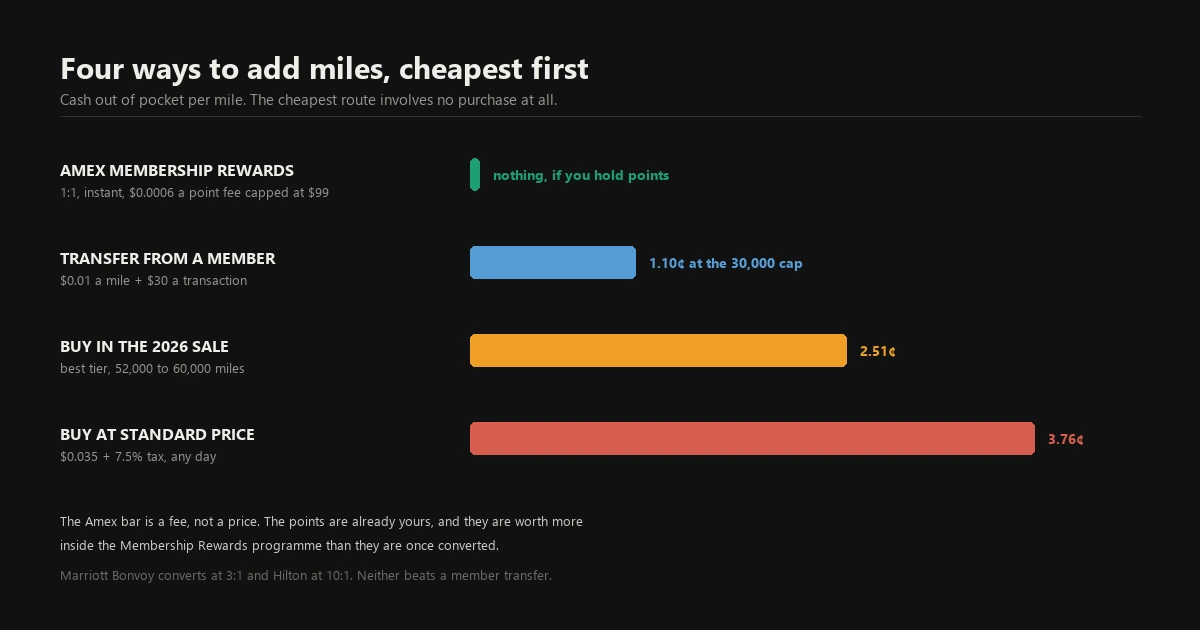
Amex Membership Rewards, at 1:1. Delta is the only United States airline programme reachable from a transferable bank currency — Membership Rewards moves to SkyMiles at one to one, usually within minutes, in 1,000-point steps. No Chase, Citi, Capital One or Bilt points reach Delta at all. Amex charges an excise tax offset fee of $0.0006 a point on transfers to United States airlines, capped at $99, so 50,000 points costs $30 in fees. You are spending an asset rather than cash, but the cash outlay is close to nothing, and the points were already yours.
A transfer from another member, at about 1.10 cents. This is the underused option. Delta’s transfer programme moves miles between two existing SkyMiles accounts for $0.01 a mile plus a flat $30 a transaction. Transfer the maximum 30,000 in one go and you pay $330, or 1.10 cents a mile — a third of Delta’s purchase price, and below the 1.2 cent redemption value. The flat fee is what makes or breaks it:
| Miles transferred | Total cost | Cost per mile |
|---|---|---|
| 1,000 | $40 | 4.00 cents |
| 5,000 | $80 | 1.60 cents |
| 10,000 | $130 | 1.30 cents |
| 20,000 | $230 | 1.15 cents |
| 30,000 | $330 | 1.10 cents |
Under about 5,000 miles the $30 fee dominates and transferring is worse than it looks. At 30,000 it is the cheapest cash route in the programme. Both accounts need to be at least ten days old with one mile earned, transfers go in 1,000-mile steps, and the caps are asymmetric: 150,000 miles out of an account a year, 300,000 in. That asymmetry is deliberate — it lets an account be a net receiver of a family’s miles, which is the closest Delta comes to a pooling feature.
Marriott Bonvoy and Hilton Honors, at 3:1 and 10:1. Both convert to SkyMiles, and both are worse than a member transfer at any realistic hotel point value. Three Bonvoy points for one SkyMile prices the mile at roughly 2.4 cents of Bonvoy value; ten Hilton points for one SkyMile is worse still. They exist, they work, and they should be the last option before paying cash.
7. The gift-versus-transfer trap
Delta prices gifting and transferring completely differently, and the difference is large enough that people pay it by accident. Gifting miles costs the same as buying them: $0.035 a mile plus tax, or 3.76 cents. Transferring costs $0.01 a mile plus $30. If you are moving miles from an account you control into another account you control — a spouse, an adult child, a second membership — transferring is the only sensible channel.
The mechanics differ too. Gifting is meant for buying miles for somebody else: up to four recipients in a single transaction, 60,000 miles a year, and the recipient must have an account at least ten days old with one mile earned. Transferring moves miles that already exist, up to 30,000 per transaction in 1,000-mile steps, and the receiving cap of 300,000 miles a year is double the sending cap. Neither route counts toward Medallion status or Million Miler, and both are final: once the miles move, they do not come back.
One restriction is worth knowing before you plan around it. The transfer programme only moves miles between SkyMiles accounts. It does not convert partner points into miles — Membership Rewards, Bonvoy and Hilton all travel through their own conversion routes, which Delta lists on its convert partner points page. People regularly try to use the transfer form for this and conclude the feature is broken.
8. When buying is the right answer
There is a defensible case for buying, and it has nothing to do with accumulating. It applies when all three of these are true.
You have a specific award in mind, and the seats exist. Not a route, not a season — a flight number with award space in the cabin you want. Delta controls award capacity, and miles in the account buy you nothing if the seat is not there.
You are short a defined number of miles. Buying 60,000 miles because the tier bonus is highest is not this. Buying 12,000 miles because the award costs 90,000 and you hold 78,000 is.
The cash fare beats the total cost of the purchase. Not the mileage price — the total: miles bought, plus tax, plus the award taxes and carrier charges you still pay at booking.
Run the same award through four routes and the ranking is not subtle. Take a transatlantic Delta One award at 90,000 miles plus $300 in taxes, against a $3,200 cash fare:
| Route to 90,000 miles | Cash out | Total with award taxes | Against the $3,200 fare |
|---|---|---|---|
| Buy at the standard price | $3,386.25 | $3,686.25 | $486 worse than paying cash |
| Buy in the 50% bonus tier | $2,257.50 | $2,557.50 | $642 better |
| Three member transfers of 30,000 | $990 | $1,290 | $1,910 better |
| Transfer from Amex Membership Rewards | $54 in fees | $354 | $2,846 better |
The table is the entire argument. The same 90,000 miles cost $3,386 one way and $54 in fees the other, and every route in between beats the published purchase price. The transfer and Amex rows spend assets rather than cash, which is a real cost — but it is a cost you already paid, and it is almost always lower than 3.76 cents a mile.
9. The break-even test
Before any purchase, do one division. Take the cash fare for the seat, subtract the award taxes and fees, and divide by the miles the award requires. That gives you the value of a mile on this specific booking.
Then compare it to what the miles cost you. At the standard price the bar is 3.76 cents, because a mile bought at 3.76 and redeemed at 3.2 is a loss on the miles and a win only if the cash fare is higher than the total spend. In the 50% bonus tier the bar drops to 2.51 cents. A member transfer at 30,000 sets it at 1.10 cents, which almost any premium award clears.
Two adjustments people skip. First, the award taxes are not small: Delta collects at least $11.20 on a domestic award, and international government taxes and carrier-imposed charges can reach several hundred dollars, which is why a London award in business is often a poor use of miles even when the mileage price looks reasonable. Second, a bought mile is a non-refundable asset in a programme with no award chart: you cannot sell it back, and the cheapest award it can buy next year may cost more miles than the same award cost on 26 November 2026.
If the division clears your cost floor with room to spare, buy. If it clears by a cent, you are taking devaluation and availability risk for a rounding error, and paying cash is the better trade.
10. What the checkout page does not tell you
None of the following is hidden, but none of it is on the slider either, and each one has caught a reader of this site at least once.
Every purchase is final. Delta’s terms state that fees for miles bought are non-refundable and that all transactions are final. There is no cooling-off period and no reversing a purchase made in the wrong account.
Posting takes 24 to 48 hours. Miles bought through the programme usually appear within one to two days. That makes buying miles a bad last-minute move for an award you have just found, because the seat can disappear while the miles are in transit. Buy only when the award is not under immediate threat, or accept the risk knowingly.
Nothing here earns status. Dollars spent on miles, gifts or transfers do not count as MQDs, and purchased miles do not count toward Million Miler. Status is earned by flying or by card spend, which the Medallion status guide sets out in full.
The tax is added at checkout, not shown in the headline price. Seven and a half per cent of the purchase, plus 5% GST for Canadian residents. Budget 3.76 cents a mile, not 3.5.
The miles do not expire, but their value drifts. SkyMiles have no expiry date, which removes the classic use-it-or-lose-it pressure, and it also means a balance bought in 2026 can sit until the awards it was intended for have repriced. Value risk, not expiry risk, is the thing to worry about.
11. The verdict
The mechanics of spending those miles well are a separate question, and the guide to the best ways to use SkyMiles covers the search order. For what is running across the programme as of 26 November 2026, the Delta SkyMiles promotions hub is kept current. Lounge access is a separate currency entirely, covered in the Delta Sky Club access guide. And if the purchase is part of a status plan rather than an award plan, the numbers do not work: the Hyatt and Delta partnership and the airline’s own qualification rules both require spend or flights, not purchases.
12. Frequently asked questions
How much does it cost to buy Delta SkyMiles?
$0.035 a mile plus the 7.5% United States federal excise tax, which comes to 3.76 cents a mile. Ten thousand miles costs $376.25 and the annual maximum of 60,000 miles costs $2,257.50. Canadian residents also pay 5% GST on the purchase.
How many Delta miles can I buy in a year?
60,000 miles into your own account per calendar year, in 2,000-mile steps with a 2,000-mile minimum. Bonus miles from a promotion do not count against the cap, so buying the full 60,000 during a 50% bonus puts 90,000 miles in the account while only 60,000 counts toward the limit.
Do purchased Delta miles count toward Medallion status?
No. Delta states that dollars spent buying miles do not count as Medallion Qualification Dollars, and purchased miles do not count toward Million Miler. The same applies to gift and transfer fees. Buying miles adds to your redemption balance and nothing else.
Is it cheaper to transfer miles than to buy them?
Usually, yes. Transferring costs $0.01 a mile plus a flat $30 a transaction, so 30,000 miles costs $330, or 1.10 cents a mile. The flat fee makes small transfers expensive, with 1,000 miles costing $40, which is 4 cents a mile. Both accounts must be at least ten days old and have earned at least one mile.
Can I transfer American Express points to Delta SkyMiles?
Yes, at 1:1, usually within minutes, in 1,000-point steps. Amex charges an excise tax offset fee of $0.0006 a point on transfers to United States airlines, capped at $99. Delta is the only United States airline programme reachable from a transferable bank currency; Chase, Citi, Capital One and Bilt do not transfer to SkyMiles.
What is the cheapest way to get Delta SkyMiles?
Flying and credit card spend, because both earn miles at no separate cost. Among the ways to add miles with cash, a member transfer at about 1.10 cents a mile is the cheapest, followed by a purchase during a 50% bonus at 2.51 cents, with the standard purchase price of 3.76 cents the most expensive option in the programme.