1. Short version
Do SkyMiles expire? No. The SkyMiles Mileage Expiration policy says so in one sentence, and unlike American AAdvantage there is no activity requirement attached to the promise. A balance can sit untouched for a decade and still be there. What can take it away is an account event, not a calendar one: Delta reserves the right to close an account and remove every mile in it in seven named situations, and a closed account forfeits the miles and any Medallion status earned alongside them.
That distinction matters more than it used to, for two reasons. The first is that “never expires” stopped being a Delta advantage in 2019. Delta was the only major US carrier without an expiry date in 2011, when it abolished the old 24-month rule; United followed in August 2019, Alaska in 2023, and Southwest never had one. Of the five largest US programmes, American is now the only one still running a clock. The second reason is that a balance with no deadline has no floor either: Delta has published no award chart since 2015, so the thing that actually erodes a balance is re-pricing, not expiry. The rest of this page is about the seven events that can clear a balance, what does not transfer when it happens, and what to do with miles you are not flying on.

2. What the programme rules actually say
The rule is one line in the SkyMiles Membership Guide and Program Rules, in the section headed Account Closure & Mileage Expiration. It reads: “Under the SkyMiles Mileage Expiration policy, miles do not expire.” There is no qualifying activity attached, no minimum balance, no tier exemption to apply for. Delta does not ask you to fly, spend on a co-branded card, shop through the portal or redeem anything to keep a balance alive.
That is unusual enough that most guides answer the question by repeating a rule Delta retired fifteen years ago. Delta did run a clock once: miles lapsed 24 months after the last qualifying earn or redeem activity, and Delta announced in February 2011 that it was ending the practice, effective 1 January 2011. At the time it was the only major US carrier without an expiry date, which is why the line is still so widely quoted. It has been parity for seven years.
| What you will read elsewhere | What the rules actually say |
|---|---|
| “SkyMiles expire after 24 months of inactivity” | False for Delta since 1 January 2011. That is American’s rule, not Delta’s. |
| “Earn or redeem something every two years” | There is no activity requirement at any tier, on any card, in any country. |
| “Elite members get an exemption” | Nothing to be exempt from. A general member’s balance is treated the same as a Diamond’s. |
| “Miles expire when you close the account” | True, and it is not called expiry. The account is closed and the miles are forfeited. |
| “Miles are your property” | “Miles are not the property of any Member.” They cannot be sold, pledged or transferred except where the rules allow. |
| “Your family can inherit the balance” | Transfer on death is expressly excluded. A deceased member’s account is one of the seven closure triggers. |
Read the last two rows again, because they answer a different question than the one in the headline. Nothing in the programme expires a balance by the passage of time. Everything in the programme treats the balance as a revocable permission rather than an asset, and revocation happens through account events.
3. The seven events that clear a balance
The rules do not leave this vague. They list seven circumstances in which Delta “reserves the right to deactivate or close an account (and accordingly remove all miles in the account)”, and the list is longer and more specific than most programmes publish:
| # | Trigger, as written | What it means in practice |
|---|---|---|
| 1 | Fraudulent activity occurs | Purchases or earnings reversed as fraudulent, including chargebacks on a mileage purchase |
| 2 | A member requests an account closure | You asked. There is no undo described in the rules, and the number stays with Delta |
| 3 | A member is deceased | No inheritance route; the balance is forfeited with the account |
| 4 | No response to repeated communication about the account | The only trigger with a time element, and it is about unanswered contact, not about flying |
| 5 | Additional accounts created under the same name | Duplicates may be cancelled or merged at Delta’s discretion |
| 6 | Residence in, or relocation to, a country where membership is prohibited | Moves, not travel. Relocating can end an account |
| 7 | Violation of the programme rules or a partner offer’s terms | The widest of the seven: includes selling miles and sharing account access |
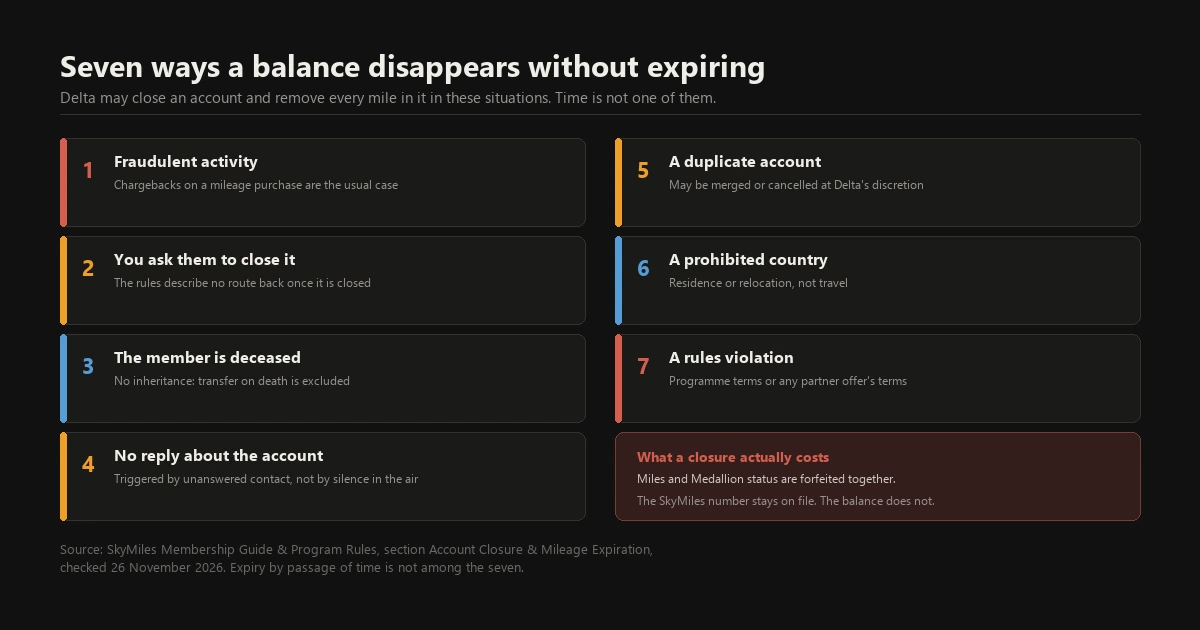
Five of the seven are things a member does or fails to do. Two are not. If a balance is meant to outlive you, or if you are posted to a country where the programme cannot operate, the rules give you no route to preserve it: the only workable answer is to redeem or transfer while the account is still open, because the transfer tool is permitted and an estate is not.
Note also what the rules say happens at closure, because this is the sentence that catches people: “Medallion Status, benefits, and/or miles in the SkyMiles account will be forfeited when an account is closed.” Closing an account to stop marketing email costs you the status as well as the miles — requests go through Delta’s SkyMiles support form — and the footnote to that sentence — that Delta retains the SkyMiles number attached to your basic information — is the reason a closed account cannot simply be reopened with the balance intact. The number survives; the entitlements do not.
4. The one-account rule, and what does not transfer
One member, one account. The rules are explicit: “Only one person may be enrolled per SkyMiles account. Members may not maintain more than one SkyMiles account.” Where a second number is issued to the same person, Delta may cancel or merge the duplicate at its sole discretion, and may move the mileage balance over — excluding any enrolment bonus — to the account it keeps.
The sentence that matters is the last one in that clause: “Credit toward Medallion Status and Million Miler status will not be transferred.” A duplicate account opened to collect a second welcome offer, or by accident at a booking screen, can cost a member a year of status progress even when the miles themselves survive the merge. Points earned toward Million Miler on the discarded account are gone, and there is no reconciliation process published for them.
This is the point where the expiry question and the status question collide. Miles that never expire still count toward an award ticket only if they sit in one account; two half-balances are worth less than one whole, because neither can reach the award price alone and Delta has no mechanism for pooling them. Household pooling does not exist in SkyMiles. If a family wants to combine, the only official route is the transfer tool, priced per mile and capped per year, and it is discussed in section 9.
5. Selling miles, and the third-party app problem
Two prohibitions sit in the rules and both end with the same consequence. The first is sale or barter: “the sale or barter of miles, vouchers, Award Tickets, upgrade certificates, Medallion Status, Medallion benefits, or any other benefit … is prohibited”, and Delta “will terminate or deduct mileage from the account of any Member who violates this rule”. Award tickets obtained that way are void, the passenger is refused travel unless a new ticket is bought at the applicable fare, and Delta reserves the right to assess the fair market value of the benefit against the member who facilitated the transaction.
The second is less well known and applies to people who would never sell a mile. The rules state that members must access their account “directly through the Delta website or Fly Delta App”, and cannot use their credentials on, or give access to, “any person or third-party website or app, including but not limited to, any mileage management service, mileage tracking service, or mileage aggregation service”. Using a balance-tracking app that stores your SkyMiles login is, by the terms of the programme, a violation of the programme.
Whether Delta polices that clause aggressively is a separate question from whether it exists, and the risk sits entirely on the member’s side of the ledger. The punishment for a violation is an account event, and an account event forfeits the balance. That is an odd trade for a currency whose selling point is that it never expires: the miles are not at risk from time, so there is no reason to accept a risk that ends in closure. If a tracker is useful, use one that reads statements or forwards confirmations rather than one that holds the login.
6. “Never expire” stopped being an advantage in 2019
In 2011 Delta was the only major US carrier without an expiry date, and the line has been in its marketing ever since. It is no longer accurate as a differentiator. United removed expiration in August 2019, after a rule that lapsed miles at 18 months. Alaska ended it in 2023. Southwest has never had one. Of the five largest US programmes, exactly one still expires a balance, and it is not Delta. Flying Blue sits on the other side of that line, running a 24-month clock with its own set of resets — how that clock works.
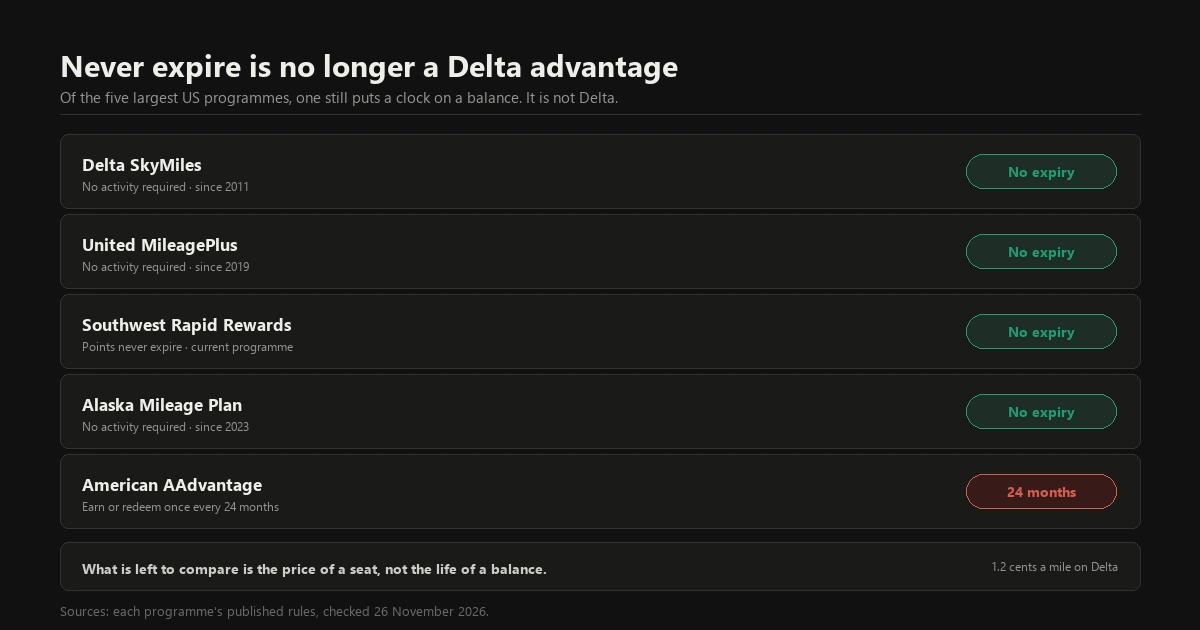
| Programme | Rule as of 26 November 2026 | Activity required | When it changed |
|---|---|---|---|
| Delta SkyMiles | Miles do not expire | None | 1 January 2011; previously 24 months |
| United MileagePlus | Miles do not expire | None | August 2019; previously 18 months |
| Southwest Rapid Rewards | Points do not expire | None | No expiry in the current programme |
| Alaska Mileage Plan | Miles do not expire | None | 2023 |
| American AAdvantage | Miles expire after 24 months without qualifying activity | Earn or redeem at least once every 24 months | Still in force; primary cardholders and members under 21 are exempt |
The practical consequence is that the expiry question no longer separates Delta from anything except American. What separates programmes now is what a balance buys and what it costs to hold, and on that measure the answer is not flattering: a SkyMile is worth about 1.2 cents against United’s similar figure, and both sit below American’s 1.45 cents on the same public valuations. Delta’s answer is TakeOff 15, the 15 per cent discount cardholders get on Delta-operated award tickets, which lifts the effective value to roughly 1.38 cents — but only for cardholders, only on Delta metal, and only when the cash fare is not cheaper.
So the honest version of the “never expire” promise is narrower than the slogan. It means you will not lose the balance to a calendar you forgot to watch. It does not mean the balance will be worth what it was worth on 26 November 2026 when you finally use it, and it does not protect the balance from any of the seven account events above. For the mechanics of what a mile is actually worth, the SkyMiles valuation guide lays out the three cost bases; for how to spend one well, the redemption guide gives the search order, and the SkyMiles partners guide sets out the charts those awards are priced against.
7. The real risk: a balance with no price list
Delta has not published an award chart since 2015. Every seat is priced dynamically, on Delta and on partners, and the same city pair can cost materially different numbers of miles a week apart. That structure does not expire anything, and it does something more corrosive: it removes the reference point a member would use to decide whether a balance is being eroded.
Three numbers are enough to hold a position. A mile is worth about 1.2 cents on average redemptions. Delta will sell you one for 3.76 cents after the federal excise tax, and the only official cash-out route — Pay with Miles at 5,000 miles for $50 — values a mile at exactly one cent. Both of those are worse than the average redemption, which is why buying or cashing out is almost always the wrong direction and why the argument for holding is really an argument for waiting for a good redemption rather than for waiting in general.
The test we use on this site is a comparison, not a valuation: price the same trip in cash, divide by the miles required, and redeem when the answer clears 1.4 cents. A 30,000-mile award on a $500 fare returns 1.67 cents and is worth taking; the same 30,000 miles on a $330 fare returns 1.1 cents and is a worse deal than paying cash and keeping the miles. Nothing about that decision involves an expiry date. Everything about it involves the price of the seat, which is the number Delta can change at any time and has no obligation to hold.
There is a fourth number worth knowing, because it is the one people forget: award flights still earn MQDs, except on Main Basic awards, and they count toward Million Miler. Redeeming does not cost status progress the way many guides claim. That is covered in the Medallion status guide, and it is the reason a balance that is not being used for a cash-equivalent trip can still be doing work.
8. What happens after miles are removed
The rules describe no route back. There is a closure trigger, a forfeiture sentence, and a note that the SkyMiles number stays attached to your basic information; there is no reinstatement procedure, no fee schedule to buy a balance back, and no deadline after which the miles return. Treat removal as final when you decide how much to keep in the account.
In practice the removals members write about are rarely about expiry and usually about one of three things. A chargeback is the most common: miles posted from a purchase, then the card payment is disputed and reversed, and the account is left with a negative or fraudulent position that the rules treat as trigger one. An audit is the second: the rules allow Delta to delay, decline or cancel miles and to suspend account access while discrepancies are investigated, with penalties “up to and including revocation of awarded miles” and closure. A death in the family is the third, and it is the one that turns a harmless balance into a write-off because the transfer-on-death route does not exist.
Two habits reduce the exposure without any mileage activity at all. Keep the contact details on the account current, because trigger four is about unanswered communication rather than inactivity — a member who has moved and stopped reading the account’s email is one of the seven cases. And keep exactly one account per person, which is a rule you can comply with by not doing anything rather than by doing something.
9. What to do with a balance you are not flying on
Because there is no clock, the wrong instinct is to manufacture activity. Members who came from American, where a single earn or redeem every 24 months keeps a balance alive, often buy a small number of miles or make a token redemption to “reset” something that is not running. On Delta that is simply a purchase of miles at 3.76 cents, and it buys nothing.
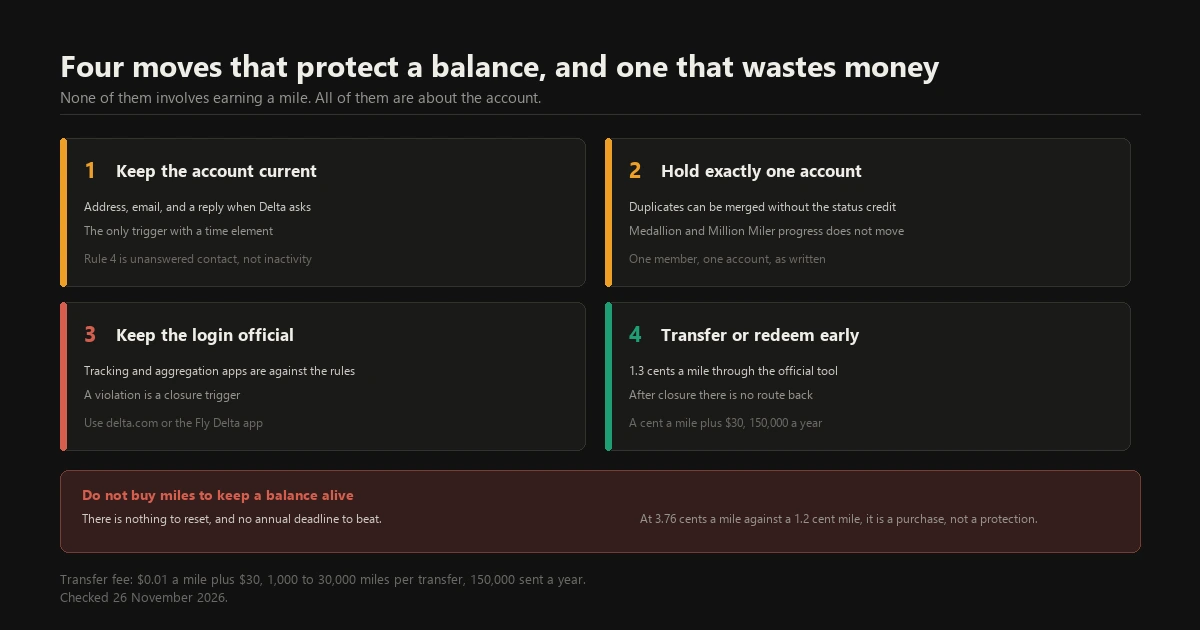
The four moves that do something are these. First, keep the account in good standing: current address, working email, one account, and a reply when Delta asks about the account. Second, if miles must move to another member, use the transfer tool rather than a broker — it is the only permitted route, priced at a cent a mile plus a $30 transaction fee, in blocks of 1,000 to 30,000, with an annual cap of 150,000 miles sent. A 10,000-mile transfer therefore costs $130, or 1.3 cents a mile: cheaper than buying at 3.76 cents, and still more than the mile is worth, which is the honest way to describe it. Third, spend down when a redemption clears 1.4 cents rather than holding for a better one indefinitely, because the balance has no floor and no deadline, so the only discipline available is the one you impose. Fourth, if the balance is small and the trip is not happening, Pay with Miles at a flat one cent per mile is a known loss, and knowing it is better than assuming the balance is an asset that will keep its value.
What none of those moves should involve is paying to keep the balance alive. The programme does not require it, and every official way of adding miles costs more than a mile is worth: buying at 3.76 cents, transferring at 1.3 cents, converting hotel points at 2.8 to 6.3 cents. That arithmetic is set out in the buy miles guide and the earning guide, and it is the reason the answer to “how do I protect my balance” is an account answer, not a miles answer. The same is true of fees: Delta’s four personal cards only pay for themselves if the credits and certificates are actually used.
10. The verdict
Two facts make the page. Miles do not expire, and miles are not property. The first is a promise Delta has kept for fifteen years and no longer holds alone; the second is the reason the promise was never as strong as it sounded. Whether you can use the Club on the day is a different rulebook, collected in the Delta Sky Club access guide. Last updated 26 November 2026. Every rule quoted on this page was checked against Delta’s own programme rules on that date. For what is running across the programme this month, the SkyMiles promotions hub is the current list. For the same question at other programmes, the points expiration hub covers hotels and airlines together, and the sibling pieces on Southwest, United, American and Alaska apply the same test to each programme’s own rules.
11. Frequently asked questions
Do Delta SkyMiles expire if I stop flying?
No. Under the SkyMiles Mileage Expiration policy, miles do not expire, and there is no activity requirement at any tier. A member who stops flying entirely keeps the balance as long as the account remains open and in good standing.
When did Delta stop expiring miles?
Delta ended mileage expiration effective 1 January 2011, replacing a rule that lapsed miles 24 months after the last qualifying activity. At the time it was the only major US carrier without an expiry date. United followed in August 2019 and Alaska in 2023.
Can Delta take my miles away even though they do not expire?
Yes. The rules list seven situations in which Delta may close an account and remove all miles in it: fraudulent activity, a member’s own closure request, death, no response to repeated communication about the account, duplicate accounts, residence in a country where membership is prohibited, and violation of the programme or a partner offer’s terms. Closing an account also forfeits Medallion status.
What happens to my miles when I die?
They are forfeited. Miles are not the property of any member and may not be transferred by operation of law or upon death, and a deceased member’s account is one of the seven closure triggers. The workable approach is to redeem the balance or transfer it to another member through the official transfer tool while the account is still open.
Is it against the rules to link my SkyMiles account to a mileage tracking app?
Yes, as written. The rules require members to access the account through the Delta website or Fly Delta app and prohibit giving credentials to any third-party site or app, expressly including mileage management, tracking and aggregation services. The consequence of a violation is account closure, which forfeits the balance.
How long can I leave a SkyMiles balance untouched?
Indefinitely, provided the account stays open and in good standing. There is no inactivity limit and nothing to reset. The risk to a long-held balance is not expiry but re-pricing: Delta has published no award chart since 2015, so the same 30,000 miles can buy materially less from one year to the next.