Short version
How much are Delta SkyMiles worth? About 1.2 cents each on an ordinary economy award — a median, not a promise, and the wrong number to use for any specific booking. The useful question is not what a mile is worth in general but what this one ticket pays when you divide the cash price you avoid by the miles you spend. Delta prices awards dynamically, so the same route can return 0.6 cents or 2.8 cents depending on the date. A balance that never expires is still exposed to that repricing, which is the argument in the case for never letting a balance sit. TakeOff 15 lowers what an eligible cardholder pays for a Delta-operated award, which lifts the return to roughly 1.38 cents, but it does nothing for partner flights or for the taxes. Award tickets still earn Medallion Qualification Dollars and Million Miler credit on Delta and partner flights, apart from Main Basic, so redeeming is not the status sacrifice it is often made out to be.
2. The three prices people confuse
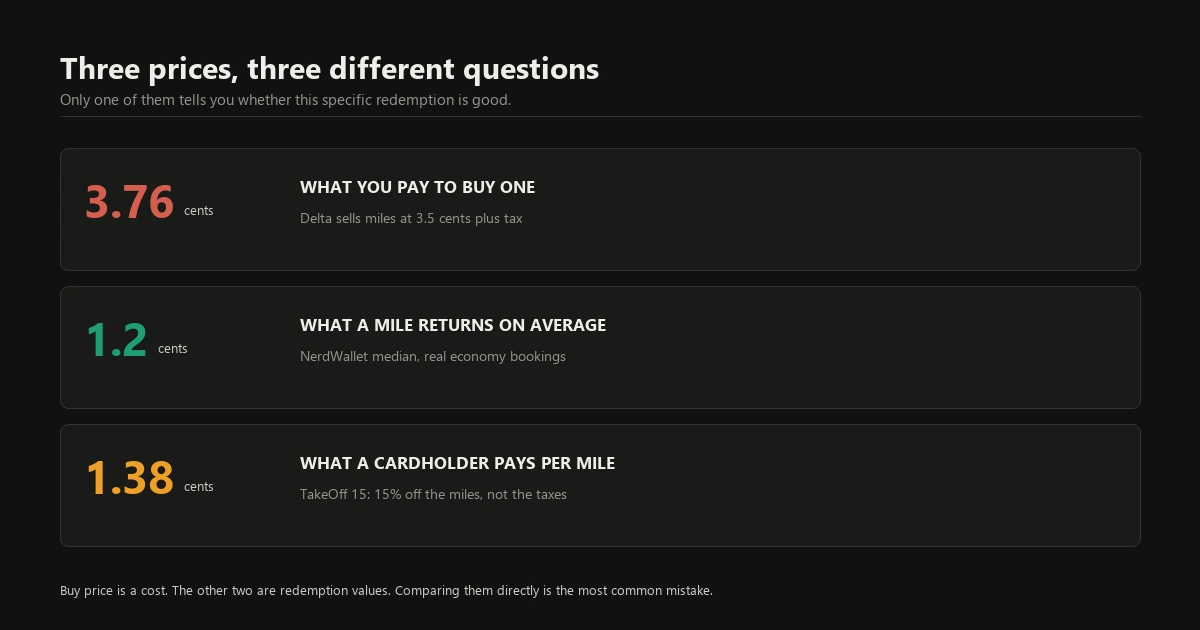
Ask what a SkyMile is worth and you will get three different numbers, all quoted as if they answer the same question. They do not. One is a cost, one is an average return, and one is a discounted return available only to cardholders on a narrow set of bookings.
| Number | What it actually measures | When to use it |
|---|---|---|
| 3.76 cents | What Delta charges to sell you a mile: 3.5 cents plus tax | Only when deciding whether to buy miles. It is a cost, never a value. |
| 1.2 cents | The median return across many real economy bookings | As a floor for judging an award already in front of you. |
| 1.38 cents | The same return after a 15% mile discount for an eligible cardholder | Only on Delta-operated awards booked through Delta, with the eligible card. |
Comparing the first number with the second is how people conclude that buying miles is a terrible deal. It is, but not for the reason they give: you are comparing a guaranteed retail price with a median outcome that varies by a factor of five. The third number is worse still. It is not a universal value of a mile, it is the value of a mile to one particular cardholder on one particular kind of ticket.
3. Where the 1.2 cent baseline comes from
The 1.2 cent figure is not invented by the airline and it is not a floor Delta guarantees. NerdWallet’s 2026 analysis compared cash and award prices across many economy routes at several booking windows and took the median. The Points Guy uses the same number. A median means that half of real bookings did better and half did worse, which is precisely why it works as a benchmark and fails as a valuation of your balance.
Other redemption channels are much worse and should not be compared on the same line. Pay with Miles takes dollars off a ticket at a fixed one cent per mile. Car rentals and hotels return roughly 0.84 and 0.42 cents respectively in published third-party estimates, because Delta converts the miles at rates it sets rather than at the market price of the underlying booking. None of these channels is a good use of a balance built for flights.
Delta has had no published award chart since 2015. There is no distance band to memorise and no saver level to wait for. The mile price moves with the cash fare, the date, the cabin and the route, which means the number printed in a valuation article can never tell you whether Tuesday is a good day to book. Only the specific search can do that.
4. The test for any single booking
Run these three steps on every award before you transfer points or commit miles. They take under a minute and they replace all argument about what a mile is worth in the abstract.
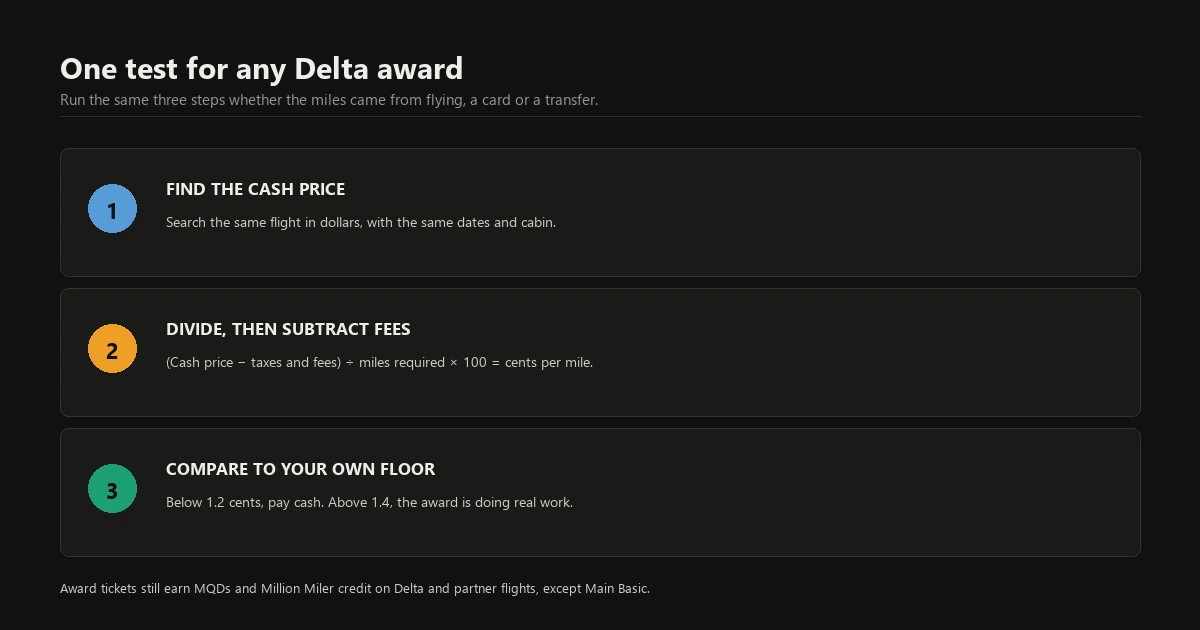
Step 1: price the same seat in cash
Search the identical dates, cabin and routing in dollars first. If you only search in miles, you have no comparison point and you will accept whatever number Delta shows you. Note the cash price before you switch the search to “Shop with Miles”.
Step 2: subtract the taxes, then divide
A domestic award requires at least $11.20 in US government taxes and fees, and international tickets can carry several hundred dollars in government and carrier charges under Delta’s award travel terms. Those charges are cash you pay either way, so they do not belong in the value of the miles. The formula is:
(Cash price − taxes and fees) ÷ miles required × 100 = cents per mile
A $500 fare priced at 40,000 miles plus $11.20 in taxes gives 1.22 cents. A $500 fare at 25,000 miles gives 1.96 cents. The cash price was identical; the dates were not.
Step 3: compare against your own floor, not the internet’s
Below 1.2 cents, pay cash and keep the miles. Between 1.2 and 1.4 cents, the award is ordinary and the decision turns on flexibility. Above 1.4 cents, the award is doing real work. If you hold an eligible Delta card and the flight is Delta-operated, shift the floor up by about 0.18 cents, because you would pay fewer miles for the same seat.
5. What TakeOff 15 actually changes
TakeOff 15 gives Gold, Platinum and Reserve cardholders, including the Business versions, at least 15% off the mileage portion of an award ticket. A 30,000 mile award costs 25,500 miles. The discount appears automatically at checkout when you are logged into a SkyMiles account linked to an eligible card, and it also applies when you change an eligible ticket.
The limits matter more than the headline. Basic card members qualify and additional cardholders do not. The entire itinerary must be on Delta and Delta Connection flights operated and ticketed by those carriers, booked at delta.com or in the Fly Delta app. It does not apply to partner-operated flights even when Delta sells you the ticket, and it does not touch taxes or fees, which must be paid with the eligible card. It cannot be stacked with eCredits, gift cards, vouchers or certificates, and it does not work on Pay with Miles, Miles + Cash or seat upgrades bought after booking.
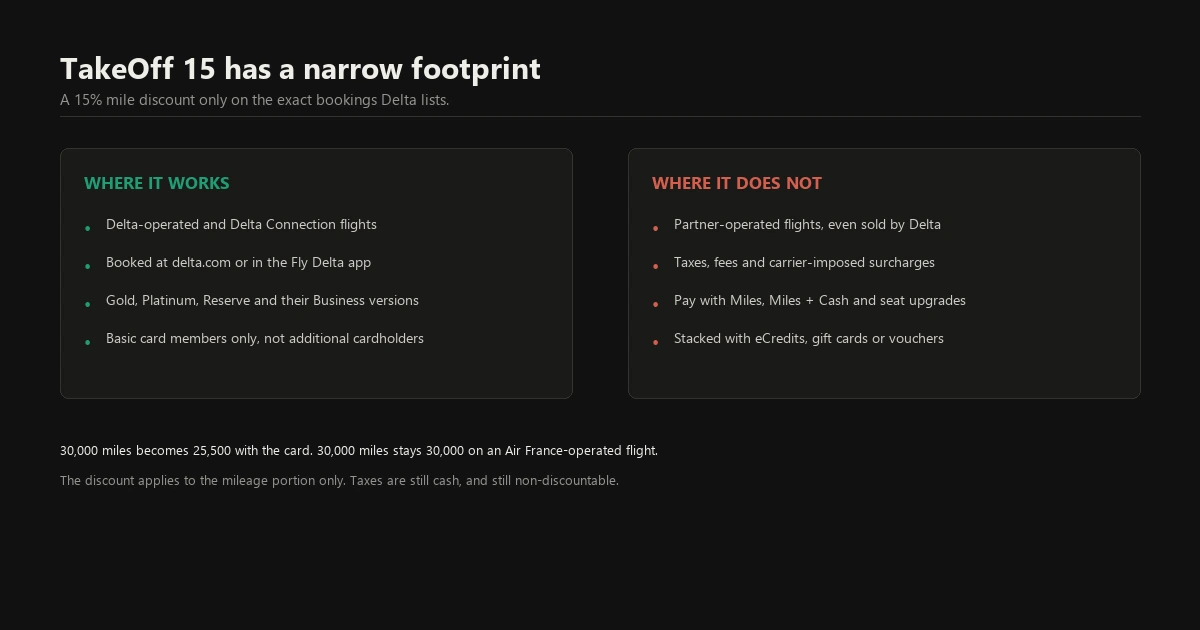
The practical consequence is that TakeOff 15 rewards Delta loyalty rather than SkyMiles flexibility. If your best award is on Air France or Korean Air, the card discount is worth nothing and the 1.2 cent floor is the right one. If you fly Delta transatlantic and hold the card, 1.38 cents is fair. Flying Blue floors at 1.00 cent, with the ceiling set month to month by Promo Rewards — the valuation explains why. Treating 1.38 cents as the value of every mile in your account overstates a partner redemption by roughly fifteen percent. The card discount and the lounge benefit are counted separately, and the Delta Sky Club access guide works through the visit arithmetic.
6. Your own cost floor
The 1.2 cent benchmark tells you what a mile typically returns. It does not tell you what your miles cost you. That number is different for every reader and it is the one that should decide a transfer.
| How you got the miles | Real cost per mile | What that means |
|---|---|---|
| Bought directly from Delta | 3.76 cents | You can never redeem your way back to break-even. Do not buy speculatively. |
| Marriott Bonvoy transfer | about 2.4 cents | 60,000 Bonvoy points become 25,000 SkyMiles with the 5,000 bonus. Count the Bonvoy points you gave up. |
| Amex Membership Rewards transfer | your MR opportunity cost | 1:1 is only good if you value Delta miles above what those MR points could do elsewhere. |
| Earned on paid Delta tickets | the fare you would have paid anyway | Lowest cost, because the miles came with travel you needed. |
| Credit card welcome bonus | annual fee and forgone cash back | Often the cheapest miles, provided you were not spending solely to earn them. |
This is why the same 1.2 cent award can be excellent for one person and poor for another. Miles earned at zero marginal cost can be spent at 1.2 cents without regret. The guide to earning SkyMiles ranks which sources produce them at zero cost and which ones do not. Miles bought at 3.76 cents need a 2.9 cent redemption just to recover the purchase price, and those exist mainly in flash sales, not on an ordinary Tuesday.
If you are comparing programs, apply the same test elsewhere. Our AAdvantage valuation explains why AA’s partner chart changes the answer, and the United valuation does the same for a second dynamic-pricing program. The method transfers; the numbers do not.
7. What an award ticket still earns
One claim appears constantly in guides to Delta value and it is wrong. Award tickets do not earn redeemable SkyMiles, but Delta’s own award travel page states that they do earn MQDs toward Medallion status on Delta and partner travel, excluding Delta Main Basic, and that award travel flight miles count toward your Million Miler balance, also excluding Main Basic.
What Delta does not publish on that page is a conversion rate. Third-party sites frequently quote one MQD per 100 miles redeemed, but treat that as an estimate rather than a term you can hold Delta to. The verifiable point is the direction: a redemption is not a status-free event. If you are close to a tier, an award in December can matter, and the discussion in our Medallion status guide explains where a small MQD balance changes the outcome.
Basic Economy is the exception in both directions. Delta Main Basic earns no miles, no MQD and no Million Miler credit on paid or award tickets, which makes it the only fare where redeeming truly gains you nothing beyond the seat.
8. Redemptions that quietly lose value
Dynamic pricing means a bad redemption is not obviously bad. The seat is the same and the miles leave the account. These are the channels where the gap is widest. Our guide to the best ways to use Delta SkyMiles ranks the ones that hold up and the four that quietly waste the balance.
| Use of miles | Typical return | Why it loses |
|---|---|---|
| Pay with Miles | 1 cent | Fixed rate set by Delta. No upside when the cash fare is high. |
| Hotels and car rentals | about 0.42 and 0.84 cents | Delta converts miles at its own rate rather than at the price of the booking. |
| Mileage upgrades | about 1 cent | You still pay the fare, so the incremental value of the upgrade is small. |
| Short-haul economy at peak dates | often below 1 cent | The mile price tracks a high cash fare but availability and routing can still work against you. |
| Transferring into Delta without a target | unknown until you search | Transfers are one-way. Search the award first, then move the points. |
None of these is forbidden. A Pay with Miles redemption at one cent can be reasonable when you need to reduce a cash outlay and have no other use for the balance. The point is to know that you are accepting one cent when the same miles routinely return 1.2, and sometimes much more.
9. Three worked examples
A domestic economy ticket
A $400 round trip priced at 38,000 miles plus $11.20 in taxes returns 1.02 cents. Below the baseline, so pay cash. The same route on a different date at 28,000 miles returns 1.39 cents, and with TakeOff 15 the miles required fall to 23,800, lifting the return to 1.63 cents. Same route, same cabin, three different decisions.
A transatlantic business award
A $3,500 one-way Delta One seat at 85,000 miles and about $5.60 in tax returns roughly 4.1 cents. Even at 115,000 miles on a peak summer date the return is close to 3 cents. These are the bookings that justify a transfer from Membership Rewards or Bonvoy, and they appear in Delta’s award deals rather than on a fixed schedule. Our Delta promotions hub separates these fare sales from the double-miles offers Delta does not run.
A partner award that looks expensive
A partner business seat priced at 70,000 miles against a $2,000 cash equivalent returns 2.8 cents, but TakeOff 15 does not apply because the flight is operated by a partner. Comparing it with the 1.38 cent cardholder figure would wrongly label it a poor redemption. Compare it with 1.2 cents instead.
10. Status changes the answer
Medallion status does not change the miles a flight costs, but it changes the cash alternative. A Diamond member clearing complimentary upgrades may value a business seat less than a general member who would otherwise pay for it. A Silver member flying with eight companions gets free first bags that alter the total cash price of the itinerary. Both are legitimate reasons to depart from the 1.2 cent benchmark, provided you can name the number you are adjusting.
Status also changes what the miles do on the ground. Every ticket price dollar is already MQD progress, and award tickets add MQDs too, apart from Main Basic. That means an award redemption is not automatically costing you the status you would have earned by paying cash. The cash fare earns miles and MQDs; the award spends miles and still earns MQDs. Choosing between them is a choice about which currency you want more of, not a choice between earning and not earning.
For the full picture of what each tier is worth before you decide whether progress matters to you, see the Delta Medallion status breakdown. The loyalty points guide explains the general rule across programs: a point is worth what it reliably buys, and a program with no award chart makes reliability a property of the date, not of the currency.
11. Frequently asked questions
How much are Delta SkyMiles worth?
About 1.2 cents each for an ordinary economy award, based on median real-world bookings. For a specific ticket, calculate it yourself: subtract taxes and fees from the cash price, divide by the miles required, and multiply by 100.
Is 1.2 cents a good redemption value for Delta?
It is the baseline, not a good result. Below it, pay cash. Around 1.4 cents is a solid redemption for an ordinary booking, and premium-cabin flash sales can exceed 3 cents. Partner awards should be judged against 1.2 cents, not the cardholder figure.
Do Delta award tickets earn MQDs?
Yes. Delta states that Award Travel on Delta and its partners earns MQDs toward Medallion status, excluding Main Basic, and that award flight miles count toward Million Miler. Delta does not publish the conversion rate on that page, so any specific formula you see elsewhere is an estimate.
What is TakeOff 15 worth per mile?
It takes roughly 1.2 cents to 1.38 cents for eligible cardholders, because the same seat costs 15% fewer miles. It applies only to Delta and Delta Connection operated flights booked through Delta, not to partner flights, taxes or fees, and not to additional cardholders. Whether the card carrying that discount repays its fee is a different calculation, and the fee arithmetic behind Delta cards works it through card by card.
Should I transfer Membership Rewards to Delta for a specific award?
Only after you have found the award and priced it in cents per mile. Transfers are one-way. A premium-cabin award above 2 cents justifies most transfers; a domestic economy award below 1.2 cents does not.
Why does the same Delta route cost so many different mile amounts?
Delta ended its published award chart in 2015 and prices awards dynamically against the cash fare, demand, date and cabin. The mile price can change daily, so the value of a mile is a property of the booking you are looking at, not of your account balance.