Short version
The best ways to use Delta SkyMiles are not a list of routes. Delta retired its award chart in 2015 and now prices every award against the cash fare, the date and the cabin, so any “best redemption” list you read online is a snapshot of prices that will have moved by the time you book. What survives is an order of operations: search the same seat on a partner airline first, then search Delta with an eligible card applied, then divide the cash fare by the miles and decide whether the answer clears your own floor. Do those three things in that order and the specific route stops mattering.

2. Why there is no sweet-spot list
Every other major programme still publishes something that looks like a table. Delta does not. The published award chart disappeared in 2015 and the replacement is a live price, recalculated against the cash fare for the same seat. Two consequences follow, and both cut against the way award guides are usually written.
The first is that a route can be a bargain in March and a waste in June. The same nonstop that prices at 22,000 miles in a quiet week can price at 94,000 during a holiday period, while the cash fare moves by a smaller multiple. A guide that tells you Los Angeles to Tokyo is the best use of SkyMiles is describing one observation on one day, not a rule you can rely on.
The second is that premium cabins are where the variance lives. Economy awards cluster in a narrow band because the cash fares they replace are also in a narrow band. Business and first awards swing far more widely, which is why the honest version of the advice is not “book this route” but “check this cabin on the dates you can travel, and only book when the arithmetic works.”
This is also why Delta keeps publishing Award Deals: short-lived cuts to specific city pairs. They are genuine discounts on the mileage price, but they are released without a fixed schedule and the inventory is limited, so the useful habit is a saved search rather than a calendar. What follows is a method that works on any date, plus a ranked list of the redemption types that most often survive the arithmetic.
3. The three searches, in order
Most people search Delta, see a number, and either accept it or give up. That single search is the most expensive habit in the programme, because the first result is rarely the cheapest way to fly the same seat.
Step one: the same seat on a partner. Delta sells awards on 21 airlines through its own website, and those awards are priced separately from Delta-operated flights. A transatlantic business seat that prices at 320,000 SkyMiles on Delta metal can price far lower on a SkyTeam partner flying a comparable route. You are not looking for a different trip. You are looking for the same trip sold by a different airline.
Step two: Delta, with an eligible card applied. If the partner option is worse, or the schedule does not work, price the Delta-operated flight again while logged in with a card that carries the TakeOff 15 benefit. The discount applies to the miles, not to the taxes, and only on Delta and Delta Connection operated flights. It does not apply to partner awards, and it does not apply to additional cardholders. That narrow scope is the whole story: it is worth fifteen per cent on one category of booking and nothing anywhere else.
Step three: the cash comparison. Only now do you decide. Take the cash fare for the identical itinerary, subtract the taxes and fees the award requires, divide by the miles, and multiply by 100. That figure is what this specific redemption pays. It is the only number that matters, and it takes about forty seconds.
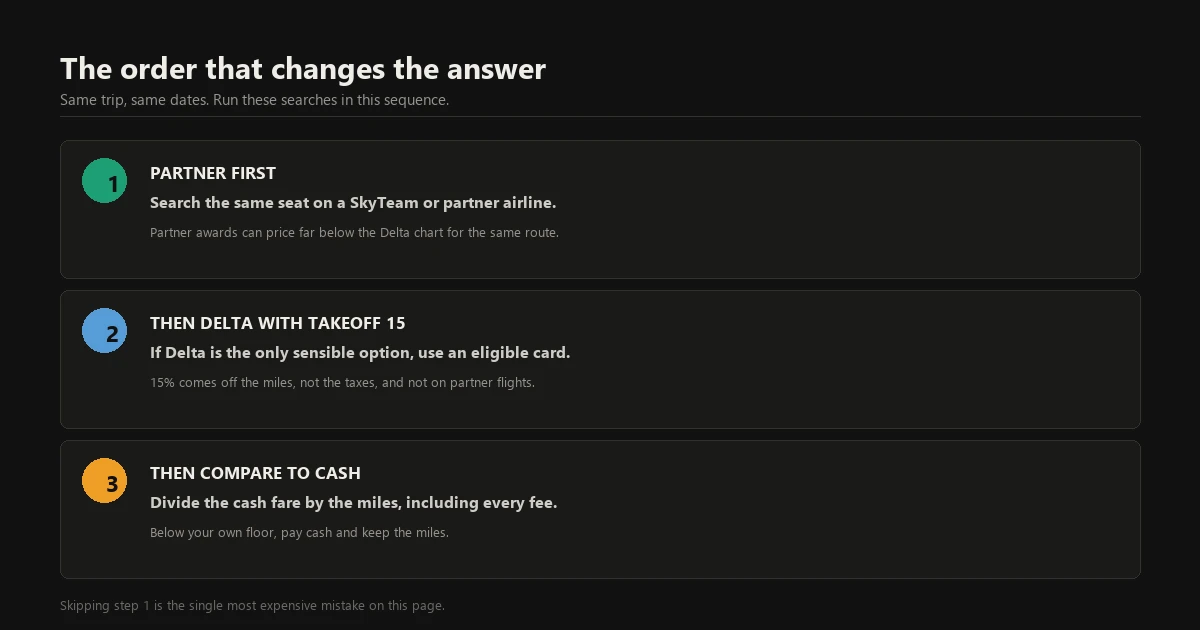
Running the searches out of order is what produces the complaints. Someone searches Delta only, finds a bad number, concludes the miles are worthless, and pays cash — when the partner award for the same seat was available at a third of the price. Or someone books a partner award without checking the Delta-operated flight with a card applied, which on a domestic route is often the cheaper of the two.
4. What a good number actually looks like
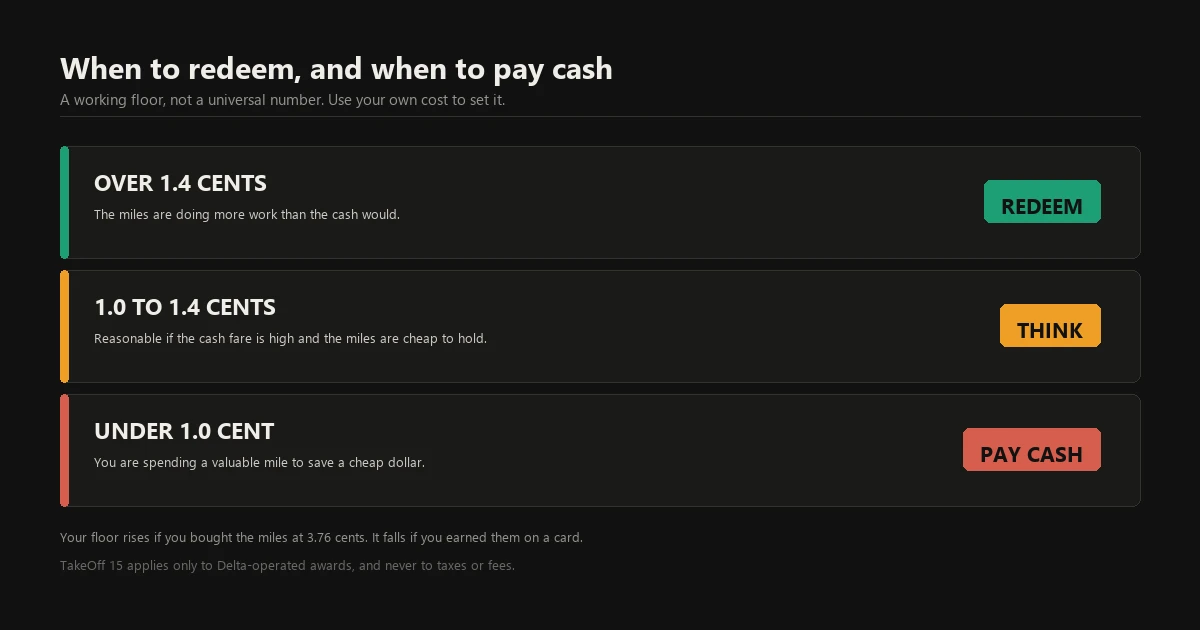
There is no universal threshold, because a mile that cost you nothing is worth less to you than one you bought at 3.5 cents. But a working set of bands keeps the decision honest, and you can adjust the bands once you know your own cost basis.
| Value of the redemption | What it means | What to do |
|---|---|---|
| Above 1.4 cents per mile | The miles are buying more than the cash would, with margin for the fees and the inflexibility. | Book it. This is the range premium cabins and partner long-haul awards reach. |
| 1.0 to 1.4 cents | Fair, not good. Common on domestic economy at short notice. | Book if the cash fare is high and your miles were cheap to acquire. |
| Below 1.0 cent | You are converting a flexible asset into a small discount. | Pay cash and keep the miles for a booking that pays better. |
The bands move with your own cost. If you bought the miles at 3.5 cents plus tax, your floor is above 3.76 cents and almost no award clears it — which is the argument against buying miles for a specific redemption. If you earned them on a co-brand card or transferred them from a programme where you had no other use, the floor is lower and a 1.3 cent redemption is a reasonable outcome.
One adjustment is worth making explicitly. An award ticket still earns Medallion Qualification Dollars and Million Miler credit on Delta and on partner flights, apart from Main Basic, so redeeming does not forfeit the status progress that a cash ticket would have produced. That removes the most common reason people give for paying cash on a booking where the miles were the better deal.
5. Six redemptions that hold up
These are the categories, not the routes. Each one survives because of a structural reason rather than a price that happened to be low on the day someone wrote it down.
Long-haul business on a partner
This is the highest-value category in the programme and the one most often missed. Partner awards are priced separately from Delta-operated flights, and a business seat across an ocean on a SkyTeam carrier frequently prices below the equivalent Delta award. The catch is availability: partner inventory is released on the partner’s schedule, not Delta’s, and it can appear or vanish without warning. Search early, and be willing to route through a hub you would not otherwise choose.
Delta One on a route with a high cash fare
When the cash fare for a lie-flat seat is $5,000 or more, an award at 250,000 miles can clear 2 cents even after taxes. Apply TakeOff 15 and the same seat costs 212,500 miles, which lifts the return further. This is the one category where the card benefit does real work, because the discount is 15 per cent of a large number rather than 15 per cent of a small one.
Short-notice travel when cash prices spike
Award prices move, but they tend to move less violently than cash fares in the final two weeks before departure. A domestic one-way that has climbed to $480 in cash can still be available for 28,000 miles, which is 1.6 cents after the $5.60 fee. The redemption is not elegant. It is simply better than the alternative on that date.
Comfort and Premium Select on long domestic routes
The mileage gap between Main Cabin and Comfort is usually small relative to the cash gap between the same two seats. On a transcontinental route the upgrade can cost 8,000 to 15,000 additional miles against a cash difference of $150 or more, which puts the incremental miles well above 1.5 cents each. Judge the increment, not the total.
Two cabins on one trip
Delta allows different experiences on the outbound and the return, so a trip can be booked in Comfort on the way out and Delta One on the way home. That is useful for overnight flights in one direction only, and it lets you spend the premium miles where the sleep actually happens. Most award guides ignore this because they search round trips as a single unit.
Booking for someone who is not flying with you
Delta allows an award ticket for another traveller even when you are not on the reservation. That makes miles a way to buy a flight for a family member at a fixed price rather than a cash fare that moves with demand. Judged purely as a transfer of value, it is usually better than converting miles into a gift card, and it is the one redemption on this list that has nothing to do with your own travel. The miles have to come from somewhere, and what each Delta card charges for decides whether the earning side pays for itself.
6. Four that waste the balance
Every option below is a legitimate redemption that Delta will happily process. None of them returns anything close to what a good award pays, and two of them carry terms that make them worse than they look.
| Redemption | What it returns | Why it fails |
|---|---|---|
| Miles + Cash | A ticket you could have priced in cash | The miles you buy to top up are nonrefundable, and the resulting ticket earns no miles at all |
| Pay with Miles | A fixed discount on a cash ticket | A card benefit with a set conversion rate; convenient, never competitive |
| Stays and car rentals paid in miles | The booking, at a set rate | The stay earns no miles when any part of it is paid with miles |
| Gift cards and merchandise | A fixed value in cents | No route to the 1.4 cents or more that a good award returns |
Miles + Cash is the trap worth understanding in detail. It is offered on Delta, Delta Connection and Delta Shuttle flights worldwide, and it lets you pay part of an award with cash for the miles you are short. Three terms matter. The ticket is an Award Ticket, so it earns no miles. The miles you purchase inside the transaction are nonrefundable even if you later cancel. And the cash portion is not a discount on a fare — it is the purchase price of miles at whatever rate Delta sets for that transaction, which is rarely a good one. Use it only when you are a few thousand miles short of an award you have already decided to book, never as a way to buy a cheap ticket.
Pay with Miles is a card benefit, not a redemption strategy. It is available to Delta SkyMiles American Express cardholders and takes a fixed amount off the cash price of an eligible ticket. It exists so that a cardholder can use a small balance without hunting for award space, and it is priced accordingly. If you have a card that carries it, treat it as a convenience for short flights, not as a way to extract value from a large balance. Note also that Delta has retired the standalone page for it: the terms now sit inside the Travel with Miles page, so any guide linking to the old URL is sending you to a dead page.
Stays and cars are the quiet one. Delta Stays and Delta Car Rentals both accept miles as payment, and the bookings are straightforward. What the terms add is that a stay paid for with miles earns no miles, regardless of how much of the reservation was paid in cash. You are trading a flexible currency for a fixed-rate discount and giving up the earning on the same booking, which is two losses on one transaction. Pay cash for the hotel, collect the miles, and keep the balance for a flight. Nothing about that plan requires a deadline, which is why it is worth knowing what actually clears a balance.
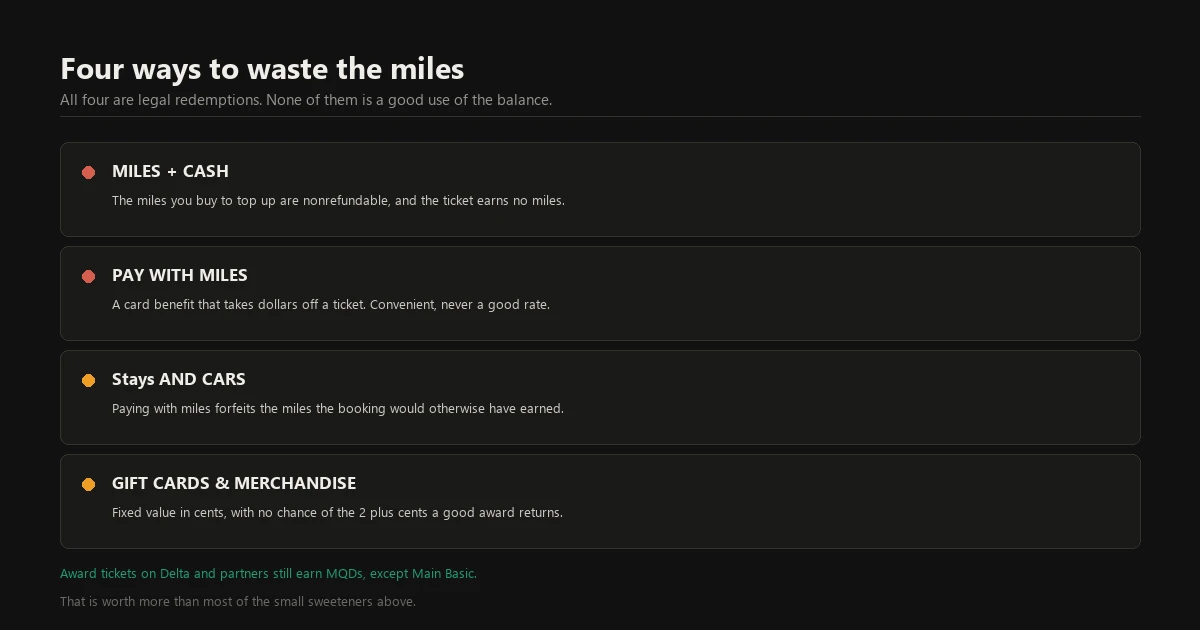
Gift cards and merchandise sit at the bottom for a simple reason: they convert miles at a fixed rate with no possibility of upside. A programme without an award chart is a programme where upside is the entire point, so a fixed-rate redemption throws away the only advantage the currency has.
7. Partner awards and what Delta lets you book
Partner redemptions are where the value is, so it helps to know exactly which airlines can be booked where. Delta splits them into two groups, and the split is not obvious from the marketing. The roster below is the one Delta publishes on its Travel with Miles page, which is also where the award rules sit.
| Booking channel | Airlines | What it means for you |
|---|---|---|
| Bookable on delta.com | Aeromexico, Aerolineas Argentinas, Air France, Cape Air, China Airlines, China Eastern, El Al, Garuda Indonesia, KLM, Korean Air, LATAM, Mandarin Airlines, Middle East Airlines, Saudia, Scandinavian Airlines, Shanghai Airlines, TAROM, Vietnam Airlines, Virgin Atlantic, WestJet, Xiamen Airlines | You can price and book these yourself, which makes comparison shopping practical |
| By phone only | Air Europa, Air Tahiti Nui, Kenya Airways | You cannot see the price online, so call before you assume the award is unavailable |
Delta describes its network as more than 30 partner airlines, and the difference between that number and the 21 bookable online is the point: the rest require a phone call or a different booking path, and the price you cannot see is the price you cannot compare. If a route only exists on one of those carriers, call before you conclude the miles are useless for it.
Two structural facts are worth holding on to. First, partner awards may carry a surcharge imposed by the operating airline, collected at the time of booking, which can wipe out the advantage of a lower mileage price. Second, partner inventory is controlled by the partner, so the award calendar you see is not a promise of what will be there tomorrow. Both are reasons to price the award before you transfer anything into your account, and neither is a reason to skip the search.
The alliance structure behind all of this — which airlines are full members, which are codeshare partners and which are joint-venture partners — decides four separate things: whether you can earn, whether you can redeem, whether bags transfer and whether you get lounge access. Those are not the same list, and our comparison of Star Alliance, oneworld and SkyTeam sets out where they diverge. Lounge access is the one of the four that the alliance alone does not settle, and the Delta Sky Club access guide sets out which credentials open the door.
8. What an award ticket still earns
This is the correction that changes more decisions than any other fact in this guide. Award tickets on Delta and its partners still earn Medallion Qualification Dollars toward status, and the miles flown still count toward Million Miler, apart from Main Basic and Basic Economy tickets. The widely repeated claim that redeeming forfeits your status progress is wrong.
What an award does not earn is redeemable miles. You spend miles and you get no miles back, which is the obvious part. But the MQD credit means the comparison between paying cash and redeeming is not “status progress versus no status progress.” It is a choice about which currency you want to accumulate, and on a route where the award pays 1.6 cents, taking the award and its MQD credit is usually the better of the two.
The taxes are the part people underestimate. A domestic award requires at least $11.20 in United States government taxes and fees, and an international award can carry up to $600 in foreign government taxes and carrier-imposed fees. Those amounts come out of the value calculation before you divide, which is why a 30,000-mile domestic award against a $300 fare is not the 1 cent it looks like: after the fee it is closer to 0.96 cents, and that changes the verdict at the margin.
Delta does not publish the formula that converts award travel into MQDs, so treat any specific conversion rate you see quoted elsewhere as an estimate. The direction of the rule is what matters for the decision, and it is confirmed on Delta’s own Travel with Miles page: award travel earns toward your next tier, with the Basic exclusion.
9. If you are short of miles
Three options, in ascending order of how much they usually cost you.
Transfer from a credit card programme. This is normally the cheapest route, because the points already exist and the transfer is at a fixed ratio. It becomes expensive only when you transfer speculatively, before you have found the award. Transfer after you have priced the seat, never before.
Buy the miles. Delta sells SkyMiles at 3.5 cents each before tax, and the tax takes the effective price to roughly 3.76 cents. That is three times what an ordinary award returns, so buying miles to fund a specific economy redemption is a losing trade by construction. Purchased miles also earn no MQDs, so they do not help with status either. Our guide to what SkyMiles are worth works through the arithmetic, and the directory of official buy-miles pages lists the current offers if you want to see the price yourself.
Pay cash and keep the miles. This is the option people forget. A 0.9 cent redemption is not a failure of the programme; it is the programme telling you that this particular seat is cheaper in dollars. Take it at face value and hold the balance for a booking that pays 1.8 cents, which is exactly what the miles are for.
One related question deserves a direct answer. If you are short because you are chasing a specific premium award, do the arithmetic before you top up: buying 40,000 miles at 3.76 cents costs $1,504, and if the award saves you a $3,000 cash fare the trade works. If it saves you $1,200, you have spent more than the seat was worth.
10. The verdict
If you want the valuation framework behind the 1.4 cent threshold, it is set out in the SkyMiles valuation guide. If the question is whether the miles are worth accumulating at all, the Medallion status guide covers what the tiers return, and the general guide to loyalty points explains why a currency without a chart behaves the way it does. If the question is how to refill the balance, the guide to earning SkyMiles ranks twelve sources by what each mile costs.
11. Frequently asked questions
What are the best ways to use Delta SkyMiles?
Long-haul business class on a partner airline, Delta One on routes with high cash fares, short-notice travel when cash prices spike, and incremental upgrades to Comfort or Premium Select. All four replace a large cash fare, which is where the value is. Avoid Miles + Cash, Pay with Miles, Stays paid in miles and gift cards.
Is there a Delta award chart?
No. Delta retired its published award chart in 2015 and prices awards dynamically against the cash fare, demand, date and cabin. Any table of mileage prices you see online is a record of past observations, not a published rate.
Should I search partner airlines before Delta?
Yes, always. Delta sells awards on 21 partner airlines through its own website, and those awards are priced separately from Delta-operated flights. The same seat on a partner can price well below the Delta award, so searching Delta first hides the cheaper option.
Does redeeming miles lose my Medallion progress?
No. Award travel on Delta and its partners still earns MQDs toward status and still counts toward Million Miler, apart from Main Basic and Basic Economy tickets. An award ticket does not earn redeemable miles, but it does earn status credit.
Is Miles + Cash ever worth using?
Only when you are a few thousand miles short of an award you have already decided to book. The miles you buy inside the transaction are nonrefundable and the ticket earns no miles, so using it as a way to buy a cheap fare costs more than paying cash.
How many miles do I need for a Delta business class award?
There is no fixed number, because Delta prices dynamically. Transatlantic and transpacific business awards commonly price between 200,000 and 400,000 miles one way, and the same route can move by tens of thousands of miles between dates. Price the specific flight rather than budgeting from an average.
More Delta and airline guides
- What Delta SkyMiles are actually worth
- Delta Medallion status: what each tier costs and returns
- Delta SkyMiles promotions: what is live and what ended
- Airline alliances compared: Star Alliance, oneworld and SkyTeam
- How much are AAdvantage miles worth
- How much are United miles worth
- The World of Hyatt and Delta partnership