1. Short version
Delta credit cards are sold as a mileage product, but the miles are the least interesting thing on the page. The four personal cards cost $0, $150, $350 and $650 a year, and the differences that decide anything sit in two columns that have nothing to do with earning: a companion certificate, and a deposit of Medallion Qualification Dollars that arrives whether you fly or not.
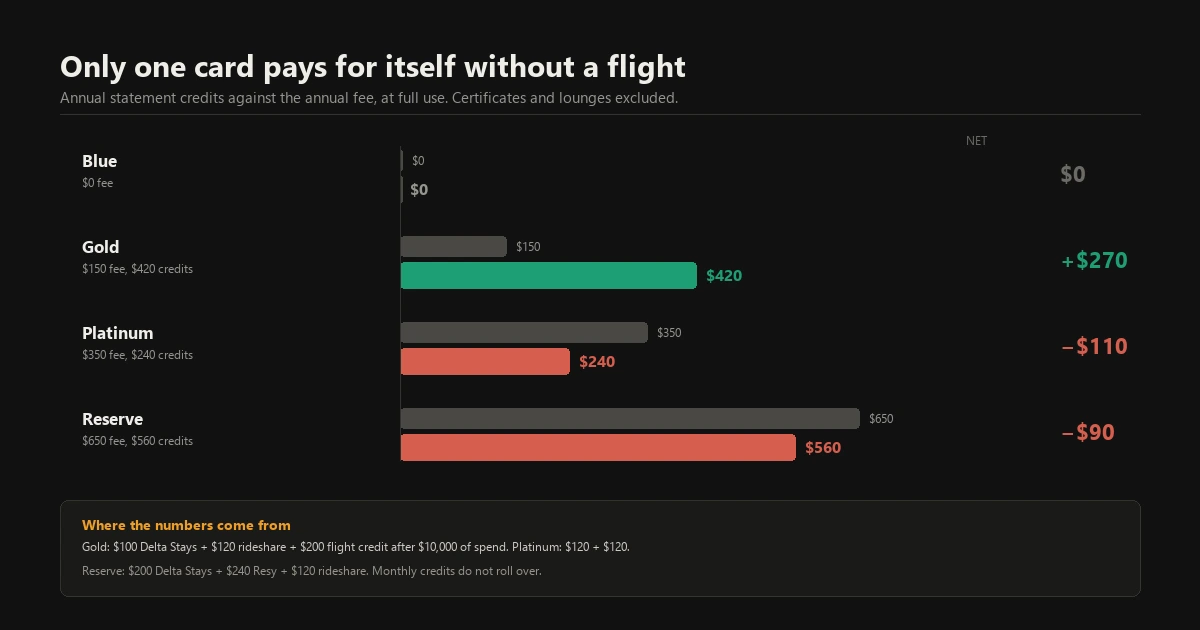
Add up the annual statement credits and only one card clears its own fee. Gold returns $420 at full use against a $150 fee, because $100 of Delta Stays, $120 of rideshare and a $200 flight credit after $10,000 of spending are all cash back in a specific shape. Platinum returns $240 against $350. Reserve returns $560 against $650. That arithmetic makes the two expensive cards look like bad coupons until you price the certificate, which is where the fee is actually decided.
The status side is cleaner and more useful. MQD Headstart pays $2,500 per eligible card type each Medallion Year, and the programme allows four deposits, which is $10,000 — exactly the Gold threshold for 2027 status. Four card types at $2,000 of annual fees therefore produce Gold with zero flights, and Delta’s own terms put a number on what that is worth: flying would have cost $10,000 of ticket spend for the same MQD. Everything below works through which card does what, the four conditions that quietly void a benefit, and which single card most Delta flyers should actually hold.

2. The four cards, side by side
All four are issued by American Express and all four earn SkyMiles rather than a transferable currency, which matters more than any single benefit: the miles land in a programme whose value you can measure per mile before deciding whether a multiplier is worth chasing. The table below is the whole product range on the two axes that separate them.
| Card | Annual fee | Miles per dollar | Checked bags | Companion certificate | Sky Club | MQD Headstart |
|---|---|---|---|---|---|---|
| Delta SkyMiles Blue | $0 | 2x Delta, 2x US restaurants, 1x elsewhere | None | None | None | None |
| Delta SkyMiles Gold | $150, waived in year one | 2x Delta, 2x US dining, 2x US supermarkets, 1x elsewhere | First free worldwide, second free on domestic Delta flights | None | None | None |
| Delta SkyMiles Platinum | $350 | 3x Delta, 3x hotels booked direct, 2x dining and supermarkets, 1x elsewhere | First free worldwide, second free on domestic Delta flights | Main Cabin, after renewal | None | $2,500 |
| Delta SkyMiles Reserve | $650 | 3x Delta, 1x elsewhere | First free worldwide, second free on domestic Delta flights | First, Comfort or Main, after renewal | 15 visits per Medallion Year | $2,500 |
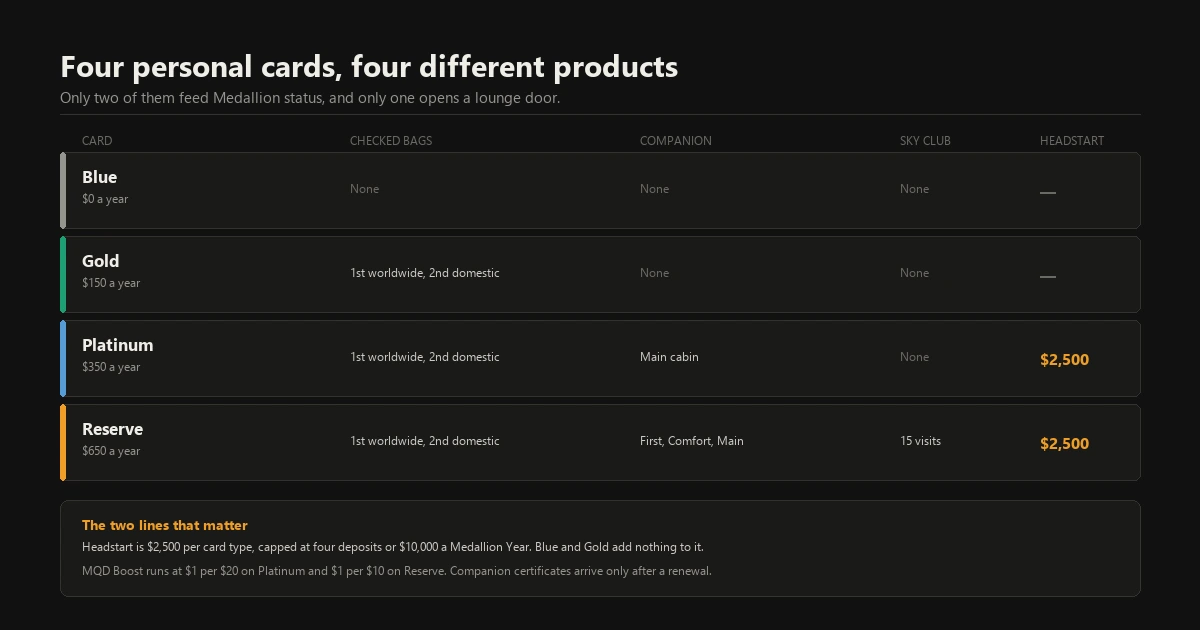
Read the last three columns and the logic of the range becomes obvious. Baggage stops being a differentiator at Gold, so the $200 step from Gold to Platinum is not buying luggage. The certificate appears at Platinum and improves at Reserve. The Sky Club appears only at Reserve. Headstart appears at Platinum and is identical at Reserve, which means the most expensive card in the range adds nothing to status that the middle card does not already add. That $10,000 is the whole of Delta’s purchase route, and the American side of the same calculation costs forty thousand dollars of spending for the comparable tier.
Two structural points before the individual cards. The first is that Main Basic fares sit outside all of this. Delta’s programme terms exclude Main Basic from earning miles and from earning MQD, and the certificate terms exclude Delta Basic experiences, so a traveller who always buys the cheapest fare is paying for benefits that the fare itself switches off. The second is that the companion certificate is issued after a renewal, not on approval, which turns a year-one calculation into a year-two one.
3. Blue: no fee, and nothing that compounds
The Blue card earns 2x on Delta purchases, 2x at US restaurants and 1x everywhere else, with no annual fee and no foreign transaction charge. It carries no checked bag, no certificate, no lounge access and no Headstart. Its sign-up offer moves with whatever American Express is testing, and the card is a legitimate product for exactly one kind of person: someone who wants SkyMiles without a relationship with the airline.
The honest case against using it as a starter card is that everything worth having in this range begins at Gold, and the gap between the two is $150. A single round trip with one checked bag, charged to a card with no bag benefit, costs more than the annual fee in bag fees alone on a two-segment itinerary. Blue does not build toward status either: no Headstart, no Boost, no MQD path beyond flying. It is a wallet filler rather than a first rung.
Is it worth it? Only if you will not otherwise pay a fee and you book Delta award travel often enough to use the card’s discount on award tickets. If you fly Delta three times a year with luggage, the fee-paying tier below is cheaper than the free one.
4. Gold: the only card that repays its fee without a flight
Gold costs $150 after a waived first year and returns up to $420 in statement credits: $100 a year against prepaid hotels or rentals booked through Delta Stays, $120 of rideshare at $10 a month, and a $200 Delta flight credit that unlocks only after $10,000 of eligible spending in a calendar year. Strip out the flight credit, which most holders never reach, and the card still returns $220 against a $150 fee. That is the only card in the range with a positive floor.
Its earning is unremarkable — 2x Delta, 2x US dining, 2x US supermarkets, 1x elsewhere — but it is the same 2x Delta rate as Blue with a baggage benefit attached. The bag terms are the quiet change in the range: the first bag is free worldwide, and a second bag has been free on domestic Delta-operated flights since 4 June 2026. The second bag arrived across Gold, Platinum and Reserve at the same time, which removed the last baggage reason to step up from Gold to Platinum.
What Gold does not have is a certificate, a lounge or a status deposit. For a household that flies Delta four or five times a year with one checked bag each way, the fee is already returned by the bag rule before any credit is counted, and the credits are then profit.
Is it worth it? Yes, for the majority of Delta flyers who check a bag and fly more than twice a year. It is the default card in this range and the one this guide would keep if it could only keep one.
5. Platinum: a Main Cabin certificate and a quarter of a tier
Platinum costs $350 and returns $240 in credits — $120 of rideshare and $120 of Resy dining at $10 a month each — which leaves $110 of fee to be justified by something else. That something is the companion certificate, and it is a narrower instrument than the marketing implies.
The certificate is valid on a Delta Main Cabin round trip within the US, to the Caribbean or to Central America, issued after the card is renewed, and it covers the second seat while the holder pays government taxes and fees of $22 to $250 depending on the itinerary. Delta Basic experiences cannot use it, one-way trips cannot use it, and partner-operated flights cannot use it. On a $400 domestic round trip the certificate saves roughly $300 after taxes, which clears the $110 gap and leaves the card ahead. On a year with no round trip in Main Cabin, it is worth nothing and the card is a $350 donation.
The status contribution is real but small in isolation: $2,500 of MQD Headstart is a quarter of the Gold threshold, and the Boost rate of $1 per $20 of spending means reaching Gold on Platinum spending alone would take $200,000. The generous part of this card is actually the earning rate on hotels booked direct, 3x, which makes it a better hotel card than most hotel cards for a Delta flyer.
Is it worth it? Yes if you take one Main Cabin round trip a year with a second person and book hotels direct. No if your trips are one-way, Basic, or on partners — the certificate then does nothing and the fee buys only $240 of credits.
6. Reserve: fifteen visits and one First Class seat
Reserve costs $650 and returns $560 in credits: $200 against Delta Stays, $240 of Resy dining at $20 a month, $120 of rideshare at $10 a month. That is 86 per cent of the fee before a single flight, which is the opposite of how the card is usually described. The lounge access and the certificate are not the value; they are the reason to accept a fee that is nearly self-funding.
The lounge allowance is 15 visits per Medallion Year, and the definition of a visit is generous: one or more Sky Club entries within a 24-hour window count once, so a three-airport connection is a single visit. Unlimited access unlocks only at $75,000 of spending on the card in a calendar year, which is a spending threshold rather than a status one. The card also opens Centurion and Escape lounges on a same-day Delta flight booked with it, subject to Delta’s arrival windows of three hours before departure, or 90 minutes for Sidecar. The full set of doors, including the ones this card cannot open, is covered in the Sky Club access guide.
The certificate is the widest in the range: a round trip in Delta First, Comfort or Main within the US and to Mexico, the Caribbean or Central America, again issued after renewal, again with taxes of $22 to $250 and again closed to Basic fares. A First Class transcontinental round trip is where this instrument is worth more than the annual fee on its own; a Main Cabin short hop is where it is worth a few hundred dollars and no more.
Is it worth it? Yes for someone who uses six or more of the 15 visits and takes one premium-cabin round trip a year. No for someone who flies Delta twice a year in Basic: the visits go unused, the certificate is void on the fare, and the credits are the only thing left.
7. Three ways to price the same $650
Reserve is the card people argue about, so it is worth pricing three ways rather than one. The first is the coupon view: $560 of credits against a $650 fee leaves $90, and two lounge visits at Delta’s own $50 guest rate close it. The second is the lounge view: divide the fee by visits actually used. At fifteen visits the card is $43.33 a visit; at six visits, which is a realistic year for a frequent domestic flyer, it is $108 a visit and worse than paying at the door. The third is the certificate view: one First Class round trip used well clears the entire fee, which makes every credit and every visit a bonus.
| How you price it | What it assumes | Result |
|---|---|---|
| Credits only | Every monthly credit used in full, no flights taken | $560 against $650, so $90 short; two lounge visits close the gap |
| Cost per visit | Fee divided by visits actually used | $43.33 at 15 visits, $108.33 at six, $162.50 at four |
| Certificate | One round trip in First, Comfort or Main, after renewal | Taxes of $22 to $250 paid, second seat free; a premium-cabin trip clears the fee alone |
The three views disagree on purpose, and the disagreement is the answer. A card that looks like a bad coupon and a bad lounge deal can still be a good certificate deal, and a holder who uses none of the three is paying $650 for a metal card and a 3x rate on Delta tickets. Before choosing any tier, it helps to know what a SkyMile is actually worth to you, because the 3x multiplier is the only part of this card that scales with spending rather than with travel.
8. The Headstart ladder: four cards, one tier
Headstart is the least advertised and most consequential benefit in the range. Delta pays $2,500 of MQD per eligible card type each Medallion Year to holders of the Platinum, Platinum Business, Reserve and Reserve Business cards, and the programme caps the benefit at four deposits, or $10,000. The 2026 thresholds for 2027 status are $5,000 for Silver, $10,000 for Gold, $15,000 for Platinum and $28,000 for Diamond, so four deposits land exactly on Gold.
The cost of that route is $2,000 of annual fees — $350 for Platinum, $350 for Platinum Business, $650 for Reserve, $650 for Reserve Business — and the comparison Delta itself invites is flying. A Delta-marketed ticket earns $1 of MQD per $1 of fare, so $10,000 of MQD normally means $10,000 of tickets. The cards deliver the same $10,000 for $2,000, which is 20 cents on the dollar, and they throw in 30 lounge visits, four certificates and $1,600 of credits along the way. What they do not throw in is a reason for Gold to be worth $2,000 to you; that judgement belongs in the Medallion status guide, which puts the case for stopping at Gold rather than chasing Platinum.
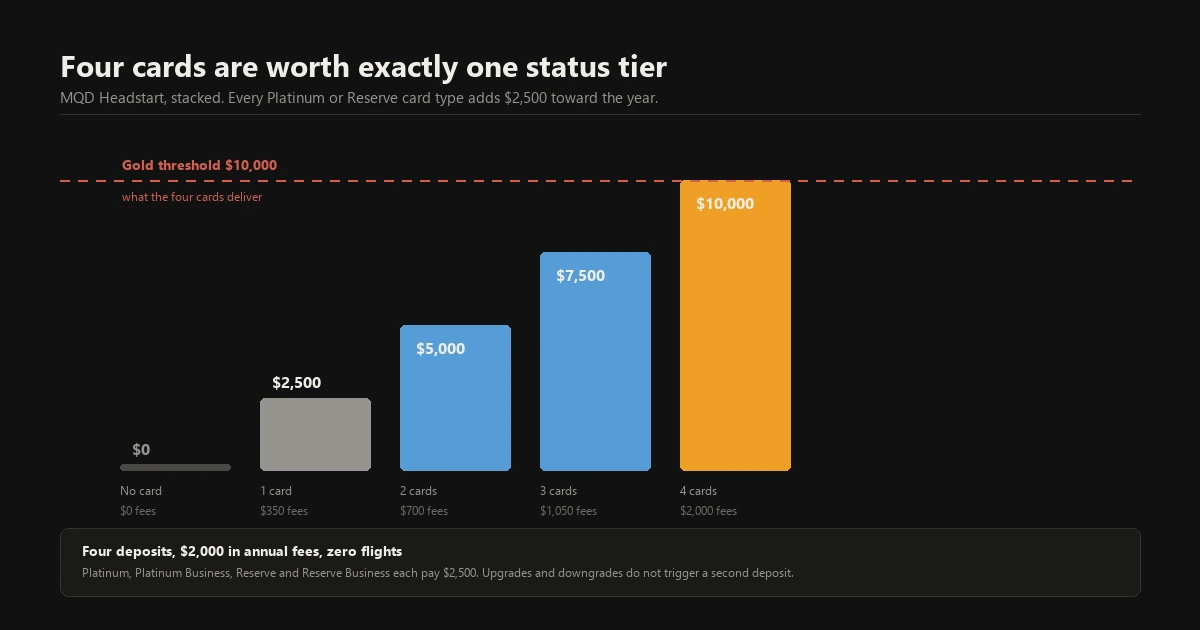
One arithmetic warning. Boost is not a shortcut on its own. At $1 per $10 on Reserve, reaching Gold on card spending alone takes $100,000; on Platinum at $1 per $20 it takes $200,000. Boost is a top-up for someone already close, not a substitute for flying.
9. Business versions and the upgrade trap
Each paid personal tier has a business twin at the same annual fee, with the same certificate, the same Headstart and the same lounge allowance on Reserve Business. The reason they matter here is structural: the business versions count as separate card types for Headstart, which is how four deposits are possible at all. A solo traveller with no company can still apply, and the earning categories differ slightly, but the strategic point is that the second deposit is a business card, not a second personal card.
The trap is in the movement between tiers. Delta’s terms state that a holder who upgrades from Platinum to Reserve, or downgrades from Reserve to Platinum, does not receive the additional $2,500 for the new card type in that Medallion Year. Product changes are therefore a bad way to chase a deposit that is $2,500 short: the deposit follows the card type, not the upgrade.
10. Four conditions the card pages bury
The benefits are real, and so are the four conditions that most often turn them into nothing. None of these are hidden in fine print so much as placed one click away from the page that sells the card.
| Condition | What it kills | Where it appears |
|---|---|---|
| Main Basic fares earn no miles and no MQD | The whole earning and status case for a Basic-only flyer | SkyMiles programme terms on the qualification page |
| Certificates are issued after renewal | Any year-one break-even calculation | Certificate terms on each card page |
| Credits are monthly and do not roll over | The full $240 or $560 assumed in every value calculation | Resy and rideshare credit terms |
| Unlimited lounge access needs $75,000 of spend | The assumption that Reserve means unlimited visits | Sky Club access terms on the Reserve page |
The certificate condition deserves a second look because it changes the timing of the whole decision. A card opened in November has no certificate until the following year’s renewal, so the first twelve months are paid for by credits alone. The same logic applies to the Gold rideshare credit, which begins after the first renewal. Year one is the weakest year on every card in this range, and that is exactly the year the sign-up offer is designed to make you overlook.
11. Which card fits which flyer
Five profiles cover most readers, and the mapping is short because the range only has four products.
| If you | Hold | Because |
|---|---|---|
| Fly Delta twice a year with one checked bag | Gold | Bag fees alone meet the $150 fee, and the Stays and rideshare credits are profit |
| Fly four or more times a year and want a lounge | Reserve | Credits cover 86 per cent of the fee; visits are worth $50 each at the door |
| Take one Main Cabin round trip a year with a second person | Platinum | The certificate is worth about $300 after taxes, clearing the $110 gap |
| Want Gold status without flying | All four eligible types | $2,000 of fees for $10,000 of MQD, which is Gold |
| Buy Main Basic every time | None of them | No miles, no MQD, no certificate, no lounge entry on that fare |
Between the middle two rows sits the only real judgement call in the range. Platinum and Reserve share the same Headstart, the same bag rules and the same $22 to $250 certificate taxes; the difference is $300, fifteen lounge visits and the right to book the certificate in First. If you will not use six visits or a premium cabin, Platinum is the better $350 and Reserve is $300 for a metal card.
One adjacent route is worth pricing before any of this: the Hyatt and Delta partnership adds a qualifying night to each programme for linking accounts, which is cheaper than a card for anyone whose status goal is hotel-side rather than airline-side.
12. What changed, and when
This range has been rebuilt twice in three years, and both rebuilds moved value from earning to permissions. Holders who bought these cards for the mileage multipliers are holding a different product now.
| Date | Change | Effect on a cardholder |
|---|---|---|
| 2024 | Medallion qualification becomes MQD-only; the three paid cards move to $150, $350 and $650; MQD Headstart introduced | Status becomes a spending question, and cards become a way to buy part of it |
| 1 February 2025 | Sky Club entry on Reserve capped at 15 visits and on the Platinum card from American Express at 10, with unlimited access at $75,000 of annual spending | Reserve stops being an unlimited lounge card |
| 4 June 2026 | Second checked bag becomes free on domestic Delta-operated flights for Gold, Platinum and Reserve, personal and business | The baggage reason to hold Platinum over Gold disappears |
The pattern across all three rows is the same: Delta keeps widening what a card can do for your status and narrowing what it can do for your comfort. The 2024 reset made MQD the only currency; the 2025 cap made lounges finite; the 2026 bag change made the middle tier thinner. Anyone still choosing a card on the multipliers is choosing on the one axis that has not moved.
13. The verdict
Gold is the card to hold, and everything above it is a purchase of something specific. At $150 it is the only card whose statement credits exceed its fee at full use, the only one where a bag fee alone repays the cost within three trips, and the only one that asks nothing of your travel habits. Blue is a bonus-collection vehicle with no status path. Platinum is a $350 certificate with $240 of credits attached. Reserve is a $650 coupon book with fifteen lounge visits and a First Class seat attached, and it is a good card for the narrow group that uses both.
The more interesting conclusion is about status. Four eligible card types produce $10,000 of MQD for $2,000 of annual fees, which is Gold with zero flights and a fifth of what flying the same MQD would cost. United will not sell the same tier at any price, and the two programmes side by side shows why. That is either the smartest play in the programme or a $2,000 subscription to a tier whose benefits are worth less than the fee, and which answer is right depends entirely on how many of those 30 visits and four certificates you will actually use. For most readers the honest sequence is Gold first, then a year of tracking real usage before adding anything above it.
Whatever the tier, the earning rate has to be judged against the mile, not against the marketing. A 3x Delta multiplier is worth 3.6 cents per dollar at a 1.2 cent valuation, which is excellent for a ticket purchase and mediocre for groceries bought to chase MQD.
14. Frequently asked questions
Do Delta credit cards give Sky Club access?
Only the Reserve. It includes 15 Sky Club visits per Medallion Year, and unlimited access requires $75,000 of spending on the card in a calendar year. The Platinum, Gold and Blue cards include no Sky Club entry at all, and the Platinum card from American Express is a separate product with its own 10-visit allowance.
Which Delta card is best for earning status?
Platinum and Reserve, because they are the only personal cards that pay MQD Headstart. Each pays $2,500 per Medallion Year, and with the business versions the programme allows four deposits totalling $10,000, which equals the Gold threshold. Gold and Blue pay nothing toward status beyond what you fly.
Is the Delta Reserve companion certificate worth the annual fee?
It can be, but only in a premium cabin. The certificate covers a Delta First, Comfort or Main round trip within the US and to Mexico, the Caribbean or Central America, with taxes of $22 to $250 paid by the holder. It is issued after renewal, Delta Basic fares cannot use it, and a Main Cabin short hop saves a few hundred dollars rather than the full $650.
Is the Delta Gold card free in the first year?
Yes. The $150 annual fee is waived in the first year and charged from the first renewal. The $120 rideshare credit also begins after that first renewal, so year one is the weakest year for credits on every card in this range.
Do Delta card statement credits roll over?
No. The Resy and rideshare credits are monthly, and unused months do not carry forward. The Delta Stays credit is annual, and the Gold flight credit requires $10,000 of eligible spending in the calendar year before it appears. Every value figure in this guide assumes full use, which is the ceiling rather than the average.
Does the Delta Platinum card include lounge access?
No. Platinum includes a Main Cabin companion certificate, $2,500 of MQD Headstart, 3x on hotels booked direct and $240 of statement credits. Lounge access starts at Reserve with 15 visits, and the separate Platinum card from American Express carries 10 visits of its own.
Related reading across the programme: what is actually live in Delta promotions, every source of SkyMiles ranked by cost per mile, where the miles go furthest, why buying miles is the most expensive top-up, the real expiry risk and the three partner lists that disagree.
15. Sources
Card terms are taken from the American Express product pages for the Blue, Gold, Platinum and Reserve cards, checked on 26 November 2026. Status thresholds, Headstart and Boost rates are taken from Delta’s qualification page and Choice Benefits page. Lounge terms are from the Sky Club access page. Offers, fees and credit amounts change without notice and vary by applicant.
Last updated 26 November 2026.