1. Short version
Delta SkyMiles partners come in three official lists, and they disagree. The airline-partnership page groups eight carriers into three regions. The mileage-earning page lists 21 airlines under two headings and carries 26 separate earning charts. SkyTeam lists 18 members, one of them suspended, and Delta is one of the 18. Ask whether an airline is a Delta partner and the honest answer is: which list?
The list that decides your miles is the second one, and the rule inside it is not about the alliance at all. Your miles depend on whose flight number is on the ticket, then on the fare class you paid for, then on the distance flown. Alliance membership decides your bag allowance and your lounge access. It does not decide your miles, and believing otherwise is how people end up with a boarding pass, a seat in business class and zero credit on either side.
Two passengers in the same Air France business cabin, on the same aircraft, on the same day, can earn 7,260 and 1,815 miles respectively. The difference is not status, fare paid or where they sat. It is the fare class code printed on the ticket. This page covers the 21 airlines Delta actually pays, the 25% to 300% ladder that sets the rate, the MQD formula almost nobody checks, and the eight ways a partner flight credits nothing at all.
2. Three lists, three different answers
Delta maintains the partner question in three places, and each answers a different question with a different number. None of them is wrong. They are maintained by different teams for different purposes, and the gap between them is where most of the confusion about partner earning starts.
| Where you look | What it lists | What it answers |
|---|---|---|
| Airline Partnerships page | Eight carriers in three regional groups: Air France, KLM and Virgin Atlantic across the Atlantic; China Eastern and Korean Air across the Pacific; Aeromexico, LATAM and WestJet in the Americas | Where Delta sells you a connected network, and which airlines it treats as commercial partners |
| Earning Miles With Airline Partners page | 21 airlines, split into Core Global Airline Partners and Global Airline Partners, with 26 fare-class charts | Whether a flight credits, and at what rate |
| SkyTeam member list | 18 airlines, including Delta, plus Aeroflot listed as suspended | Which carriers recognise your status and carry your bag for free |
The three lists do not nest. LATAM and WestJet appear on Delta’s partnership page and on the earning page, and neither is a SkyTeam member. Aerolíneas Argentinas is a SkyTeam member and appears only under the second, global heading, on a chart dated 10 September 2026 with no Medallion bonus at all. Air Baltic appears on the earning page only, and its chart says something no alliance would say: only Delta-marketed flights earn.
So the useful question is not “is this airline a Delta partner?” but “which of the three things do I need from it?” If you want miles, read the earning page. If you want a lounge or a free bag, read your SkyTeam tier; for Delta’s own lounges, the Sky Club access guide sets out which credentials work. If you want a connection Delta will sell you on one ticket, read the partnership page. Those three answers can point at three different airlines on the same trip.
3. Alliance, codeshare, joint venture: three contracts
The word “partner” covers three commercial arrangements that are negotiated separately, priced separately and can be cancelled separately. They overlap often enough that the overlap looks like a rule. It is not.
| Arrangement | What it creates | What it decides | What it does not decide |
|---|---|---|---|
| Alliance membership (SkyTeam) | A shared brand, reciprocal elite recognition, lounge and baggage standards across 18 airlines | Your bag allowance, lounge access, priority check-in and boarding on any member | How many miles a flight earns |
| Bilateral mileage agreement | A published chart of earn percentages by fare class, per airline, per region | Miles and MQDs on a partner-marketed flight | Whether you get a lounge, or whether the ticket can be sold as one journey |
| Codeshare | One airline puts its flight number on another airline’s aircraft | Whose rules apply, because the marketing carrier sets the earning basis | Whether the operating airline is in your alliance |
| Joint venture | Revenue sharing and antitrust immunity on a set of routes, with coordinated schedules and fares | Prices, frequencies, connections and through-checked bags on those routes | Mileage rates, which still come from the bilateral chart |
The practical consequence is that a joint venture can put you on a better schedule with a worse earning rate, and an alliance can give you a lounge on a flight that earns you nothing. Travelers routinely assume the strongest commercial relationship produces the best miles. Delta’s own charts show the opposite: the transatlantic joint venture partners pay 200% of distance in business, while one SkyTeam member on the same page pays 100%.
4. The marketing carrier decides your miles
Every earning rule on Delta’s partner page begins the same way: a flight marketed by the partner earns a percentage of the distance flown, determined by the fare class paid. A flight marketed by Delta earns on the price of the ticket, at the rates in the main earning guide. Same aircraft, same seat, two different formulas, and the switch between them is the flight number, not the airline operating the flight.
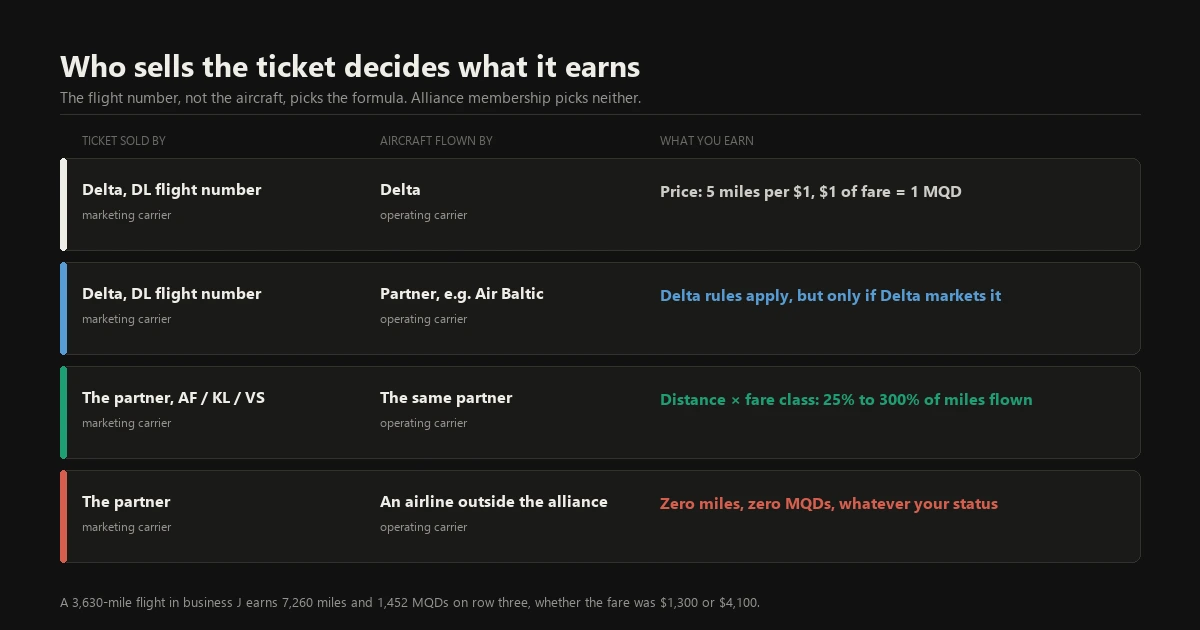
SkyTeam states the same rule from the alliance side, in one sentence on its earning page: “In order to earn miles, the airline shown on your ticket (marketing carrier) and the operating airline must both be SkyTeam members, and you must purchase a fare that qualifies for earning miles.” Both ends have to match. A SkyTeam flight number on an aircraft belonging to somebody outside the alliance earns nothing, which is a real trap on regional wet-lease and feeder operations.
Air Baltic makes the point in Delta’s own words. The entry reads: “SkyMiles Members can earn miles and earn towards Medallion Status on Delta marketed flights, operated by Air Baltic”, followed by the exclusion that “Air Baltic-marketed flights are not eligible to earn miles and earn towards Medallion Status.” One airline, two outcomes, decided by who sold the ticket. Flying Blue credits Miles on the fare paid rather than the cabin, which is why the fare family you book matters more than the seat.
Air France supplies the strangest version of the same problem. Its international chart excludes three things sold under an Air France flight number: TGVAIR segments provided by SNCF, the French rail operator; boat and ferry services with the fare basis YBOAT; and bus services. You can buy a ticket that says AF, board a train, and earn nothing, because the marketing carrier rule only reaches aircraft.
5. The 21 airlines Delta actually pays
Delta splits its earning page into two headings that do not correspond to any alliance structure. Core Global Airline Partners covers seven airlines, all of them on the transatlantic or transpacific joint ventures or the Latin American partnership. Global Airline Partners covers the remaining fourteen, including SkyTeam members Delta does not sell as core partners and three airlines outside the alliance entirely.
| Airline | Alliance | Delta’s group | Miles in business | MQD in business |
|---|---|---|---|---|
| Air France (AF) | SkyTeam | Core | 200%, first 300% | 40%, first 60% |
| KLM (KL) | SkyTeam | Core | 200% | 40% |
| Virgin Atlantic (VS) | SkyTeam | Core | 200% | 40% |
| Korean Air (KE) | SkyTeam | Core | 200%, first 300% | 40%, first 60% |
| Aeromexico (AM) | SkyTeam | Core | 200% | 40% |
| China Eastern (MU) | SkyTeam | Core | 200%, some business 300% | 40% to 60% |
| LATAM (LA) | None | Core | 200% | 40% |
| SAS (SK) | SkyTeam | Global | 200% | 20% |
| Kenya Airways (KQ) | SkyTeam | Global | 200% | 20% |
| Air Europa (UX) | SkyTeam | Global | 175% | 20% |
| Aerolíneas Argentinas (AR) | SkyTeam | Global | 125% | 20% |
| China Airlines (CI) | SkyTeam | Global | 100% | 20% |
| Garuda Indonesia (GA) | SkyTeam | Global | 100% | 20% |
| Middle East Airlines (ME) | SkyTeam | Global | 100% | 20% |
| Saudia (SV) | SkyTeam | Global | 100% | 20% |
| TAROM (RO) | SkyTeam | Global | 100% | 20% |
| Vietnam Airlines (VN) | SkyTeam | Global | 100% | 20% |
| XiamenAir (MF) | SkyTeam | Global | 100% | 20% |
| WestJet (WS) | None | Global | 100% | 20% |
| EL AL (LY) | None | Global | 100% | 20% |
| Air Baltic (BT) | None | Global | Delta-marketed only | Delta rules |
Read the fourth column as a single fact rather than 21 separate ones: business class on a Delta partner earns between 100% and 300% of the distance flown, and the airline you choose moves you across that entire range. A business seat on Air France earns three times the miles of a business seat on China Airlines or Saudia, for the same number of hours in the air. Nothing about the cabin explains the gap. It is the bilateral chart.
The fifth column is worse, and it is the one almost nobody checks. Business class earns 40% of the distance in MQDs on the seven core partners, and 20% on most of the global list. The same flight, rebooked from Air France onto SAS metal with a SAS flight number, halves your status credit while leaving your cabin unchanged.
Delta publishes 26 charts for 21 airlines, because several carriers need more than one. Korean Air has a new chart for flights on or after 15 June 2026 and an old one for 2024 through 14 June 2026. Air Europa changed on 1 November 2026. SAS has one chart for Scandinavian-marketed flights operated by a SkyTeam carrier and a second for Scandinavian-marketed flights operated by Delta, with different percentages in economy. Virgin Atlantic carries four separate tables on the same page. The chart is not a constant, and the date on it is part of the answer.
6. The fare-class ladder: 25% to 300%
Air France’s long-haul chart is a good specimen because it is complete and it is dated, and because Air France is the partner most Delta members in the United States actually fly. Every row is a percentage of the great-circle distance, and the MQD column is a second percentage of the same distance.
| Fare class | Miles earned | MQDs earned | On a 3,630-mile flight |
|---|---|---|---|
| First (P, F) | 300% | 60% | 10,890 miles / 2,178 MQDs |
| Business (J) | 200% | 40% | 7,260 miles / 1,452 MQDs |
| Discounted business (C, D, I, Z) | 200% | 30% | 7,260 miles / 1,089 MQDs |
| Premium economy (W, S, A) | 150% | 25% | 5,445 miles / 908 MQDs |
| Full economy (Y, B, M) | 125% | 20% | 4,538 miles / 726 MQDs |
| Economy (U, K) | 100% | 15% | 3,630 miles / 545 MQDs |
| Economy (H, L, Q) | 50% | 15% | 1,815 miles / 545 MQDs |
| Discounted economy (T, E, N) | 50% | 10% | 1,815 miles / 363 MQDs |
| Deep discount economy (R, G, V, X) | 25% | 5% | 908 miles / 182 MQDs |
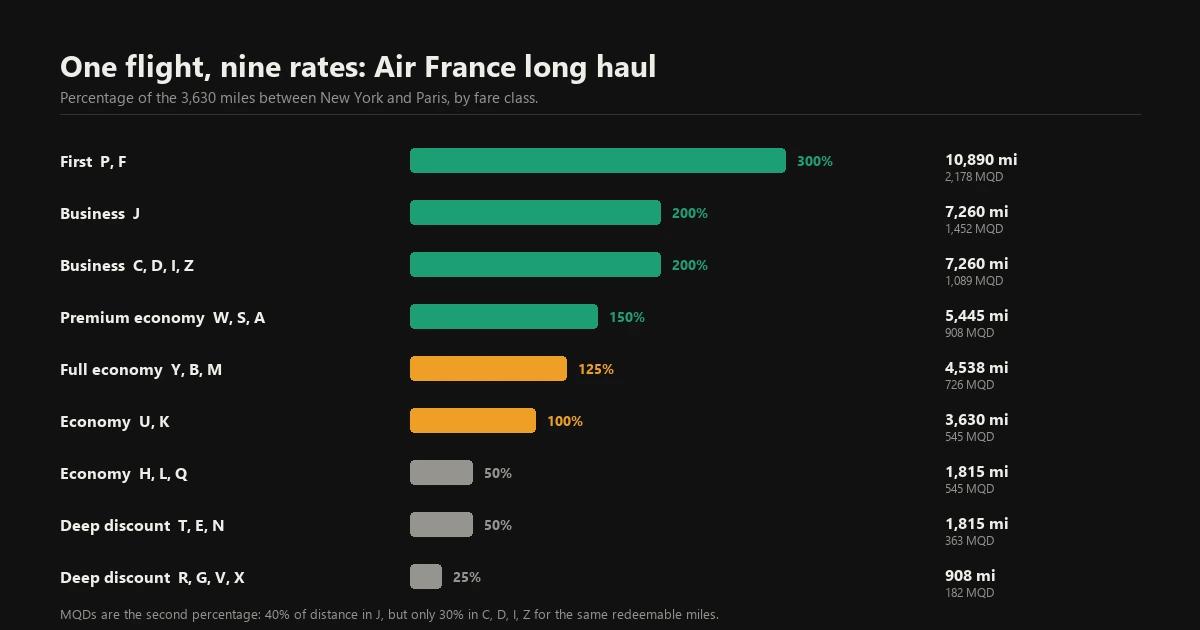
Three things in that table are worth more than the rest. The first is the size of the range: the cheapest deep-discount fare earns 908 miles on a flight where first class earns 10,890, a factor of twelve, for the same 3,630 miles in the air. The second is the H, L, Q row, which earns half the miles of the U, K row but the same MQDs, so a cheaper fare in that band costs you redeemable miles and nothing else. The third is that the business rows split: J pays 40% of distance in MQDs and C, D, I, Z pay 30%, which is a 25% cut to status credit for a fare that still earns the same redeemable miles.
The old shorthand that a partner ticket earns “mileage based on distance, not price” is correct and incomplete. The percentage is a function of the fare class, and the fare classes are ordered by price, so the distance formula ends up tracking price after all, just at a different slope and with a much wider spread. What the formula really rewards is distance bought cheaply in a premium cabin, and what it punishes is a long flight in the cheapest bucket.
7. MQDs on partner flights: the distance formula
Medallion qualification on partner metal works differently from miles, and this is the part of the page most guides skip. On a partner-marketed flight, Delta credits MQDs as a percentage of the distance flown, using a second column of the same chart. It is not the price you paid and it is not a conversion of the miles earned. It is distance multiplied by a percentage that runs from 5% to 60%.
Run the numbers on a New York to Paris round trip, 7,260 miles flown, business class. On Air France with a discounted business fare that credits at 30%, the trip produces 2,178 MQDs. On Air France with a full J fare at 40%, it produces 2,904 MQDs. Neither figure moves if the ticket cost $1,300 or $4,100, because the formula never sees the price.
That cuts both ways, and the direction depends entirely on how much you paid. On a $4,100 business fare, a partner ticket returning 2,904 MQDs is worse than a Delta-marketed ticket at the same price, which would return $4,100 of MQDs on the one-dollar-one-MQD rule. On a $1,300 promotional business fare, the same partner ticket returns 2,904 MQDs against $1,300, more than double. The shorthand that partner flights earn less status credit than their dollar value is true for expensive tickets and false for cheap ones, and the crossover is roughly where the fare per mile flown falls below the chart percentage.
Delta has been quietly replacing the price-based version of this rule with the distance version. Aeromexico’s entry now reads: “For tickets issued on or after 9/10/2026, Delta-ticketed, Aeromexico-marketed flights will earn miles based on a percentage of distance flown as determined by the fare class paid (instead of the ticket purchase price).” The parenthetical is the news: before that date, the same flight earned on what you paid. Korean Air moved to a new chart on 15 June 2026, Air Europa on 1 November 2026, WestJet on 1 March 2026 and Aerolíneas Argentinas on 10 September 2026. If you learned these rates before 2026, you learned a different programme.
For a Delta member chasing status rather than miles, the operative rule is therefore simple to state and easy to get wrong: the cheapest way to buy MQDs on a partner is a long flight in a premium cabin, bought from the partner rather than from Delta, in a fare class that still carries a high MQD percentage. The most expensive way is a short flight in business on a carrier that pays 20%.
8. What status is worth on a partner
Status is the part of the partnership that the alliance genuinely controls. Delta maps its four tiers onto SkyTeam’s two, and the mapping is lopsided: Silver is SkyTeam Elite on its own, while Gold, Platinum and Diamond are all SkyTeam Elite Plus. There is no distinction between Gold and Diamond at a SkyTeam lounge door. American’s ladder does distinguish, and how far up it goes is set out in a side-by-side of the two ladders.
| Delta tier | SkyTeam tier | Lounge on a partner | Checked baggage |
|---|---|---|---|
| Silver Medallion | SkyTeam Elite | No | One extra bag, or 10kg |
| Gold Medallion | SkyTeam Elite Plus | Yes, plus one guest on the same flight | One extra bag, or 20kg |
| Platinum Medallion | SkyTeam Elite Plus | Yes, plus one guest on the same flight | One extra bag, or 20kg |
| Diamond Medallion | SkyTeam Elite Plus | Yes, plus one guest on the same flight | One extra bag, or 20kg |
SkyTeam describes the lounge entitlement precisely: access for Elite Plus, First and Business customers at more than 850 lounges, with one guest allowed provided that guest is travelling on the same SkyTeam-operated flight. Since 1 April 2025 the alliance has also extended Elite Plus lounge access to domestic itineraries at selected member lounges, now numbering more than 70, which narrows a long-standing gap between the alliance’s international promise and what members experienced at home.
Delta frames the same benefits more narrowly on its own site, under a heading that reads “SkyTeam Benefits (For International Flights)”. That is not a contradiction so much as a description of the default: the alliance’s headline entitlements were written for international itineraries, and the domestic extension is newer, partial and lounge-specific. If your trip is a domestic connection on a partner, check the specific lounge rather than assuming the tier carries.
Two caveats are worth knowing before you rely on any of this. Kenya Airways’ Asante programme is flagged by SkyTeam itself: “Members of Kenya Airways’ Asante Program may not experience full Frequent Flyer reciprocity across all SkyTeam member airlines.” And SkyTeam publishes a Loyalty Benefits Calculator rather than a fixed table, because priority services vary by airport even when the tier does not. The alliance is a floor, not a guarantee.
9. What the joint ventures add, and what they do not
Delta’s deepest partnerships are joint ventures, and the transatlantic one is the largest: Delta, Air France, KLM and Virgin Atlantic have operated a revenue-sharing joint venture since 2020, with antitrust immunity covering the North Atlantic. Delta’s own description of what that delivers is a list of operational things, not mileage things: coordinated schedules, aligned policies, through-checked baggage, reciprocal elite recognition and access to any of the four airlines’ lounges where the customer is eligible.
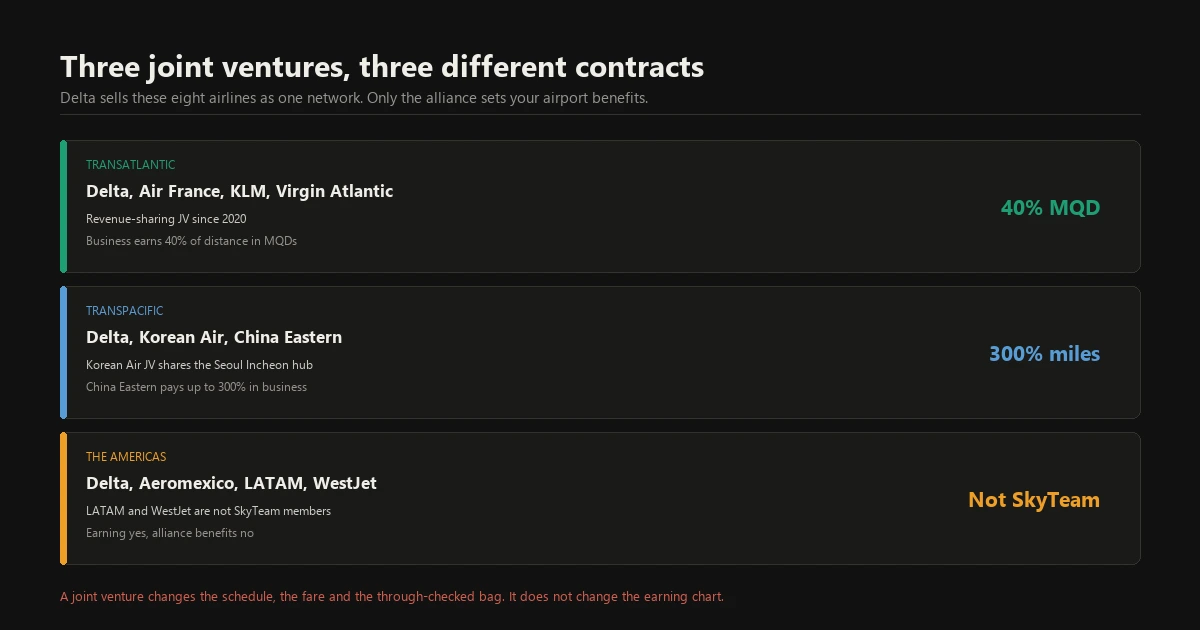
The transpacific arrangement is built around Korean Air and a shared hub at Seoul Incheon, which Delta describes as a joint venture with combined operations at the airport. China Eastern is described as a partnership rather than a joint venture, and its chart shows the difference in the only place it matters to a passenger: 200% of distance in business, with some business fare classes at 300%, which is the most generous line on the entire page.
What the joint ventures do not do is change the earning formula. The percentage still comes from the bilateral chart, the marketing carrier still decides which chart applies, and the MQD percentage is still a function of distance and fare class. A joint venture buys you a better schedule, a cheaper fare and a bag checked through to the final destination. It does not buy you a better rate, and on the transatlantic it does not even buy you a single rate: Air France pays 40% of distance in MQDs for business, while SAS, in the same alliance and on the same ocean, pays 20%.
The regional list is also the clearest evidence that partnership and alliance are different things. LATAM left oneworld in 2020 and belongs to no alliance; WestJet has never belonged to one. Both are Delta partners with full earning charts, both can be booked with SkyMiles, and neither will recognise your SkyTeam Elite Plus status or let you into a lounge on the strength of it. The partnership page sells you a network. The alliance decides what your card does at the door.
10. Eight ways a partner flight credits nothing
Every one of these is documented on Delta’s own page or in SkyTeam’s rules. None of them is exotic, and several are common enough that a frequent flyer will hit one eventually without noticing until the miles fail to post.
- The flight is marketed by the partner and you bought a basic fare. Basic and similar fares are excluded from Million Miler credit on partner-marketed flights, and several charts show no earn at all for the cheapest buckets.
- It is an award ticket. “No miles are earned for Award Travel” appears under every chart. Award flights do earn MQDs and count toward Million Miler, with Main Basic awards excluded, but the mileage line is zero.
- The flight number is SkyTeam but the aircraft belongs to a non-member. Both the marketing and the operating carrier must be members for the alliance rule to apply.
- You bought the codeshare from the wrong airline. Air Baltic-marketed flights earn nothing; the same aircraft under a Delta flight number earns normally.
- The segment is not an aircraft. Air France sells TGVAIR rail segments, ferry services under fare basis YBOAT and bus services under its own flight numbers, and none of them earn.
- The fare class is not on the chart. Every table carries the same line: if a class is not listed, no miles are earned. Consolidator, bulk and tour fares frequently sit outside the list.
- The number was never on the reservation, and nine months have passed. Retroactive credit is available through the Mileage Request Form for up to nine months after the flight. After that the window closes.
- Kenya Airways, via Asante. SkyTeam itself warns that Asante members may not receive full reciprocity, which can leave a flight earning miles but not benefits, or the reverse.
The pattern behind the list is that Delta credits the ticket, not the journey. Anything that breaks the link between an eligible ticket and an eligible flight number, whether it is a rail segment, a wet lease, an award booking or a fare bucket outside the chart, breaks the credit with it.
11. How to book so it credits
None of this requires memorising 26 charts. It requires checking four things in the right order, and the order matters because the first one decides which chart you are even reading.
- Decide whose flight number you want. A Delta flight number earns on price; a partner flight number earns on distance and fare class. On a cheap long-haul premium fare the partner number is usually better for MQDs; on an expensive fare the Delta number usually is.
- Find the chart for that airline and that date. Charts carry effective dates and several have changed during 2026. The date on the chart has to cover your flight date, not your booking date.
- Identify the fare class, not the cabin. Business is not one rate. On Air France, J pays 40% of distance in MQDs and C, D, I and Z pay 30%, with identical redeemable miles.
- Put the SkyMiles number on the reservation before you fly. Delta’s page is explicit that credit is automatic only when the number is in the booking, and that the manual route is a request form with a nine-month limit.
One more decision sits outside the chart: buy from the partner or from Delta. The published rule keys on the marketing carrier, and Delta’s Aeromexico note shows that ticket stock has mattered historically, because it describes a change from price-based to distance-based earning for Delta-ticketed flights. When the difference between two otherwise identical tickets is a few thousand MQDs, the channel you buy through is part of the fare, not an afterthought.
12. The roster keeps moving
Alliance lists look permanent and are not. Four changes in five years have reshaped SkyTeam, and each one silently changed what a Delta member could earn or where a card worked.
| Date | Change | What it meant for a Delta member |
|---|---|---|
| 31 December 2018 | China Southern leaves SkyTeam | An entire mainland China network outside the alliance, and outside the partner chart |
| April 2022 | Aeroflot membership suspended | Status recognition and earning on the largest Russian carrier stop |
| 1 September 2024 | SAS joins SkyTeam, leaving Star Alliance | A new earning chart at 200% in business but only 20% of distance in MQDs |
| 26 October 2024 | Czech Airlines leaves SkyTeam and ceases operations | A chart disappears with the airline |
| 30 April 2025 | ITA Airways leaves SkyTeam | The Italian flag carrier drops off Delta’s partner page entirely; ITA joined Star Alliance on 1 April 2026 |
The ITA case is the instructive one. Italy is a large market, Rome is a major connection point, and the airline that operates there is no longer on Delta’s earning page at all: search the page and there is no ITA entry, because there is no bilateral chart. A traveler who books Rome on the assumption that a European flag carrier must be a SkyTeam partner will earn nothing on the flight and get no lounge at Fiumicino, whatever their tier. Cards sit outside that hierarchy entirely, and the Reserve and Platinum trade-off is where the two systems overlap.
13. The verdict
Two sentences hold the page together. The alliance decides the airport, and the chart decides the balance. Everything else, including which of Delta’s three lists an airline appears on, is administration. For the earning sources beyond flying, the guide to earning SkyMiles ranks all twelve by what a mile costs; for how the tiers are actually earned, the Medallion status guide sets out the MQD thresholds, and the valuation guide explains why 1.2 cents is the number to hold against any partner fare. Last updated 26 November 2026. Every rate and roster change on this page was checked against Delta’s partner page and SkyTeam’s member list on that date, and the charts cited carry their own effective dates.
14. Frequently asked questions
Is Air France a Delta partner?
Yes, on all three counts. Air France is a SkyTeam member, one of Delta’s seven Core Global Airline Partners, and a participant in the transatlantic joint venture with Delta, KLM and Virgin Atlantic. A flight marketed by Air France earns 200% of distance in business and 40% of distance in MQDs, and Delta Silver status or above is recognised at the airport.
Do I earn SkyMiles on all SkyTeam flights?
Only when the flight qualifies. SkyTeam’s rule requires both the marketing carrier and the operating carrier to be members, and Delta requires a fare class that appears on that airline’s chart. A SkyTeam flight number on an aircraft operated by a non-member earns nothing, and a fare class outside the chart earns nothing even on a member’s own aircraft.
How many miles do I earn flying business class on a Delta partner?
Between 100% and 300% of the distance flown, depending on the airline and the fare class. Air France, KLM, Virgin Atlantic, Korean Air, Aeromexico, China Eastern, LATAM, SAS and Kenya Airways pay 200% for a full business fare, with Air France and Korean Air reaching 300% in first. China Airlines, Garuda, Saudia, TAROM, Vietnam Airlines, XiamenAir, WestJet and EL AL pay 100%.
Do partner flights earn MQDs toward Medallion status?
Yes, as a percentage of distance flown rather than a percentage of the fare. On a 7,260-mile round trip in discounted business, Air France credits 30% of that distance, or 2,178 MQDs, regardless of what the ticket cost. The same cabin on SAS or Kenya Airways credits 20%, which is 1,452 MQDs on the same distance.
Can I use SkyMiles on LATAM and WestJet?
Yes. Both are Delta partners with published earning charts and bookable award space through Delta, and neither is a SkyTeam member. You earn miles and MQDs on their flights, but your Medallion status does not carry the SkyTeam benefits: no alliance lounge access and no SkyTeam baggage allowance on the strength of the tier alone.
Do partner flights count toward Million Miler?
Yes, with one exclusion. Delta states that members flying on a partner-marketed flight, excluding basic and similar fares, can count flight miles toward Million Miler status. That makes a long partner flight worth two things at once: redeemable miles on the chart, and lifetime progress toward the Million Miler tier.