1. Short version
Delta Sky Club access is not a status question, and Delta’s own access page is organised to prove it. The table lists entry types, not tiers. There are four credentials that work: a premium cabin ticket, a card with a visit allotment, a paid membership, and an alliance tier. Status appears twice, and both times with a condition attached, which is why a Diamond Medallion Member flying Atlanta to New York in Main Cabin walks past the door while a Gold member flying to Tokyo in Premium Select walks in.
The numbers that decide whether the Club is part of your travel year are two: fifteen and ten. Fifteen visits come with the Delta SkyMiles Reserve card, ten with the Platinum card from American Express, both resetting every Medallion Year and both uncapped at $75,000 of spending on the card. A visit is not one entry. Delta defines it as entry to one or more Clubs within a 24-hour window, so a connection through three airports is one visit and a same-day round trip is also one.
Two routes that older guides still describe no longer exist. Single Visit Passes are no longer sold, so there is no way to buy a single entry at the door. Annual memberships, the $695 and $1,495 kind, are now sold only to Medallion Members, which means cash alone does not get you in either. What remains is a page of conditional credentials, and this guide works through each one, the fare families that void all of them, and what a visit actually costs once you divide the annual fee by the visits you will really use.

2. Four credentials, four different rules
Delta’s access page is a table of entry types with a policy written beside each one. Reading it as a ladder from Silver to Diamond is the mistake that produces most of the confusion, because the tiers do not appear as rows at all. What appears is the thing you hand the ambassador at the desk: a boarding pass in a particular cabin, a card, a membership, or an alliance tier. Which alliance tier is worth what at those doors, with American in the other column, is in the comparison with American.
| Credential | Who holds it | What it admits | Guests |
|---|---|---|---|
| Delta One or SkyTeam premium cabin ticket | Anyone who bought the seat | Same-day domestic Delta One, or Delta One on an international itinerary including the domestic connection, or a same-day international First or Business ticket on a SkyTeam carrier with every segment confirmed in that cabin | None |
| SkyMiles Reserve or Reserve Business card | Card Member, including additional Card Members | 15 visits per Medallion Year, uncapped at $75,000 of eligible spending in a calendar year | Two guests at $50 each, or four One-Time Guest Passes a year |
| Platinum card from American Express, US-issued | Card Member, including additional Card Members | 10 visits per Medallion Year, uncapped at the same $75,000 threshold | Two guests at $50 each |
| Diamond Choice Benefit membership | Diamond Medallion Members only | Individual Membership for two of three selections, or Executive Membership for all three | Executive: two free, two more at $50. Individual: guests at $50 |
| Paid annual membership | Medallion Members only, renewals included | Individual at $695 or 69,500 miles, Executive at $1,495 or 149,500 miles | Executive: two free. Individual: guests at $50 |
| SkyTeam Elite Plus | Non-Delta elite members of a SkyTeam airline | Same-day international flight on a SkyTeam carrier in any cabin, or a transfer between two SkyTeam flights | One, on the same flight |
| Medallion status, Diamond through Gold | Delta’s own elite members | Only in Premium Select or Delta One on an international itinerary, or Delta First to Mexico, Canada and Central America | One, in the same cabin |
| Single Visit Pass | Nobody new | Sales discontinued; existing passes honoured to the printed expiry date | None |
Read down the third column and the pattern appears. The ticket route is absolute but narrow. The card route is generous but counted. The membership route is unlimited but gated behind status. The alliance route is the widest of the four and belongs to people who are not Delta members at all.
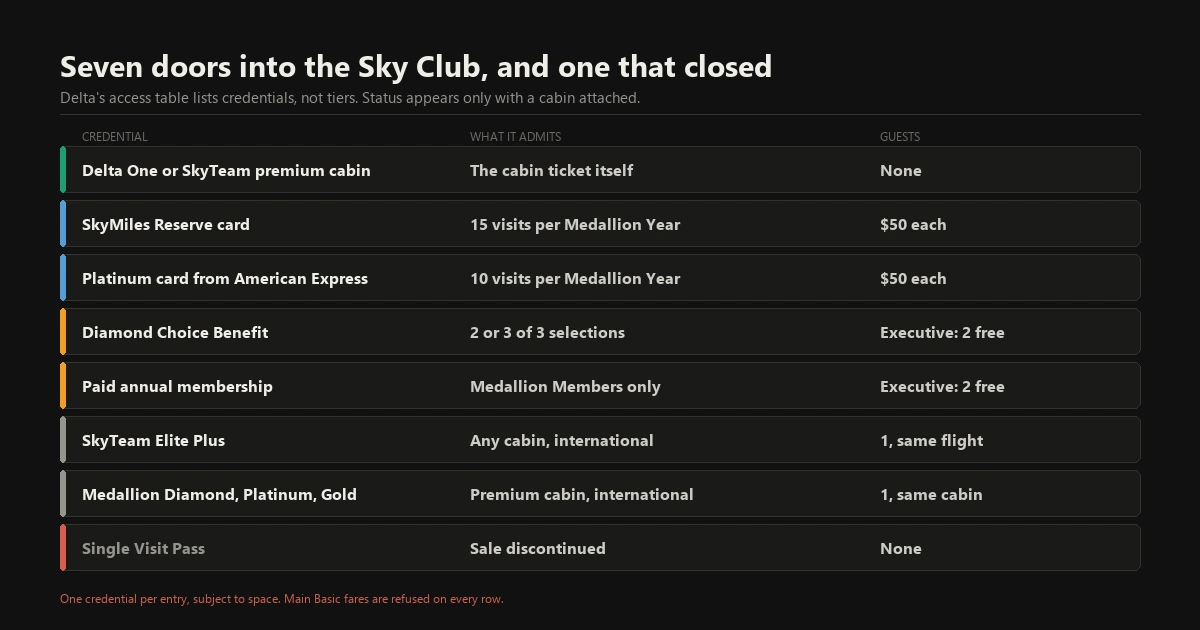
The network itself is not the constraint: Delta describes more than 50 locations, listed on its Club overview page, and access is subject to space at every one of them. One more line in the policy applies to every row without exception: only one credential may be used for Club access. You cannot stack a Diamond membership and a Reserve card to extend a guest allowance, and you cannot use a visit from your allotment while a membership is active. Delta’s own FAQ answers that directly, saying the membership or Delta One credential is recognised at check-in and the visit is not deducted, which is good news for the allotment and bad news for anyone hoping the two combine.
3. The card route: fifteen, ten, and what a visit means
For most readers this is the route that actually gets used, and it is the one where the arithmetic is least understood. Since 1 February 2025 the two premium cards have carried a visit allowance rather than unlimited access: fifteen visits per Medallion Year on the Reserve, ten on the Platinum card. A Medallion Year runs from 1 February to 31 January, which is not the calendar year your card fee runs on, and the visits are issued on 1 February and expire on 31 January with no rollover.
Delta defines the unit precisely, and the definition is the most valuable sentence on the page: a visit is entry to one or more Delta Sky Clubs, or use of the Grab and Go feature, at one or more airports, for a period of up to 24 hours starting at the first entry. Delta’s own example is a passenger flying Atlanta to Los Angeles to Honolulu who uses the Club in Atlanta before departure, again in Los Angeles during the connection, and again in Honolulu after landing. That is one visit, not three.
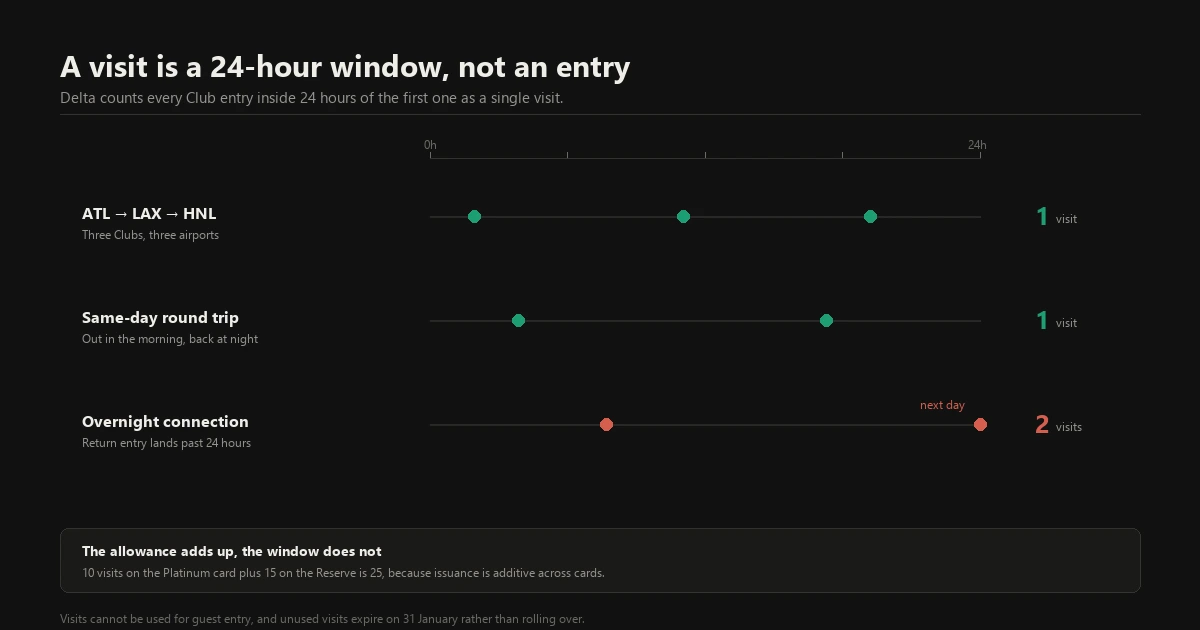
The same logic cuts the other way, which is where the allowance gets consumed faster than people expect. A same-day round trip using the Club in both directions is one visit, because the return entry falls inside the 24 hours. An overnight connection is two visits, because the second entry happens more than 24 hours after the first. A week of Monday-to-Friday flying is five visits at best and can be more. Fifteen is therefore not fifteen entries; it is roughly fifteen travel days, and for a consultant flying weekly that is just under a third of the year.
Three refinements change the count again. Visits are additive across cards for the same person: Delta’s FAQ gives the example of holding both the Platinum card at ten visits and the Reserve at fifteen for a total of twenty-five, and states that each additional Card Member on an account also receives a full allotment of their own. Visits cannot be given to guests either. Delta states that visits can only be used by the Card Member and cannot be used for guest entry, so a family of four flying together spends one visit and pays $50 for each of the other three. The Reserve partly offsets that with four One-Time Guest Passes a year, of which at most two can be applied to a single visit.
Then there is the $75,000 line. Both cards lift the cap entirely once eligible purchases on the card account reach $75,000 in a calendar year, and Delta warns the change can take up to twelve weeks to become effective. It is worth pricing that before chasing it. Fifteen visits beyond your allowance would cost $750 at the guest rate of $50. If you are not already spending $75,000 on the card, spending it to unlock unlimited access is a $75,000 decision taken to avoid a $750 bill.
4. The status route: why Gold does not get you in
This is the single most common misconception in the programme, and Delta’s policy is unambiguous once you read the condition instead of the tier. Diamond, Platinum and Gold Medallion status permits Club entry when you are flying a same-day international flight in Delta Premium Select or Delta One, or the equivalent cabin on a partner-operated flight. It also permits entry when flying Delta First to Mexico, Canada and Central America. One guest is allowed, and the guest must be in the same cabin.
Outside those cases, status is not a credential. A Diamond member flying Atlanta to LaGuardia in Main Cabin has no Club access on the strength of the tier, and neither does a Platinum member flying the same route in First, because the domestic First exception is limited to Mexico, Canada and Central America rather than applying to domestic First generally. The tier gets you into the Sky Club in Delta’s own system only when the cabin does the work.
There is one clause where status alone is enough, and it is not a Sky Club: Diamond, Platinum and Gold status permits entry to a Delta partner-operated lounge or a SkyTeam-branded lounge when travelling in any cabin. That is why a Gold member on a Delta-marketed flight operated by a SkyTeam partner can use the partner’s lounge in a foreign airport while being unable to use Delta’s own Club at home. The benefit is real, it is simply not the one the marketing implies.
5. Diamond’s Choice Benefit: two picks or three
Diamond is the only Delta tier that can turn a Choice Benefit into Club access, and the exchange rate is steep. Delta lists an Individual Membership at two of the three selections a Diamond member receives, and an Executive Membership, the one with two free guests, at all three. Platinum members get one selection and no Club option at all: the benefit table reads “Not Available” on that row.
Set that against the cash price and the trade becomes visible. Delta sells the same two products at $695 or 69,500 miles for Individual and $1,495 or 149,500 miles for Executive. A Diamond member spending all three selections on the Executive Membership is therefore paying the equivalent of $1,495 for a product they could buy outright, using currency whose other uses include 40,000 bonus miles, worth roughly $480 at this site’s 1.2 cent valuation, plus four Global Upgrade Certificates and a third selection. Unless two free guests on every visit is worth more to you than that combination, the two-selection Individual Membership is the better trade, and buying the membership outright is better again if the $1,495 is not a constraint.
One detail matters for anyone holding both: Delta states the membership runs simultaneously with an existing membership, and that a member with a membership credential does not lose a visit from a card allotment. The two products do not merge into a larger allowance. You pick one at the desk and the other stays untouched.
6. Annual membership now requires status
The route that most older guides describe first is now the narrowest. Delta’s policy reads: “Annual memberships (including renewals) to Delta Sky Club are available for purchase only by Medallion Members of the Delta SkyMiles Program.” That is a status gate on a cash purchase, and it inverts the usual advice. You cannot buy your way into the Club as a non-elite traveller; you have to be Silver or above before the door is even offered.
For anyone who does hold status, the two products are straightforward. Individual Membership at $695 or 69,500 miles covers the member alone, with guests at $50 each. Executive Membership at $1,495 or 149,500 miles covers the member plus two guests, or a spouse or domestic partner and children under 21, on every visit, with two further guests allowed at $50 each. Both are annual, both renew, and both require the same-day boarding pass rule that applies to every credential on the page.
Lifetime memberships are a separate, closed category. Delta states that new Lifetime Memberships are not available and that the provision applies to existing Lifetime Members only, who may continue to access the Club with a same-day ticket on any airline. It is the only credential on the page that does not care which airline you are flying, and it cannot be bought, inherited or earned.
7. The Delta One Lounge, which status cannot buy
Delta now runs a second lounge product that is not a Sky Club and is not reachable through any tier: the Delta One Lounge, at JFK, Los Angeles in both Terminal 3 and Terminal 2, Boston and Seattle. Entry requires a same-day Delta One ticket, departing or arriving. The arrival half of that sentence is the substantive difference, because Sky Club access is a pre-departure product and the Delta One Lounge is not.
The eligibility list is short. Delta One passengers on a same-day Delta One ticket count, whether departing or arriving. Delta 360 Members departing or arriving in Delta First also count, excluding Delta First Basic. Partner cabins count only in the specific cases Delta names: LATAM Premium Business, KLM Business, and Korean Air First and Prestige. At Boston, capacity limits push Air France and KLM business passengers to the Air France lounge in Terminal E or to the Sky Clubs in Terminals A and E instead.
Guests cost $100 each, up to two, or immediate family, and the guest must be flying a same-day Delta-operated flight. Children under two enter free. And there is a dated change worth diarising: Delta states that customers travelling in Basic Business will not have access to the Delta One Lounge for travel on or after 19 January 2027. Combined with the Main Basic rule at the Sky Club, that closes the last premium-cabin fare family that still opened a lounge door.
8. SkyTeam Elite Plus: any cabin, international only
The widest credential on the page belongs to people who are not Delta members. SkyTeam Elite Plus customers, excluding Delta Medallion Members, may access the Club when travelling in any cabin on a same-day international flight operated by a SkyTeam member, or when transferring between two SkyTeam-operated flights, which includes a same-day Delta domestic segment connecting to an international one. One guest is permitted, and the guest must also be on a SkyTeam flight.
Two conditions do the work. The flight has to be international, and Delta excludes travel between the United States and the Caribbean from that definition, listing the countries and territories it means. And the Elite Plus tier has to belong to another programme: a Delta Platinum or Diamond member is not admitted under this clause, because Delta routes its own elites through the cabin-based rule in section 4. The same traveller can therefore have access on a Delta-operated flight under one clause and not the other, depending on whose card is in the wallet. The same test on the other alliance behaves differently, and it is one of three in the Delta vs United comparison.
9. Three rules that void every credential
Three conditions sit above the credential table and cancel it outright. They are the reason a traveller with a membership, a card and a premium ticket can still be turned away, and none of them is about status.
| Rule | What it says | Who it catches |
|---|---|---|
| Main Basic fares | Customers travelling on Delta Main Basic, or similar light or basic tickets on a Delta partner, will not have access to the Delta Sky Club. The exclusion is repeated for card members, guests, single visit pass holders and every other entry type | Anyone who saved $40 on the fare and lost a $50 entry |
| The three-hour window | Customers can access Clubs within three hours of scheduled departure; connecting customers can use the Club at the connecting airport at any time before departure. Delta 360 Members and existing Lifetime Members are exempt | Early arrivals, long check-in queues, and anyone planning to work from the airport all afternoon |
| One credential per visit | Only one credential may be used for Club access, and entry is subject to space availability | Travellers trying to combine a membership with a card allowance, or to bring in more guests than one credential allows |
The three-hour rule is the one that quietly changes itineraries. A 7pm departure means the Club opens at 4pm, not when you clear security at noon, and a tight connection is covered by the connecting clause rather than by the three hours. The Main Basic rule is the one that quietly changes value: at a $50 guest rate, saving $40 on the fare to lose the entry is a losing trade before you count the seat.
10. What a visit actually costs
Divide the annual fee by the visits you will really use and the cards stop looking similar. The Reserve costs $650 and carries fifteen visits, which is $43.33 each if you use all of them. The Platinum card costs $895 and carries ten, which is $89.50 each. Held together, the two cost $1,545 for twenty-five visits, or $61.80 each, and the marginal visit beyond the allowance is $50 flat.
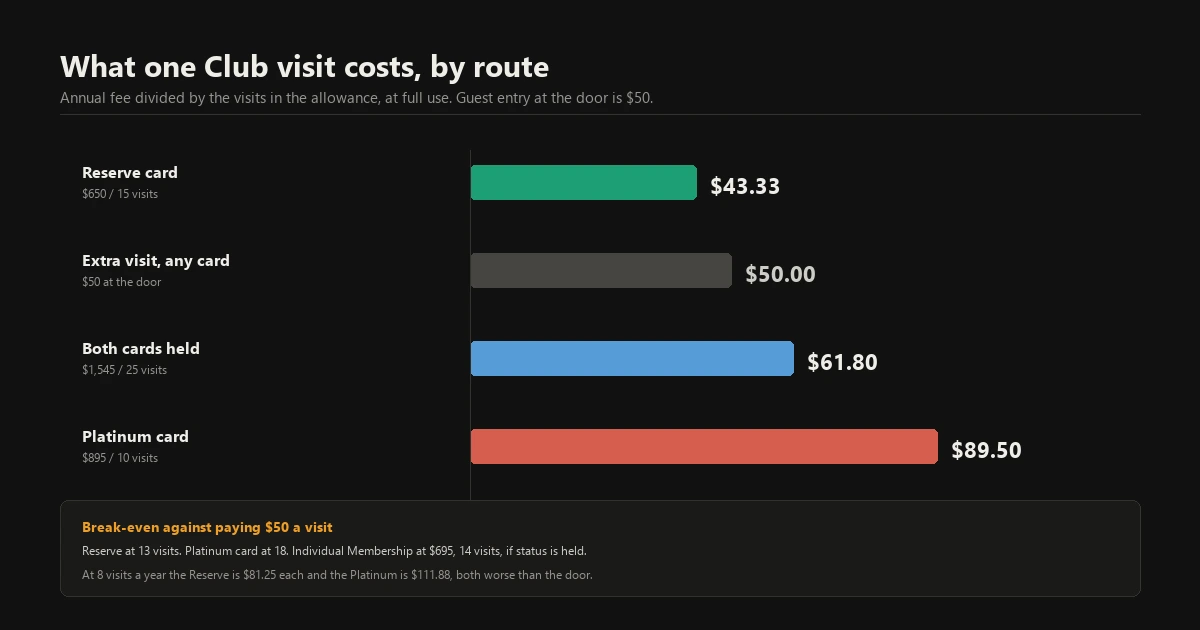
Those figures are the ceiling, not the average, because they assume full use. At eight visits a year the Reserve works out at $81.25 a visit and the Platinum at $111.88, both worse than paying $50 at the door on the days you actually fly. The break-even is arithmetic, not opinion: the Reserve pays for itself against the $50 rate at thirteen visits, the Platinum card at eighteen. Below those numbers you are buying a card for its other benefits and treating the Club as a bonus, which is a defensible position as long as it is a deliberate one.
| Route | Annual cost | Visits | Cost per visit | Break-even against $50 |
|---|---|---|---|---|
| Reserve card, full use | $650 | 15 | $43.33 | 13 visits |
| Platinum card, full use | $895 | 10 | $89.50 | 18 visits |
| Both cards, full use | $1,545 | 25 | $61.80 | 31 visits |
| Beyond the allowance | $0 | Per entry | $50 | — |
| Individual Membership, cash | $695 | Unlimited | Falls with use | 14 visits |
| Executive Membership, cash | $1,495 | Unlimited, two guests | Falls with use | 15 visits for two |
The membership rows in that table explain why the products survive alongside the cards. An Individual Membership at $695 beats paying $50 a visit from the fourteenth visit onwards, and it has no per-trip cap and no 24-hour accounting. An Executive Membership at $1,495 covers two people on every visit, so a couple flying together reaches the same break-even at fifteen visits between them rather than fifteen each. The catch is unchanged: you have to be a Medallion Member before either is offered.
11. What changed, and when
The access rules have been rewritten twice in three years, and most of the confusion in circulation is older advice that was accurate when it was written. The dates below are the ones Delta publishes; where a change is in force but undated, the page says so.
| Change | When | What it did to access |
|---|---|---|
| Visit allowances replace unlimited card access | 1 February 2025 | Reserve and Reserve Business Card Members receive 15 visits each Medallion Year; Platinum and Business Platinum Card Members receive 10, both uncapped at $75,000 of eligible spending |
| The visit is defined as a 24-hour window | 1 February 2025 | Multiple entries and multiple airports inside 24 hours count once, which is what makes a connecting itinerary affordable and a week of commuting expensive |
| Single Visit Passes withdrawn from sale | No date published | Existing passes are honoured to the printed expiry, and are refused on Main Basic fares like every other credential |
| Annual membership restricted to Medallion Members | In force, no date published | Cash alone no longer buys entry, renewals included |
| Basic Business loses Delta One Lounge access | Travel on or after 19 January 2027 | The last premium-cabin fare family that opened a lounge door is closed |
The direction of travel is consistent across all five rows: fewer unconditional doors, more conditions attached to the ones that remain. The card route survived by becoming countable, the membership route survived by becoming gated, and the single-entry route did not survive at all.
12. How to check your own case
Four questions settle almost every case, and they are worth running before you buy anything.
What are you holding at the desk? A boarding pass in Delta One, a card, a membership, or an alliance tier. Pick one, because only one counts. What fare family is on the boarding pass? Main Basic voids every credential on the page, and Basic Business will void the Delta One Lounge from 19 January 2027. Which cabin, and which route? For status holders the cabin has to be Premium Select or Delta One on an international itinerary, or First to Mexico, Canada and Central America; for SkyTeam Elite Plus the flight has to be international and on a SkyTeam carrier. How many travel days, not entries? Multiply your flying days by the number of days that cross a 24-hour boundary, and compare that number with fifteen, ten or twenty-five.
If the answer puts you near the limit, price the alternatives before assuming the card is the cheapest route in. Above roughly fourteen visits a year an Individual Membership is cheaper than paying $50 a visit, and above fifteen a year for a couple the Executive Membership is cheaper again, provided status is already in place. The card that carries those visits is priced fee by fee in the Delta credit card guide.
13. The verdict
Everything else is administration, including the Choice Benefit arithmetic, which almost always favours two selections over three. For the tiers themselves, the Medallion status guide sets out the MQD thresholds and what each tier actually changes at the airport; the partner guide explains why a SkyTeam-branded lounge and a Delta Sky Club are not the same credential; and the earning guide covers the twelve sources that fund the trips the Club sits at the start of. Last updated 26 November 2026. Every rule and price on this page was checked against Delta’s access policy, Delta’s Choice Benefits terms and the two card issuers’ published fees on that date.
14. Frequently asked questions
Can I get into Delta Sky Club with Gold Medallion status?
Only in specific cabins and on specific routes. Gold, Platinum and Diamond status permits entry on a same-day international flight in Delta Premium Select or Delta One, or the equivalent cabin on a partner-operated flight, and on Delta First to Mexico, Canada and Central America. On a domestic Main Cabin flight the tier is not a credential, and one guest is allowed only when they are in the same cabin.
How many Sky Club visits does the Delta Reserve card include?
Fifteen visits per Medallion Year, which runs from 1 February to 31 January. The cap lifts entirely once eligible purchases on the card account reach $75,000 in a calendar year, which Delta says can take up to twelve weeks to take effect. Once the fifteen are used, further visits cost $50 per person.
Can I buy a day pass to Delta Sky Club?
No. Delta has discontinued the sale of Single Visit Passes, and passes already held are honoured only to the expiry date printed on them. Annual memberships are the remaining cash route, and those are available for purchase only by Medallion Members, renewals included.
Does a Sky Club visit count per airport or per day?
Per 24-hour window. Delta defines a visit as entry to one or more Clubs, at one or more airports, for up to 24 hours from the first entry, so a connecting itinerary through three airports counts once and a same-day round trip also counts once. An overnight stop followed by a new entry the next day counts as two.
Do Amex Platinum and Delta Reserve visits add together?
Yes. Visit issuance is additive across eligible cards held by the same person, so ten visits on the Platinum card and fifteen on the Reserve give twenty-five per Medallion Year. Each additional Card Member on an account also receives a full allotment of their own rather than sharing the primary cardholder’s.
Can I bring guests into the Sky Club for free?
Only with an Executive Membership, which covers two guests or a spouse or domestic partner and children under 21 on every visit, plus two more at $50 each. Card Members pay $50 per guest, with the Reserve also carrying four One-Time Guest Passes a year, of which at most two can be used on a single visit. Visits themselves cannot be used for guest entry.