Rapid Rewards runs three tiers from 1 January 2027 — Silver, Gold and Platinum — and the gap between them is narrower than the names suggest. All three include free seat selection at booking, Priority and Express Lane access, priority member support, and same-day standby even on a Basic fare. What separates them is checked bags, the size of the flight bonus, and one benefit that exists only at the top: unlimited Companion Pass trips at Platinum.
The short version: Silver takes 35,000 Tier Qualifying Points (TQPs) or 25 qualifying one-way flights, Gold takes 65,000 or 50, and Platinum takes 140,000 or 100. The number that decides everything is not the threshold but the exchange rate: TQPs earned on flights are multiplied by 2 to 10 depending on fare, while TQPs earned on a co-branded card are multiplied by one. That single asymmetry means status is roughly ten times cheaper to earn by flying than by spending, which reverses the advice most people expect. Earn Silver by flying, skip Gold unless you check two bags, and treat Platinum as a Companion Pass purchase rather than a status goal.

At a glance
| Tier | TQPs | Or one-way flights | Flight bonus | Free checked bags | The benefit that decides it |
|---|---|---|---|---|---|
| Silver | 35,000 | 25 | 40% | 1 | Seat choice at booking, with a 48-hour Extra Legroom upgrade |
| Gold | 65,000 | 50 | 60% | 2 | Extra Legroom selectable at the moment you book |
| Platinum | 140,000 | 100 | 120% | 3 | Unlimited Companion Pass trips |
Every tier also includes Priority Lane and Express Lane access, priority member support, and same-day standby on any fare including Basic. The flight bonus applies to Rapid Rewards points earned on Southwest-operated flights, not to TQPs. TQPs reset to zero on 1 January, and the tier you qualify for in one calendar year is valid through 31 December of the next — so activity in 2027 produces a 2028 tier that runs to the end of 2028.
What each tier actually gives you
Silver, 35,000 TQPs or 25 flights. You can pick a Standard or Preferred seat free at booking, or any time up to 60 minutes before departure, and you can move into an Extra Legroom seat free within 48 hours of the flight when one is left. Boarding is Group 1, the first checked bag is free, and the seat benefit covers up to eight additional passengers on the same reservation. That last detail is the one families underestimate: a single Silver member can seat a party of nine together in the forward cabin at no cost, which is $15 to $49 a segment at published rates.
Gold, 65,000 TQPs or 50 flights. The upgrade from Silver is narrower than the 30,000-TQP jump implies. You get Extra Legroom selectable at booking instead of waiting 48 hours, a second free checked bag, boarding ahead of Group 1, a 60% bonus instead of 40%, and two premium drinks per flight. Extra Legroom sells for $39 to $79 a segment and the second bag costs $55, so the added benefits are worth roughly $94 to $134 per one-way flight — but only if you would have paid for both. A member who packs in a carry-on gets a boarding group, a drinks voucher and a points bonus, and nothing else.
Platinum, 140,000 TQPs or 100 flights. This is the only tier where the benefit cannot be bought at any price: unlimited Companion Pass trips. You also get a third free bag, boarding ahead of Gold, and a 120% flight bonus. Everything else repeats Gold. The Companion Pass still flies one designated person at a time with three changes a year, and the taxes and fees from $5.60 one way still apply. Value it against your own travel: a companion seat on a $300 round trip is $300 saved, so four trips a year is about $1,200, and ten is about $3,000.
What a Tier Qualifying Point really costs
This is where the program stops looking like a hotel scheme. There are five ways to earn TQPs, and they are not priced alike:
- Travel on qualifying Southwest-operated flights
- Purchases on any Southwest Rapid Rewards credit card, one TQP per dollar with no cap, including the entry-level Plus card
- Purchases on the Rapid Rewards debit card, one TQP per $2
- Qualifying Getaways by Southwest vacation bookings
- Travel on qualifying Southwest Groups bookings
Flights pay TQPs at the same multiple as points: 2X the base fare on Basic, 6X on Choice, 8X on Choice Preferred, and 10X on Choice Extra, before any tier bonus. Card spend pays 1X, flat. That ratio is the whole story, and it produces this table for Silver:
| Route to 35,000 TQPs | What it actually takes |
|---|---|
| All flights, Choice Extra fares at $200 | 18 one-way segments, about $3,600 in fares |
| All flights, Choice fares at $200 | 30 one-way segments, about $6,000 in fares |
| All card spend | $35,000 |
| Fifteen segments plus card spend | About $3,000 in fares and $17,000 on the card |
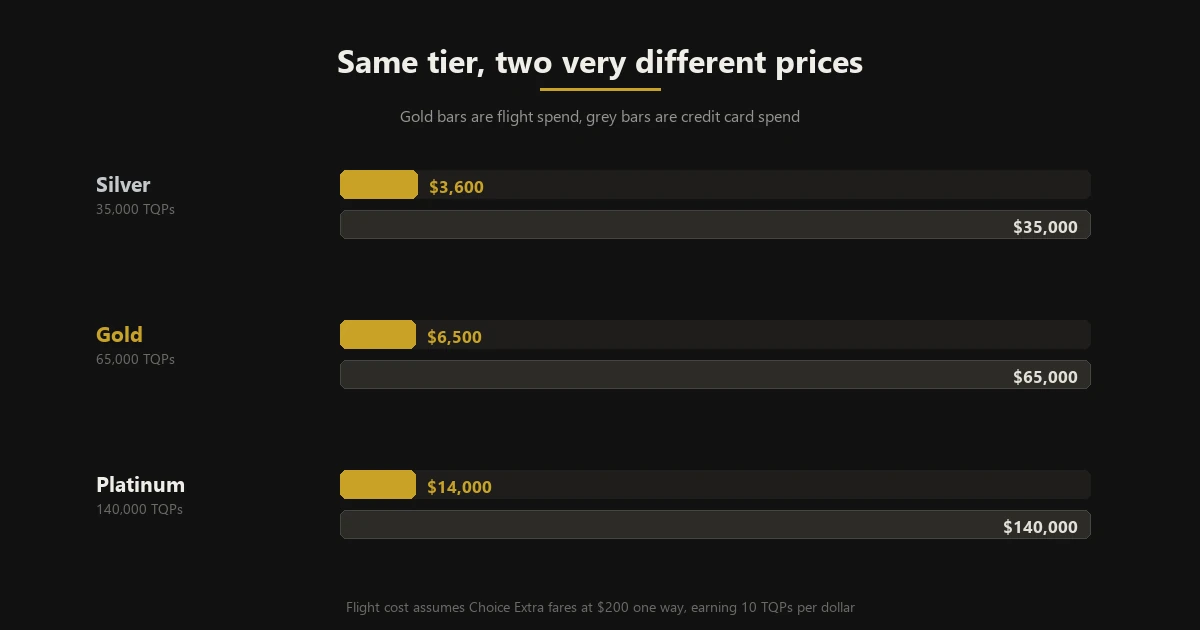
The same arithmetic scales up. Gold costs about $6,500 in Choice Extra fares or $65,000 on a card. Platinum costs about $14,000 in Choice Extra fares or $140,000 on a card. Flying earns TQPs between six and ten times faster per dollar than spending does, so the practical question is never “can I reach Platinum,” it is “do I already fly enough that Platinum arrives on its own.”
Run the card path backwards and it stops making sense on its own terms. Silver’s bags and seats are worth roughly $600 to $940 a year to a member flying ten segments with a checked bag. Spending $35,000 to collect that is a return of 1.7% to 2.7%, which is what an ordinary 2% cashback card already pays with no annual fee. If the spending is not already happening, buying status with it is a worse deal than the card in your wallet. If your goal is redeemable points rather than status, topping up during a buy-points discount puts points in the account without touching the qualification maths at all.
What does not count toward status
The exclusion list is long and it kills the most popular shortcut. These earn Rapid Rewards points but contribute nothing to TQPs:
- Credit card welcome bonuses
- Referral bonuses and anniversary points
- Bonus points from card spending categories
- Hotel, car rental and other partner earnings
- Award flights, Companion Pass travel and charter flights
- Purchased points
- Vacation packages booked through online travel agencies, and tickets where the operating carrier is not disclosed before purchase
So a 75,000-point welcome bonus is worth $75,000 of spending toward nothing at all. The one legitimate acceleration left is the fare you buy: choosing Choice Extra over Basic on the same route triples the TQP yield per dollar, and on a work trip someone else is paying for, that is the cheapest status you will ever buy.
The status year, and the 130,000-TQP boost
TQPs reset on 1 January and progress toward both Milestones resets with them. The tier you earn is valid through 31 December of the following year, and if you cross a higher threshold mid-year the upgrade posts as soon as the activity does — no waiting for January. Milestone benefits stay valid through 31 December of the year after they are earned.
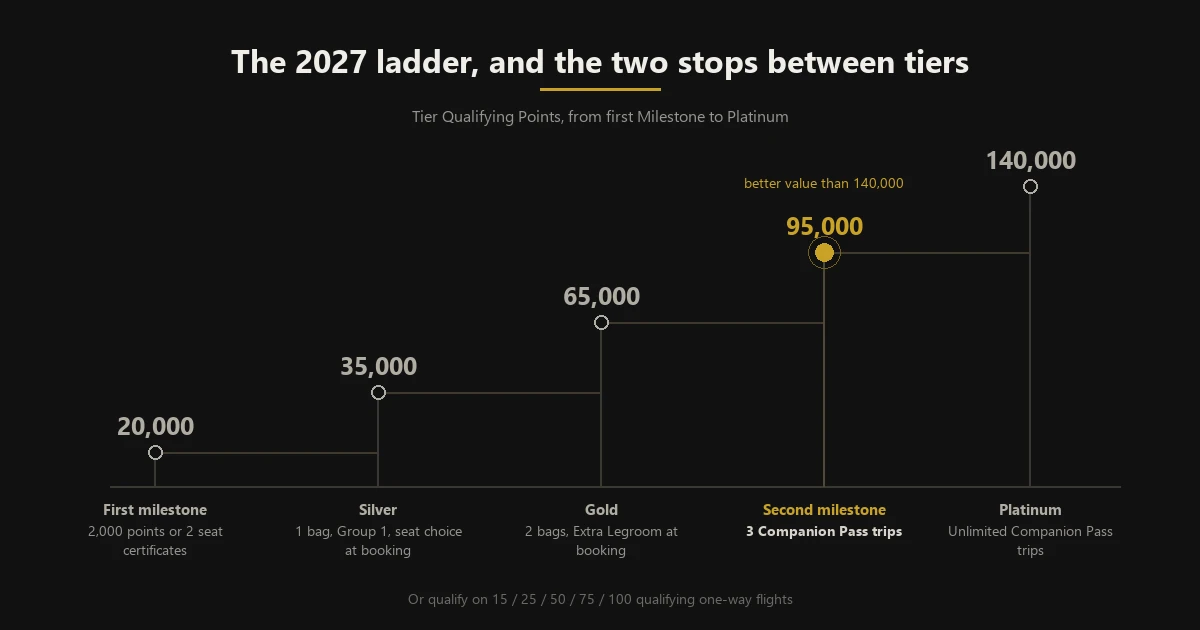
Two Milestones sit on the ladder. At 20,000 TQPs or 15 flights, before Silver, you choose either 2,000 Rapid Rewards points or two Preferred Seat Certificates, and the certificates can only be redeemed through the modify-or-upgrade flow, not while booking. At 95,000 TQPs or 75 flights you receive three Companion Pass trips, each of which covers one one-way or one round trip and is consumed entirely when used — so always spend one on a round trip.
There is also a one-time boost for 2027 only: primary cardmembers who reach 130,000 TQPs by 31 December 2027 receive 10,000 bonus TQPs within 30 days, which is enough to clear Platinum at 130,000 instead of 140,000. It is one per member, requires the card to be open and not in default, and it disappears after 2027.
Which tier to actually aim for
Fly fewer than 15 one-way segments a year and check no bags: aim for nothing. The co-branded card already gives you Group 5 boarding, a free first bag and complimentary seat selection, which covers most of what Silver adds. Chasing 35,000 TQPs for a boarding group is spending real money to save queueing.
Fly 15 to 30 segments and check a bag: Silver is the only tier worth planning for. A single free bag at $45 a segment pays for itself in ten trips, the forward-cabin seat selection is worth $150 to $490 across the same ten, and 25 segments of ordinary Choice flying already produces close to 35,000 TQPs on their own. This is the one tier that arrives almost by accident.
Fly 50 or more segments: Gold comes with the flying. Do not spend to reach it. If you get there, the second bag and the booking-time Extra Legroom access are genuine, but they are worth $94 to $134 a flight and no more.
Want the Companion Pass: aim at 95,000, not 140,000. Three companion trips for 95,000 TQPs costs $9,500 in Choice Extra fares against $14,000 for unlimited at Platinum. Unless you would genuinely use the pass more than three times, the Milestone is the better buy, and if you would use it ten times the pass is worth $3,000 and Platinum becomes defensible. For a full breakdown of how the pass is earned and used, see the Southwest Companion Pass guide, and for the live offers side of the program see Southwest Rapid Rewards promotions.
Verdict
Earn Southwest status by flying, never by spending. The 2X-to-10X multiplier on flights against a flat 1X on cards makes the card path roughly ten times more expensive per TQP, and the card path buys benefits worth 2% of what it costs. Silver is the tier to take if it is already within reach, Gold is a dividend of frequency rather than a goal, and Platinum is a Companion Pass with a status badge attached — worth 140,000 TQPs only to someone who would have flown most of them anyway.
Frequently asked questions
How many Tier Qualifying Points do I need for Southwest elite status?
Silver takes 35,000 TQPs or 25 qualifying one-way flights, Gold takes 65,000 or 50, and Platinum takes 140,000 or 100. Either the points or the flight count is enough on its own.
Do credit card welcome bonuses count toward Southwest status?
No. Welcome bonuses, referral bonuses, anniversary points, bonus-category points, partner earnings and purchased points all earn Rapid Rewards points but no TQPs, so they cannot move you toward Silver, Gold or Platinum.
How long does Southwest elite status last?
Status earned in a calendar year is valid through 31 December of the following year. TQPs reset to zero on 1 January, and a higher tier earned mid-year posts as soon as the qualifying activity does.
Is Southwest Gold status worth earning?
Only if you check two bags and want Extra Legroom on every flight. The 30,000 extra TQPs buy a second free bag worth $55 a segment, booking-time Extra Legroom access worth $39 to $79, two drinks per flight and a 20-point bonus increase. Pack light and the tier pays back very little.
Can I reach Southwest status without flying?
Yes, through credit card spending at one TQP per dollar, but it is expensive: $35,000 for Silver, $65,000 for Gold and $140,000 for Platinum. The same thresholds cost about $3,600 to $14,000 in Choice Extra fares, so flying is the cheaper route by a wide margin.
Do elite benefits extend to other passengers on my reservation?
The seat benefit does. Silver, Gold and Platinum members can select seats for up to eight additional passengers on the same reservation, so a party of nine can sit in the forward cabin at no charge. If the member is removed from the booking, those seat selections are released.
More Southwest Guides
Southwest Rapid Rewards promotions — every live offer and what it is worth.
How to earn Southwest Rapid Rewards points — the five sources and their real rates.
How much are Southwest Rapid Rewards points worth — the valuation behind every redemption.
Best way to use Southwest Rapid Rewards points — three rules instead of three routes.
Southwest Companion Pass — how the pass is earned, what three trips are worth, and where it stops applying.
Southwest Rapid Rewards credit cards — which card fits which kind of flying.
Southwest Rapid Rewards partners — interline, loyalty and hotel partners, and why the points only flow one way.
Buy Southwest Rapid Rewards points — when a sale beats the redemption rate, and when it does not.
Do Southwest Rapid Rewards points expire — no, and the risk that matters is depreciation, not the calendar.
If you want the wider context on how qualification currencies work across programs, how loyalty points work explains why earn rates and redemption values move in opposite directions.