Seven rewards currencies move points into TrueBlue, and a hotel programme makes eight. Five of them convert at par — Chase Ultimate Rewards, Bilt, Citi ThankYou on its premium cards, Wells Fargo Rewards and Rove — while American Express sends 200 points for every 250, Capital One sends 600 for every 1,000, and IHG One Rewards sends one point for every five. Ranked by ratio, that looks like a simple league table with a clear bottom half.
Ranked by what the transfer actually costs you, it is not. TrueBlue prices awards off the cash fare, so a point lands worth the same 1.3 to 1.4 cents whichever bank sent it — the transfer cannot make it worth more than it already is. All a transfer decides is which balance you spend, which means the real question is not which ratio is best but which balance you can afford to lose. This guide prices all eight routes on that basis, names the two balances that should go first, and explains why the United partnership is not a transfer partner at all.

On this page
- The eight routes, in one table
- Why the ratio is only half the bill
- What each balance is worth elsewhere
- Each route, judged
- The one-way valve
- The three cases where a transfer works
- How to move points, in order
- United: a redemption partner, not a transfer partner
- Verdict
- What changed in 2026
- Questions
The eight routes, in one table
Every major transferable currency in the United States now reaches TrueBlue. HSBC and U.S. Bank are the only major ones that do not, and that is recent: Bilt joined on 20 October 2026 as its 27th travel partner, closing the last big gap. What has not levelled out is the price of getting there. Every programme-to-programme ratio on the site, airlines and hotels alike, sits in the transfer partner index.
| Source | Ratio | Points sent per 1,000 TrueBlue | Minimum | Arrival | Verdict |
|---|---|---|---|---|---|
| Chase Ultimate Rewards | 1:1 | 1,000 | 1,000 | Instant | Keep for Hyatt and United |
| Bilt Rewards | 1:1 | 1,000 | 1,000; 2,000 on Blue | About 20 minutes, allow 48 hours | Only to top off |
| Citi ThankYou | 1:1 on Strata Premier and Strata Elite; 1:0.7 on no-fee cards | 1,000 | 1,000 | Instant | Keep for American |
| Wells Fargo Rewards | 1:1 | 1,000 | 1,000 | Instant | The balance to spend |
| Rove | 1:1 | 1,000 | 1,000 | Not published | The balance to spend |
| Amex Membership Rewards | 5:4 | 1,250, plus a US$0.75 fee | 250 | 48 hours | Last resort |
| Capital One Miles | 5:3 | 1,667 | 1,000 | Same day | Last resort |
| IHG One Rewards | 5:1 | 5,000 | Not published | Not published | Almost never |
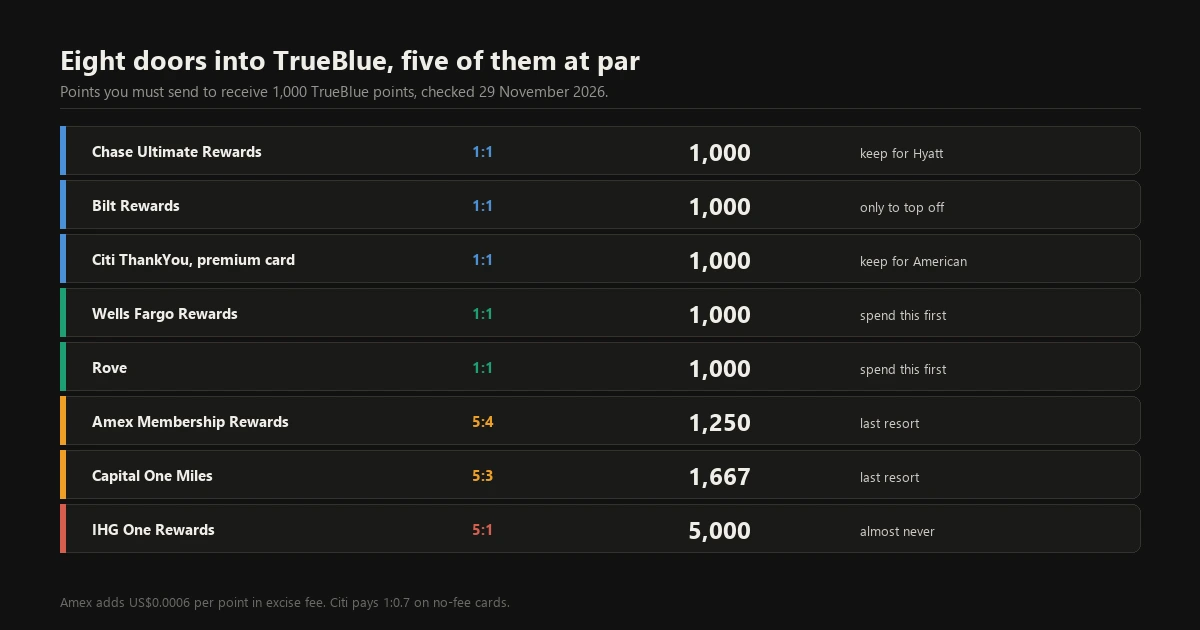
Two rows need a footnote. The Amex fee is a federal excise tax offset that applies to transfers into United States airline programmes, charged at US$0.0006 per point and capped at US$99, so a 250-point transfer costs 15 cents and a 100,000-point transfer costs US$60. And Citi’s 1:1 rate depends on which card you hold, not on which points you send — pooled ThankYou points transfer at the premium rate only because the premium card is the one doing the sending.
Why the ratio is only half the bill
TrueBlue is a revenue-based programme. There is no award chart and no sweet spot that turns a transferred point into three cents of value, because the points price is derived from the cash fare on the same flight. A Main Cabin seat that sells for US$201 prices at roughly 15,000 points, and it prices at that whether the points arrived from Chase or from a Barclays welcome offer. Transfer in and the balance grows; the value per point does not.
That single feature makes JetBlue transfers different from transfers into, say, Aeroplan or ANA, where the usual advice is to move points when an award is underpriced against cash. Here nothing is underpriced against cash, by construction. So a transfer is never an investment. It is a payment method — a way to settle a bill you have already decided to pay, using a currency that would otherwise sit idle.
Which is why the useful number on the table is not the ratio but the third column. Five routes need 1,000 points; one needs 1,250 plus a fee; one needs 1,667; one needs 5,000. If all eight produced the same 1,000 TrueBlue points, buying that award with IHG points would cost five times as much of the underlying balance as buying it with Wells Fargo points. The ratio is a tax on using the wrong currency.
There is one alternative outside the transfer system entirely, and it is worth pricing alongside these eight: buying the points. The buy-points tiers are set out here, and at the top tier a point still costs 1.43 cents against a 1.34-cent valuation — which is the same test every transfer on this page has to pass.
What each balance is worth elsewhere
The next step is to put a price on the points leaving your account. The table below uses the average redemption value of each currency — what a typical, unhurried redemption returns, not the best one published on a blog. It then compares that against 1,000 TrueBlue points at 1.34 cents, the middle of the range this programme actually delivers.
| Source | Points sent | Average value of those points | Cost of 1,000 TrueBlue | Received | Net |
|---|---|---|---|---|---|
| Chase Ultimate Rewards | 1,000 at 2.0 cents | US$20.00 | US$20.00 | US$13.40 | Minus US$6.60 |
| Bilt Rewards | 1,000 at 1.5 cents | US$15.00 | US$15.00 | US$13.40 | Minus US$1.60 |
| Citi ThankYou | 1,000 at 1.8 cents | US$18.00 | US$18.00 | US$13.40 | Minus US$4.60 |
| Wells Fargo Rewards | 1,000 at 1.5 cents | US$15.00 | US$15.00 | US$13.40 | Minus US$1.60 |
| Rove | 1,000 at 1.25 cents | US$12.50 | US$12.50 | US$13.40 | Plus US$0.90 |
| Amex Membership Rewards | 1,250 at 2.0 cents | US$25.00 | US$25.75 with the fee | US$13.40 | Minus US$12.35 |
| Capital One Miles | 1,667 at 1.7 cents | US$28.34 | US$28.34 | US$13.40 | Minus US$14.94 |
| IHG One Rewards | 5,000 at 0.5 cents | US$25.00 | US$25.00 | US$13.40 | Minus US$11.60 |
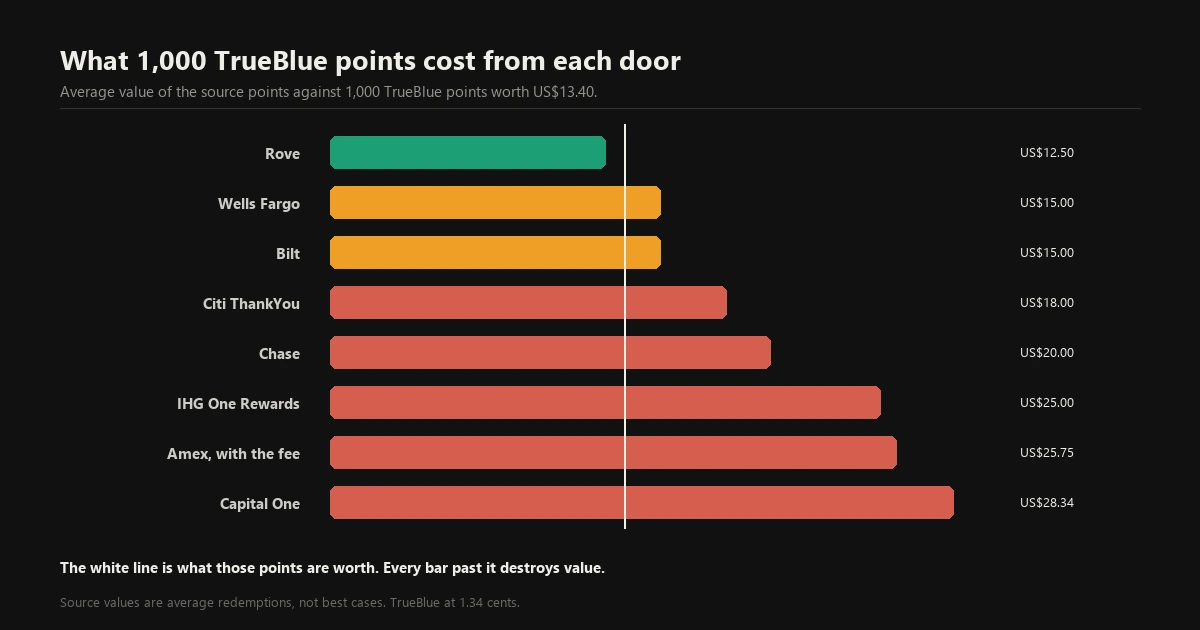
Read this table as an upper bound, not a verdict. It says that on average, seven of the eight routes destroy value, and that is true. What it also says is that the swing between the best and worst route is about US$16 per 1,000 points — a 90-cent gain on Rove against a US$14.94 loss on Capital One — and that the ordering is set entirely by what the source currency is worth somewhere else.
Average value is the wrong number for the decision, though. Nobody transfers at the average. You transfer the marginal balance — the points you have no plan for. Chase points sitting behind a Sapphire Reserve are worth 2 cents because Hyatt and United exist; the same points on a Freedom card with no premium card attached are worth 1.25 cents and cannot reach a partner at all. The transfer decision is about which of those two states you are in, not about the published valuation.
Each route, judged
Chase Ultimate Rewards, 1:1
The best ratio attached to the best currency, and for that reason the worst place to spend it. Ultimate Rewards reaches Hyatt at better than 2 cents and United at roughly 1.8, and a 1:1 transfer into a programme that tops out at 1.4 burns the difference in one click. The exception is narrow: a Chase balance that is too small to book anything at Hyatt and too small for a Saver award on United, where the alternative is a cash ticket you were going to buy anyway. Is it worth it? Rarely, and never with a balance large enough to matter.
Bilt Rewards, 1:1
New since 20 October 2026, and the only route that turns rent into TrueBlue. At par, which puts it level with Chase and ahead of Amex, and transfers complete in about twenty minutes although Bilt asks you to allow 48 hours. Two house rules: points move in 1,000-point blocks, and members on Bilt’s entry Blue tier have a 2,000-point minimum. The caution is structural rather than technical — Bilt has said it will cut its Hyatt ratio on 1 January 2027, which tells you Bilt is repricing its partner list, and a partner added in October can be repriced in the same way. Is it worth it? For a 2,000 to 5,000-point top-off, yes. As a place to park a Bilt balance, no.
Citi ThankYou, 1:1 or 1:0.7
Citi is the only major bank that transfers to American Airlines, which makes a ThankYou balance the most expensive currency in this table to waste. The 1:1 rate is reserved for the Strata Premier and the Strata Elite; the Double Cash, Custom Cash, Rewards+ and Strata convert at 1,000 to 700, and the legacy Citi ThankYou Mastercard lost JetBlue entirely on 20 September 2026. Pooling saves you: points earned on a no-fee card transfer at 1:1 once they sit under a premium card. Is it worth it? Only if you do not fly American and have no plan to.
Wells Fargo Rewards, 1:1
This is the row that gets skipped in most comparisons because the card does not have a cult following. It should not be. Wells Fargo Rewards transfers at par, arrives instantly, and has the thinnest list of alternative high-value uses of any currency here — no alliance-wide award chart, and no hotel partner that reliably returns two cents. That combination is exactly what you want from a balance you are about to convert: the opportunity cost is the lowest of the five 1:1 routes, so the same 1,000 points cost you less in forgone value. Is it worth it? Yes, ahead of any other 1:1 source.
Rove, 1:1
The cheapest route in the table, and the only one where 1,000 TrueBlue points cost less than they are worth. Rove points carry a lower average value than the airline currencies, so converting them at par is a small gain rather than a loss. JetBlue has also been the destination for Rove’s transfer bonuses — a 20 percent bonus ran until 14 November 2026, turning the ratio into 1:1.2 — which is a signal that Rove is using TrueBlue to build volume. Is it worth it? Yes, and it is the one route worth waiting for a bonus on.
Amex Membership Rewards, 5:4 plus a fee
Two hundred TrueBlue points for every 250 Membership Rewards points, a US$0.0006-per-point excise fee, and a 250-point minimum. At a 2-cent Membership Rewards valuation, 1,000 TrueBlue points cost US$25.75 against US$13.40 of value — the second-worst trade on the page. What rescues it in practice is granularity: because the minimum is 250 points, Amex is the only route that can close a 900-point gap without forcing you to move 1,000. Is it worth it? For gaps under about 2,000 points, and only then.
Capital One and IHG, 5:3 and 5:1
Grouped because they share a problem: the ratio is so wide that the transfer only makes sense when the alternative is losing the points. Capital One needs 1,667 miles per 1,000 TrueBlue; IHG needs 5,000 hotel points for the same 1,000. Against a 1.34-cent redemption, IHG is handing over US$25 of hotel value for US$13.40 of airline value. Is it worth it? Capital One, only for a small top-off. IHG, only if an account is closing or the points are about to be forfeited, and even then it is a salvage operation rather than a plan.
The one-way valve
Every route in this guide runs in one direction only. TrueBlue points cannot go back to Chase, cannot move on to another airline, and cannot be sent to another person’s account unless the names match. There is no transfer-out partner list, because there is no transfer out.
Three consequences follow. First, a transfer is irreversible at the moment it is submitted — there is no cancellation window and no reversal if the award disappears while you are moving points. Second, a mistaken transfer cannot be corrected by sending the points somewhere else; the only recovery is to redeem them, at whatever the fare happens to be. Third, TrueBlue’s own flexibility does not travel with the points: they never expire and can be used on any seat, which is genuinely useful, but that is a property of the programme you moved into, not a safety net for the decision.
The three cases where a transfer works
Because the value per point does not change, a transfer only works when the alternative is worse than 1.34 cents. There are three situations where that is true, and one where it feels true but is not.
A confirmed award you are short on. You have found the seat, priced it, and the balance is 4,000 points short. Paying cash for the ticket costs more than the points you would burn, so the transfer is the cheapest way to settle a bill you have already agreed to. This is the only case where the ratio stops mattering — a 5:3 route that closes the gap beats a 1:1 route that cannot. If the gap is larger than a few thousand points, price a points purchase against the transfer first: the current buy-points tier is worth checking before you raid a currency you will want later.
A partner award that cash cannot buy. Qatar Airways, Etihad, Icelandair, Condor, Cape Air, Singapore Airlines and South African Airways all price in TrueBlue points only. No cash fare exists to compare against, so the 1.34-cent average is not the relevant benchmark — the relevant benchmark is what the same seat costs through another programme, and that comparison can put the value well above 2 cents.
A currency about to lose value. A transfer bonus that ends on a date, a partner ratio that has been announced for a cut, an account that is closing. In each case the points you are moving are worth less tomorrow than today, and 1.34 cents beats whatever the alternative returns.
The case that is not one: topping up a balance for later. Moving 50,000 Chase points into TrueBlue because you might fly JetBlue next year is a straight loss of about US$330 against redeeming them at Hyatt, and it buys nothing that holding the Chase points would not also buy. The award you eventually book will price identically. There is no early-mover advantage in a revenue-based programme.
How to move points, in order
The order matters more than the mechanics, because the irreversible step comes last.
Find and price the award first, in cash and in points, and write down the exact number of TrueBlue points it needs. Then check the balance and decide whether the gap is one you want to fund. Only after that do you link the accounts: TrueBlue is linked inside the bank’s transfer portal by entering the TrueBlue number and the account holder’s name, and the names have to match exactly. Then transfer the minimum that closes the gap, not the round number — an extra 5,000 points on a 1.34-cent programme is US$67 of value moved for no reason.
Arrival times are worth planning around. Chase, Citi and Wells Fargo land instantly. Capital One completes the same day. Amex quotes 48 hours, and Bilt about twenty minutes with a 48-hour allowance. None of that matters if the award is still there when the points land, which is why the confirmation of the seat comes before the transfer rather than after it.
United: a redemption partner, not a transfer partner
Blue Sky is the part of this picture that gets confused with a transfer partnership, and it is not one. Miles do not move between TrueBlue and MileagePlus. What the two airlines have built since 2025 is a sales and loyalty agreement: earn and redeem on each other’s flights, then, from 10 February 2026, buy those flights with cash on either website, and from 14 May 2026, receive reciprocal elite perks at the airport.
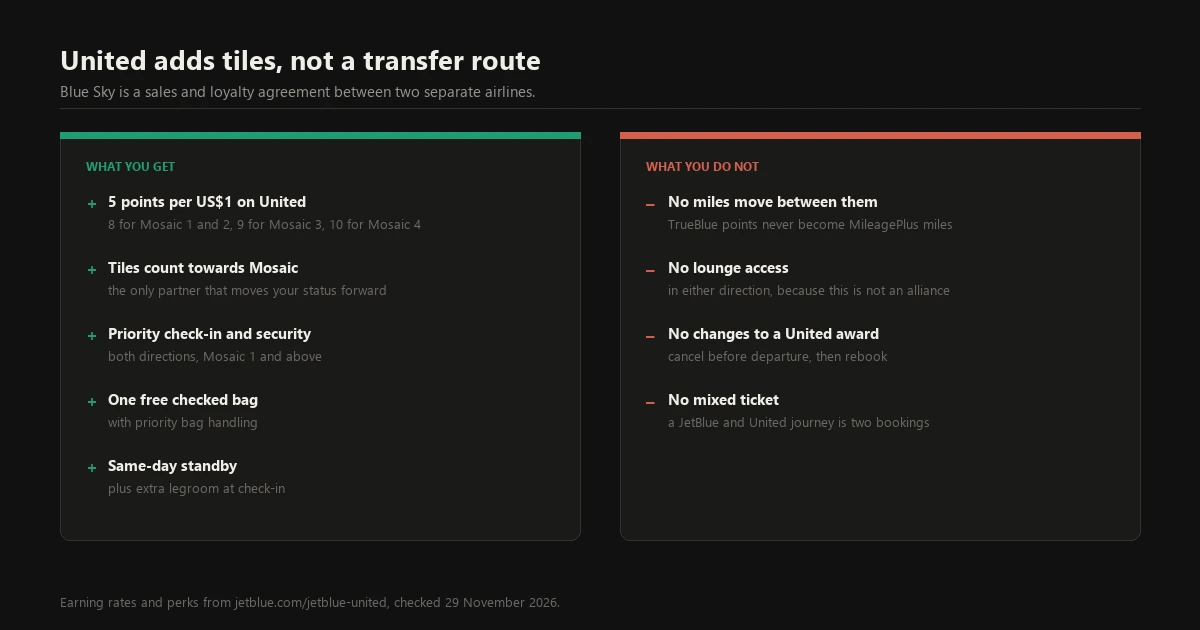
For a TrueBlue member the earning side is the interesting half. United-operated flights booked on jetblue.com earn 5 points per dollar of pre-tax fare and carrier surcharges, rising to 8 for Mosaic 1 and 2, 9 for Mosaic 3 and 10 for Mosaic 4 — and they earn tiles, which makes United the only partner that moves a member towards status. Every other partner on the list earns points and no tiles, which is the split set out in the earning guide. The perk table is real but narrow: priority check-in and security, priority boarding, one free checked bag with priority handling, preferred seats after booking, extra-legroom seating at check-in, and same-day standby. Mosaic 1 boards United with Group 2; Mosaic 2, 3 and 4 board with Group 1.
Three limits are worth knowing before you plan around it. A single itinerary cannot mix JetBlue-operated and United-operated flights — you book two tickets. Changes to a United award booked with TrueBlue points are not permitted at all; you can cancel before the first outbound flight, so one-way bookings are the flexible way to book. And there is no lounge access in either direction, because Blue Sky is a bilateral agreement rather than an alliance.
Verdict
Transfer into TrueBlue only to settle a bill you have already agreed to. The programme is revenue-based, so a transferred point is worth exactly what a point earned by flying is worth, and the transfer cannot improve that number. What it can do is let you pay with a balance that would otherwise sit idle — which is a real benefit, but a narrow one, and it depends entirely on which balance you choose.
In practice that means Wells Fargo and Rove first, because their points have the fewest alternative uses and the lowest average value. Bilt next, for small top-offs only. Citi only if American is not part of your year, since the ThankYou balance is the only route to AAdvantage. Amex and Capital One for gaps under 2,000 points, because their ratios are wide enough that anything larger is a gift. IHG last, and realistically never. And Chase last of all, which is not a comment on the ratio but on what those points are worth somewhere else.
Last updated: 29 November 2026.
What changed in 2026
| Date | Change | What it means for a transfer |
|---|---|---|
| 20 October 2026 | Bilt Rewards added TrueBlue as a 1:1 partner, its 27th | Rent can now become TrueBlue, at par |
| 14 November 2026 | Rove’s 20 percent transfer bonus ended | The ratio returned to 1:1 from 1:1.2 |
| 20 September 2026 | The legacy Citi ThankYou Mastercard lost TrueBlue entirely | No-fee Citi cards still convert at 1:0.7 |
| 14 May 2026 | Reciprocal elite perks began under Blue Sky | United became useful at the airport as well as in the air |
| 10 February 2026 | Cash sales opened across both airlines | United flights can be booked on jetblue.com |
No transfer bonus into TrueBlue is running as of 29 November 2026. When one appears it is usually targeted or tied to a single programme, so the ratio to check is the one in your own account rather than the one on a comparison page.
Questions
Can you transfer Chase points to JetBlue?
Yes, at 1:1, in 1,000-point increments, and the transfer is instant. It is also the route most worth avoiding, because Ultimate Rewards reaches World of Hyatt at better than 2 cents a point and TrueBlue returns about 1.34. Transfer only when a Chase balance is too small to be useful anywhere else.
Which programme has the best ratio to TrueBlue?
Five transfer at 1:1: Chase, Bilt, Citi’s Strata Premier and Strata Elite, Wells Fargo and Rove. Among them the cheapest to actually use is Wells Fargo, because its points have the fewest alternative high-value redemptions, followed by Rove, whose points are worth slightly less than the TrueBlue points they become.
Can you transfer TrueBlue points to another airline?
No. TrueBlue points cannot be moved to a bank programme, to another airline, or to another person. The only way to use them on a partner is to redeem for a partner award through JetBlue. That includes United under Blue Sky: the points stay in TrueBlue and buy a United seat, they do not become MileagePlus miles.
How long does a transfer to TrueBlue take?
Chase, Citi and Wells Fargo are instant. Capital One completes the same day. Amex quotes 48 hours and Bilt about twenty minutes, with a 48-hour allowance for delays. Points usually appear before the confirmation email, but confirm the award is still available before transferring rather than after.
Do transferred points count towards Mosaic status?
No. Transfers earn no tiles, because a transfer is not travel spend. Tiles come from eligible flight spending and from spending on the JetBlue cards. The one exception on the earning side is a United-operated flight booked on jetblue.com, which earns tiles as well as points.
Can you transfer points into someone else’s TrueBlue account?
No. The name on the bank account and the name on the TrueBlue account have to match, and a mismatch blocks the transfer. Sharing a balance with family is a separate mechanism — TrueBlue’s Family Pooling combines points after they are earned, and does not let one member fund another’s account from a bank programme.
More guides
- JetBlue TrueBlue promotions: what is live, and what is worth it
- Buying TrueBlue points: the four bonus tiers and the break-even maths
- What a TrueBlue point is worth, and why Mint is not the sweet spot
- The best ways to redeem TrueBlue points, ranked by what you can undo
- JetBlue Mosaic status: the four tile tiers and what each one now returns
- How to earn TrueBlue points: every route, and which ones reach the tile counter
- Do TrueBlue points expire? The points do not, and the status clock is not the one you expect
- JetBlue fare tiers: the twelve options, and when Base costs more than Standard
- JetBlue credit cards: the other way into TrueBlue, without moving points in
- JetBlue Mint: which transfer route funds a lie-flat award
Work out the gap before you choose a currency. If the award is short by more than a few thousand points, compare the transfer against paying cash and against buying the difference — the buy-points tiers are priced here, and at the top tier a point still costs more than it is worth.