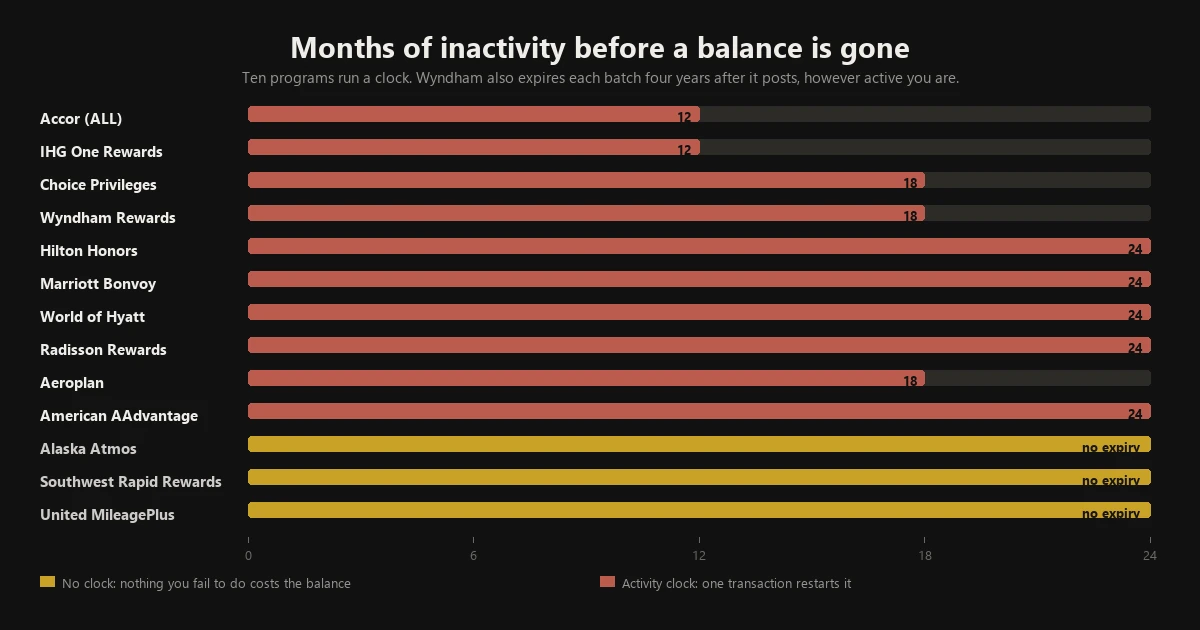
Do points expire? In ten of the thirteen programs on this page, yes: leave a balance alone long enough and it is deleted, on a window that runs from twelve months to twenty-four. In the other three it does not. But the question that decides whether you actually lose a balance is not whether a clock exists. It is which clock you are on, what stops it, and whether your account is one of the ones the program has exempted.
The windows do not track value. Two of the three tightest belong to hotel programs — Accor and IHG’s entry tier, both twelve months — while the loosest run to twenty-four months at Hilton, Marriott, Hyatt, Radisson and American. Nor do they track generosity. A program can offer a long window with no way out of it, or a short window you switch off permanently with a status tier that takes five nights to earn.
This page is the index for all of it: every window, every program’s private definition of “activity”, every exemption, and the one deadline on the page that arrives on 30 November 2026.

Every window, in one table
Sorted from tightest to loosest inside each group, because that is how the risk reads: the programs at the top of each block are the ones that will take a balance off you first. New programs get inserted in the same position rather than appended at the end, so the order stays a ranking and not a history.
| Program | Clock | Window | What resets it | Who is exempt |
|---|---|---|---|---|
| Accor (ALL) | Rolling validity | 12 months from the last qualifying earn | A stay, a dining bill or a partner earn. A redemption does not extend it. | ALL Signature subscribers, through the monthly credit |
| IHG One Rewards | Inactivity | 12 months | One earn or one redemption | Silver and above, while the tier is held |
| Choice Privileges | Inactivity | 18 months | One earn or one redemption | Gold and above, while the tier is held |
| Wyndham Rewards | Batch expiry plus inactivity | 4 years from posting, or 18 months idle | Any earn, redeem or transfer that changes the balance | Earner Premier primary cardholder |
| Hilton Honors | Inactivity | 24 months | A stay, an earn, a points purchase or a donation | None |
| Marriott Bonvoy | Inactivity | 24 months | Any qualifying earn or redemption | Lifetime Elite members, currently |
| World of Hyatt | Inactivity | 24 months | Any earn or redemption | None, Globalist included |
| Radisson Rewards | Inactivity | 24 months | Qualifying points activity. A transfer is not one. | None |
| Air Canada Aeroplan | Inactivity | 18 months, enforced from 30 November 2026 | Any earn, redemption, transfer or donation | Elite 25K and above, and primary co-brand cardholders |
| American AAdvantage | Inactivity | 24 months | One qualifying transaction, with no minimum | Members under 21, and primary co-brand cardholders |
| Alaska Atmos Rewards | None | No expiry since April 2023 | Nothing to reset | All members |
| Southwest Rapid Rewards | None | No expiry | Nothing to reset | All members, though closing the account forfeits the balance |
| United MileagePlus | None | No expiry since August 2019 | Nothing to reset | All members |
Two things in that table are not visible from the columns. The first is that the window is the least useful number in it: what decides most outcomes is the exemption, and a twenty-four month clock you cannot escape is harder to survive than a twelve-month clock that stops running the moment you hold Silver. The second is Wyndham, the only program here that can take points from a member who is doing everything right.
Three clocks, and one is not a clock at all
Ten of these programs run an activity clock. Nothing happens until you stop transacting; once you do, a countdown starts and a single qualifying transaction resets it to full. This is the model people have in mind when they ask whether points expire, and it is the easiest to manage, because the rule is the same everywhere: one transaction every window.
One program runs a batch clock. Wyndham attaches an expiry date to each batch of points at the moment it posts, and that batch dies four years later regardless of how much activity the account has seen since. The member who stays every month and the member who has not logged in since 2024 are on the same four-year fuse for that batch. Wyndham also runs the inactivity clock on top of it, so a balance can be lost either way: eighteen months of silence forfeits everything, and four years of loyalty forfeits the oldest points anyway.
Three programs run no clock at all: Alaska, Southwest and United. Nothing you fail to do costs you the balance. What can still cost you the balance is covered further down.
Do hotel points expire? All eight here do
No hotel program in this table has removed the clock. If you have read that hotel points never expire, you have read about an exemption — a status tier or a co-brand card that suspends expiry for as long as you hold it — and not about a program with no deadline. The distinction matters, because an exemption can be lost, and the balance goes with it.
At twelve months, the two tightest clocks belong to Accor and to IHG’s entry tier. Accor is the unusual one: it is a rolling validity date rather than a dormancy rule. Every qualifying earn extends the entire balance by twelve months from the date of that activity, and the earn has to be an earn — a stay, a dining bill charged to the room, a partner credit. Redeeming does not extend anything, and neither does donating. That produces a counter-intuitive result: the member who finally spends their Accor points at month eleven is the one whose remaining balance still dies at month twelve. Using points does not buy time. Only earning does.
IHG’s version is a plain dormancy rule with a generous escape hatch. Club members need one earn or one redemption every twelve months, and the annual free night that comes with the co-branded card does not count as either — IHG states that explicitly. Silver status ends the clock permanently, and Silver takes ten qualifying nights.
At eighteen months sit Choice Privileges and the inactivity half of Wyndham. Choice’s clock starts on the first day of the month after your activity posts, not the day you stayed, which gives away a few extra weeks; it stops at midnight Pacific on the last day of the eighteenth month, and it takes the whole balance rather than the oldest points. Elite members have been exempt since the January 2026 refresh. Wyndham’s inactivity rule forfeits everything after roughly eighteen months, but the four-year rule operates whether or not you are active, and only the Earner Premier card stops both.
At twenty-four months sit Hilton, Marriott, Hyatt and Radisson, which is the most common window in the industry and, on its own, the least informative fact about any of them. Hilton lists four actions that keep an account alive — a stay, an earn, a points purchase, a donation — and exempts nobody, at any tier. Marriott exempts Lifetime Elite members and reserves the right to stop doing so. Hyatt exempts nobody, Globalist included, though the account stays open and starts earning again after a forfeiture. Radisson’s forfeiture is discretionary, its reminders are a courtesy it does not promise, and a transfer between accounts is explicitly not qualifying activity.
Do airline miles expire? Three of these five do not
The three largest US programs have all dropped expiry, and they did it at different times for the same reason: a mile that cannot be lost is a mile the member stops thinking about, and a mile the program still controls the price of.
Alaska ended expiry in April 2023, and the rename from Mileage Plan to Atmos Rewards in August 2025 carried the rule forward. What still resets on 1 January is status points, which are a separate balance with a separate fate: redeemable points have no deadline, status progress is wiped annually.
United ended the eighteen-month rule in August 2019. There is no activity requirement at all, and losing Premier status does not touch the balance. Miles can still be forfeited, but through the six situations in the program rules — fraud, account closure and the rest — not through silence. PlusPoints and travel credits each keep their own deadline, which is where most United members actually lose value.
Southwest has never expired points, and the 2027 rewrite keeps it that way. The only stated way to lose a balance is to close the account, at which point the points are terminated rather than expired, and there is no reinstatement process to appeal to.
American kept the clock, and it is the rare case where an expiry has a price list. Twenty-four months without a qualifying transaction forfeits the balance; one transaction of any size resets it, with no minimum number of miles. Members under 21 and primary co-brand cardholders are exempt. Expired miles can be reinstated within twenty-four months of expiry, up to 500,000 miles, for a fee of $60 to $2,000 — which makes AAdvantage the one program here where expiry is a bill rather than a loss.
Aeroplan is the exception that will cost somebody a balance this month. Air Canada suspended expiry during the pandemic and extended the pause repeatedly; it ends on 30 November 2026, and the eighteen-month rule applies from that date. The countdown did not restart on 30 November. Any account whose last qualifying transaction predates roughly 30 May 2025 loses its entire balance on the day the rule comes back, then expiry continues on a rolling daily basis. Elite members and primary holders of the TD, CIBC and American Express Aeroplan cards are exempt. Expired points can be reinstated within six months by flying, by opening a card, by claiming missing credit or by buying the points back.
What counts as activity, where the definitions differ
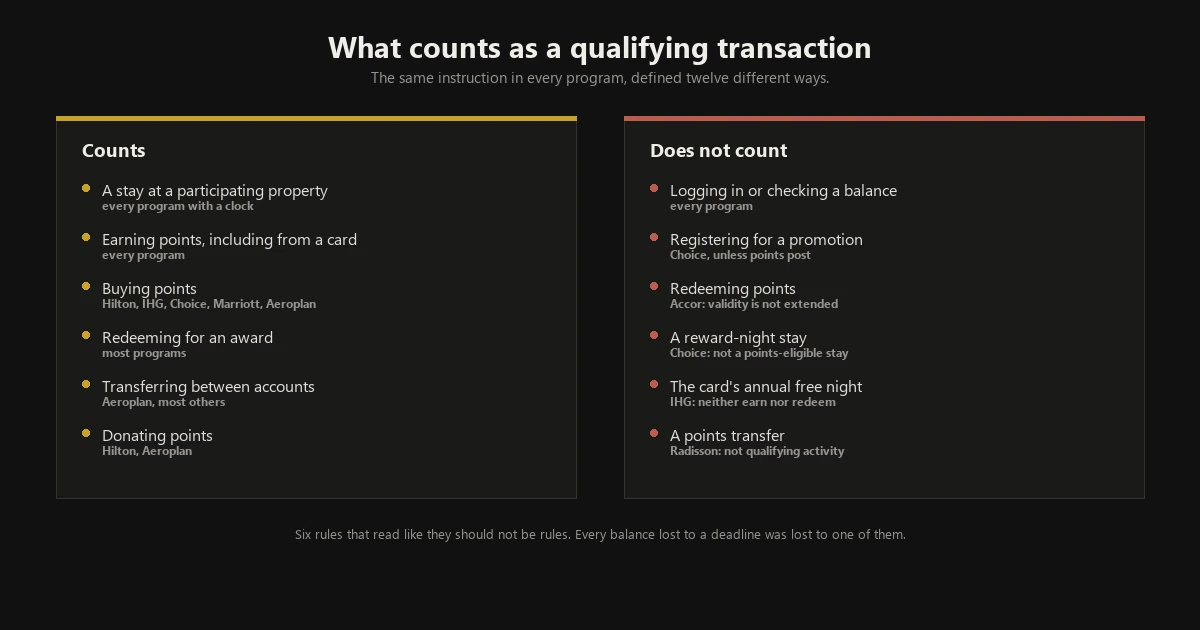
Every program on this page says the same sentence — earn or redeem once inside the window — and then defines both words differently. Six of those differences cost real balances, and five of them punish the member who thinks they have already done enough.
Logging in counts nowhere. Not one of the thirteen programs treats a sign-in, a balance check or an app open as activity. Every one of them wants a transaction. Attention is not activity, and the members who lose balances are usually the ones who were paying attention.
Registering for a promotion counts at Hilton and not at Choice. Hilton lists promotion registration among the four actions that keep an account active. Choice states the opposite in its own rules: registering for a promotion is listed as an example of activity that does not qualify. Where the two ends of the range are that far apart, assume registration does nothing unless points actually post.
A redemption is not always enough. It resets the clock at most programs, but Accor only extends validity on an earn, so spending points there does not buy the remaining balance any time. At Choice, a reward-night stay is not a points-eligible stay, so staying on points does not extend the clock either.
The card’s free night does not count. IHG is explicit: the one night a year that comes with its co-branded card is neither an earn nor a redemption, and it will not stop expiry. Holding the card is not the same as using it.
A transfer counts at Aeroplan and not at Radisson. Aeroplan lists transfers and donations among the qualifying actions. Radisson states that moving points between accounts, including between your own, is not qualifying points activity and does not extend validity.
Donating counts at Hilton and Aeroplan, and not at Accor. Where a program accepts donations as activity, it is often the cheapest reset available: a token donation costs nothing close to the balance it protects.
The exemption is worth more than the window
Sort the same thirteen programs by how hard it is to become permanently exempt and the ranking inverts. The programs with the shortest windows turn out to be the easiest to leave behind, and the two with the longest windows offer no exit at all.
| Program | What qualifies you for exemption | What it takes |
|---|---|---|
| Choice Privileges | Gold or above | 5 nights, or 10,000 Elite Qualifying Credits |
| IHG One Rewards | Silver or above | 10 qualifying nights |
| Aeroplan | Elite 25K, or a primary TD, CIBC or Amex Aeroplan card | A card, including the no-fee tier |
| Wyndham Rewards | Earner Premier primary cardholder | Holding the card, not using it |
| American AAdvantage | Primary co-brand cardholder | While the card account is open |
| Accor (ALL) | Active ALL Signature subscription | The monthly credit resets the clock automatically |
| Marriott Bonvoy | Lifetime Elite | Years of status, not a purchase |
| Hilton Honors | Nobody | No tier and no card changes the rule |
| World of Hyatt | Nobody | Globalist is included in the rule |
| Radisson Rewards | Nobody | Forfeiture stays discretionary |
The practical consequence is that the same balance carries opposite risk in two programs with the same window. A Choice member who reaches Gold never thinks about expiry again; a Hyatt member at Globalist has to make a transaction every two years like everyone else. If you are choosing where to concentrate a balance you will not spend quickly, that asymmetry is worth more than the difference between an eighteen-month and a twenty-four month clock.
The cheapest way to stop each clock
The cheapest reset is almost never a stay. It is the smallest transaction the program accepts, and in several cases that is a points purchase in the minimum increment or a transfer from a bank program you already hold.
| Program | Cheapest qualifying action | What to watch for |
|---|---|---|
| Hilton Honors | Register for a promotion, or buy the minimum | Purchase and donation both count |
| IHG One Rewards | One earn or redemption; the 1,000-point minimum purchase | The card’s free night does nothing |
| Marriott Bonvoy | Any earn or redemption, including a small purchase | No minimum transaction size |
| World of Hyatt | Any earn or redemption | No exemption to fall back on |
| Accor (ALL) | A stay, a dining bill or a partner earn | A redemption does not extend the balance |
| Wyndham Rewards | Any balance-changing activity | Does not stop the four-year rule |
| Radisson Rewards | A purchase or a stay | A transfer is not activity |
| Choice Privileges | The 1,000-point minimum purchase | Registering for a promotion does nothing |
| American AAdvantage | Any transaction, with no minimum | One mile from a shopping portal is enough |
| Aeroplan | A 1,000-point transfer from a bank program | Free, instant, and it must post before 30 November 2026 |
| Alaska, Southwest, United | Nothing | There is no clock to stop |
There is exactly one purchase on that list worth making without hesitation: the minimum increment, where it saves a balance worth many times the price. Paying $12.80 for 1,000 Choice points to protect 40,000 points worth roughly $280 is not a points purchase. It is insurance at three cents on the dollar. The same logic applies at IHG, where the 1,000-point minimum is the smallest lever the program sells: buying IHG points in that increment costs less than a checked bag and resets a twelve-month clock that would otherwise take the whole balance.
What does not work is buying to build a balance. Every program here sells points above what the points redeem for, which is the arithmetic behind our guide to what points purchases actually cost. The purchase only makes sense as protection, and only in the smallest size the program allows.
What a program with no deadline can still take
The three no-expiry programs are not safer. They are slower to show you what happened. A balance can still leave through an account closure, through a dormant account being frozen, through a fraud flag, or through a change to the rules that the program reserves the right to make at any time. Southwest states the position plainly in its own rules: members do not acquire property rights in accrued points. That sentence is the reason none of the three no-expiry programs offers an inheritance mechanism, and the reason a no-expiry promise is a promise about the account being open rather than about the balance keeping its value.
Expiry is the most visible way to lose a balance and, for most members, the least likely. Closure, dormancy, a chargeback, a merged duplicate profile and a rule change remove more points every year than deadlines do — the mechanics are the same ones we set out in the Southwest expiry guide, and they apply whether or not the program runs a clock.
Verdict
Check the exemption before the window. A twelve-month clock that stops running when you hold Silver is safer than a twenty-four month clock with no exit, and the cheapest exemption in this table costs five nights. If you already qualify somewhere, that program is the one to park a balance in.
Balances die from definitions, not from deadlines. Nobody loses points because the window was eighteen months instead of twenty-four. They lose them because they registered for a promotion, stayed on a reward night, transferred points between accounts, or assumed a login counted — and every one of those is a published rule that reads like it should not be.
No expiry is not safety, and it is not generosity either. The three programs that dropped the deadline all price awards off the cash fare or a dynamic chart, where the program controls value directly and does not need a deadline to manage the liability. A deadline is the crudest possible tool for that job; a price is a finer one. Which means the balance you never lose is not the balance you keep. It is the one you spend.
Last updated: 25 November 2026. Windows, definitions of activity and exemptions were checked against each operator’s published terms on 25 November 2026. Air Canada’s expiry pause ends on 30 November 2026 and this page will be revised if the date moves.
Frequently asked questions
Do hotel points ever not expire?
Not in this table. All eight hotel programs run a clock of some kind, from twelve months at Accor and IHG’s Club tier to twenty-four months at Hilton, Marriott, Hyatt and Radisson. What does exist is an exemption: IHG Silver, Choice Gold, a Wyndham or Aeroplan co-branded card, or Marriott Lifetime Elite status. Each one suspends expiry only while you hold it.
Do airline miles expire?
Three of the five airlines here do not expire miles at all: Alaska since April 2023, Southwest with no deadline, and United since August 2019. American keeps a twenty-four month inactivity rule, and Aeroplan restores an eighteen-month rule from 30 November 2026 after a pause that ran through the pandemic.
Does logging into my account keep points alive?
No, at any of the thirteen programs. Every one of them requires a transaction that changes the balance — an earn, a redemption, or in some cases a purchase, transfer or donation. Checking your balance, opening the app and updating your profile all count for nothing.
How long do I have before points expire?
Twelve months at Accor and IHG’s Club tier. Eighteen months at Choice, Aeroplan and the inactivity half of Wyndham. Twenty-four months at Hilton, Marriott, Hyatt, Radisson and American. Wyndham adds a four-year rule that expires each batch of points from its posting date regardless of activity.
Can expired points be restored?
Sometimes, and the programs that allow it are specific about the terms. American reinstates within twenty-four months of expiry for $60 to $2,000, up to 500,000 miles. Choice allows a reinstatement request within 180 days. Aeroplan allows it within six months by flying, opening a co-branded card, claiming missing credit or buying the points back. Hilton, Hyatt, Marriott, Accor and Radisson do not reinstate.
Which program is safest to leave a balance in for years?
One where you already hold the exemption, rather than one with the longest window. Choice at Gold, IHG at Silver, Wyndham with the Earner Premier card and Aeroplan with a co-brand card are all permanently exempt while the qualifying condition lasts. Hilton, Hyatt and Radisson exempt nobody, so a balance there is only as safe as your calendar reminder.
More guides
This page is the index. Each program’s own rule, including the parts that only apply to one of them, is covered in full below.
Hotel programs
- Do Hilton Honors points expire?
- Do Marriott Bonvoy points expire?
- Do IHG One Rewards points expire?
- Do World of Hyatt points expire?
- Do Accor points expire?
- Do Wyndham Rewards points expire?
- Do Radisson Rewards points expire?
- Do Choice Privileges points expire?
Airline programs
- Do Alaska miles expire?
- Do AAdvantage miles expire?
- Do United miles expire?
- Do Aeroplan miles expire?
- Do Southwest Rapid Rewards points expire?
The mechanics underneath
- How loyalty points work — why a currency priced off the cash fare cannot hold its value, deadline or no deadline.
- What buying points actually costs — the arithmetic that makes a minimum purchase insurance and a large one a loss.
Next step: open the three accounts with the largest balances and write down the date of the last transaction in each. Compare that date to the windows above, and where the gap is already past half the window, do one small qualifying transaction today rather than in the month before the deadline — the members who lose balances are almost always the ones who left it to the last statement.