1. Short version
Comparing Delta vs United on status used to require translating two different currencies, because United counted flights and Delta counted dollars. That ends on 1 January 2027, when United removes Premier qualifying flights and joins Delta on a single number. For the first time the two ladders can be laid side by side, and the result is not the one most comparisons reach.
United’s thresholds are exactly 20% higher at Silver, Gold and Platinum: 6,000 PQP against 5,000 MQD, 12,000 against 10,000, 18,000 against 15,000. At the top the gap narrows to 14%, because 1K rises to 32,000 while Diamond stays at 28,000. That 20% is the number everyone quotes, and it is the least important number in the comparison.
The important one is four. United requires four flights on United or United Express in the year, at every tier, and no amount of card spending replaces them. Delta has no segment minimum of any kind. Four card types at $2,000 of annual fees produce Gold on Delta with zero flights; the same ambition on United costs $180,000 of card spending and still requires you to board an aircraft four times. Delta sells status. United rents it, and keeps the keys.
2. Two currencies that now mean the same thing
Delta moved to a single metric first. Medallion status is earned on Medallion Qualification Dollars alone, at $1 of MQD per $1 of ticket price on a Delta-marketed flight, whether Delta or a partner operates it. There is no segment count, no mileage count and no waiver. One dollar of eligible fare is one dollar of qualification, and Delta publishes the thresholds as a single row of four numbers. The tier structure itself, including what each tier carries beyond the alliance, is set out in the Delta status guide.
United spent years offering two routes to every tier: a points figure, or a lower points figure plus a segment count. From 1 January 2027 the segment route disappears. Premier status becomes Premier Qualifying Points only, at roughly $1 of PQP per $1 of eligible fare on United-operated flights, and United’s qualification terms now state the four thresholds without an alternative.
That is why this comparison is worth running now and was not worth running in 2024. Both programmes price status in dollars of airfare. The units have different names, and for United-operated flights they behave identically. Where they stop behaving identically is partner airlines, which section nine works through, and it is the part of this comparison that changes the answer.
One timing note before the numbers. The figures below pair Delta’s published thresholds for the 2026 calendar year, which set 2027 Medallion status, with United’s thresholds for the 2027 calendar year, which set 2028 Premier status. The two are one year apart in name and identical in construction. Delta has not moved its four numbers since the programme was simplified, so the comparison holds whichever pair of years you pick.
3. The thresholds, side by side
Every row below is a published threshold, not an estimate. The right-hand column is the part that decides behaviour rather than arithmetic.
| Delta SkyMiles | United MileagePlus | |
|---|---|---|
| Qualification currency | MQD | PQP |
| Second tier | Silver, 5,000 MQD | Silver, 6,000 PQP |
| Third tier | Gold, 10,000 MQD | Gold, 12,000 PQP |
| Fourth tier | Platinum, 15,000 MQD | Platinum, 18,000 PQP |
| Top tier | Diamond, 28,000 MQD | 1K, 32,000 PQP |
| Minimum flights | None | Four on United or United Express |
| Card-only route to Gold | Yes, $2,000 of annual fees | No, flights still required |
| Own lounge, domestic | Status never qualifies | Status never qualifies |
| Own lounge, international economy | No, premium cabin required | Yes |
| Partner lounge, domestic | No | Yes, at selected airports |
Read the bottom four rows before the top five. A tier table tells you what a status costs. Only the access rows tell you what it does, and on three of the four access questions the answer for both programmes is “no”, which is the finding that resets most people’s assumptions.
4. Why the gap is exactly twenty percent
Silver to Platinum, United is 20% more expensive than Delta at every step. 6,000 against 5,000. 12,000 against 10,000. 18,000 against 15,000. Three tiers, one ratio, no rounding. A constant multiplier across a published table is not a coincidence; it is one programme’s numbers expressed in the other’s scale.
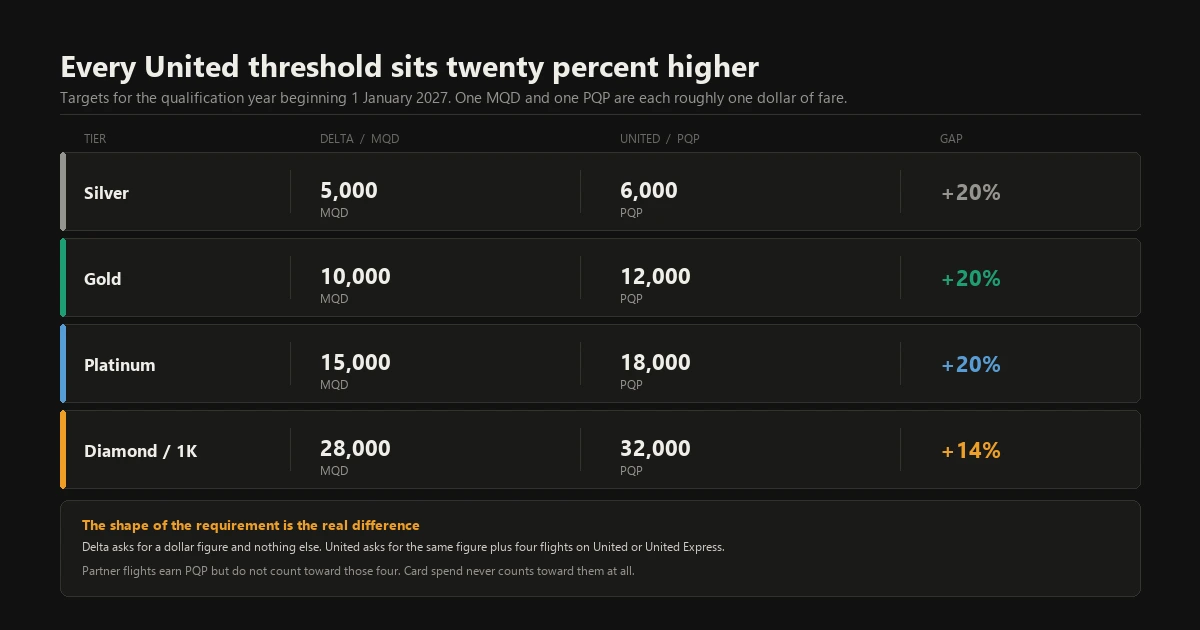
The top tier breaks the pattern, and the break is the interesting part. Diamond stays at 28,000 while 1K rises to 32,000, which is 14% rather than 20%. United raised 1K from 28,000 for 2027 specifically, so the top tier moved twice: once to match Delta’s number, then again on top of it. If you are chasing the top tier, United is the more expensive programme by a smaller margin than at Gold, and it is the only tier where the gap is closing rather than fixed.
What the 20% buys is not obvious from the table, because on United-operated flights both currencies accrue at the same rate. A $500 United ticket earns roughly 500 PQP. A $500 Delta ticket earns roughly 500 MQD. The 20% is therefore a pure premium on the finish line, not a discount on the journey, and it is charged to everyone regardless of how they fly. Only the card and partner rules change who pays it in full.
5. The gate United will not waive
Four flights. United requires at least four flights operated by United or United Express in the qualification year, at every tier up to and including 1K, and partner flights do not count toward the four even though they earn PQP. Delta has no equivalent rule. Its qualification page lists one requirement and one only, and that requirement is a dollar amount.
The practical consequence is stark, and it is the reason the two programmes are not really the same product. On Delta, a cardholder can reach Gold without boarding an aircraft: Platinum, Platinum Business, Reserve and Reserve Business each deposit $2,500 of MQD Headstart, the programme allows four deposits, and $10,000 is the Gold threshold. On United, the same ambition runs into a wall that spending cannot climb. A Club card earns 1 PQP per $15 with a 32,000 PQP annual cap, which is enough to clear 1K on paper at $480,000 of spending. Without four flights, it produces nothing at all.
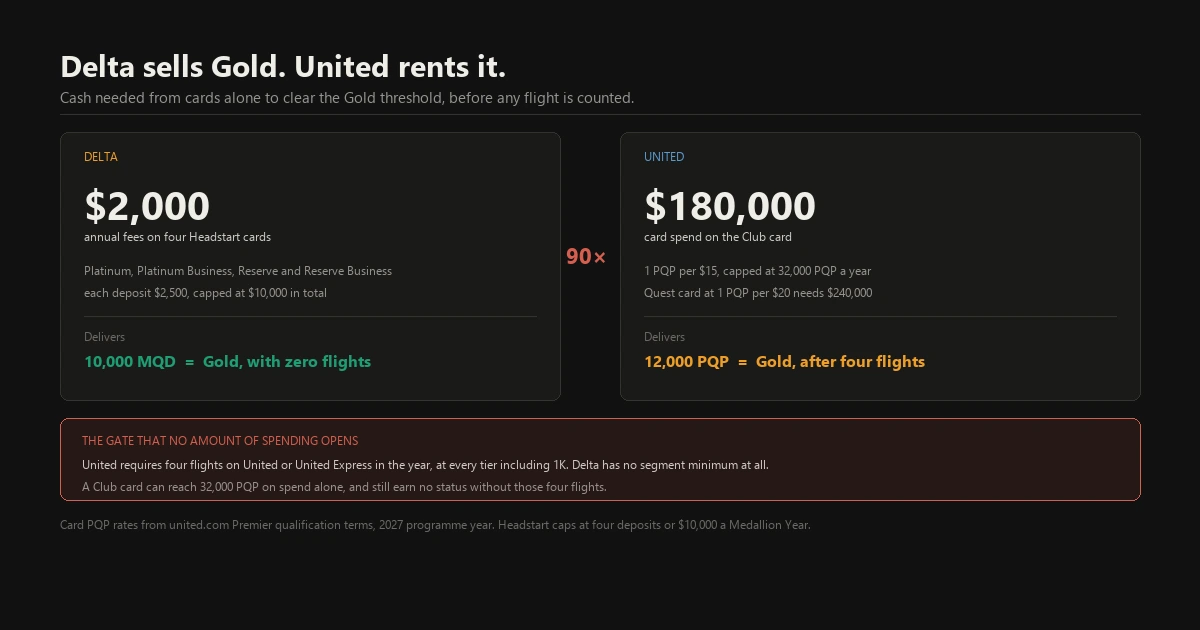
Put the two numbers next to each other and the ratio is 90 to one, for the same tier, in the same year, in programmes that now use the same metric. The comparison is not quite fair to United, because the Delta route requires four separate card accounts and $2,000 of fees that never come back. But the direction is unambiguous: at the entry point, Delta prices status and United prices a lottery ticket that still needs four flights to cash.
Cheapest legal way to satisfy the four flights, for anyone determined to buy their way in: two round trips, four segments, on the shortest United or United Express routes you can find. At roughly $99 a segment that is about $400, which turns $180,000 into $180,400. The money is not the obstacle. The four boarding passes are the point, and they exist to make sure status still means you fly.
6. What each tier actually unlocks
Both programmes use four tiers and both map onto an alliance at the second tier. The mapping is where the two statuses stop being equivalent, and it is not the mapping most people assume. For the alliance structure itself, and how SkyTeam and Star Alliance compare outside these two programmes, see the alliance comparison.
| Tier | Delta alliance status | United alliance status |
|---|---|---|
| Silver | SkyTeam Elite | Star Alliance Silver |
| Gold | SkyTeam Elite Plus | Star Alliance Gold |
| Platinum | SkyTeam Elite Plus | Star Alliance Gold |
| Top tier | SkyTeam Elite Plus | Star Alliance Gold |
Gold is the tier where both programmes hand over the alliance’s top status, and it happens at Gold rather than Platinum on both sides. Anyone who tells you Delta needs Platinum for Elite Plus is working from a table that predates the current structure. On paper, then, 10,000 MQD of Delta status and 12,000 PQP of United status buy the same alliance position: the top tier, one guest, business-class lounge access at partner airports worldwide.
On paper is where it ends. The alliance tier is identical and the access it produces is not, because each airline writes its own rules for its own lounges and both have written rules that exclude their own elites. That is the next section, and it is where a 20% price difference turns into a difference in kind.
7. The lounge test nobody runs
Run three tests against both statuses and the pattern that emerges is not the one either programme advertises. The tests are: can the status enter the airline’s own lounge on a domestic flight, on an international flight in economy, and can it enter somebody else’s lounge on a domestic flight.
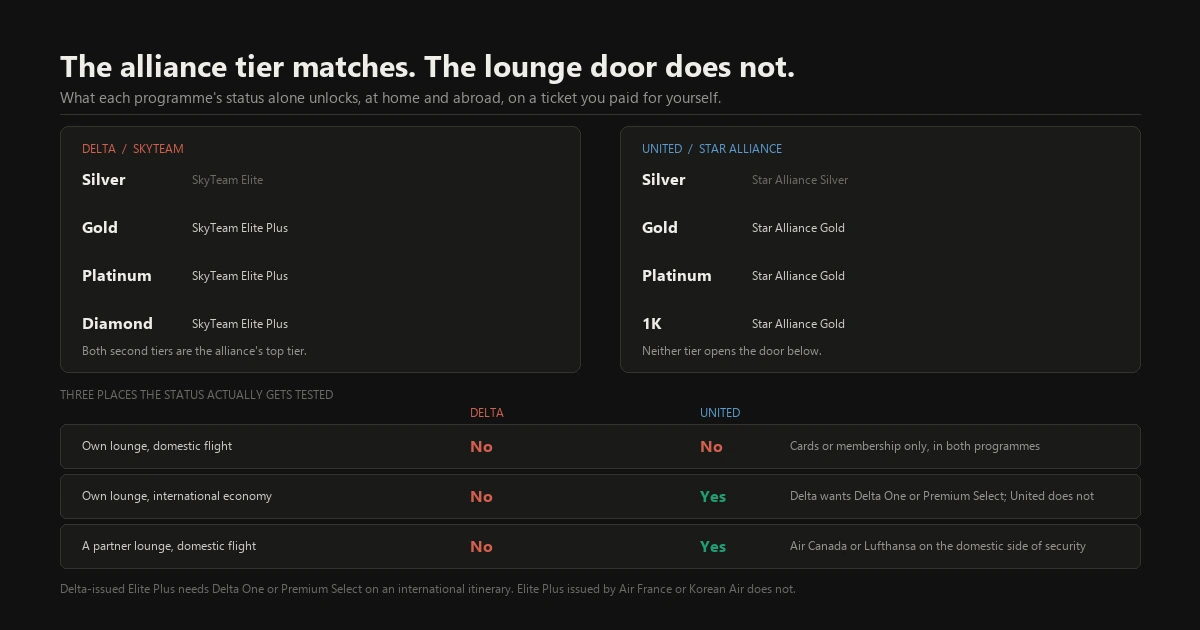
Domestic, own lounge: both fail. Delta Sky Club access for SkyTeam Elite Plus is restricted to same-day international itineraries, and Delta-issued Elite Plus needs Delta One or Premium Select on top of that, which every route in the Sky Club access guide runs through in order. A Gold Medallion flying Atlanta to Denver enters nothing. United is blunter: Star Alliance Gold customers may access United Clubs within the US only when departing on an international Star Alliance flight, and United states the carve-out explicitly. A Premier Gold flying Chicago to Newark enters nothing either.
International, own lounge in economy: Delta fails, United passes. This is the row that surprises people, because Delta’s ladder is cheaper and its status is worth less at exactly the moment it should be worth most. A SkyTeam Elite Plus member whose status came from Delta needs Delta One or Premium Select to enter a Sky Club on an international trip. The same Elite Plus tier earned through Air France or Korean Air enters from economy. United imposes no cabin condition on Star Alliance Gold at its own clubs: an international itinerary and a same-day boarding pass are enough. Delta’s status is therefore cabin-conditional in a way United’s is not, and no amount of extra MQD changes it.
Partner lounge, domestic flight: Delta fails, United passes. Star Alliance’s Gold policy covers any Star Alliance-operated flight that day, domestic included, and United’s restriction applies only to United’s own clubs. The practical result is that Premier Gold can use a Lufthansa lounge at Dulles or Detroit, or an Air Canada Maple Leaf lounge at Los Angeles or San Francisco, on a domestic United ticket, wherever the lounge sits on the same side of security as the gate. SkyTeam’s April 2025 expansion of domestic Elite Plus access excluded Delta’s own network, and there is no equivalent back door on the Delta side.
So the honest summary of the lounge question is this: both programmes withhold their own lounges from their own elites on domestic flights, which makes the co-branded card the only reliable domestic route in either programme. Above that, United’s status does more with less. Delta’s status is cheaper to earn and narrower to use.
8. Buying the gap with a card
Cards are where the two programmes diverge most, because Delta lets a card produce status outright and United lets a card only shorten the distance to it.
Delta. MQD Headstart pays $2,500 per eligible card type each Medallion Year, deposited six to eight weeks after 1 February if the card is still open. Four card types qualify: Platinum, Platinum Business, Reserve and Reserve Business. Four deposits reach the $10,000 cap, which is Gold. The annual fees are $350, $350, $650 and $650, so $2,000 buys the tier. MQD Boost then runs on top at $1 per $20 on the Platinum cards and $1 per $10 on the Reserve cards, which means Reserve spending converts at 10% of face value toward status. The whole structure is documented on Delta’s business card page as well as the personal ones.
United. Card spending earns PQP at 1 per $15 on the Club and Club Business cards, 1 per $20 on the Quest and Explorer, with annual caps of 32,000, 18,000 and 1,000 respectively from the 2027 programme year. United also deposits starter PQP worth 5% of your tier’s threshold if you hold an eligible card by 31 December and already hold status, which is 300 at Silver, 600 at Gold, 900 at Platinum and 1,600 at 1K. That deposit is worth having and is much smaller than Delta’s Headstart, because it is priced off a percentage rather than a flat amount.
Note what the two cap structures imply. Delta’s Headstart is capped by card count, so the ceiling is $10,000 and it is reachable with four cards. United’s caps are per card and scale with the tier being chased, so the ceiling moves with your ambition and the spending required scales with it. A Club cardholder chasing 1K needs $480,000 of spending and four flights. A Quest cardholder chasing Gold needs $240,000 of spending and four flights. Neither number is a typo, and both explain why United’s card programme is a supplement to flying rather than a substitute for it.
9. Partner flights: where 20% becomes 60%
This is the section that changes the answer, and it is the part of the comparison almost nobody runs. On flights the airline operates and sells, both programmes accrue at roughly one point per dollar. On partner flights the two diverge completely, because they measure different things: Delta measures the fare, United measures the miles.
Delta awards $1 of MQD per $1 of ticket price on a Delta-marketed flight, including flights operated by partner airlines. There is no per-segment cap on that. Buy a $4,000 transatlantic business-class round trip through Delta on a partner carrier and you receive 4,000 MQD, which is 40% of the Gold threshold in one trip.
United awards PQP on partner flights at one PQP per five award miles on preferred partners, with a cap of 750 PQP per segment in economy and premium economy and 1,500 in business and first. The cap, not the rate, is what matters. A transatlantic business-class round trip has two segments. Two segments at the 1,500 cap is 3,000 PQP however expensive the ticket was, so the same $4,000 fare credits 3,000 PQP against a 12,000 threshold rather than 4,000 against 10,000.
Run that through to the finish line and the 20% gap becomes something else. At $4,000 a trip, Delta reaches Gold in two and a half trips, or $10,000 of fare. United reaches Gold in four trips, or $16,000 of fare, because the cap throttles the earning on every one of them. That is a 60% premium on the same flying, not 20%, and it applies to exactly the traveller both programmes most want: the one buying long-haul premium cabins on partner metal.
The mechanism cuts the other way for anyone whose partner flying accumulates at a low rate. Below the cap the earning is proportional to miles credited, so a discounted partner fare in economy earns very little regardless of what it cost. Delta’s fare-based method is indifferent to cabin and indifferent to distance; United’s is sensitive to both and capped at the top. If your flying is long-haul premium on partners, Delta’s method is worth materially more. If your flying is short-haul partner economy, neither method is generous and the four-flight minimum decides more than the rate does.
10. Where Delta is cheaper than the table says
Three Delta routes to MQD have no United equivalent, and each one lowers the effective price of Delta status below the 20% headline.
Delta Vacations. MQD accrues at $1 per $1 on the package value, apportioned between the lead booker and the rest of the itinerary. A vacation package that includes a flight therefore produces MQD on the hotel and car components as well, which is spending you were going to make anyway. United has no equivalent; its package product does not feed PQP.
Headstart timing. Delta deposits $2,500 within six to eight weeks of 1 February, and a new cardholder receives it six to eight weeks after card issue. That means a card opened in November produces MQD inside the same calendar year, before the qualification year closes. United’s starter PQP is tied to status already held and a card open by 31 December, so it cannot be manufactured in December by opening a card.
No flight minimum. This is the largest of the three and it is not really a discount, it is an eligibility rule. Delta’s status is available to someone who does not fly. United’s is not available to anyone who does not fly, at any price. For the traveller whose flying is concentrated in a few expensive long-haul trips rather than spread across many segments, the difference between “must fly four times” and “must spend the right amount” is worth more than 20% of a threshold.
11. The one place United is genuinely better
United’s status does something Delta’s does not, and it is not the threshold table or the card programme. It is the partner lounge, on a domestic ticket, described in section seven. A Premier Gold flying a domestic United leg can enter a Lufthansa or Air Canada lounge where one sits on the domestic side of security. A Delta Gold Medallion flying a domestic Delta leg cannot enter anything, and neither can a Delta Platinum or Diamond, because SkyTeam’s domestic expansion excluded Delta’s own network.
That is a real, usable, repeatable benefit and it costs nothing extra. It is also narrow: it depends on the airport, on which side of security the lounge sits, and on whether the lounge is open when you are there. At Chicago O’Hare the Swiss and SAS lounges are behind international security and therefore unreachable on a domestic ticket; at Dulles the Lufthansa and Turkish lounges are not. It is a benefit that rewards people who know their hub, and it is the strongest argument for United status among travellers who already hold the higher tier.
Everything else on the United side is either equal to Delta or more expensive. The thresholds are higher, the card route is capped and gated, the partner earning is capped per segment, and the top tier moved up twice in one year. If you want one sentence: United’s status costs more and does slightly more at the airport; Delta’s status costs less and does slightly less.
12. When to start, and what resets
Both programmes run on the calendar year and both reset on 1 January, so the timing question is the same and the answers differ at the margin.
| Delta | United | |
|---|---|---|
| Qualification year | 1 January to 31 December | 1 January to 31 December |
| Status validity | Day earned to 31 January of the following year | Day earned to end of the next programme year |
| Headstart or starter deposit | 6 to 8 weeks after 1 February | 5% of tier threshold, card open by 31 December |
| Card spending counted | Calendar year, via Boost | Calendar year, via PQP |
| Carryover | None | None |
Two practical notes. First, Delta’s Headstart lands in February and March, so a January qualification run that depends on it will look short until the deposit posts. Second, United’s starter PQP is priced off the status you hold on 1 February, so a tier earned late in December produces a deposit sized to last year’s tier rather than this year’s. Neither rule changes a total, and both change what your account looks like in the first quarter, which is when most people panic.
For anyone switching programmes, the asymmetry is worth knowing: Delta’s status match programme caps you at the tier you matched into, so a match to Gold cannot be upgraded to Platinum through the challenge. United’s equivalent has historically allowed the same restriction. Matching is a way to skip a year, not a way to jump a tier.
13. Which ladder to climb
The answer depends on one question: do you fly enough that the four-flight gate is irrelevant.
If you fly United or Delta more than a dozen times a year, the gate costs you nothing and the comparison reduces to the thresholds and the partner rules. If your long-haul flying is on Star Alliance partners in premium cabins, Delta’s fare-based MQD is worth up to 60% more per dollar of fare and the lower thresholds compound it. If your long-haul flying is on United metal, the two programmes are close enough that the lounge back door should decide it, and that points to United. American is the third case and it breaks the pattern: what American sells instead turns on a tier that neither Delta nor United can reach.
If you fly a handful of times and want the perks, Delta is the only one of the two that will sell you the tier. $2,000 of annual fees across four Headstart cards produces Gold, which carries SkyTeam Elite Plus, free checked bags, priority boarding and a shot at upgrades. United will not produce Gold for any amount of money without four flights, so the honest comparison at this end of the market is Delta versus “no status” rather than Delta versus United.
If what you actually want is lounge access, neither status delivers it domestically and both cards do. Delta Reserve at $650 carries 15 Sky Club visits a Medallion Year; United Club at $695 carries unlimited United Club access and two guests. On a per-visit basis Delta’s card is better value if you fly fewer than 15 times, and United’s is better if you fly more. That decision has nothing to do with status, which is the point: in the United States, the lounge is a card product and the status is a boarding product.
Where that leaves the 20%: it is real, it is charged every year, and it is smaller than the effect of the four-flight gate, the partner cap and the cabin condition on Delta’s own lounges. Anyone choosing between these two programmes on the threshold table alone is optimising the one variable both airlines have already agreed on.
Last updated 26 November 2026. Thresholds, card earning rates and lounge rules verified against delta.com and united.com on that date. United’s PQP-only structure takes effect for the 2027 qualification year; 2026 activity still follows the old rules.
14. Frequently asked questions
Is Delta or United status easier to earn?
Delta, on every measure. Its thresholds are 20% lower at Silver, Gold and Platinum, it has no minimum flight requirement, and four card types produce Gold with no flying at all. United requires four flights on United or United Express at every tier, and no amount of card spending replaces them.
Does United still require Premier qualifying flights?
Not from 1 January 2027. Premier qualifying flights stop counting for the 2027 qualification year, and status is earned on Premier qualifying points alone at 6,000 for Silver, 12,000 for Gold, 18,000 for Platinum and 32,000 for 1K. The four-flight minimum is separate and remains.
Can I reach Delta Gold with credit cards only?
Yes. MQD Headstart pays $2,500 per eligible card type each Medallion Year, and Platinum, Platinum Business, Reserve and Reserve Business all qualify. Four deposits reach the $10,000 cap, which is the Gold threshold, for $2,000 of annual fees and no flights.
Can I reach United Gold with credit cards only?
No. Card spending earns PQP, at 1 per $15 on the Club cards and 1 per $20 on the Quest, but United requires at least four flights on United or United Express in the year to qualify for any tier. A Club card can reach 32,000 PQP on spending alone and still produce no status without those flights.
Is SkyTeam Elite Plus the same as Star Alliance Gold?
As a tier, yes, and both arrive at the second status level in their programme. As access, no. Delta-issued SkyTeam Elite Plus needs Delta One or Premium Select to enter a Sky Club on an international trip, while Star Alliance Gold enters a United Club on an international itinerary in any cabin.
Can Delta Gold or United Gold get into a lounge on a domestic flight?
Not their own airline’s lounge. Delta restricts Sky Club access for SkyTeam Elite Plus to international itineraries, and United restricts Star Alliance Gold access to its own clubs to international itineraries. United Gold can use selected partner lounges on a domestic ticket, such as Lufthansa at Dulles or Air Canada at Los Angeles; Delta Gold has no equivalent route.
Sources
Delta Medallion thresholds, MQD earning and Headstart terms: delta.com. Delta Sky Club access rules for SkyTeam Elite Plus: delta.com. Delta business card annual fees: delta.com. United Premier qualification, PQP earning and the four-flight minimum: united.com. United lounge access rules including the Star Alliance Gold carve-out: united.com. United 2027 programme changes: united.com.