Flying Blue elite status runs on XP, not Miles, and the two numbers that decide it are quoted wrongly almost everywhere. The thresholds read 100, 180 and 300 XP, and most guides present them as a total to aim at. They are not totals. They are step costs. Flying Blue takes each threshold out of your counter the moment you cross it, then starts a new twelve-month period with whatever is left. Silver costs 100 XP, Gold costs another 180 on top of that, and Platinum another 300 on top of Gold. From a standing start, Platinum is 580 XP, not 300, and the difference is three long-haul business returns.
The second thing worth knowing is that XP cannot be bought the way Miles can. There is no XP sale, no transfer partner and no shopping portal. XP come from flying, from sustainable aviation fuel bought against a booking, and from a co-branded card that hands out a small allowance at renewal. A reward ticket earns none at all, which means the frequent flyer who books everything with Miles never moves up a level however often they fly.
Short version: Silver arrives at 100 XP and buys a bag, priority boarding and free standard seats. Gold is 180 XP further and is the tier that changes a trip, because it adds lounge access for two and SkyPriority across the airport. Platinum is 300 XP beyond Gold and matters most to anyone spending Miles, since it removes award change and cancellation fees, including on the Light awards that cannot otherwise be touched, and it unlocks La Premère. Ultimate is 900 UXP earned only on Air France or KLM flight numbers, and it is a different kind of proposition: four upgrade vouchers a year. In 2026 Flying Blue also added Choice Benefits at 450, 600 and 750 XP, which are the first thing to pay out in the empty stretch between Platinum and Ultimate.
XP and Miles do different jobs
The confusion is understandable, because both live on the same account page and both are described as points. They are not interchangeable. Miles are the currency; XP are the attendance record. You spend Miles on seats and you accumulate XP towards a level, and neither converts into the other at any rate.
| Miles | XP | |
|---|---|---|
| What it is | The reward currency | The status counter |
| How you get it | Flights, hotels, cars, shopping, transfers from banks, direct purchase | Eligible flights, sustainable aviation fuel, some card allowances |
| Can you buy it | Yes, from around 3.05 US cents each | Only indirectly, through fuel or a card |
| What it does | Buys award seats and upgrades | Moves you up a level, then gets spent doing it |
| Does it expire | Yes, after 24 months of inactivity | Yes, at the end of each qualification period |
| Earned on a reward ticket | No | No |
The last row is the one people miss. Flying Blue reward tickets earn neither Miles nor XP, so a member who flies four transatlantic business awards a year is, for status purposes, a member who did not fly. Anyone chasing a level has to pay cash for the flights that count. If the Miles themselves are the problem, the cost of buying them is a separate calculation from anything on this page.
The ladder, priced correctly
Flying Blue states the mechanic plainly in its own terms: once you gain enough XP to level up, you are upgraded immediately and the XP that brought you to that level are deducted from your counter. The same document defines a qualification period as twelve months or the moment the member gained enough XP for the next level, whichever occurs first, and confirms that a new period starts as soon as you level up.
Read those two sentences together and the ladder stops being a list of totals. Each level has a price, you pay it, and the receipt is a fresh twelve-month window in which to save for the next one. A new member who earns 300 XP in a single year does not become Platinum. They become Gold, with 20 XP banked towards a level that now costs another 300.
| Level | Step cost | Cumulative from zero | Clock |
|---|---|---|---|
| Explorer | – | 0 XP | Counter resets to zero if you do not level up |
| Silver | 100 XP | 100 XP | New 12 months from the day you qualify |
| Gold | +180 XP | 280 XP | New 12 months from the day you qualify |
| Platinum | +300 XP | 580 XP | New 12 months from the day you qualify |
| Ultimate | +900 UXP | 900 UXP on top of Platinum | UXP only, Air France and KLM flight numbers |
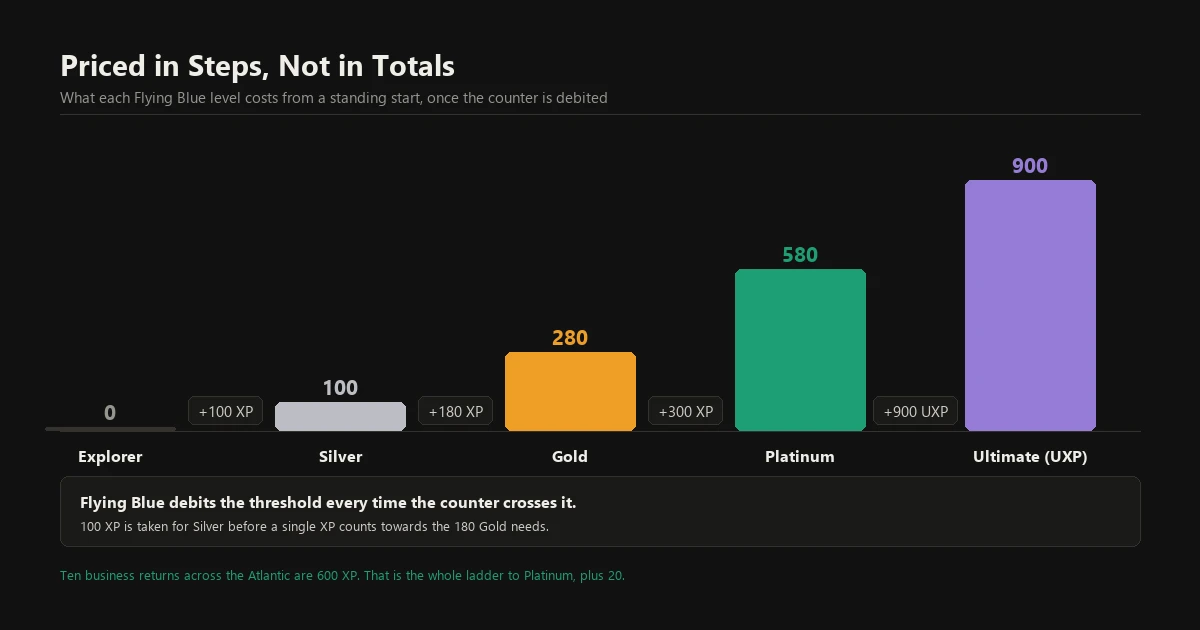
Two consequences follow, and they point in opposite directions. The bad news is that Platinum is nearly twice as expensive as the number everyone quotes. The good news is that every level-up hands you a fresh year, so the 580 does not have to be earned inside a single twelve-month window. A member who reaches Gold in March starts a new clock in March and has until the following March for the 300 that Platinum needs.
The step structure also explains a pattern that looks like bad luck. Members report sitting on 290 XP with a month to run, certain that Platinum is ten points away. It is not. From Gold, Platinum is 300 XP, and 290 means twenty short of Gold renewal, not ten short of Platinum. The counter tells you what you have spent, not what you have earned.
What each level actually gives
The benefits ladder is gentler than the XP ladder, and the surprise is in the baggage column: every elite tier from Silver upwards includes exactly one free extra checked bag on SkyTeam flights. Nobody gets two. What separates the tiers is the lounge, the timing of seat selection, and the treatment of award tickets.
| Silver | Gold | Platinum | Ultimate | |
|---|---|---|---|---|
| Miles per euro spent | 6 | 7 | 8 | 9 |
| SkyTeam tier | Elite | Elite Plus | Elite Plus | Elite Plus |
| Extra checked bag | 1 | 1 | 1 | Extra allowance on Air France and KLM |
| Lounge | No | You and one guest | You and one guest | You and up to eight guests |
| SkyPriority | No | Yes | Yes | You and up to eight companions |
| Seat selection | Standard seats free, some options 24h before | Options free 72h before | All seat options free | All seat options free |
| Award changes and refunds | Fee applies | Fee applies | Free | Free |
| La Premère awards | No | No | Yes | Yes |
| Extras | – | – | Platinum Service Line | Four upgrade vouchers a year, a Platinum card to give away |
Gold is the tier that changes a trip rather than a booking. Lounge access for two at any SkyTeam lounge, SkyPriority through security and boarding, and seat options three days out covers the parts of the airport that cost money or patience. Silver is thinner than it looks: priority check-in and a bag are worth having on a busy Friday, but six Miles per euro against four for an Explorer is a modest rebate.
Platinum is the tier that matters if you spend Miles rather than cash, and the reason is the row that reads free. Award changes and cancellations cost a fee for everyone else. Platinum and Ultimate members do not pay it, and that applies to the cheapest award on the shelf: a Light business award, which is otherwise locked, can be changed at no charge by a Platinum member. Since 8 September 2026 that is worth more than it was, because the fare brand you book now decides what the ticket can do. Platinum also unlocks La Premère, which no other tier can book with Miles, and adds a service line that answers. Those first class seats are priced in Miles rather than cash, so what a Mile costs to buy matters more to a Platinum member than to anyone else.
Ultimate is a different animal. Four one-cabin upgrade vouchers per membership year, lounge access for eight, a Platinum card you can hand to someone else, and nine Miles per euro. It is the only tier where the extras are worth more than the fare difference, and it is also the only tier with a separate currency.
How a flight turns into XP
XP come from two inputs: how far the segment is, and where you sit. Every one-way segment is scored separately, so a connection earns more than a direct flight of the same total distance. The table is fixed and published, which makes the arithmetic easy to run before you book.
| Segment | Economy | Premium | Business | First |
|---|---|---|---|---|
| Domestic, within one country | 2 | 4 | 6 | 10 |
| Medium, under 2,000 miles | 5 | 10 | 15 | 25 |
| Long 1, 2,000 to 3,500 miles | 8 | 16 | 24 | 40 |
| Long 2, 3,500 to 5,000 miles | 10 | 20 | 30 | 50 |
| Long 3, over 5,000 miles | 12 | 24 | 36 | 60 |
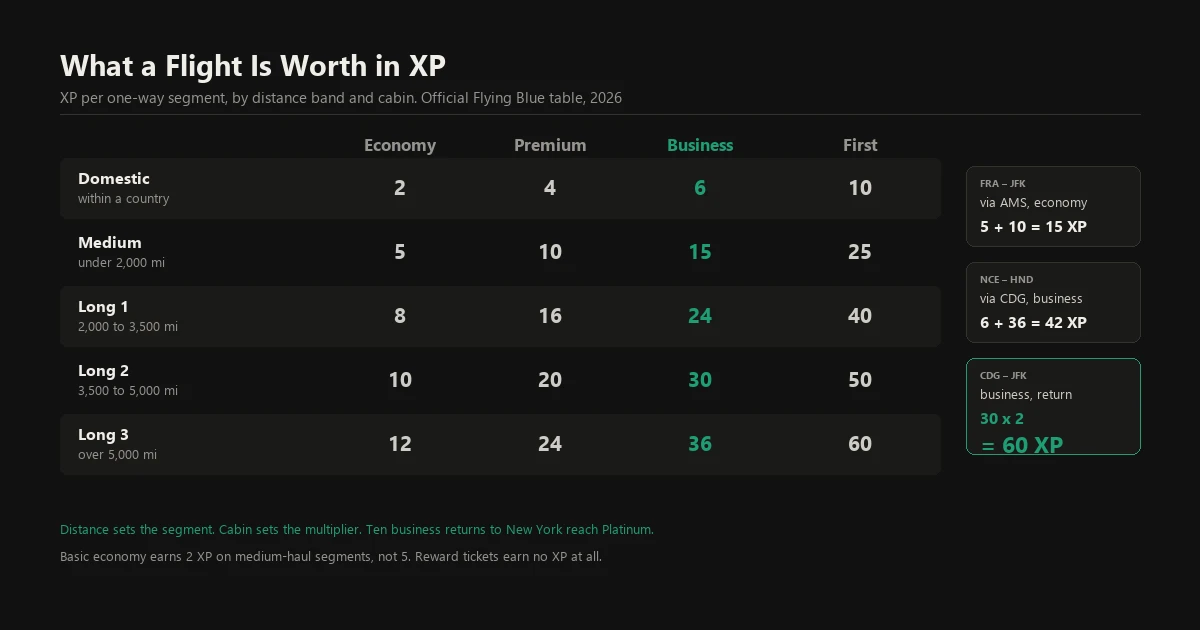
Two worked examples make the scale clear. Frankfurt to New York via Amsterdam in economy is 5 XP for the short hop plus 10 XP for the long one, so 15 XP. Nice to Tokyo via Paris in business is 6 XP for the domestic leg plus 36 XP for the long one, so 42 XP. The connecting itinerary earns more than a direct flight would, which is why people planning a run deliberately route through a hub.
Paris to New York is 3,630 miles, which lands in the Long 2 band: 30 XP each way in business, 60 XP for the return. That single number makes the whole ladder legible. Two business returns across the Atlantic are 120 XP, enough for Silver with 20 to spare. Five returns are 300 XP, which pays for Silver and Gold and leaves 20 banked. Ten returns are 600 XP, which pays for all three levels and leaves 20 towards whatever comes next. An economy return on the same route is 20 XP, so the same ten trips in the back of the plane would not reach Gold.
The cabin multiplier is the lever, and premium economy is the weakest version of it. It doubles the economy figure while business triples it and first multiplies it by five. On a Long 3 segment, premium economy pays 24 XP and business 36. If the purpose of the trip is XP rather than comfort, the upgrade from premium to business buys 50% more status progress than the upgrade from economy to premium.
The clock, the rollover and the drop
The qualification period starts when you earn your first Mile or your first XP, runs to the end of the twelfth month, and restarts the moment you level up. That means the calendar is personal. Two members chasing the same tier in the same year can have windows three months apart, and XP earned after one window closes counts towards the next one rather than the one that just ended.
At the end of the period, the cost of your current level is deducted and the remainder carries forward. The carry is capped at 300 surplus XP, which is exactly one Platinum threshold, a detail Flying Blue describes as equivalent to one extra year of Platinum. In practice:
- Gold with 250 XP. 180 is deducted to renew Gold, 70 carries into the new year, and the next level is 230 XP away rather than 300.
- Platinum with 600 XP. 300 is deducted, 300 carries, and you start the new year already qualified for the level you hold.
- Platinum with 700 XP. 300 is deducted, 300 carries, and 100 is lost. More flying than 600 XP in a Platinum year is wasted unless it is aimed at Ultimate.
Falling short is gentler than it used to be in most programmes. You drop one level, not to the bottom: Platinum becomes Gold, Gold becomes Silver, and the threshold of the lower tier is deducted. An Explorer who never levels up has their counter reset to zero. There is no published soft landing beyond the one-step drop, and no way to pause a year.
The long game is Platinum for life, awarded after ten consecutive years at Platinum by reaching the required threshold each time. Because the rollover cap is 300 XP, the most a heavy year can do is bank one extra year of progress, so the ten years cannot be compressed much below ten.
Buying XP without flying
There is one honest way to buy XP, and it is priced like a top-up rather than a shortcut. Sustainable aviation fuel bought against a booking earns XP, and the rate changes on 1 December 2026: until 30 November 2026 it is 1 XP for every €10 contributed, and from that date it is 1 XP for every €15.
The arithmetic at the new rate is unforgiving. Closing a 40 XP gap to Gold costs about €600. Buying Silver from scratch costs €1,500, Gold €2,700 and Platinum €4,500, and 900 UXP would be €13,500. For a member who is twenty XP short of a renewal with three weeks to run, a fuel contribution is a reasonable way to protect a year of lounge access. For anyone starting from zero it is the most expensive status in the programme, and it competes badly with simply paying for the cabin that earns the XP in the first place.
Co-branded cards are the other route, and a much smaller one. The Air France-KLM cards in the United States award a modest XP allowance at renewal or on spending thresholds, which is useful for nudging a counter over a line and useless for building a level. Treat card XP as the last 20 points, not the first 100.
Choice Benefits: what the gap now pays
The stretch between Platinum at 300 XP and Ultimate at 900 UXP was, until 2026, a place where XP went to die. The rollover cap meant anything above 600 XP in a year was wasted. Choice Benefits change that by putting three pay stations inside a heavy Platinum year.
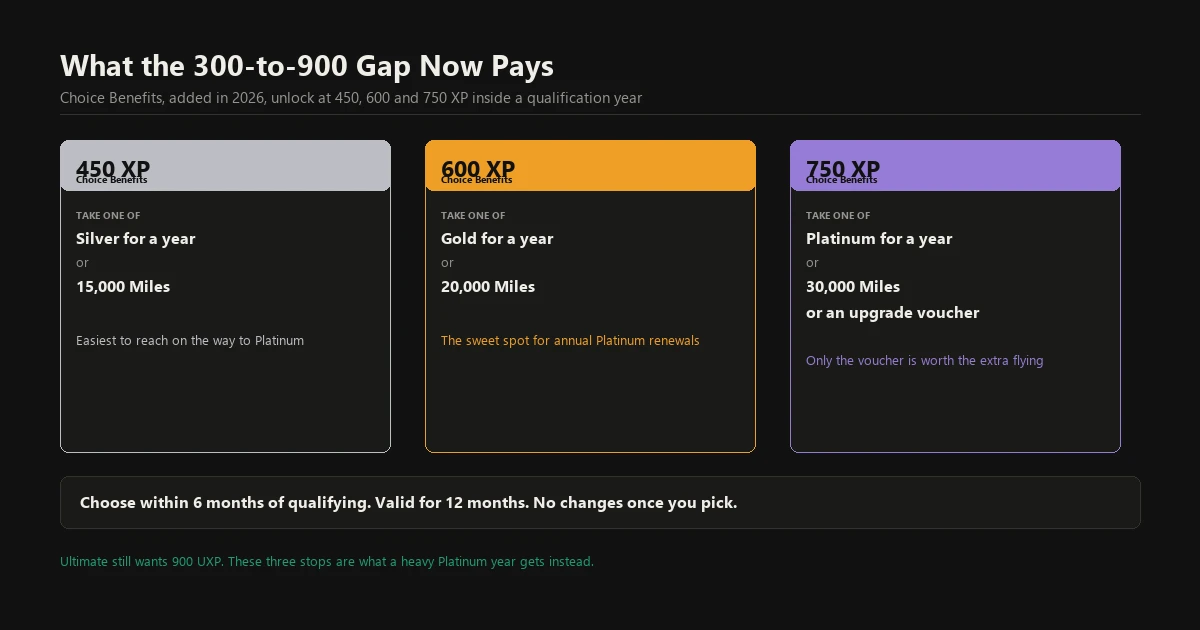
At 450 XP you take one benefit from a short list: a year of Silver for someone else, or 15,000 Miles. At 600 XP the same choice improves to a year of Gold, or 20,000 Miles. At 750 XP it becomes a year of Platinum, 30,000 Miles, or an upgrade voucher. The deadline is six months from qualifying, the benefit runs for twelve months, and the choice cannot be changed once it is made, which makes it worth reading twice before clicking.
Which to take depends on who you fly with. The status card is the best value if you have a partner or a colleague who travels once or twice a year on SkyTeam, because a year of Gold handed to someone else is worth more to them than 20,000 Miles is to you. The upgrade voucher is the only option at the 750 mark that pays in cabin rather than currency, and it is the reason a member already flying enough for 750 XP should take the last 150 seriously. The Miles are the safe choice for everyone else, and at 1.3 US cents each they are worth roughly $195, $260 and $390 at the three stops.
One warning: Choice Benefits do not stack with Ultimate. They are a consolation for the years you fly a lot without hitting 900 UXP, so nobody should plan a year around 750 XP and then discover the voucher cannot be combined with a tier they already hold.
Where XP goes missing
Four rules quietly delete XP that members assume they have earned.
Reward tickets earn nothing. Not Miles, not XP. A business award across the Atlantic earns zero status progress, which is why heavy redeemers often hold lower tiers than their flying suggests.
Upgrades do not count. XP are calculated on the fare you paid for, not the cabin you sat in. An operational upgrade to business earns economy XP, and so does a Miles upgrade.
UXP needs Air France or KLM flight numbers. XP count on SkyTeam partners, but the Ultimate currency does not. Only Platinum and Ultimate members earn UXP, and only on flights marketed by Air France or KLM, plus fuel bought with those bookings. A KLM-operated flight sold under a Delta flight number earns XP and no UXP, which is the single most common reason a would-be Ultimate member arrives at 600 UXP and stalls.
Cancellations and no-shows earn nothing. If the flight does not operate as booked, there is no XP, and disputes have to be raised within six months of the flight.
There is a smaller trap for the frugal as well. On medium-haul segments a Basic economy fare earns 2 XP rather than the standard 5, so the cheapest ticket is also the slowest route to a level.
Is any of it worth chasing
Status is worth what you would otherwise pay for the same things, which means the answer changes by tier rather than by programme.
Silver pays for itself on two or three return trips a year with a checked bag and a tight connection. Priority check-in, one extra bag and free standard seats are worth perhaps €60 to €90 across a year, and 100 XP is one and a half business returns across the Atlantic. Chase it if a bag is part of every trip.
Gold is the only tier where the arithmetic is comfortably positive for a leisure traveller. Lounge access for two, SkyPriority and seat options three days out are worth several hundred euros a year if you fly through Paris or Amsterdam more than twice. The 180 XP step is also the cheapest on the ladder, which is the one place where the step structure works in your favour.
Platinum is worth it to anyone spending significant Miles, and close to worthless to anyone paying cash. Free award changes are the benefit that pays: on a Light business award, a single changed date would otherwise mean losing the ticket. Add La Premère, which cannot be booked any other way, and eight Miles per euro on paid flights. If that pushes you towards more award bookings, it also makes the price you pay for the Miles matter, and the current buy-miles rate is the number to check before you top up.
Ultimate is not worth chasing deliberately. Nine hundred UXP is roughly fifteen long-haul business returns on Air France or KLM metal in one qualification year, and the return is four upgrade vouchers, a wide guest allowance and a card to give away. Members who reach it are people whose employer already books that flying. Nobody should manufacture it.
The last comparison worth making is between status and a cheaper fare. A Gold member who books economy and reaches Silver-level comfort through the airport is often better served than a member paying for business to earn XP towards a level that only restores what the fare already included. Status is a hedge, not a destination, and the hedge is cheapest at Gold.
Frequently asked questions
How many XP do you need for Flying Blue Platinum?
300 XP while you hold Gold, which is 580 XP from a standing start. Flying Blue deducts each threshold from your counter when you cross it, so Silver takes 100 XP, Gold a further 180 and Platinum a further 300. Most guides quote the 300 without the two steps that come before it.
Do Flying Blue XP expire?
Yes. XP are tied to a qualification period that lasts twelve months or ends the moment you level up. At the end, the cost of your current level is deducted and up to 300 surplus XP carry into the next period. Anything above that is lost. An Explorer who never levels up has the counter reset to zero.
Can you buy Flying Blue XP?
Only indirectly. Sustainable aviation fuel bought against a booking earns XP, at 1 XP per €10 until 30 November 2026 and 1 XP per €15 from 1 December. Co-branded cards award a small allowance at renewal. There is no XP sale, no transfer from bank points, and no way to convert Miles into XP.
Does Flying Blue status include lounge access?
From Gold upwards. Gold and Platinum members can use SkyTeam lounges with one guest, and Ultimate members can bring up to eight. Silver has no lounge access, though it keeps priority check-in and one extra checked bag. The lounge benefit also applies when you fly on a Light award that does not include it.
What are Flying Blue Choice Benefits?
Benefits earned at 450, 600 and 750 XP inside a qualification year, added in 2026. At 450 XP you choose a year of Silver for someone else or 15,000 Miles. At 600 XP the options are a year of Gold or 20,000 Miles. At 750 XP they are a year of Platinum, 30,000 Miles or an upgrade voucher. You have six months to choose, the benefit lasts twelve months, and the choice cannot be changed.
What is the difference between XP and UXP?
XP count on any eligible flight and move you between Silver, Gold and Platinum. UXP are the same currency restricted to Ultimate: they are earned only by Platinum and Ultimate members, and only on flights marketed by Air France or KLM, plus fuel bought with those bookings. Nine hundred UXP in one qualification year reaches Ultimate, and a KLM flight sold under a Delta flight number earns XP but no UXP.
More guides
- The elite multiplier behind four to nine Miles per euro
- Transfers that also reset the Miles expiry date
- Why Silver is the cheapest way out of Miles expiry
- Flying Blue promotions: what is live and what is worth it
- Light, Standard or Flex: what each award fare includes
- What a Flying Blue mile is actually worth
- Promo Rewards: how the monthly sale works
- Buy Flying Blue miles: the real cost per mile
- Airline alliances explained, including where Flying Blue sits
Last updated: 27 November 2026.