JetBlue has four co-branded cards, issued by Barclays, and the annual fees look like a ladder: nothing, US$99, US$99, US$499. Read the benefits and it is not a ladder at all. The two US$99 cards sell baggage and a small annual credit. The US$499 card sells status progress and lounge access. The no-fee card sells nothing except an earning rate. They are three different products that happen to share a logo.
That matters because the way these cards are usually compared — by counting up statement credits against the annual fee — flatters all of them. A credit is only worth its face value if you would have spent that money anyway, and two of the four biggest numbers on the Premier card are conditional on spending US$15,000 and US$75,000 in a year. This guide prices each card on the value it actually delivers, sets out the two arithmetic traps in the line-up, and explains why none of the airport benefits follow you onto a United flight.
On this page
- The four cards, in one table
- What 6x is actually worth
- The bag is the product on the US$99 cards
- The rebate threshold nobody quotes
- The US$499 card, broken into four parts
- 25 tiles, and the other 25
- Companion Pass is a refund, not a free seat
- None of it follows you onto United
- Which card for which flyer
- Verdict
- Questions
The four cards, in one table
The line-up has not changed shape since the Premier launched in 2025, but the Premier’s benefits were rebuilt in May 2026 without a fee increase. The figures below are the ones published on JetBlue’s own comparison page, checked on 29 November 2026. Welcome offers move constantly; the structural benefits do not.
| JetBlue Card | JetBlue Plus | JetBlue Business | JetBlue Premier | |
|---|---|---|---|---|
| Annual fee | US$0 | US$99 | US$99 | US$499, plus US$150 per authorised user |
| Welcome offer | 10,000 points | 60,000 points | 50,000 points | 80,000 points |
| JetBlue, Vacations, TrueBlue Travel | 3x | 6x | 6x | 6x |
| Restaurants and grocery | 2x | 2x | — | 2x |
| Office supply | — | — | 2x | — |
| Everything else | 1x | 1x | 1x | 1x |
| First checked bag | — | Free, plus 3 companions | Free, plus 3 companions | Free, plus 3 companions |
| Boarding | — | — | Group 3 | Group 3 |
| Redemption rebate | — | 10% | 10% | 15% |
| Anniversary points | — | 5,000 | 5,000 | 5,000 |
| Statement credits | — | US$100 on JetBlue Vacations | US$100 on JetBlue Vacations | US$300 TrueBlue Travel, plus up to US$2,000 in companion credits |
| Status | 1 tile per US$1,000 | 1 tile per US$1,000 | 1 tile per US$1,000 | 25 tiles a year, plus 1 per US$1,000 |
| Lounges | — | — | — | Priority Pass and BlueHouse |
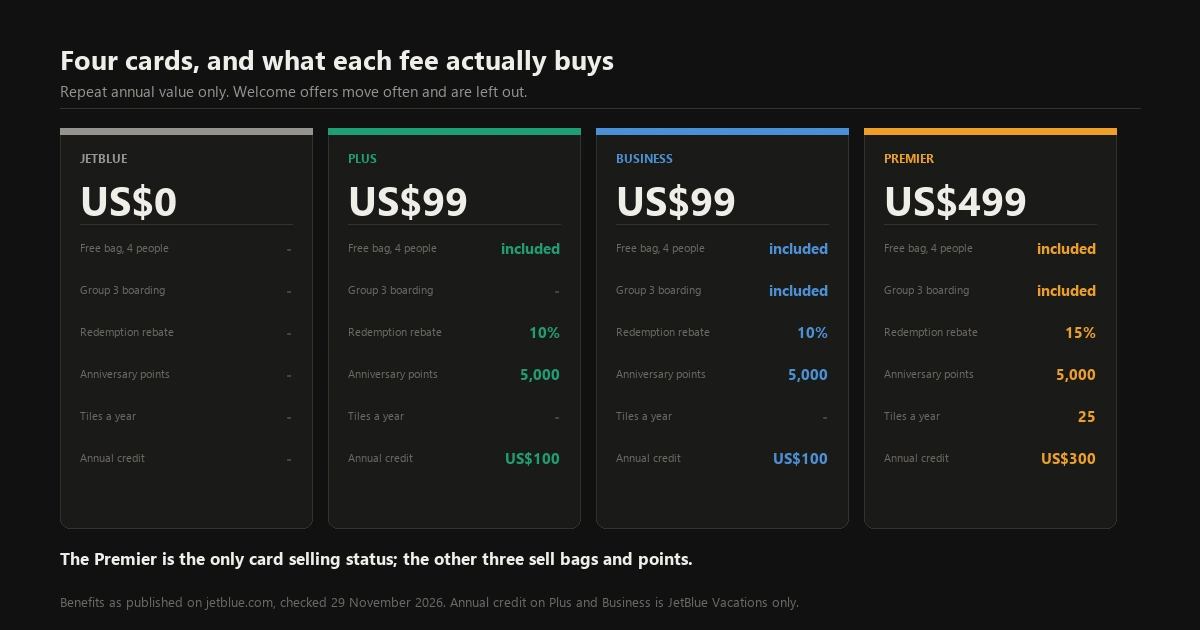
One structural oddity is worth flagging before anything else: the Plus and the Business cost the same US$99, and the Business is the better card for most people who qualify for it. It adds Group 3 boarding and 2x on office supplies; it gives up 2x on restaurants and grocery. If your grocery bill is larger than your need to board early, the Plus wins. If the reverse, the Business is strictly more card for the same fee — and it is the only place in the line-up where that is true.
What 6x is actually worth
TrueBlue points are worth about 1.34 cents each, so 6x on JetBlue spending returns roughly 8 cents of value per dollar — an 8 percent return on the only spending category that matters. That is high for an airline card, and it is also the whole of the card’s earning argument. Everything outside the bonus categories earns 1x, which is 1.34 percent: below a plain 2 percent cash-back card, and well below what a transferable currency returns. The points-101 guide explains why a fixed-value airline point cannot win that comparison.
So these are not everyday cards, and treating them as such is the most common way to lose money on one. The useful version of the question is narrower: how much of your annual spending goes through jetblue.com and JetBlue Vacations? At 8 percent, a US$3,000 year of JetBlue bookings returns about US$240 of points value, which clears even the US$99 fee on its own. At US$600 it returns US$48 and the card is being carried for the bag.
Two smaller mechanics are easy to miss. Card spending counts towards Mosaic at 1 tile per US$1,000, on all four cards, which makes a card a status tool and not only a points tool — the tile arithmetic is set out here. And inflight purchases are half price when paid with any of the four cards, which is a 50 percent discount rather than a points rate.
The bag is the product on the US$99 cards
A first checked bag on a domestic JetBlue flight costs US$45 off-peak and US$49 on peak dates when added at least 24 hours ahead, per bag, each way. A Plus or Business card waives that for the cardholder and up to three companions on the same reservation, on JetBlue-operated flights, provided the booking is paid with the card and the cardholder’s TrueBlue number is on it.
Run one round trip for a family of four: eight bag fees, US$360 off-peak, US$392 in peak season. That is three to four times the annual fee from a single trip, and it is the reason the US$99 cards are the value pick in this line-up. Add the US$100 JetBlue Vacations credit (a package purchase of US$100 or more, once a year) and 5,000 anniversary points worth about US$67, and a cardholder who takes one bag-carrying round trip and books one package a year comes out roughly US$158 ahead on a US$99 fee.
Three conditions decide whether you actually collect. The whole booking must be paid with the card, including any reissued ticket after a change. The card has to be open and linked to your TrueBlue number before you fly, and the terms allow a seven-day window, so a card approved in the week of a flight may not cover it. And the benefit covers JetBlue-operated flights only, which is the subject of a later section.
The rebate threshold nobody quotes
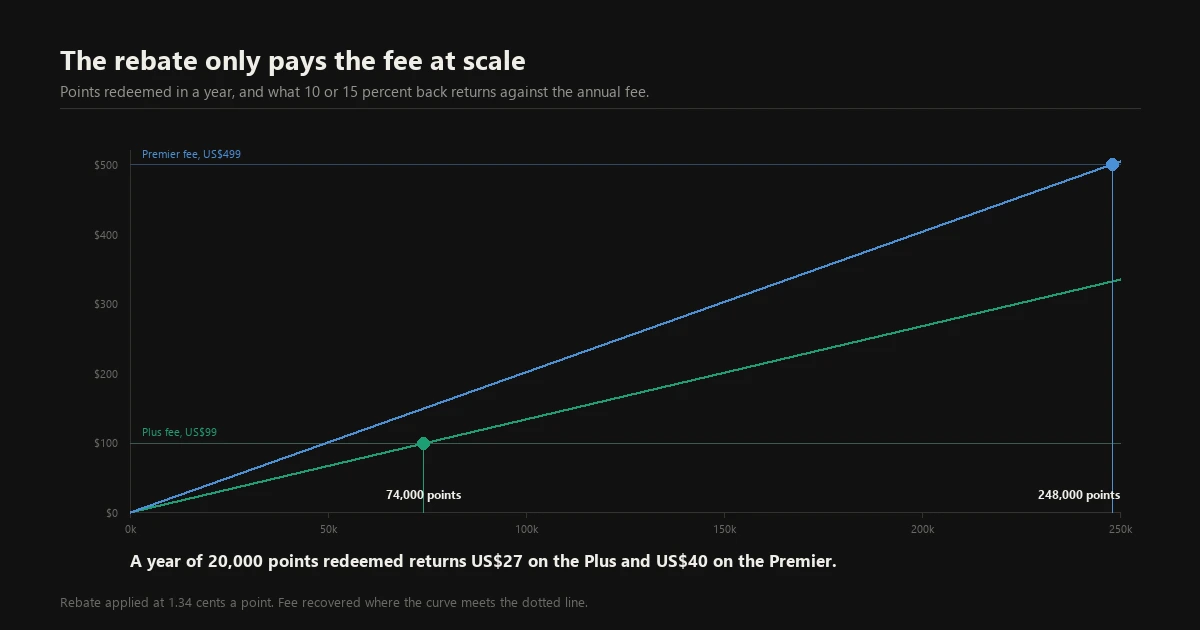
“10 percent back on redemptions” reads like a rebate on spending. It is a rebate on redeeming: you get 10 percent of the points back after an award flight, so the benefit only exists in proportion to how much you redeem. To recover the US$99 fee through the rebate alone, a Plus cardholder has to redeem about 74,000 points in a year — roughly US$990 of award travel at 1.34 cents.
The Premier’s 15 percent version needs about 248,000 points redeemed to return its US$499 fee. Both numbers are reachable for a heavy redeemder and unreachable for everyone else, which is the point: the rebate is a bonus on an activity you were already doing at scale, not a reason to hold the card. Treat it as the last item on the list, not the headline.
The US$499 card, broken into four parts
The Premier is the only card here that needs a spreadsheet, because four of its benefits carry dollar signs and only two of them are unconditional.
US$300 in TrueBlue Travel credits. Earned on hotels, car rentals and cruises booked through TrueBlue Travel, with each qualifying purchase of US$1 or more counting, up to US$300 a year. This is the one credit that behaves like cash for anyone who books a hotel or a car through the portal, and it takes the effective fee to US$199.
US$120 Global Entry or TSA PreCheck credit every four years. Worth US$30 a year, and only if you would otherwise pay for it.
Companion Pass credits, up to US$2,000. US$500 after US$15,000 of net spending in a calendar year, and a further US$1,500 once you reach US$75,000. Conditional on spending you may not have.
The 15 percent rebate, worth about US$499 only at 248,000 points redeemed. Plus 25 tiles, Priority Pass, BlueHouse access, Group 3 boarding and 5,000 anniversary points.
Strip out the companion credits and the card costs US$169 a year after the travel credit and Global Entry, or US$102 once the anniversary points are counted. Set against a Plus cardholder who never books a JetBlue Vacations package — net cost US$32 — the Premier is US$70 more expensive. Against one who does, it is US$170 more. That is the price of the lounges, the 25 tiles and the wider rebate. Whether that is worth it depends almost entirely on whether the tiles change your status outcome.
25 tiles, and the other 25
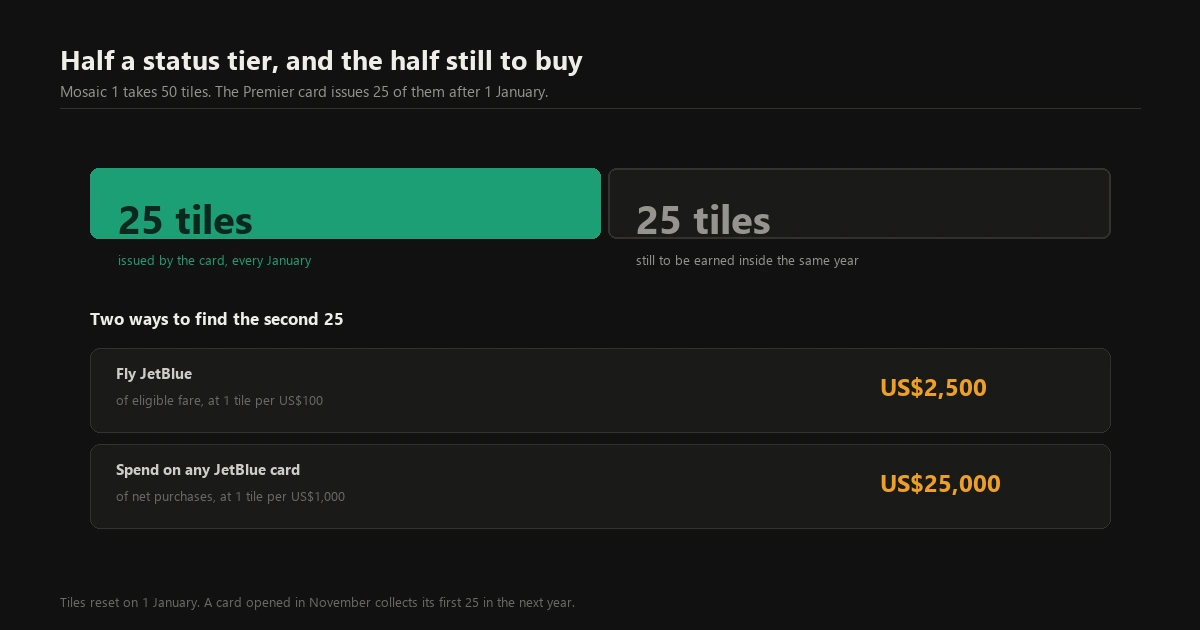
Mosaic 1 requires 50 tiles. The Premier hands over 25 of them shortly after the start of each calendar year, which is genuinely half the entry tier — but only half. The remaining 25 tiles have to come from somewhere, and the two routes are US$2,500 of eligible JetBlue flight spending or US$25,000 of card spending.
That reframes the benefit. For someone who flies JetBlue enough to earn 25 tiles anyway, the card converts a 50-tile year into a 25-tile year, and the US$499 fee buys a status tier that would otherwise have cost US$2,500 of flying. For someone who flies JetBlue twice a year and puts US$8,000 on the card, the 25 tiles deliver nothing at all: they sit in a counter that resets on 1 January and never reaches 50.
Timing matters too. The bonus is issued after the beginning of the calendar year, so a card opened in November collects its first 25 tiles in January — not at approval. Anyone planning to use the card to reach Mosaic in the same year they apply should check that assumption before applying.
Companion Pass is a refund, not a free seat
The name suggests a free ticket for a second person. The mechanism is a statement credit: you book and pay for your companion’s trip on your own reservation, apply the pass, and receive the credit after you both travel. So the US$500 pass requires you to fund the companion fare up front, and it reimburses up to US$500 of it.
Two limits follow. The credit is capped, so a US$900 companion fare returns US$500. And the second, larger credit at US$75,000 of spending is a rebate on a very high spend level rather than a benefit most cardholders will see. As with the travel credit, the value is real but arrives after the money leaves.
None of it follows you onto United
This is the part that Blue Sky makes confusing. Since the United partnership, a TrueBlue member can book United-operated flights on jetblue.com, earn 5 to 10 points per dollar on them, and earn tiles — United is the only partner that does the last part. What does not travel is the card.
JetBlue’s own terms state that the free checked bag, the inflight purchase savings and Group 3 boarding apply to JetBlue-operated flights only; codeshare flights and flights operated by a partner airline are excluded. A United flight booked on jetblue.com therefore earns points and tiles, and charges you for the bag. On a family trip that is the difference between a US$99 card paying for itself and not.
The same boundary runs through the rest of the portfolio. Priority Pass and BlueHouse are airport benefits tied to the Premier card, not to status, so they apply wherever you are flying from — but the bag and boarding benefits are tied to the operating carrier. Anyone weighing these cards because of Blue Sky should price the bag separately.
Which card for which flyer
Two to four JetBlue round trips a year, usually with a checked bag. The Plus, or the Business if you qualify and value Group 3 boarding. The bag alone covers the fee on one family trip. Skip the Premier: the credits will not clear US$499 without the companion spend.
Flying JetBlue enough to sit at 20 to 30 tiles a year. The Premier, and the case is the 25 tiles rather than the lounge. The card turns a near-miss year into Mosaic 1, and Mosaic 1 brings its own free bag, so the bag benefit and the status benefit stack rather than overlap.
Booking JetBlue once a year, no bag. The no-fee card, for the 3x on JetBlue spending and nothing else. Paying US$99 for a bag you do not check is the most common mistake in this line-up.
Spending on United instead. None of the four, at least not for the airport benefits. The earning rates still work on United flights booked through jetblue.com, but the bag, boarding and inflight discounts do not.
Verdict
The Plus is the best card in the line-up for most JetBlue flyers, and the reason is unglamorous: US$45 a bag, four people, one round trip. The Business is the same card with a different bonus category and better boarding, and it should be the default for anyone with a business to put it through. The Premier earns its fee only for people who are close to Mosaic 1 and would otherwise spend US$2,500 of flying to get there — the lounges and credits are real, but they are not US$499 of real for a light traveller.
The no-fee card is worth having and not worth expecting anything from. And the one number to ignore in every review, including this one, is the welcome offer: 80,000 points is about US$1,072 of award travel at 1.34 cents, and it is available once per card product, not once per year.
Last updated: 29 November 2026.
Questions
Which JetBlue credit card is the best?
The JetBlue Plus for most flyers, because a free first checked bag for the cardholder and three companions covers the US$99 fee on a single family round trip. The Business card is the better version of it for anyone who qualifies, since it costs the same and adds Group 3 boarding. The Premier only wins for people close to Mosaic 1.
Is the JetBlue Premier Card worth US$499?
For a flyer who reaches 20 to 30 tiles a year, yes: the 25-tile bonus converts a near-miss into Mosaic 1. For everyone else the credits do not clear the fee. The US$300 TrueBlue Travel credit and the US$30-a-year Global Entry credit take the effective cost to about US$169, and the companion credits need US$15,000 of spending before they exist.
Do JetBlue cards give a free checked bag on United flights?
No. The free bag, the inflight discount and Group 3 boarding apply to JetBlue-operated flights only. JetBlue’s terms exclude codeshare flights and flights operated by a partner airline, so a United flight booked on jetblue.com earns points and tiles but charges for the bag.
How much are the points these cards earn worth?
About 1.34 cents each, so 6x on JetBlue spending returns roughly 8 percent of the amount spent. That is the card’s strongest feature and the reason a JetBlue booking should go on it. Everything outside the bonus categories earns 1x, which is 1.34 percent and worse than a 2 percent cash-back card.
Does card spending count towards Mosaic status?
Yes, on all four cards, at 1 tile per US$1,000 of spending. The Premier adds a 25-tile bonus after the start of each calendar year, which is half of the 50 tiles needed for Mosaic 1. The other 25 tiles come from US$2,500 of JetBlue flight spending or US$25,000 of card spending.
Can I hold more than one JetBlue card?
Yes, but each product’s welcome offer is limited to applicants who have not previously held an account in that programme, so the bonus on a card you have already held is generally unavailable. Holding a Plus and a Premier at the same time means paying both fees and earning the bag benefit once, since the benefit is per person, not per card.
More guides
- JetBlue TrueBlue promotions: what is live, and what is worth it
- JetBlue Mosaic status: the four tile tiers and what each one now returns
- How to earn TrueBlue points: every route, and which ones reach the tile counter
- What a TrueBlue point is worth, and why Mint is not the sweet spot
- The best ways to redeem TrueBlue points, ranked by what you can undo
- Buying TrueBlue points: the four bonus tiers and the break-even maths
- Do TrueBlue points expire? The points do not, and the status clock is not the one you expect
- JetBlue fare tiers: the twelve options, and when Base costs more than Standard
- Transfer partners: the eight routes into TrueBlue, and which balance to spend
- JetBlue Mint: what the Premier card’s tiles and credits do for a premium seat
Decide the card by the bag, then by the tiles, and only then by the welcome offer. The full benefit list and current terms are on JetBlue’s card comparison page, and the published bag fees are on JetBlue’s baggage page.