How much are United miles worth? For most redemptions, independent valuations put a MileagePlus mile at about 1.2 to 1.3 cents — NerdWallet’s August 2026 analysis says 1.2 cents, Frequent Miler’s Reasonable Redemption Value is 1.3 cents, and The Points Guy publishes around 1.35 cents. That is the baseline, not the ceiling. A Polaris or Star Alliance business-class award can return 3 to 5 cents per mile, while cash back and gift cards often return less than 1 cent. This guide gives you the real range, explains why United’s dynamic pricing makes each booking different, and shows you how to calculate the value of any award before you spend a mile.
At a glance
| Question | Short answer |
|---|---|
| Independent baseline | 1.2–1.3 cents per mile (NerdWallet 1.2¢, Frequent Miler 1.3¢, The Points Guy ~1.35¢) |
| Best redemptions | 3–5 cents on partner business or first class, and on premium cabins when the cash fare is high |
| Worst redemptions | Under 1 cent via cash back, gift cards, or low-fare domestic economy |
| Fixed award chart? | No. United uses dynamic pricing, so the same route varies by date and demand |
| Cardholder discount | United cardholders get at least 10% off many awards; Premier members 15% or more |
| Do miles expire? | No. There is no activity requirement. |
The independent baseline
Start with the number the experts publish. NerdWallet’s analysis completed in August 2026 values a MileagePlus mile at 1.2 cents, based on Main Cabin economy fares rather than a best-case redemption. Frequent Miler’s Reasonable Redemption Value sits at 1.3 cents, and The Points Guy publishes roughly 1.35 cents. Those figures cluster tightly, and they tell you the sensible floor: aim to get at least 1.2 to 1.3 cents out of a mile, and treat anything below that as a weak use.
They also tell you what a mile is not worth. The 3-to-5-cent figures you see in airline articles are real, but they describe exceptional redemptions on expensive cabins, not the average trip. A fair way to think about the baseline is this: if you can consistently beat 1.3 cents, you are doing well; if you cannot, you are better off with cash back on a different card.
One detail matters for 2026. United cardholders receive at least a 10% discount on many United-operated award flights, and Premier elites often 15% or more. That discount raises the value you personally get from a mile, so a redemption that returns 1.2 cents for a general member can be meaningfully better on your account.
Value by redemption type
The category you redeem into matters far more than the program’s headline valuation. The same mile can be worth a tenth of a cent or five cents depending on what you book.
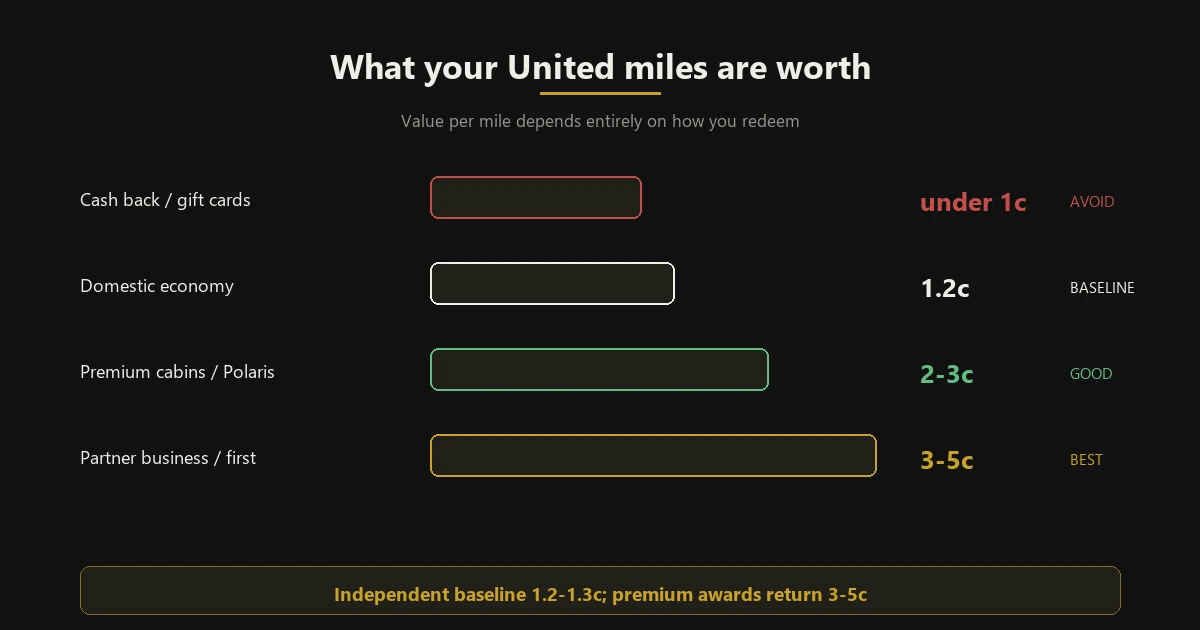
Under 1 cent — avoid. Cash back, gift cards, and shopping portal redemptions usually convert miles at a poor fixed rate. Paying with miles for a $200 item often costs more value than the item is worth.
Around 1.2 cents — the economy baseline. Domestic economy awards, especially booked close in or on competitive routes, tend to land near the independent baseline. That is acceptable, not exciting.
2 to 3 cents — premium cabins. United Polaris and premium-economy awards on long-haul routes frequently return 2 to 3 cents when the cash fare is high. A transpacific Polaris seat priced around 90,000 miles against a $5,000 cash fare is roughly 5.6 cents, though saver availability on United metal is scarce.
3 to 5 cents — the top tier. Partner business and first class booked through MileagePlus, such as ANA or Lufthansa, can return 3 to 5 cents or more. These are the redemptions that justify accumulating United miles in the first place — but they require award space, flexible dates, and often booking many months ahead.
Why dynamic pricing changes the answer
United dropped its published award chart in 2020 and prices most awards dynamically. The number of miles a flight costs moves with demand, how close you are to departure, and the cash fare — so “how much is a mile worth” has no single answer that holds for every date.
The practical consequence is that value is found, not assumed. The same route can be a poor use of miles on one date and an excellent use a week later. CNN Underscored illustrated this on a Singapore to San Francisco itinerary: the economy award came to about 2.0 cents per mile, Premium Plus about 4.3 cents, and Polaris about 4.6 cents — on the same flight, for the same traveller. Cabin choice and date did most of the work.
Partner awards are the exception that makes planning possible. Star Alliance partners such as Lufthansa, SWISS, ANA, and EVA often price at predictable levels, which is why they dominate the high-value examples. Note that United has removed the Excursionist Perk, so free stopovers no longer add value the way they once did.
How to calculate value yourself
You do not need an expert estimate to judge an award. One calculation answers it: subtract the taxes and fees you pay on the award from the cash price of the same ticket, then divide by the miles required. The result is cents per mile, and you compare it against the 1.2-to-1.3-cent baseline.
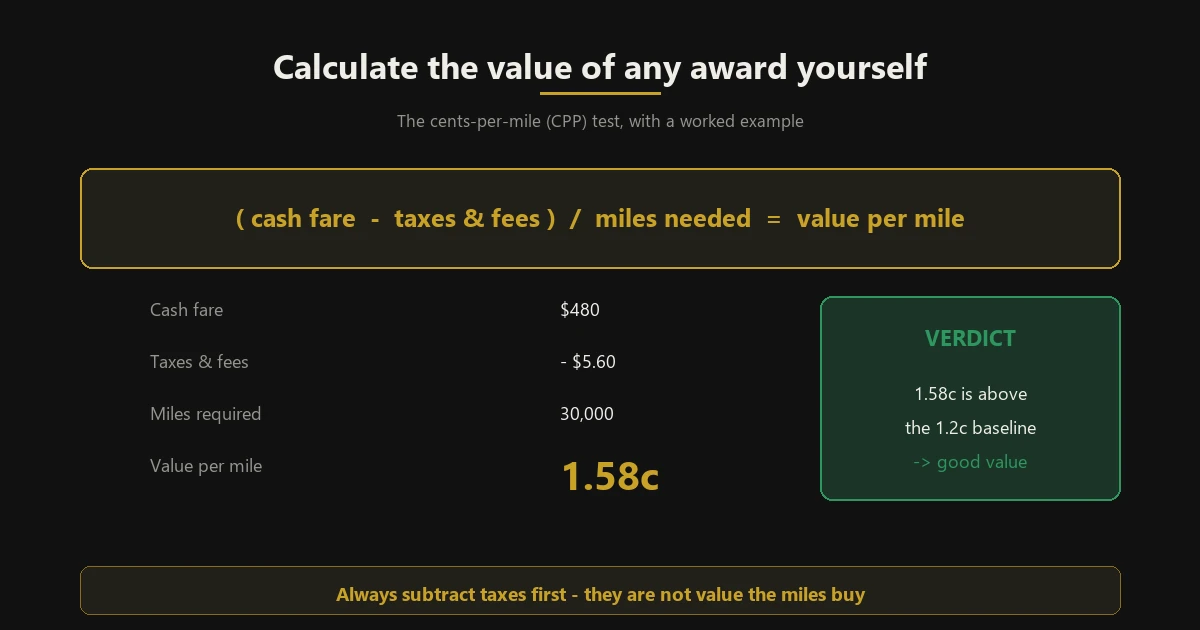
In the worked example, a $480 fare minus $5.60 in taxes gives $474.40 of value delivered by 30,000 miles — 1.58 cents each, above the baseline, so a good use. A $100 flight that costs 12,500 miles returns about 0.76 cents after fees, well below the baseline; pay cash and keep the miles.
Always subtract the fees. You pay the taxes on an award whether you book with cash or miles, so they are not value the miles created. Leaving them in flatters every redemption and can turn a mediocre one into an apparent win. This single habit is the difference between a reliable test and a comforting one.
Price a transfer before you buy. Chase Ultimate Rewards and Bilt both transfer to United at 1:1. If you hold either, those miles cost no cash, and the comparison changes completely — the question becomes whether United or another transfer partner gives you more value, not whether to buy.
Where miles are worth the most
Three situations reliably produce above-baseline value, and they are worth setting alerts for.
Transatlantic and transpacific premium cabins. Business or first class on a high-priced route is the classic case. A one-way Polaris seat to Europe that sells for $3,000 to $5,000 and prices at 80,000 to 90,000 miles returns 3 cents or more. Premium economy is often the quiet winner: on long-haul routes it can return over 4 cents for only a modest premium in miles over economy.
Star Alliance partner awards. Lufthansa or SWISS transatlantic business around 80,000 miles, and ANA or EVA business to Asia around 88,000, regularly return 3 to 5 cents against cash fares that clear $3,000. Availability is the constraint, not the maths — search early and be flexible on dates.
Last-minute domestic spikes. United’s dynamic pricing sometimes leaves the miles required flat while the cash fare jumps around holidays or on busy routes. A $329 fare for 12,700 miles is 2.5 cents, an unexpectedly good use. These are opportunistic, not planned, but they are real.
Where miles are worth the least
The same discipline works in reverse. Avoid redemptions that quietly destroy value:
Cash back and gift cards. Typically under 1 cent per mile, sometimes much less. This is the clearest way to turn a valuable balance into a poor one.
Low-fare domestic economy. A $250 ticket for 25,000 miles returns 1 cent, below the baseline. Pay cash and save the miles for a trip where they matter.
Upgrades and portal spending. MileagePlus upgrade awards and non-flight travel purchases usually land between 0.5 and 1 cent, well short of what a premium award returns.
Booking United metal when a partner is cheaper. On some routes the same United-operated flight costs far fewer miles through another loyalty program — one 2026 comparison found a Newark–London Polaris round trip at 121,000 MileagePlus miles versus 70,000 Aeroplan points. Always check a partner program before committing your United balance.
Does the value justify buying miles?
Only when the gap between value and price is large enough. United sells miles at a standard 3.76 cents, and sales bring the top tier to roughly 1.88 to 1.98 cents. Against a 1.2-to-1.3-cent baseline, buying at even the best sale price is a premium — you are paying about 1.9 cents for something worth about 1.3 on an ordinary redemption.
That changes if you have a specific high-value award in mind. Buying at 1.88 cents to book a Polaris seat worth 4 cents still leaves a wide margin, and topping up a balance for a partner business-class award is one of the better uses of cash in points. Buying speculatively with no award priced is not: the miles do not expire, so there is no deadline, and the next sale is never far away. For the full price structure and the two purchase caps, see our guide to buying United miles.
Verdict
How much are United miles worth? About 1.2 to 1.3 cents on an ordinary economy redemption, 2 to 3 cents on a good premium-cabin booking, and 3 to 5 cents on a well-timed partner business or first-class award. The baseline is a floor to beat, not a value to settle for — and because United prices dynamically, the difference between a weak and an excellent redemption is usually the date and cabin you choose, not the program itself.
The practical rule is simple: calculate cents per mile before you book, subtract the fees, and compare against 1.3 cents. Beat it consistently and MileagePlus is a worthwhile program; fall short and redirect your spending to a currency that returns more. For what is live on the account as of November 2026, see our United MileagePlus promotions tracker, and for the wider framework, read how loyalty points work.
Last updated: 21 November 2026. Valuations are independent estimates; award prices and availability change with United’s dynamic pricing.
Frequently Asked Questions
How much are United miles worth?
Independent valuations put a MileagePlus mile at about 1.2 to 1.3 cents: NerdWallet says 1.2 cents, Frequent Miler 1.3 cents, and The Points Guy roughly 1.35 cents. Premium and partner awards can return 3 to 5 cents, while cash back and gift cards often return under 1 cent.
Is 1.88 cents a good price to buy United miles?
Only against a specific, expensive award. The best sale price is below the 3.76-cent standard rate but above the 1.2-to-1.3-cent value most people get from a mile. It works when you are topping up for a Polaris or partner business-class award worth far more, not for speculative buying.
What is a good cents-per-mile value for United?
Anything above the 1.2-to-1.3-cent baseline is acceptable, 2 cents is good, and 3 cents or more is excellent. Always subtract taxes and fees from the cash fare before dividing by the miles required.
Why do valuations disagree between NerdWallet and The Points Guy?
They measure different things. NerdWallet bases its 1.2 cents on real Main Cabin economy pricing, while The Points Guy estimates what a mile can be worth when used well, which is higher. Treat the 1.2-to-1.35-cent spread as the realistic baseline rather than picking one number.
Do United miles expire?
No. MileagePlus miles do not expire and there is no activity requirement. That means you can wait for a high-value redemption rather than being pushed into a poor one by a deadline.
Do United credit cards change the value of miles?
Yes. United cardholders get at least 10% off many United-operated award flights, and Premier elite members often 15% or more. A lower mileage price for the same ticket raises the value you get from each mile.
Are partner awards better value than United flights?
Often. Star Alliance partners such as Lufthansa, SWISS, ANA, and EVA can return 3 to 5 cents on business-class awards, and sometimes cost fewer miles than the same United-operated route. Check partner availability before booking United metal.
How do I work out the value of a specific award?
Subtract the taxes and fees from the cash price of the same flight, then divide by the miles required. If a $480 fare minus $5.60 in fees costs 30,000 miles, the result is 1.58 cents per mile — above the baseline, so a good use.
More United MileagePlus Guides
- United credit cards ranked, the four Chase cards compared on fees, earning and PQP.
- Does United have an award chart, how dynamic pricing works and the partner Saver floor.
- Do United miles expire, why MileagePlus miles never lapse and the six forfeiture exceptions.
- Buying United miles, the real price bands, both purchase caps and when a top-up pays.
- Best way to use United miles, the top redemptions ranked by value, current Saver levels and what to avoid.
- United MileagePlus elite status, all four tiers, 2026 thresholds and what changes in 2027.
- How to earn United miles, flight rates, bank and hotel transfers and the routes to avoid.
- United MileagePlus promotions, every live offer and which accounts should act on it.
- How loyalty points work, the framework for valuing any balance before you spend it.
- All United Airlines coverage, every guide and offer we have published.
Price the exact award you want, subtract the fees, and divide by the miles required. If the result beats 1.3 cents, book it — and check a Star Alliance partner before committing your balance.