Flying Blue miles are worth 1.3 to 1.4 cents each on the valuations published this quarter, and that number is the least useful figure on this page. The programme publishes no award chart, prices every seat dynamically, and sells its own miles at four different prices depending on which week you look. A valuation is an average of outcomes you did not choose. What actually decides a redemption is what you paid to acquire the mile and what the seat would have cost in cash.
Short version: three numbers matter, and none of them is the valuation. A Capital One transfer at 1:1 costs about 1.00 cent and remains the cheapest way to acquire a Flying Blue mile; during the 20% bonus that closed on 30 November 2026 it was 0.83. The best cash purchase of the year came in near 1.24 cents and closed on 23 November, while the standing Buy & Gift price is 3.05 cents. On the spending side, the 25% Promo Rewards discount is genuine, but since 8 September 2026 it buys a Light fare, which means no checked bag in economy and no lounge in business. The same mile returns close to 6 cents against the right business-class seat and about 1 cent against a short European hop. Both are real. Only one of them is worth spending on.
Three prices, and only one of them is a value
Coverage of this programme habitually collapses four different prices into a single row, then compares the wrong two. Kept apart, most of the confusion disappears.
| What you are measuring | Figure for 2026 | What it tells you |
|---|---|---|
| Standing retail price (Buy & Gift) | 3.05 to 3.17 cents a mile | The ceiling. Roughly $30.50 per 1,000 miles, and worth paying only to close a small gap. |
| Best promotional purchase (Multiply, 16X with a 50% bonus, closed 23 November 2026) | about 1.24 cents | The floor on the buy side, and available only to members with qualifying flight activity. |
| Transfer from a bank programme (Capital One, 1:1) | about 1.00 cent | The cheapest route of the four, limited by how many transferable points you hold. A 20% bonus ran to 30 November 2026. |
| What the mile returns when you spend it | 1 cent to 6 cents | The only figure that decides anything, and it varies by cabin and by route. |
The trap is comparing the promotional purchase price with the valuation and concluding that a mile costing 1.24 cents is worth 1.30. That margin of six hundredths of a cent survives no error at all: a fare that moves by a hundred dollars, a direction that adds three hundred dollars of surcharges, and the purchase stops being cheap. The transfer price of about 1.00 cent carries a fifth of the margin again, which is why it wins before any purchase is considered.
There is a second trap in the other direction. Because the retail price is 3.05 cents, some readers conclude that a redemption returning 2 cents is a loss. It is not. The mile you already hold has no alternative use at 3.05 cents, because nobody is obliged to buy at that price. Judge a redemption against what you paid, not against what the airline would charge someone else. If you do want to buy, the rate moves with every window, so check the live buy-miles price on Flying Blue before you plan around a number from an article.
Where 1.3 and 1.4 cents come from
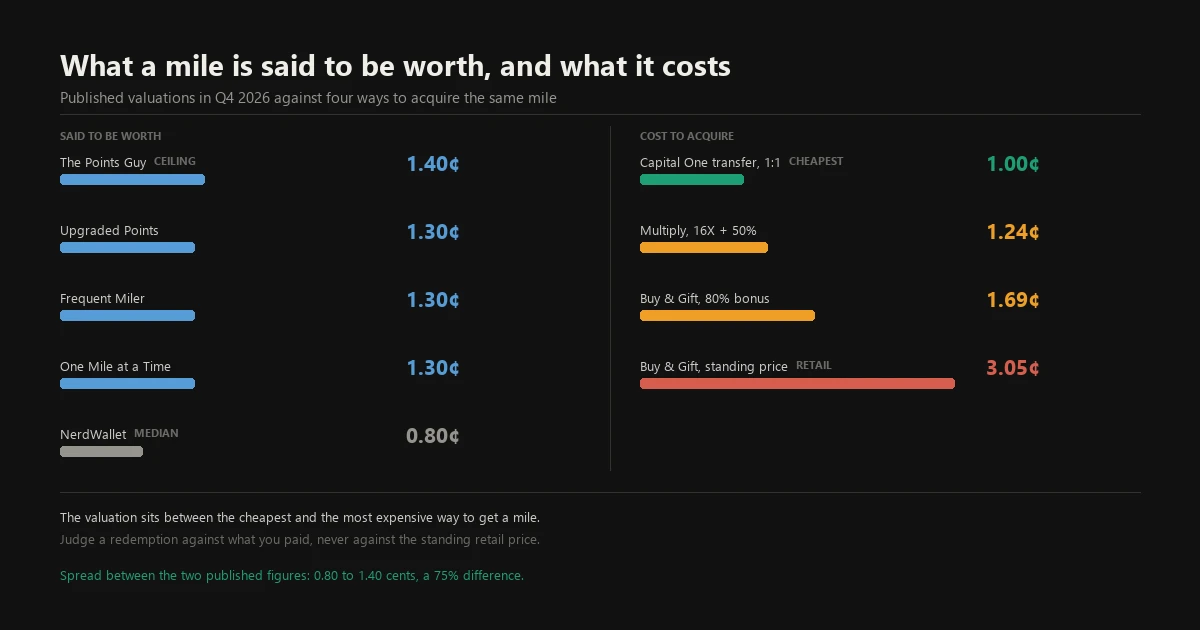
Four publishers maintain a running valuation of this currency, and they disagree by more than half. The Points Guy puts a mile at 1.4 cents, having cut it twice during 2026 from 1.55. Upgraded Points, Frequent Miler and One Mile at a Time all sit at 1.3. NerdWallet reports 0.8, which is a median of what members actually redeem for rather than a best-case redemption. The spread is not sloppiness. Each house is answering a different question.
A best-case valuation asks what the currency can do in expert hands, and the answer is a business-class seat at a promotional rate. A median valuation asks what the typical member gets, and the answer includes a lot of short-haul economy and a lot of dates nobody wanted. When a publisher quotes 1.4 cents, it is describing a ceiling reached on maybe one redemption in twenty. When it quotes 0.8, it is describing the middle of the distribution. Flying Blue shows both, because it prices dynamically and its award floor and its award ceiling are further apart than in a chart-based programme.
So use the published figure for one thing only: as a sanity check. If your arithmetic produces 4 cents, you are not a genius, you found a route where the cash fare is high and the award price is low. If it produces 0.9, you are not being cheated, you picked a cabin where the mile is genuinely worth less than a cent. The valuation tells you which of those two situations is normal. It does not tell you what to do.
One more caveat that the published valuations mostly bury. A dynamic programme can move the award price between the day you plan and the day you book. A seat quoted at 45,000 miles in October can price at 62,000 in December for the same cabin and the same city pair, because the fare bucket changed. This is the strongest argument against buying miles speculatively: you are taking a fixed cost against a variable price. The only defensible purchase is one made after the award is visible and priced on screen.
What 60,000 miles actually buys
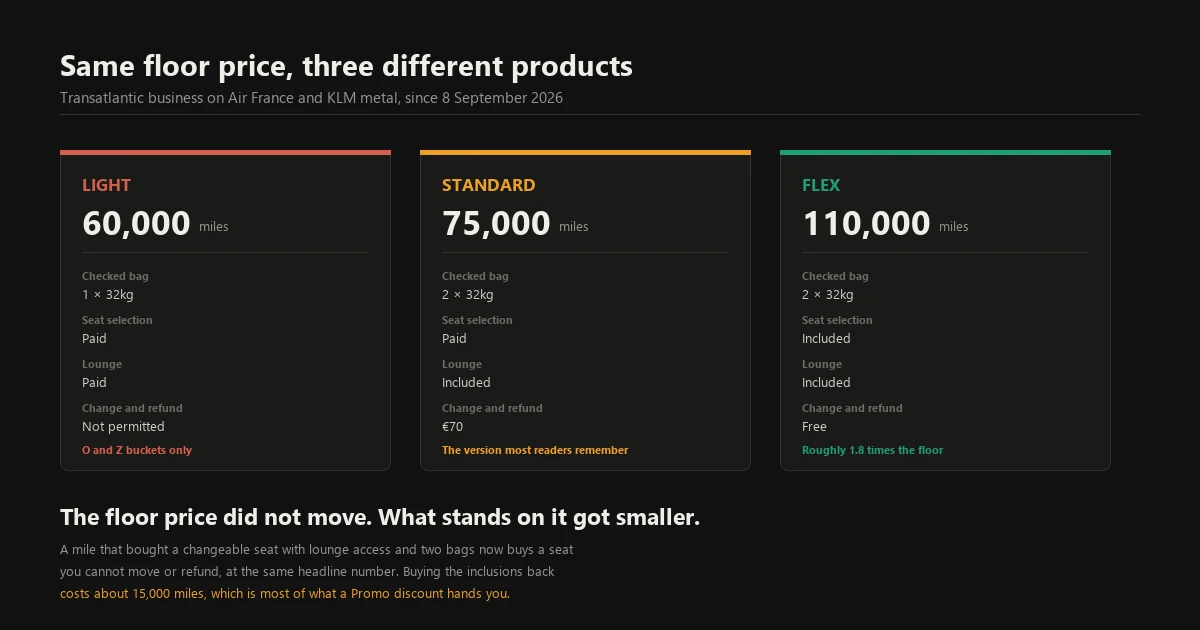
Since 8 September 2026, every Air France and KLM award carries one of three fare brands, and they are not cosmetic. This is the change that has done more to the real value of a Flying Blue mile than any pricing move in the past two years, and it is invisible in every valuation published.
| Light | Standard | Flex | |
|---|---|---|---|
| Business, Europe to North America (representative) | from 60,000 miles | about 75,000 miles | about 110,000 miles |
| Checked bag, economy and premium economy | None | 1 × 23kg | 1 × 23kg |
| Checked bag, business | 1 × 32kg | 2 × 32kg | 2 × 32kg |
| Seat selection | Paid | Paid | Included |
| Business lounge | Paid | Included | Included |
| Change | Not permitted | €70 | Free |
| Refund | Not permitted | €70 | Free |
Read the first row and the last two together. The floor price of a transatlantic business award did not rise. The thing standing on that floor got smaller. A mile that bought a changeable seat with lounge access and two checked bags in 2025 now buys, at the same headline number, a seat you cannot move and cannot refund. The version with the flexibility costs 25% more miles, which is to say the devaluation was applied to the product rather than to the number.
Three details decide edge cases. Business-class Light is only offered in O and Z buckets, so a route with no O or Z availability has no Light price at all. An itinerary that mixes Air France or KLM with a SkyTeam partner is issued as Standard and cannot be bought as Light. And Platinum and Ultimate members can change or refund a Light award free of charge regardless of the table above, which means the fare brand costs them nothing.
The practical consequence is that any comparison of Promo Rewards against a cash fare has to be a comparison of like with like. A 45,000-mile business award that drops your bag and refuses changes is not competing with a $3,000 flexible cash ticket. It is competing with a $3,000 cash ticket you also cannot change. If you would have bought the flexible one, add 15,000 miles before you call the award a bargain.
The surcharge that never appears in a valuation
Flying Blue awards carry carrier surcharges, and on a transatlantic business redemption they are not a rounding error. A New York to Paris business award priced at 45,000 miles in November 2026 came with $334 in taxes and surcharges on top. That number has to come out of the cash fare before any per-mile figure is calculated, and in most published valuations it does not.
Direction matters more than most readers expect. Surcharges are set by the operating carrier and by the direction of travel, and the same city pair can differ by hundreds of dollars depending on whether you start in Europe or in the United States. An award that returns 5 cents a mile eastbound can return 3 cents westbound with an identical mileage price, purely because the taxes moved. Price both directions before deciding a route is a sweet spot.
This is also where the comparison with cash collapses most often. A $3,000 business fare includes the taxes. A 60,000-mile award does not. Subtract first, divide second, and the result is usually one cent lower than the figure a headline quotes.
Your own cost floor, in one line of arithmetic
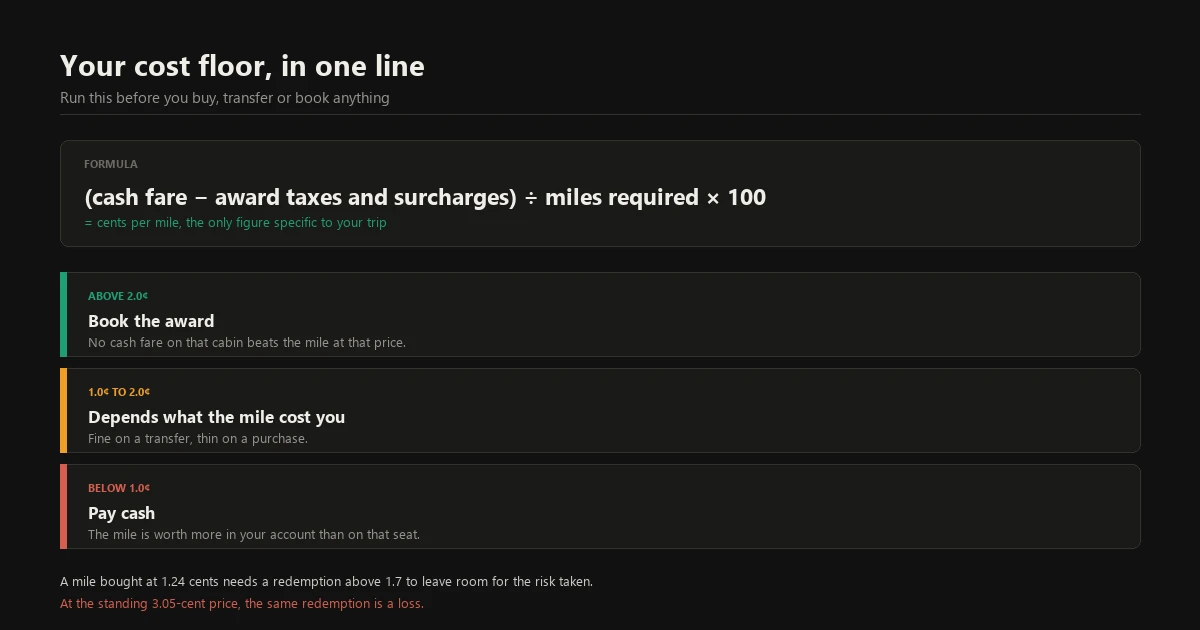
Forget the published valuation and calculate the only number that is specific to you. Take the cash fare for the exact seat you want, subtract the taxes and surcharges the award will charge you, divide by the miles required, and multiply by 100.
(cash fare − award taxes) ÷ miles required × 100 = cents per mile
Then compare that result with what the mile cost you. If your miles arrived through a transfer at about 1.00 cent, almost anything above 1.3 cents is a sound use. If you bought them at 1.24 in the November window, you need the redemption to clear about 1.7 cents to leave a margin for the risk you took. If you are topping up at the standing 3.05 cents, the redemption has to clear 4 cents before the purchase makes sense, and very few do.
Two thresholds are worth memorising. Below 1 cent, pay cash: the mile is worth more in your account than on that seat, and short-haul economy redemptions land here constantly. Above 2 cents, book the award if the dates work: no cash fare on that cabin beats the mile at that price, and business class on a discounted route is where this programme earns its reputation. Between the two, the decision belongs to your own balance and your own travel plans, not to a chart.
One arithmetic habit is worth more than any of this. Price the award before you acquire the mile. Every bad Flying Blue purchase follows the same shape: miles bought first, award searched second, and a 60,000-mile seat that turns out to want 82,000 on the dates that were actually available. If you need a top-up, size it against a seat you have already found, and check the current price per mile before you commit.
Four redemptions, priced
The same currency, four real prices. Cash fares below are representative of what a search returned in November 2026 for the cabin and route named; your dates will differ, and that is the point.
| Redemption | Miles and taxes | Cash fare | Return per mile |
|---|---|---|---|
| New York to Paris, business, promotional | 45,000 + $334 | $3,000 | 5.9 cents |
| New York to Paris, business, Standard | 60,000 + $334 | $3,000 | 4.4 cents |
| New York to Paris, economy, promotional | 18,750 + $180 | $650 | 2.5 cents |
| Paris to Milan, economy, promotional | 6,000 + $60 | $120 | 1.0 cent |
The spread is the whole argument of this page. The best redemption in the table is worth almost six times the worst, and both are the same Flying Blue mile on the same day. Nothing in the programme changed between the first row and the last. The cabin, the route and the cash fare did.
Look also at the gap between rows one and two. Fifteen thousand miles buys the right to check two bags, sit in a selectable seat and change your mind for €70. Whether that is worth 15,000 miles depends on the trip: on a two-week holiday with luggage it usually is, since 15,000 miles is a fraction of one bag fee for a family; on a four-day work trip with a carry-on it usually is not. The fare brand, not the headline price, is where most of the value decision now lives.
Row four is the one to remember. A promotional short-haul economy award at 6,000 miles sounds like a gift, and at 1 cent a mile it is worse than a transfer would have cost you. Cheap in miles is not the same as good value, and the routes Flying Blue discounts most heavily in economy are frequently the routes where the cash fare was already low.
Why the 25% discount is not 25% off
Promo Rewards publishes a new list on the first of every month, discounts selected Air France and KLM routes by up to 25%, and restricts travel to Air France and KLM metal with connections through Paris or Amsterdam. It is a genuinely useful list. It is also the most misread one in the programme.
Since 8 September 2026 the promotional price equals the Light fare. That means the 25% is calculated against a fare brand that did not exist two years ago, on a product with fewer inclusions. If you remember a transatlantic business award at 60,000 miles with lounge access and two bags, the 45,000-mile Promo price is not 25% off that award. It is 25% off a leaner one, and buying back the inclusions you remember costs roughly the 15,000 miles you thought you had saved.
For some travellers that is a good trade. If you fly carry-on only, never change a booked ticket and have lounge access through status or a card, the Light fare is exactly what you want and the discount is real money. For everyone else, the honest comparison is 45,000 miles plus a paid bag plus no flexibility against 60,000 miles with all three included, and the discount shrinks towards nothing.
The list also has a habit of moving the value in the other direction, which is why it is worth checking monthly even if you are not buying anything. A route that prices at 63,750 miles in business on the promotional list is the same seat that would cost 85,000 without it, and no purchase of miles at any price in 2026 got close to that margin. If your travel dates are flexible and your origin happens to be on the list, the discount does more for the value of your balance than any acquisition strategy.
The verdict
A Flying Blue mile is worth 1.3 to 1.4 cents on the published valuations and something between 1 and 6 cents in practice, and the difference is entirely about which seat you point it at. Treat the published figure as a reference point for judging your own arithmetic, not as a target to beat.
Three conclusions survive the numbers. First, the cheapest way to hold this currency is a transfer from a bank programme, not a purchase, and at about 1.00 cent against a 3.05-cent retail price the gap is not close. Second, the fare brands introduced in September 2026 cut the real value of the award floor without touching the headline price, so any older comparison you remember is now an overstatement. Third, the mile pays properly only in a premium cabin on a discounted route with a high cash fare behind it, which is why Promo Rewards matters more than any sale on the buy side.
What to do with that depends on one fact about you. If you hold transferable points and a specific trip, move the points and book. If you hold no points and no trip, buy nothing: a speculative purchase at 1.24 cents against a currency that prices dynamically is a bet on a seat that does not exist yet. And if you are one of the members who can see a top-up offer, look at the official miles page for the current rate before you assume last month’s number still applies.
Last updated: 27 November 2026.
FAQ
What are Flying Blue miles worth in 2026?
Between 1.3 and 1.4 cents each on the valuations published this quarter, with NerdWallet reporting a median of 0.8 and The Points Guy a ceiling of 1.4. In practice a mile returns about 1 cent on a short-haul economy award and close to 6 cents on a discounted transatlantic business seat, because Flying Blue prices dynamically and the range between its floor and its ceiling is wide.
Is it worth buying Flying Blue miles?
Only against an award you have already priced, and only at a promotional rate. The standing price is 3.05 cents a mile, more than twice the published valuation. The best window of 2026 came in near 1.24 cents through Multiply at 16X with a 50% bonus, which closed on 23 November. A transfer from Capital One at the plain 1:1 ratio costs about 1.00 cent, cheaper than either, and involves no purchase at all.
Are Flying Blue miles better than cash back?
On a premium cabin, yes, by a wide margin. On short-haul economy, often no. The test is arithmetic rather than loyalty: subtract the award taxes from the cash fare, divide by the miles required, and compare the result with what the mile cost you. Below 1 cent, take the cash. Above 2 cents, take the seat.
What is the cheapest way to get Flying Blue miles?
A transfer bonus from a bank programme. Capital One transfers at 1:1, which puts the cost near 1.00 cent a mile with no annual purchase cap; a 20% bonus that ran through 30 November 2026 took it to 0.83. If you have no transferable points, Multiply at 16X with a 50% bonus was the cheapest cash route of 2026, but it only appears for members with miles credited inside a qualifying window.
Do Flying Blue miles lose value over time?
Yes, in two separate ways. The fare brands introduced on 8 September 2026 cut what the award floor buys without raising the floor price, which is a quiet devaluation. And the programme prices dynamically, so the same seat can cost more miles next quarter without any announcement. Both effects argue for spending a balance on a specific trip rather than holding it for a better day.
Is 45,000 miles a good deal for business class to Europe?
Usually. A transatlantic business award at 45,000 miles plus roughly $334 in taxes, against a cash fare near $3,000, returns about 5.9 cents a mile, which is well above any acquisition cost available in 2026. Check what the 45,000 buys, though: since September 2026 that is a Light award, with one 32kg bag, lounge access charged separately and no changes or refunds. The Standard version at about 60,000 miles returns 4.4 cents and includes all three.
More guides
- What a mile must be worth for earning it to pay
- What a mile costs to acquire against what it is worth
- What an expiring balance is worth before it goes
- What status is worth in miles, tier by tier
- The three award fare brands, and which one your miles should buy
- Promo Rewards: how the monthly sale works, and what the 25% takes off the fare
- Flying Blue promotions: what is live, what ended, what is worth it
- Buy Flying Blue miles: what a mile costs and when it pays
- Airline alliances explained, including where Flying Blue sits in SkyTeam
- Every official buy-points link in one place
- How loyalty points work, and how to make them worth something
- Do points expire? The programmes that run a clock, and the ones that do not