1. Short version
How to earn Delta SkyMiles is not a question about which source is most generous. It is a question about what each mile costs you. A SkyMile is worth roughly 1.2 cents whether it arrived from a flight, a shopping portal or a hotel conversion, so the only question worth asking about the twelve sources below is what that mile costs you. Holding them costs nothing, because SkyMiles do not expire; the risk sits in the account. Flying returns 6 to 8.4 per cent of the fare at general-member rates, and up to 13.2 per cent for a Diamond. A shopping portal returns the same value on money you were going to spend anyway, and at some merchants it beats every flight. A hotel programme conversion gives up five to six cents of hotel value to produce a 1.2-cent mile. And the Delta credit card that looks like the backbone of the programme pays 1.2 per cent on everyday spend, which a plain two per cent cashback card beats without asking for an annual fee.
Two 2026 changes make this worth getting right. Delta now prices earning by the travel experience you buy, so the cheapest seat on the plane earns nothing at all — not miles, not MQDs. And the sources that look like easy multipliers, Stays, Cars, Cruises and Vacations, all run through Delta’s own booking engines, which are not always the cheapest place to book the same room. Every mile on this page is worth 1.2 cents; every method is judged on how much cash or how much forgone value it takes to produce one.

2. The 2026 structure: four experiences, four tiers
Delta used to pay a flat five miles per dollar on every ticket it marketed. It does not any more. Since the travel experience structure took effect, the rate depends on which version of the fare you buy, and the spread is wider than most guides admit: the cheapest seat earns nothing, the most flexible main cabin seat earns seven miles per dollar, and a premium cabin bought at a Basic rate earns two.
| Travel experience | Miles per $1 | What it looks like at booking |
|---|---|---|
| Delta Main Basic | 0 | Basic economy. The cheapest seat on the plane |
| Delta Basic in a premium cabin | 2 | Basic fare on Comfort+, Premium Select, First or Delta One |
| Delta Main Classic (and Refundable) | 5 | Standard main cabin, changeable |
| Delta Main Extra | 7 | Fully flexible main cabin with same-day confirmed changes |
Two names on Delta’s own page cause most of the confusion. “Delta Basic” is not the same product as “Delta Main Basic”: the first is a discounted fare inside a premium cabin and pays two miles per dollar, the second is basic economy and pays none. The gap between the two is worth knowing before you click the cheapest fare, because people who buy basic economy to save $40 and then wonder where the miles went have usually bought the zero.
The earning base is the fare plus carrier-imposed surcharges, not the total you pay. Government taxes and fees are excluded, so a $300 ticket with $60 of tax earns on $240. Miles are credited to the passenger named on the ticket, not to whoever paid, which matters in a household where one person holds the card.
Medallion status then multiplies the rate. Delta publishes one figure per tier without splitting it by experience:
| Status | Miles per $1 | Return on $100 at 1.2¢ |
|---|---|---|
| General member | 5 | $6.00 |
| Silver Medallion | 7 | $8.40 |
| Gold Medallion | 8 | $9.60 |
| Platinum Medallion | 9 | $10.80 |
| Diamond Medallion | 11 | $13.20 |
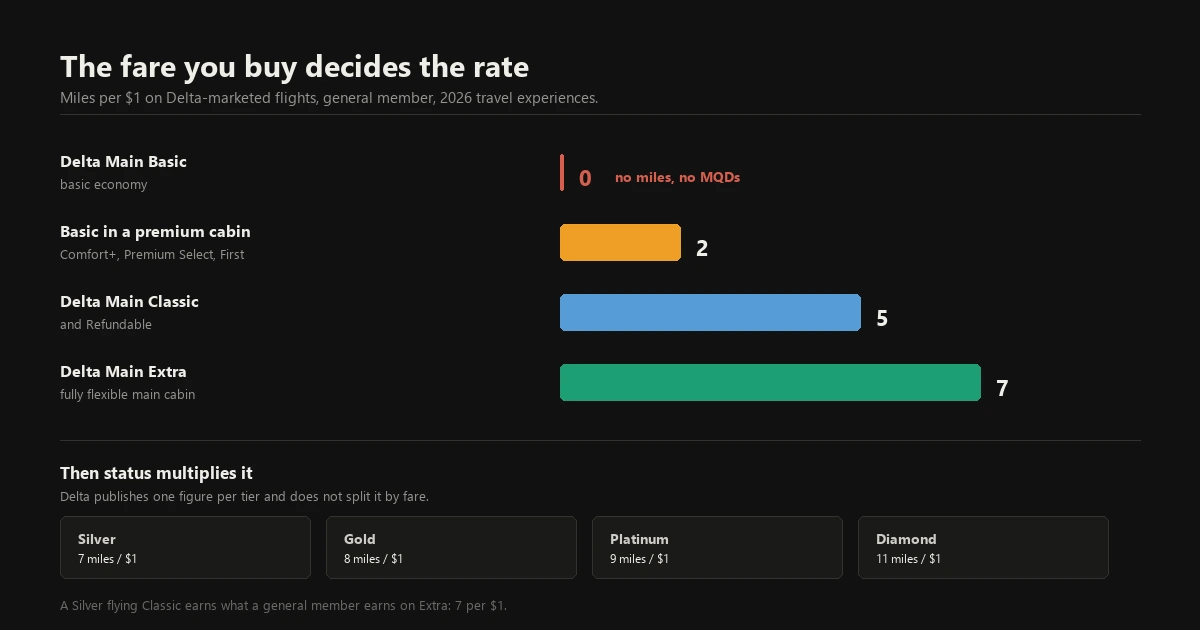
Because Delta does not publish a combined table, treat the tier figures as the Classic rate plus the tier bump of 2, 3, 4 and 6 miles. On that reading a Diamond flying Extra earns 13 miles per dollar, or about 15.6 per cent of the fare. It is the single best return in the programme, and it is also the one number on this page I would not quote as official: the only figure Delta commits to in writing is 11.
Notice one oddity in the ladder. A Silver Medallion flying Classic earns seven miles per dollar, exactly what a member with no status earns on Extra. Status and fare choice are substitutes, and if you cannot have both, buying the more flexible fare is the cheaper way to close the gap. The Medallion status guide covers what each tier actually costs to reach.
3. The twelve, ranked by what $100 returns
This is the table the rest of the article unpacks. Every row is measured the same way: spend $100, receive miles, convert them at 1.2 cents. The right-hand column is the part other guides leave out, because a source that pays eight miles per dollar on a Hertz rate that is 30 per cent above the market is not paying eight miles per dollar.
| # | Source | Miles per $1 | Value of $100 | What it costs you |
|---|---|---|---|---|
| 1 | SkyMiles Shopping portal | set by each retailer, 1 to 10+ | $1.20 to $12+ | Nothing, if you were buying anyway |
| 2 | Delta Main Extra airfare | 7 | $8.40 | Nothing beyond the ticket |
| 3 | SkyMiles Dining | up to 5 | up to $6.00 | Nothing; restaurant prices do not change |
| 4 | Delta Main Classic airfare | 5 | $6.00 | Nothing beyond the ticket |
| 5 | Hertz through Delta Car Rentals | 4 | $4.80 | Hertz base rates, which run high |
| 6 | Delta Vacations package | up to 10,000 miles per booking | about $4.00 on a $3,000 trip | Package pricing versus booking the parts |
| 7 | Delta Stays, Cars and Cruises | 2 | $2.40 | The portal price versus the direct price |
| 8 | Airbnb (homes 1, experiences 3) | 1 to 3 | $1.20 to $3.60 | Nothing, inside a 10-day booking window |
| 9 | Uber and Uber Eats | 1 to 3 | $1.20 to $3.60 | Nothing |
| 10 | Starbucks | 1 | $1.20 | Nothing |
| 11 | Delta Amex everyday spend | 1 to 2 | $1.20 to $2.40 | An annual fee, and 0.8 per cent against a cashback card |
| 12 | Hotel programmes converting points to miles | 1 to 2 | $1.20 to $2.40 | Five to six cents of hotel value per mile |
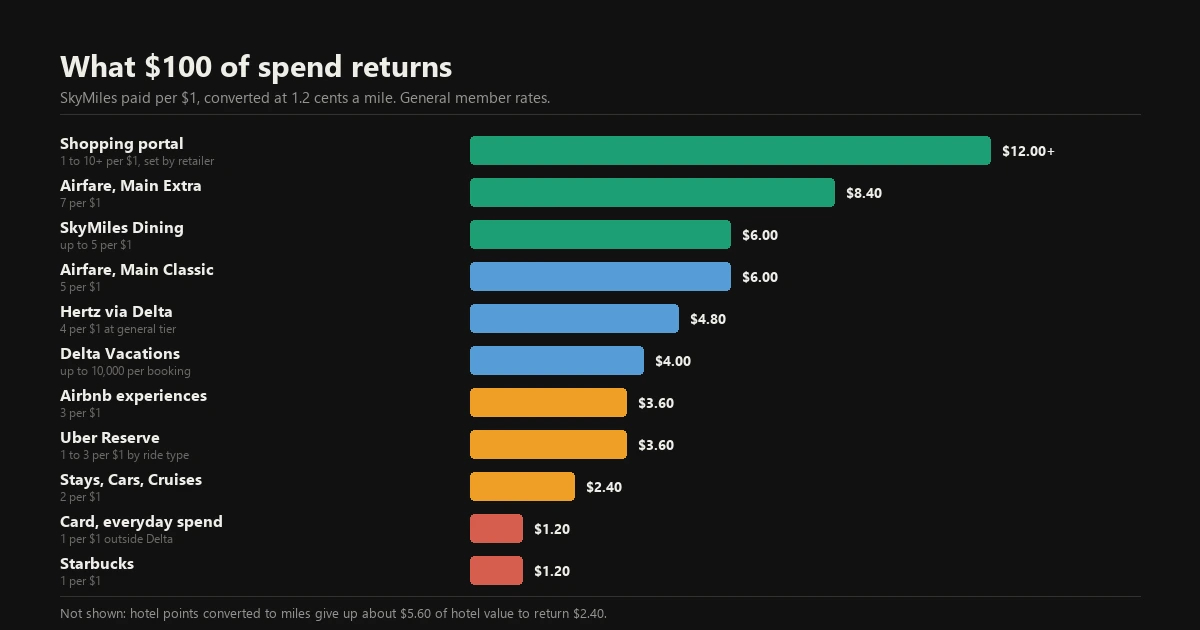
Read the table in one direction and it says something uncomfortable: the two rows that pay best are the two that have nothing to do with flying. Read it in the other direction and the worst row is not the obvious one. Hotel conversions look like a mild downgrade and are in fact the most expensive mile on the page after buying, which is a separate and even worse story covered in the guide to buying SkyMiles.
4. Three corrections that reorder the table
The ranking above uses published rates. Three adjustments change the order, and they are the reason a 7-mile source can lose to a 2-mile source.
One: the mile is worth 1.2 cents, not 1. Seven miles per dollar is 8.4 per cent of the ticket back, not 7 per cent, and one mile per dollar is 1.2 per cent, not 1 per cent. That sounds trivial until you compare it with a cashback card, where the difference between 1.2 and 2.0 per cent is the whole argument. The SkyMiles valuation guide derives that figure from real awards rather than repeating a published valuation, and the number holds up across 2026 inventory.
Two: the portal price is part of the rate. Delta Stays pays two miles per dollar, and the hotel engine behind it is run by Expedia. If the same room is $185 direct and $205 on the portal, you have paid $20 for 410 miles, which is 4.9 cents a mile for something worth 1.2. The miles did not make the booking worse by themselves — the price did. The rule is not “never book through Delta”, it is “compare before you book, and treat the difference as the real price of the miles”. Delta’s own terms are explicit that Stays miles are bonus miles and do not count toward Million Miler, and that stay spend does not earn MQDs unless a limited-time offer says so.
Three: stacking beats switching. The rows in the table are alternatives, but the best real-world outcome uses three at once. A Delta Platinum or Reserve card adds three miles per dollar on Delta purchases on top of the five to seven the flight earns, which is where Delta’s “up to 8 miles per dollar” claim comes from: five from the flight, three from the card. Then the ticket itself runs through a shopping portal where one is available, and the card still earns its normal rate on the rest of the spend. Stacked, a single $400 Extra fare can produce 3,200 miles rather than 2,800, which is a 14 per cent improvement for one click.
5. The four that cost nothing
Four sources pay miles on transactions you were going to make at the same price. They are ranked below the flight only because the ceiling is lower on a typical purchase, not because the return is worse.
SkyMiles Shopping. More than a thousand retailers pay miles when you click through the portal first, and the rate is set merchant by merchant rather than by Delta. That is why the range is so wide: a category that pays one mile per dollar and a category that pays ten look identical on the portal home page. The mechanic that matters is that portal miles stack on top of whatever your card earns, so a 10-mile merchant plus a 2 per cent cashback card is a 14 per cent return on a purchase you had already decided to make. The failure mode is equally simple: install the browser extension, forget it once, and the same purchase pays nothing. Delta periodically layers a bonus on top — the November 2026 version paid up to 2,000 extra miles for $1,200 of cumulative spend between 1 and 21 November.
SkyMiles Dining. Register a card with the dining programme, then eat at participating restaurants and the programme pays up to five miles per dollar. Delta advertises the ceiling; the actual rate depends on how far up the programme’s own ladder you are, and most members sit below five. The miles post automatically from the registered card, so nothing changes at the table. This is the highest-paying no-effort source in the programme for anyone who eats out regularly, and it is also the one most often left unregistered.
Starbucks. Link the two accounts and Starbucks purchases pay one mile per dollar, plus double Stars on days you fly Delta. One mile per dollar is 1.2 per cent, which is small, but coffee is a weekly habit and the linking takes two minutes. There is no annual cap worth worrying about.
Uber and Uber Eats. Linking the accounts pays one mile per dollar on eligible airport rides, two on premium rides and three on Reserve, with Uber Eats paying one mile per dollar on orders of $40 or more in the United States. The tiering is the point: a Reserve ride to the airport pays three times what an UberX does for the same journey, and since airport runs are the rides most people take, the difference is worth knowing before you tap the cheapest option.
6. Flights, and the two different formulas
Flying is where the programme pays best in absolute terms, and it is also where the rules change depending on who markets the ticket. There are two formulas and they do not convert into each other.
Delta-marketed flights pay by spend. Five miles per dollar on Classic and Refundable, seven on Extra, two on a premium-cabin Basic fare, nothing on Main Basic. Status adds 2, 3, 4 or 6 miles per dollar. Buy the ticket with a Delta Platinum or Reserve card and the card adds three more miles per dollar, which is how a Platinum Medallion flying Extra with the card reaches twelve miles per dollar on a $400 fare. For a family of four the calculation is worth doing in advance, because Main Basic saves perhaps $40 a seat and costs 2,800 miles across the booking, which is about $34 of value — close to a wash on the fare and a clear loss once the missing MQDs are counted.
Partner-marketed flights pay by distance. When the ticket carries a partner’s code rather than Delta’s, miles are a percentage of the distance flown, set by the fare class paid, and MQDs are calculated the same way. Delta publishes a table per airline because the percentages differ; some cheap fare classes earn nothing at all, and an award ticket never earns miles. The status bonus is different here too: instead of 2 to 6 miles per dollar it is a percentage of base miles, at 40 per cent for Silver, 60 for Gold, 80 for Platinum and 120 for Diamond. American pays exactly the same four percentages, so the bonus is not where the two programmes part company; the head-to-head with American shows where they do.
That second formula is why two people on the same aeroplane can land wildly different balances. A Delta-coded seat on a partner-operated flight earns on the fare; the identical seat bought under the partner’s own code earns on distance and fare class. Neither is automatically better — a cheap long-haul partner fare can beat a Delta fare on distance, and an expensive short Delta hop can beat both on spend — but the only way to know is to price the flight both ways, which Delta’s own booking engine will not always show you. The partner earning tables are published per airline for exactly this reason.
Award flights sit outside both formulas in a way that trips people up. An award ticket earns no redeemable miles, but it does earn MQDs on Delta and partner flights, excluding Main Basic and Basic Economy awards, and it counts toward Million Miler. Redeeming is therefore not the status dead end that most guides describe; it is a dead end for miles only. The SkyMiles promotions hub tracks what is running across the programme, including the multipliers that occasionally apply to flying.
7. The portal travel sources
Delta sells five kinds of travel beyond the seat, and all five pay miles at a rate that looks generous until you check the price you are paying for it.
| Product | Base rate | Holiday rate to 15 December 2026 | Where the miles come from |
|---|---|---|---|
| Delta Stays | 2 miles per $1 | 5 miles per $1 | Base hotel rate, before taxes and fees |
| Delta Car Rentals | 2 miles per $1, Hertz 4 to 8 | 2 miles per $1 | Base rental rate |
| Delta Cruises | 2 miles per $1 | 5 miles per $1 | Base cruise rate, port charges excluded |
| Delta Vacations | Up to 10,000 miles per booking | 3X bonus miles | Package total, plus flight miles |
| Airbnb | 1 mile per $1 on homes, 3 on experiences | 2,000 bonus miles on $50+ experiences | Booking value |
Delta Stays is a hotel engine powered by Expedia wearing Delta colours. Two miles per dollar on the room rate is 2.4 per cent, which is decent if the rate matches what you would pay elsewhere and poor if it does not. Stays miles are bonus miles: they do not count toward Million Miler, and a completed stay does not earn MQDs unless a limited-time offer says otherwise. The 5X holiday rate through 15 December 2026 changes the maths to six per cent, which is enough to absorb a small price premium but not a large one.
Delta Car Rentals pays a flat two miles per dollar with most brands, but Hertz is the exception and the rate is tiered by status: four miles per dollar for a general member, five for Silver, six for Gold, seven for Platinum and eight for Diamond. Eight miles per dollar is 9.6 per cent, the highest published rate anywhere in the programme outside a promotion, and it comes with Hertz elite status thrown in for Medallion members. The catch is the same as everywhere else on this page: Hertz base rates are usually higher than the discount brands, so the eight miles can be the most expensive ones in the rental.
Delta Cruises pays two miles per dollar on the base cruise rate, excluding port charges, taxes and travel protection, and the 5X holiday rate through 15 December 2026 makes it the best of the portal products while it lasts. Cruises are large transactions, so the absolute numbers are large too: a $4,000 base fare at 5X produces 20,000 miles, about $240 of value, which is real money against a booking most people make once a year.
Delta Vacations is the one portal product that also moves status. Packages pay up to 10,000 bonus miles per booking on top of the flight miles, and the vacation spend earns MQDs at a dollar per dollar, which almost nothing else outside flying does. That combination is why Vacations is the only row in this section I would recommend without a price check first: the MQD component has no substitute at any price.
Airbnb pays one mile per dollar on homes and three on experiences and services, after linking the accounts. The detail that catches people is the ten-day booking window, which expires and has to be renewed at deltaairbnb.com before the next booking. Miss it and the stay pays nothing.
8. Credit cards: the weakest mile and the strongest bonus
The Delta SkyMiles American Express cards are the most advertised earning method in the programme and, per dollar of everyday spend, the weakest. That is not a reason to skip them; it is a reason to use them for the right thing.
On everyday spend the cards pay one mile per dollar on the Blue and Gold outside bonus categories, two on Delta purchases for Blue and Gold, and three on Delta purchases for Platinum and Reserve. At 1.2 cents a mile, one mile per dollar is 1.2 per cent back, and two miles per dollar is 2.4 per cent. A no-fee two per cent cashback card beats the first of those outright, and matches the second without an annual fee. Anyone who moves all household spending onto a Delta card to “build miles” is choosing a 1.2 per cent return over a 2 per cent one, and paying $150 to $650 a year for the privilege.
Where the cards earn their keep is in three places that are not spend. The welcome bonus is the largest single injection of miles most people will ever receive, advertised “as high as” and therefore offered at whatever level the applicant qualifies for rather than at the headline figure. The MQD Headstart deposits $2,500 MQDs into the account each Medallion year on the Platinum, Platinum Business, Reserve and Reserve Business cards, with no spending requirement at all, which is half of Silver before a single flight. And the Reserve adds an MQD Boost that converts spending into MQDs at $10 to $1, against $20 to $1 on the Platinum, which matters only if you are deliberately buying status. The status guide works through how far that gets you.
One genuine stacking win is worth repeating: paying for a Delta ticket with a Platinum or Reserve card adds three miles per dollar on top of the flight miles, which is how Delta arrives at its “up to 8 miles per dollar on Delta purchases” claim. Three extra miles per dollar on airfare is 3.6 per cent, better than any category rate the same card pays elsewhere, and it costs nothing beyond holding the card you already have.
9. Hotel points into miles: the trade that loses
Hotel loyalty programmes will convert your points into Delta miles, and Delta lists the partners as though they were another earning source. They are not. They are a currency exchange, and the rate is bad.
Take Marriott Bonvoy, which pays two Delta miles per dollar at its premium brands and one at the select brands when you choose miles instead of points. Choosing miles means giving up the ten Bonvoy points the same stay would have earned. At the valuations this site uses, roughly 0.8 cents a point, those ten points are worth about eight cents; the two miles are worth 2.4 cents. You have spent 5.6 cents of hotel value to receive 2.4 cents of airline value, which works out to about 2.8 cents per mile.
World of Hyatt is worse. A Medallion member earns one mile per dollar at participating Hyatt hotels instead of the five points per dollar a standard member would earn. Five Hyatt points are worth roughly 7.5 cents at 1.5 cents each; one mile is worth 1.2 cents. That is 6.3 cents per mile, five times the value of the mile you receive, and it is the reason Hyatt-to-airline conversions are almost never worth making unless the points are stranded in an account you will not use. The Hyatt and Delta partnership guide covers the other direction, where the trade is considerably better.
There is one exception, and it is narrow. If the hotel points would otherwise expire unused, converting them at any rate beats losing them. That is a salvage operation, not a strategy.
10. Live holiday multipliers
Delta is running a set of holiday multipliers that end on 15 December 2026, and they temporarily overturn the ranking in section three. As of 26 November 2026:
| Offer | Rate | Window |
|---|---|---|
| Delta gift cards of $400 or more | 3 miles per $1 general, 4 for Silver and Gold, 5 for Platinum and Diamond | 9 November to 15 December 2026 |
| Delta Stays | 5 miles per $1 | Through 15 December 2026 |
| Delta Cruises | 5 miles per $1 | Book by 15 December 2026 |
| Delta Vacations | 3X bonus miles, plus MQDs | Through 15 December 2026 |
| Airbnb experiences and services | 2,000 bonus miles on $50 or more | 16 November to 15 December 2026 |
The gift card offer deserves a warning. Buying $400 of Delta credit to earn 1,200 miles is a 2.4 per cent return on money that is now locked into one airline, and the miles are worth about $14. That is a fair trade only if you were going to spend $400 on Delta anyway and would have paid cash. Anyone buying gift cards to manufacture miles has swapped $400 of cash for $400 of restricted credit and $14 of value, which is a losing position dressed as a promotion.
The Stays and Cruises multipliers are the two that genuinely beat their own base rates by enough to matter, because they apply to large transactions. The full terms, including the status tiers on gift cards, are on Delta’s holiday offers page. Everything in this section expires on the dates shown; the base rates in section seven do not.
11. Earning without flying
Miles are one currency and MQDs are another, and the second is the one that buys status. Almost everything that earns miles does not earn MQDs, which is why “earning without flying” is a much narrower idea than it sounds. There are four routes, and only four.
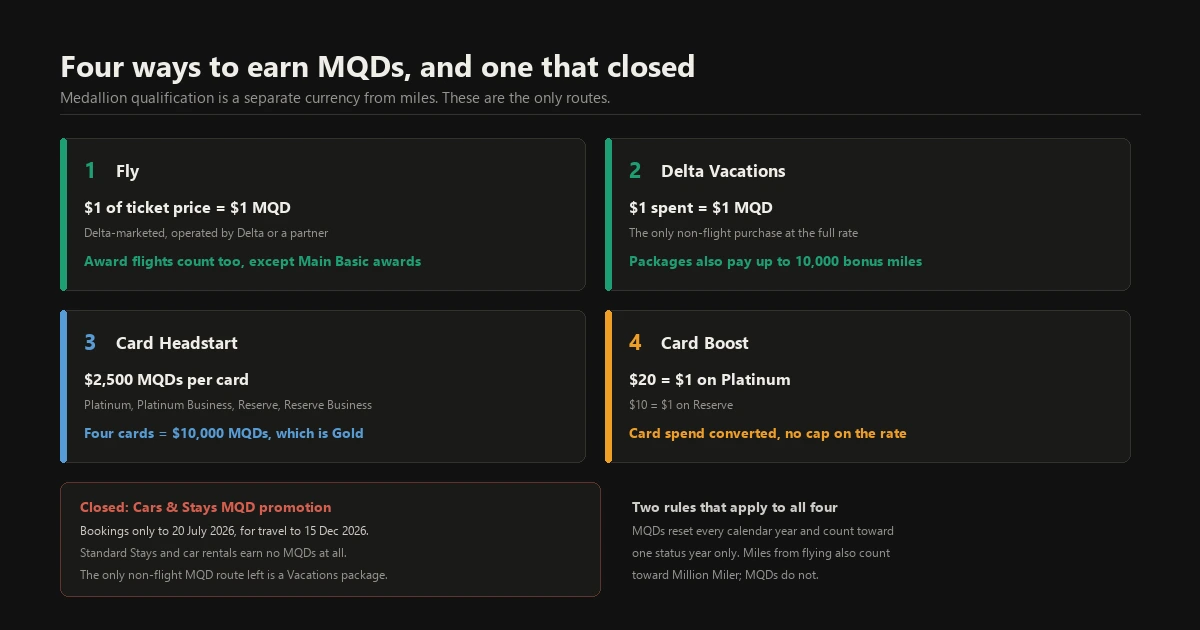
One: fly. A Delta-marketed flight operated by Delta or a partner earns one MQD per dollar of ticket price, which is the simplest rule in the programme and the only one that scales with normal travel.
Two: book a Delta Vacations package. Vacation spend earns one MQD per dollar, on top of the miles, which makes a package the only non-flight purchase that moves status at full rate. The rival programme prices the same tier differently, and the two ladders compared works out which one a card can actually buy.
Three: hold a qualifying card. The MQD Headstart deposits $2,500 MQDs per card per Medallion year on the Platinum, Platinum Business, Reserve and Reserve Business cards, with no spending attached. Four cards produce $10,000 MQDs, which is Gold Medallion without a single flight, and it is the reason the card section earlier is about status rather than about miles.
Four: convert spending into MQDs. The MQD Boost turns card spending into MQDs at $20 to $1 on the Platinum and $10 to $1 on the Reserve. At the Reserve rate, 10,000 MQDs — enough to close the gap from Silver to Gold — takes $100,000 of spending. That is a real option for a small business and a fantasy for everyone else.
One route that used to exist has closed. Delta ran a promotion through its Cars & Stays platform in 2026 that paid MQDs on standalone hotel, vacation rental and car bookings at one per cent of the pre-tax amount, with a booking window that closed on 20 July 2026 for travel through 15 December 2026. No new booking can earn under it, and standard Stays and Car Rentals bookings do not earn MQDs at all. If you have a qualifying stay from that window, the MQDs post separately and can take up to eight weeks; if you are booking now, the only non-flight MQD route left is a Delta Vacations package. The qualification rules are the controlling document, and they change more often than the mile rates do. Card multipliers are the other half of the same sum, and the card tiers compared prices them against what each card costs a year.
12. The verdict
Two numbers make the whole page. A Delta mile is worth about 1.2 cents, and the programme will sell you one for 3.76 cents while paying you 1.2 cents of value for a hotel point conversion. Everything else is detail. For what is running across the programme this month, the promotions hub is the current list; for the mechanics of turning a balance into a seat, the redemption guide covers the search order; and for the cheapest ways to add miles with cash, the buy miles hub lists every official purchase page alongside the transfer options that beat it. What those miles buy at the airport is a different question, and the Delta Sky Club access guide covers the credentials that open the door. Last updated 26 November 2026. Every rate on this page was checked against Delta’s own pages on that date, and the holiday offers in section 10 expire on the dates shown.
13. Frequently asked questions
How many Delta miles do I earn per dollar on a flight?
Five miles per dollar on Delta Main Classic and Refundable fares, seven on Delta Main Extra, two on a Basic fare inside a premium cabin and zero on Delta Main Basic, which is basic economy. Medallion status raises the rate to 7, 8, 9 or 11 miles per dollar, and paying with a Delta Platinum or Reserve card adds three more miles per dollar on Delta purchases.
Does basic economy earn SkyMiles?
No. Delta Main Basic earns neither miles nor MQDs, so a basic economy ticket makes no progress toward status and adds nothing to your balance. A Basic fare inside a premium cabin is a different product and earns two miles per dollar.
Do partner flights earn miles the same way as Delta flights?
No. Delta-marketed flights earn on the dollars spent, while partner-marketed flights earn a percentage of the distance flown based on the fare class paid. The status bonus differs too: a percentage of base miles rather than miles per dollar, at 40 per cent for Silver up to 120 per cent for Diamond. Some partner fare classes earn nothing.
Do hotel stays earn Delta miles?
Only through Delta Stays, which pays two miles per dollar on the base room rate, or by converting hotel programme points into miles. Converting is a poor trade: ten Marriott points worth about eight cents become two miles worth about 2.4 cents, and five Hyatt points worth about 7.5 cents become one mile worth 1.2 cents.
Do award flights earn miles or MQDs?
Award flights earn no redeemable miles, but they do earn MQDs on Delta and partner flights, excluding Main Basic and Basic Economy awards, and they count toward Million Miler. Redeeming a ticket costs you miles but not status progress.
What is the fastest way to earn Delta SkyMiles?
The welcome bonus on a Delta SkyMiles American Express card, which is the largest single deposit most members will receive, followed by flying Extra fares and using the shopping portal for purchases you were going to make anyway. Buying miles is the fastest way to add a specific number and the most expensive way to add any.