Flying Blue fare types are not three products. They are one award seat sold at three prices, and the cheapest of the three is a smaller ticket than the same miles bought in August. Since 8 September 2026, every new reward booking on Air France and KLM operated flights is issued as Light, Standard or Flex. The mileage figure at the top of the search results did not move. What sits behind it did. A business award across the Atlantic still starts at 60,000 miles, except that 60,000 now buys one checked bag, no lounge access and a ticket that cannot be changed or refunded. The version that includes what 60,000 included in August costs 75,000.
Short version: Light is the headline price and it is thin: in economy and premium economy there is no checked bag at all, and in business there is one 32kg bag and a lounge you pay for at the door. Standard adds the bag, the lounge and changes or refunds for €70. Flex adds free changes, free refunds and advance seat selection, at a mileage cost that rarely repays itself. The three options apply only to Air France and KLM metal, only to tickets issued on or after 8 September 2026, and only at the lowest price band, which is why Light does not appear on every flight. Partner awards are untouched. Status is the one thing that still overrides all of it: Silver keeps a bag and seat selection on Light, Gold adds the lounge, and Platinum and Ultimate keep free changes and refunds on the cheapest ticket in the programme. If you hold none of those, the honest reading is that business class now starts at 75,000 miles rather than 60,000.
What changed on 8 September 2026
Before that date, a Flying Blue award on Air France or KLM came with one set of conditions regardless of price. An economy award included a checked bag. A business award included lounge access. A change or a cancellation cost €70, and a refund cost the same. Those conditions were part of the ticket, not a separate purchase.
From 8 September, Flying Blue split that single ticket into three fare brands and modelled them on the commercial fare structure Air France and KLM already use for cash tickets. The lowest mileage price stayed where it was and became Light. The conditions that used to come with it were moved up into Standard, which costs more miles. This is worth stating plainly because the announcement framed it as more choice, and in one narrow sense it is: a traveller who flies with hand luggage on dates that will not move now pays the lowest price for a ticket that suits them. For everyone else, the same seat costs more miles than it did in August.
Two mechanics decide whether the change applies to you at all. It is judged on the issue date, not the travel date, so an award ticketed before 8 September keeps its original conditions permanently, including after a later change. And it applies only to flights operated and sold by Air France or KLM. An award on Delta, Korean Air or any other partner is still sold as a single unbranded ticket with the conditions it always had.
The official wording is short enough to quote: rewards tickets issued by Air France and KLM can be issued as Light, Standard or Flex fares from September 2026, and tickets issued before 8 September 2026 keep the conditions that applied when they were booked. La Première is outside the structure entirely, and remains bookable with miles only by Platinum and Ultimate members.
The three brands, cabin by cabin
The comparison that matters is per cabin, because the same brand name means different things depending on where you sit. In business, Light loses the lounge and the second bag but keeps SkyPriority. In economy it loses the bag entirely. In premium economy it loses both bags. Read the tables with one question in mind: what would I actually pay for separately on this trip?
Business class
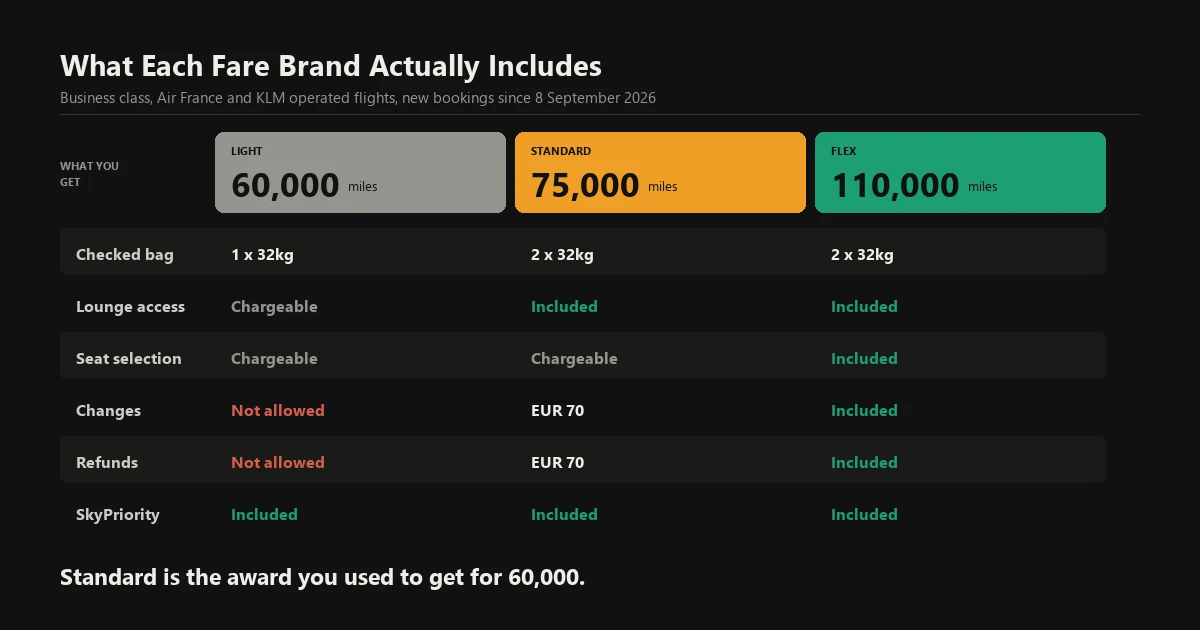
| Light | Standard | Flex | |
|---|---|---|---|
| Checked baggage | 1 × 32kg | 2 × 32kg | 2 × 32kg |
| Hand baggage | 2 items, 18kg | 2 items, 18kg | 2 items, 18kg |
| Lounge access | Chargeable | Included | Included |
| Advance seat selection | Chargeable | Chargeable | Included |
| SkyPriority | Included | Included | Included |
| Changes | Not permitted | €70 | Free |
| Refunds | Not permitted | €70 | Free |
The lounge line is the one to read twice. Every business award included lounge access before 8 September. A business Light award does not, and Flying Blue restricts that option to the O and Z booking classes, which sit at the bottom of the award ladder. If the lounge is part of why you fly business, business now starts at Standard unless buying a day pass works out cheaper for that particular trip.
Premium economy
| Light | Standard | Flex | |
|---|---|---|---|
| Checked baggage | None | 2 × 23kg | 2 × 23kg |
| Hand baggage | 1 item, 12kg | 1 item, 12kg | 1 item, 12kg |
| Lounge access | Chargeable | Chargeable | Chargeable |
| Advance seat selection | Chargeable | Chargeable | Included |
| SkyPriority | Included | Included | Included |
| Changes | Not permitted | €70 | Free |
| Refunds | Not permitted | €70 | Free |
Economy
| Light | Standard | Flex | |
|---|---|---|---|
| Checked baggage | None | 1 × 23kg | 1 × 23kg |
| Hand baggage | 1 item, 12kg | 1 item, 12kg | 1 item, 12kg |
| Lounge access | Chargeable | Chargeable | Chargeable |
| Advance seat selection | Chargeable | Chargeable | Included |
| SkyPriority | Not included | Not included | Not included |
| Changes | Not permitted | €70 | Free |
| Refunds | Not permitted | €70 | Free |
Two details sit outside the tables. There is no Basic award, even though Basic exists as a cash fare: on a purchased ticket it earns 2 XP per segment, while an award ticket earns no miles and no XP at all, whichever brand you pick. And the change and refund rules are identical in all three cabins, so the only variable between economy and business is baggage, the lounge and seat selection.
Four boundaries the charts leave out
Light only appears at the lowest price band. The brand is attached to the cheapest level of each cabin, which is why it is not offered on every flight. Once award pricing rises above that level, the ticket is sold as Standard by default. This has a practical consequence: if the dates you need carry no saver availability, the three-option screen you were promised collapses into one price, and it is the higher one.
Business Light is limited to two booking classes. O and Z only. On routes where those classes are not released, the cheapest business award you can see is already Standard.
Partner awards have no brands at all. An award flown on Delta, Korean Air, Japan Airlines or another SkyTeam or Flying Blue partner is still one ticket with one set of conditions, unchanged by any of this. If a trip mixes Air France or KLM with a partner flight, only Standard is offered, so the cheap brand disappears from mixed itineraries entirely.
You cannot mix brands within one booking. Brands can differ across cabins in the same booking, so an economy Light leg can sit next to a business Light leg. What you cannot do is put economy Light next to business Flex. If any segment needs Flex conditions, the whole booking moves up.
The price of the same seat
On a Paris to New York business award searched in November 2026, the three options priced at 60,000, 75,000 and 110,000 miles. Taxes and carrier surcharges added roughly €527 on Light and Standard, and roughly €262 on Flex. Those cash figures move with the route and the date, but the mileage ladder is the part that repeats.
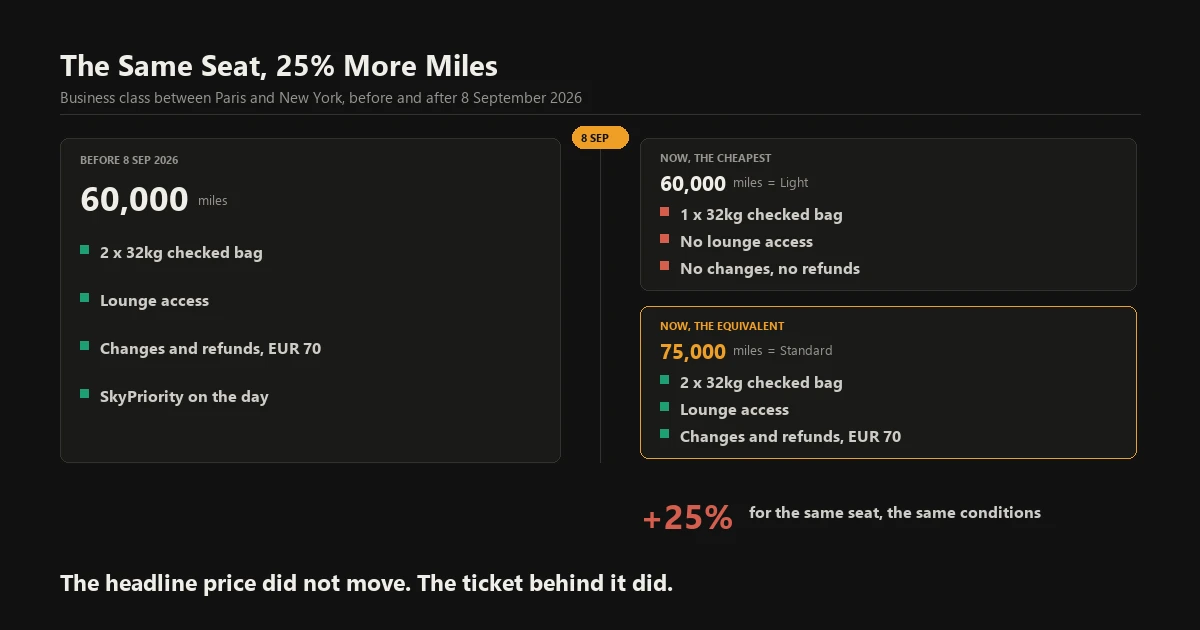
Set the old ticket beside the new ones and the arithmetic is not subtle. In August, 60,000 miles bought two 32kg bags, lounge access, and a change or refund for €70. In November, 60,000 miles buys one 32kg bag, a lounge pass you buy yourself, and no changes at all. The ticket that matches August costs 75,000. That is a 25% increase in miles for a seat that has not changed, and the increase is invisible unless you know what the old award included.
Short-haul shows the same pattern in a smaller number. A Berlin to Barcelona economy award that held at 10,000 miles under Light moves to 13,000 under Standard, a 30% rise simply to keep the bag and the flexibility that 10,000 miles used to include. Long-haul economy follows the same ratio: 25,000 at Light, higher at Standard.
None of this makes Light a bad ticket. It makes it a specific ticket. If you are flying alone, one cabin bag, dates set in advance, Light is the same award you would have booked anyway, at the same price, and the loss is theoretical. The error is booking Light by default and discovering the gap at the airport, where a checked bag on a return transatlantic trip runs more than the miles you saved. If you are short of miles for Standard, the honest alternative is not Light, it is closing the gap, and the price of a Flying Blue mile decides whether buying the difference costs less than the bag fee.
Status is the only exemption
Flying Blue status benefits apply on top of any brand, and this is where the change lands unevenly. Silver keeps one checked bag and advance seat selection even on a Light award. Gold adds lounge access. Platinum and Ultimate keep free changes and free refunds on Light, which is to say the cheapest ticket in the programme behaves like a Flex ticket for them.
Work through what that means. A Platinum member booking business Light gets two bags through status, walks into the lounge on status, and changes the ticket for free on status, having paid 60,000 miles. A member with no status booking the same seat gets one bag, pays for the lounge, and cannot change anything, also for 60,000 miles. The two passengers are on the same aircraft in the same seat, and one of them bought a materially better ticket for the same price.
That is the real story of 8 September: the fare brands did not devalue status, they priced it. Until that date, elite benefits were conveniences layered on a ticket that was already complete. Now they replace inclusions that everyone else has to buy back with miles. If you were undecided about pursuing Silver or Gold, the cheapest way to see the difference is to price a business Light award with and without status attached.
The Flex arithmetic nobody runs
Flex looks like the safe choice, and on a per-mile basis it is the worst of the three. Take the Paris to New York business example. Standard is 75,000 miles with about €527 in cash. Flex is 110,000 miles with about €262. The difference is 35,000 miles to save €265.
Divide one by the other: 265 divided by 35,000 is 0.0076 euros, or about 0.76 euro cents per mile. For context, the cheapest way to acquire Flying Blue miles in 2026 was around 1.07 euro cents each during the November multiplier promotion, and the standard purchase price is far higher. Flex therefore asks you to spend miles at a rate below what it costs to buy them. Every mile you put into that upgrade is worth less than the mile you could have bought with the same cash.
The conclusion is not that Flex is a trap. It is that Flex has exactly one justification: you genuinely expect to change or cancel, and you would rather pay in miles than in fees. If that is not you, Standard is the correct purchase, and the €70 change fee you might occasionally pay is cheaper than 35,000 miles held in reserve. Anyone who buys miles specifically to fund a Flex upgrade is paying real money for a discount that does not exist. If you are tempted, check what a Flying Blue mile costs to buy before you decide, because the comparison usually settles it.
Three questions that pick the fare
Most travellers do not need the full table. Three questions resolve it, and they are the same three every time: do you hold Platinum or Ultimate, are you checking a bag, and might your dates move.
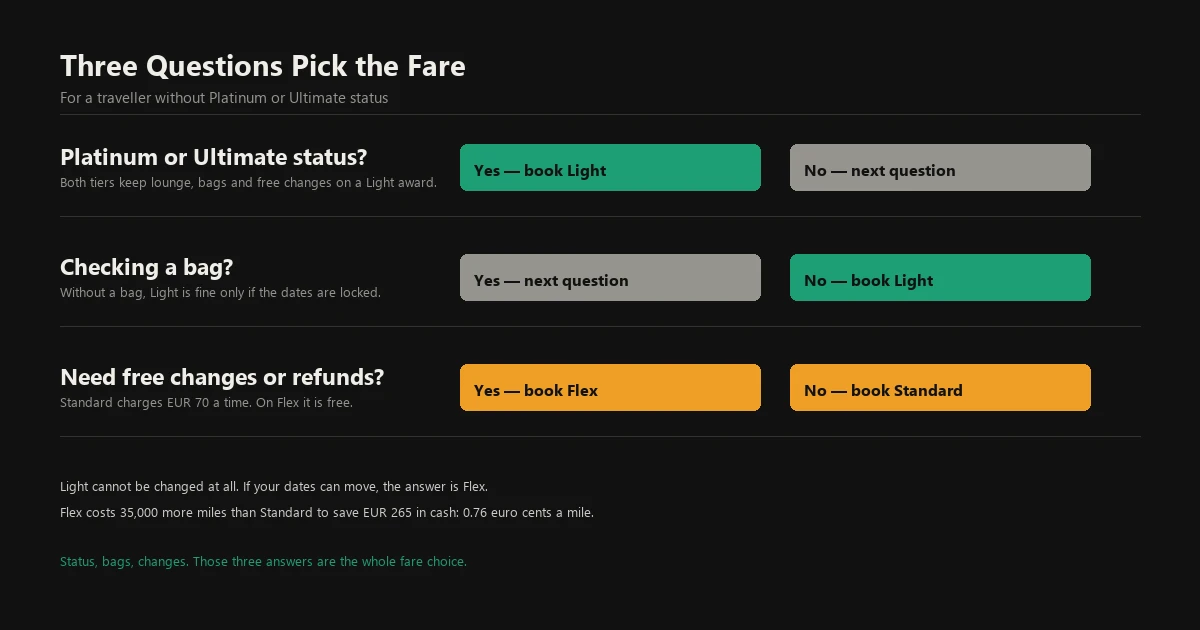
Hold Platinum or Ultimate and the answer is Light, every time, because status restores the bag, the lounge and the flexibility that Light removes. Hold nothing, are travelling with hand luggage only, and have locked dates, and Light is also correct. Hold nothing and are checking a bag, and Standard is the floor, because the bag fee on a return trip usually exceeds the mileage difference.
The last question is the one people answer wrongly. Light cannot be changed at all, not for a fee, not for a difference in fare. If there is any chance the dates move, the decision is no longer between Light and Standard, it is between Standard and Flex, and the arithmetic in the previous section applies. On a business award, that means paying 15,000 miles for the right to change at €70, and 35,000 more on top of that to change for nothing.
Two ways around the fare brands
The first is a partner award. None of this applies to Delta, Korean Air, Japan Airlines, Etihad or the rest of the partner list, where an award is still a single ticket with the conditions it always had. On some routes a partner award in business costs fewer miles than an Air France Standard award and carries a lounge and a bag as standard. Before accepting a 25% rise on Air France metal, price the same city pair through a partner, because the comparison is not the one the search screen shows you.
The second is Cash & Miles, where part of the award is paid in cash and part in miles. It sits outside the three brands and is worth checking when you are a few thousand miles short of Standard rather than Flex, since it can close the gap without committing to the most expensive option. Neither route is a loophole. Both are simply cheaper ways to buy the same seat, which is the habit worth building: the fare brand screen is one price list, not the only one.
The verdict
Light, Standard and Flex are a real choice for a narrow group and a price rise for everyone else. The narrow group is elite members and hand-luggage travellers on fixed dates, who now pay the lowest mileage price for a ticket that fits. Everyone else was buying, in August, a ticket that included a bag, a lounge and a change for €70. That ticket still exists. It costs 25% more miles and it is called Standard.
The practical rules worth keeping: treat Standard as the true business class price and plan around 75,000 rather than 60,000. Never book Light if the lounge is part of the reason for the cabin. Skip Flex unless you will genuinely change, because it converts miles at about 0.76 euro cents each. Check your status before you check the price, since status is the only thing that makes the cheapest brand whole. And if the number matters, price a partner award first. The miles are the same miles; the conditions attached to them are now a menu, and the cheapest item on the menu is the smallest.
Frequently asked questions
What are Light, Standard and Flex awards?
They are the three fare brands Flying Blue has used for reward tickets on Air France and KLM operated flights since 8 September 2026. Light is the cheapest and carries the fewest inclusions, Standard adds a checked bag, lounge access in business, and changes or refunds for €70, and Flex adds free changes, free refunds and advance seat selection. The mileage price rises with each brand. Partner awards and La Première are outside the structure.
Which fare brand should I book?
If you hold Platinum or Ultimate, book Light, because your status restores the bag, the lounge and the flexibility. If you hold no status, are travelling with hand luggage only and your dates are fixed, Light is also correct. If you are checking a bag, Standard is the practical floor. If your dates might move, skip Light entirely and choose between Standard at €70 a change and Flex at no fee.
Does a Light award include a checked bag?
In economy and premium economy, no. Light includes hand baggage only, one item of 12kg. In business, Light includes one checked bag of 32kg rather than the two that Standard and Flex allow. Silver members and above keep a checked bag on Light through their status, which is why the brand is less painful for them than for a member with no status.
Can I change or cancel a Light award?
No. Light awards cannot be changed or refunded, not for a fee and not for a difference in fare. The exception is status: Platinum and Ultimate members keep free changes and refunds on Light under their own benefits. If there is any chance your dates move, book Standard, where a change or refund costs €70, or Flex, where both are free.
Do partner awards have fare brands?
No. Awards flown on Delta, Korean Air, Japan Airlines and the other Flying Blue partners are still sold as a single ticket with a single set of conditions, unaffected by the September 2026 change. If an itinerary combines Air France or KLM with a partner flight, only Standard is offered, so the cheapest brand is not available on mixed bookings.
Is Standard worth 25% more miles?
For a business award, usually yes, because the extra 15,000 miles buys a second 32kg bag, lounge access, and the right to change or cancel for €70, which is roughly what those inclusions cost to buy separately. For economy with hand luggage only, no: the extra miles buy a bag you will not use and a flexibility you do not need. The answer depends on which of the three inclusions you would actually pay for.
More guides
- Why a cheaper fare credits fewer Miles
- Paying for a Light award with transferred points
- Extending a balance you cannot spend on a Light award
- How status overrides the cheapest award fare brand
- Flying Blue promotions: what is live, what ended, what is worth it
- Promo Rewards: how the monthly sale actually works
- What a Flying Blue mile is actually worth
- Buy Flying Blue miles: what a mile costs and when it pays
- Airline alliances explained, including where Flying Blue sits in SkyTeam
- Every official buy-points link in one place