Transfer points to Flying Blue from any of six programmes and five of them quote 1:1. That sentence is true, widely repeated, and almost useless, because the ratio describes what arrives rather than what it costs. A Capital One mile is worth about a cent as cash; a Bilt point is worth closer to 1.6 cents. Both convert at 1:1. One transfer creates value and the other destroys it, and the transfer page shows the same number for both.
The figure that decides everything is the value of the point you give up, not the value of the mile you receive. Once that is on the table, the six routes sort themselves into two clear groups: Capital One and Citi cost about a cent per Flying Blue mile, while Chase, Amex, Bilt and Marriott cost more than the mile is worth. That is the opposite of how the transfer partners are usually ranked, which tends to put Amex first because it is the programme most people already hold. Flying Blue is one destination among many, and the same arithmetic decides all of them: what each bank currency actually costs per mile across every partner.
Short version: Capital One and Citi are the only two routes that reliably cost less than the mile is worth, at roughly 1.00 cent against a Flying Blue mile valued at about 1.30 cents. Chase lands at 1.25 cents and is close to break-even; Amex and Bilt sit above the value line and are worth using only to cover a shortfall on a specific award. Marriott pays a 5,000-mile bonus at every full 60,000 points, which turns 3:1 into 2.4:1, and even then it costs 1.92 cents per mile, which is the most expensive route on the list. Transfers are one-way and cannot be reversed, so the order that matters is award first, transfer second, and only for the shortfall. A transfer also counts as an earn activity, which resets the whole balance’s expiry date by 24 months.
The ratio is not the price
A transfer costs you whatever those points would have bought elsewhere. For a programme whose points redeem at a fixed cash rate, that number is easy to look up, and it is the only number that matters. The table below uses the standard cash-out or portal value for each currency, which is the floor rather than the optimistic case; a reader who routinely gets two cents from Amex by transferring to a different airline should substitute that figure and watch the ranking change.
| Source | Ratio into Flying Blue | Value of the source point | Cost per Flying Blue mile |
|---|---|---|---|
| Capital One Miles | 1:1 | About 1.00 cent | 1.00 cent — below the mile’s value |
| Citi ThankYou (premium cards) | 1:1 | About 1.00 cent | 1.00 cent — below the mile’s value |
| Chase Ultimate Rewards | 1:1 | 1.25 cents in the portal | 1.25 cents — roughly break-even |
| Amex Membership Rewards | 1:1 | 1.5 cents, on typical airline use | 1.50 cents — above the mile’s value |
| Bilt Rewards | 1:1 | About 1.6 cents | 1.60 cents — above the mile’s value |
| Marriott Bonvoy | 3:1, or 2.4:1 at 60,000 | About 0.8 cents | 1.92 to 2.40 cents — the most expensive route |
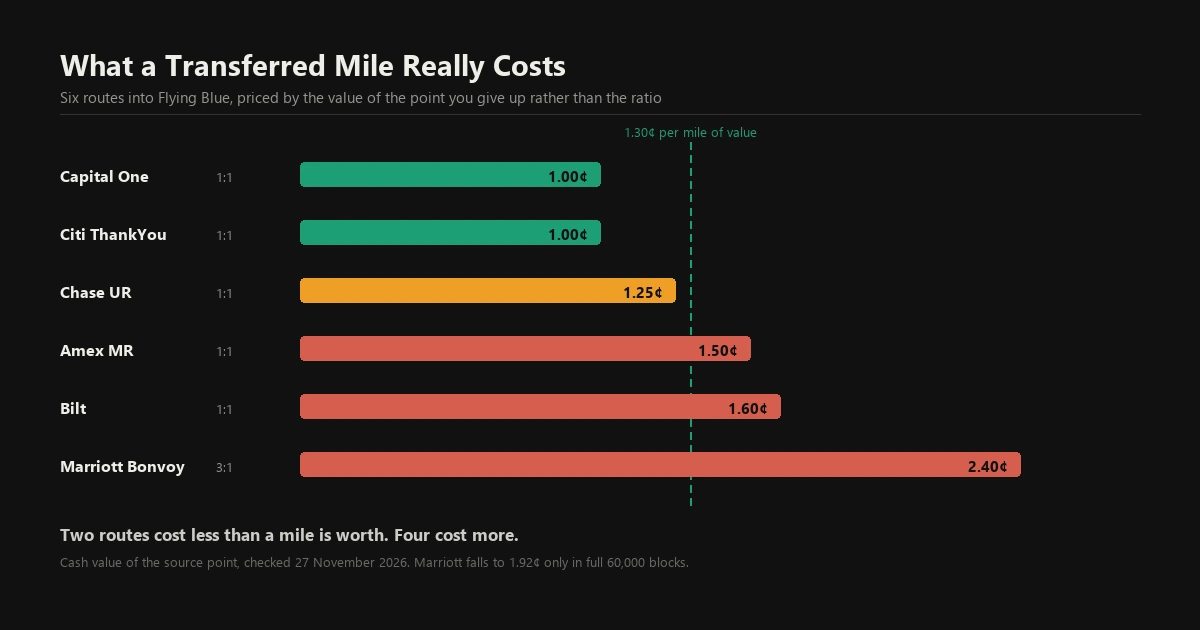
The 1.30-cent line is the valuation this site uses for a Flying Blue mile, and it comes from awards rather than from a published rate: the same mile is worth wildly different amounts depending on whether it is spent on a transatlantic business award or a short-haul economy seat. On the routes where Flying Blue is strong — Air France and KLM premium cabins, and the monthly Promo Rewards sale — a mile clears two cents with ease. On a short European hop booked at the last minute it can fall below one. The 1.30 figure is the middle of that range, and anyone whose redemptions sit at either end should adjust the threshold rather than the method.
What the table makes visible is that the four programmes most people hold are the four that cost the most. Amex and Chase dominate the US points market, so most guides start from the assumption that they are the natural route, and then explain the ratio without ever pricing the point. Bilt is the sharpest example: it is the only programme that turns rent into airline miles, it transfers at 1:1, and at 1.6 cents a point it is the most expensive of the six. Somebody who pays rent with Bilt and moves the proceeds to Flying Blue has done something reasonable and expensive at the same time, which is exactly the kind of trade that a ratio-only comparison cannot see.
Capital One and Citi sit on the other side for a structural reason rather than a generous one. Both currencies have a straightforward cents-per-point cash value, so the opportunity cost of moving them is fixed and visible. Neither programme offers a meaningful path to outsized value elsewhere, which makes Flying Blue one of the better destinations for them rather than a compromise. A point that can only be worth a cent is not devalued by becoming a mile that is worth 1.3.
What each programme actually does
Five of the six convert at 1:1 for most cardholders, so the differences that decide an actual transfer are the floor, the speed and the fine print. The floor matters because it sets the smallest useful move, and the speed matters because Flying Blue prices awards dynamically, which means an award that exists at 9am may not exist at 5pm.
| Programme | Ratio | Minimum | Typical arrival | Watch out for |
|---|---|---|---|---|
| Capital One Miles | 1:1 | 1,000 | A few hours | Transfers are final at submission |
| Citi ThankYou | 1:1 on premium cards | 1,000 | About a day | Basic cards convert at 1:0.7 |
| Chase Ultimate Rewards | 1:1 | 1,000 | Next business day, up to 7 days | Requires Sapphire Preferred, Reserve or Ink Business Preferred |
| Amex Membership Rewards | 1:1 | 1,000 | Usually instant | Canadian MR reached 1:1 only from 3 January 2026 |
| Bilt Rewards | 1:1 | 2,000 | A few hours | Rent Day frequently carries a transfer bonus |
| Marriott Bonvoy | 3:1 | 3,000 | Several days | Bonus only at full 60,000 blocks |
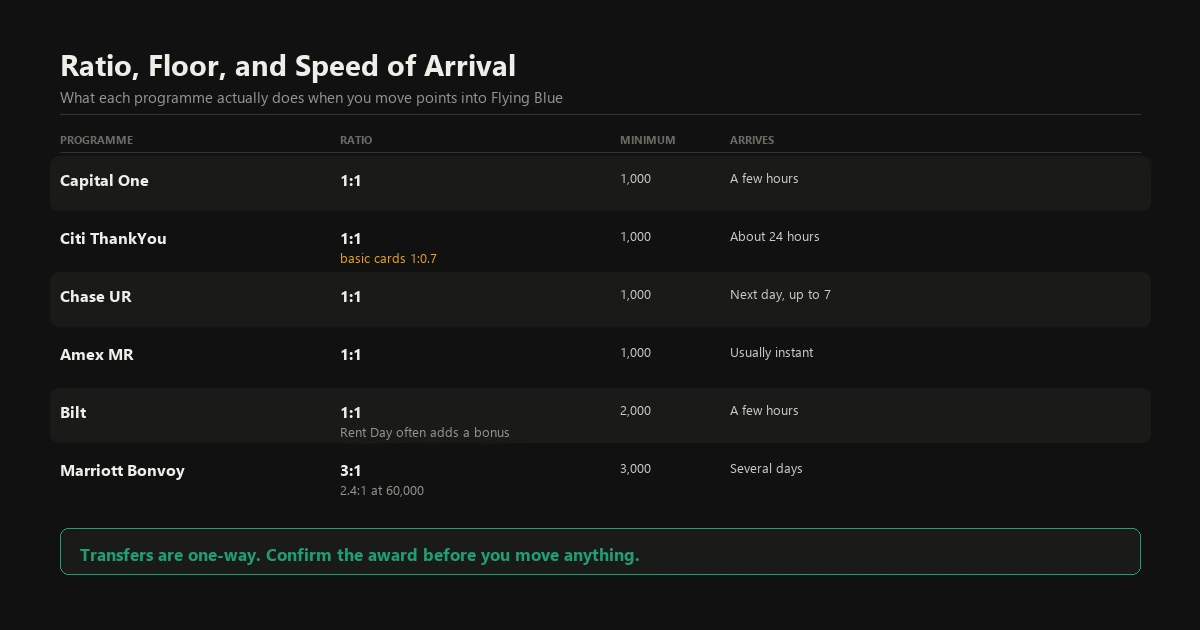
Citi has two ratios under one brand. ThankYou points from the premium cards move at 1:1, and points from the entry-level cards move at 1:0.7. A member holding a Citi card that earns ThankYou points but converts at 0.7 is looking at 1.43 cents per Flying Blue mile, which puts it above every other route on the list. The card name decides this, not the programme name, and the transfer page will show the correct ratio before submission — which is the moment to check it rather than after.
Chase is the slow one, and that is not a footnote. Chase states that most transfers complete by the next business day but can take up to seven. On a Flying Blue award that is showing three seats at a good price, a week is longer than the award will last. The workaround is not to transfer earlier and hope; it is to have the points already sitting in Flying Blue before the award you want appears, which only makes sense for members who fly the airline often enough to spend them.
Bilt carries a monthly rhythm. Transfers start at 2,000 points, which is higher than the others, and the first of the month is when Bilt runs its Rent Day promotions — bonuses on transfers, multipliers on spending, and occasionally both. A member who is going to move Bilt points anyway should look at the calendar before doing it, because the same transfer on a different day can arrive 25% to 50% larger.
Amex is fast and expensive, which is the worst combination for a spontaneous decision. Points leave immediately, the award is booked minutes later, and the 1.5 cents of value that funded it is gone. Speed is worth paying for when an award is genuinely about to disappear, and it is worth nothing when the member is transferring because the balance looked idle. The instant arrival is also what makes Amex the easiest programme to over-transfer from, since there is no waiting period in which to reconsider.
Marriott: the 60,000 rule, and why it still loses
Three to one is the worst ratio on the list, and the bonus does less for it than the marketing suggests. Every full 60,000 Bonvoy points converts to 20,000 miles plus 5,000 bonus miles, so 60,000 points become 25,000 and the effective ratio improves to 2.4:1. Below 60,000 nothing extra lands, which means a transfer of 12,000 points converts at a straight 3:1 and a transfer of 59,000 converts at a straight 3:1 as well.
Applied to the same method as every other row, the ratio is not the cost here either. Bonvoy points are worth roughly 0.8 cents each, so 3:1 costs 2.40 cents per Flying Blue mile and 2.4:1 costs 1.92. The bonus is real and it is not enough: both figures sit above the 1.30 cents a mile is worth, and both sit far above the 1.00 cent of a Capital One transfer. Marriott improves from the worst route on the list to merely the worst route on the list.
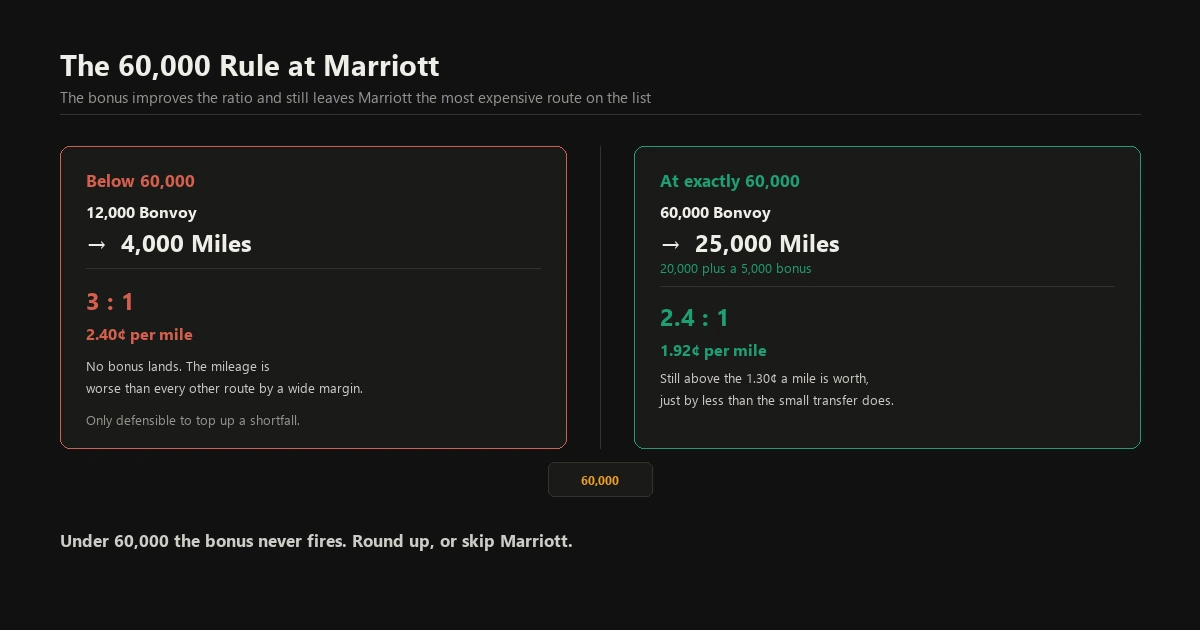
The consequence is a rule rather than a judgement. Marriott is worth using when it is the only transferable currency you hold, and then only in full 60,000 blocks. A member who needs 4,000 miles is better off transferring 4,000 points from Capital One, which costs about forty dollars of forgone value, than 12,000 Bonvoy points, which cost about ninety-six and leave 8,000 miles stranded in an account with nothing to spend them on.
There is one situation where the arithmetic flips, and it is about accumulation rather than value. Bonvoy points are the easiest flexible currency to gather by accident, through hotel stays, co-branded cards and points transferred in from elsewhere, and a member who has 180,000 of them sitting idle is holding a 75,000-mile Flying Blue balance at 1.92 cents. That is more than the mile is worth, so it is not a good trade; it is a better trade than letting the points sit unused until they are devalued, which is the realistic alternative for most people holding a large Bonvoy balance with no hotel plans. Members still adding to one rather than spending it will find booking the next stay through Marriott builds the balance without touching a bank programme at all.
One mechanical point matters before committing 60,000 points: Marriott transfers are the slowest of the six, routinely several days, and the bonus posts with the base miles rather than arriving separately. A member who transfers 60,000 on the morning an award appears will probably lose the award. Marriott suits a balance being built toward a target that is already known, and it is the wrong tool for rescuing a booking that is about to disappear.
Award first, transfer second
Transfers into Flying Blue are one-way. There is no route back to Amex, Chase, Citi, Capital One, Bilt or Marriott, no cancellation window, and no process for reversing a transfer that landed in the wrong account. That single fact dictates the sequence, and the sequence is the part most members get wrong under time pressure.
Step one: find the award and price it. Search the actual dates on the Flying Blue site and note the miles required, in the cabin you want, for the number of passengers travelling. Flying Blue prices dynamically, so the same route can differ by tens of thousands of miles between adjacent dates, and the figure that matters is the one attached to a seat that is actually for sale. A transfer based on a mileage chart rather than a live search is a transfer based on an average.
Step two: subtract what you already hold. The amount to transfer is the shortfall, not the award price. A member with 42,000 miles facing a 50,000-mile award needs 8,000 points, and transferring 50,000 leaves 42,000 miles stranded in an account that will need its own reason to exist. The leftover miles do not expire any faster — a transfer is itself an activity, which is covered below — but points that could have stayed in a flexible currency have become miles that can only be spent one way.
Step three: transfer in one move, then book. Splitting a transfer across two submissions adds a day to the timeline and gains nothing, because the ratio does not improve with size except at Marriott’s 60,000 threshold. Submit once, wait for the miles to appear in the Flying Blue account, confirm the award is still available, and book. The gap between arrival and booking is the only risk left, and it is measured in minutes for Capital One and hours for Chase.
Names are the other thing that stops a transfer, and they stop it silently. The name on the bank account and the name on the Flying Blue account must match; a middle initial, a maiden name or a hyphen is enough to have a transfer rejected or held. Members who have changed names on one side should fix it before the day they need the miles, because the fix takes days and the award does not wait.
A transfer also resets the expiry clock
A transfer into Flying Blue is an earn activity, and an earn activity extends the validity of the entire Miles balance by 24 months from the date of that activity. That makes a transfer the only move in the programme that does two jobs at once: it buys miles for a specific award and it resets the expiry date on everything already in the account.
The comparison that makes this concrete is a purchase. Buying Miles does not extend validity, because a purchase is a cash transaction rather than an activity recorded against a flight or a partner. A member who spends money on 2,000 miles three weeks before the expiry date has bought 2,000 miles and kept the same date; a member who transfers 2,000 points has bought 2,000 miles and moved the whole balance forward two years. The costs are similar and the outcomes are not. The full expiry rules cover who is exempt and what does not count, which is a longer list than most members expect.
Two details are worth carrying into the decision. The first is that the clock runs from the date of the activity, not the date the miles post, so a transfer submitted on the last day of the window is not necessarily a transfer recorded inside it. The second is that a transfer of 1,000 points is enough — the smallest permitted move does the same job as a large one, which makes expiry rescue the cheapest use of a transfer and the reason to keep a small balance in a flexible currency rather than converting it all at once.
When a bonus window changes the answer
Transfer bonuses are how the arithmetic moves. During 2026, Amex ran a 25% bonus into Flying Blue that closed on 31 October, and Capital One ran a 20% bonus that closed on 30 November. At 25%, Amex drops from 1.50 cents per mile to 1.20, which moves it from the wrong side of the 1.30 line to the right side. At 20%, Capital One drops from 1.00 to 0.83, which is below the best buy-miles price of the year at 1.24.
That is the correct way to read a bonus: not as a gift of 25% more miles, but as a temporary cut in the price of the mile, which can flip a route from value-destroying to value-creating. A 25% bonus on the most expensive programme is worth more than a 25% bonus on the cheapest one, because it is the expensive programmes that need the discount to become competitive.
The mistake the bonuses encourage is waiting with no award in mind. A member who transfers during a window because the window exists has converted a flexible balance into miles at a moment when nothing needed buying, and the 25% gain has to be weighed against the possibility that the award they eventually want is priced higher than the value they received. A bonus covers a fifth or a quarter of the cost; choosing the wrong destination or the wrong cabin loses all of it and more. The sane version of the strategy is to hold points in the flexible currency until an award appears, then check whether a bonus happens to be running, then transfer. That order keeps the optionality and collects the bonus when it is free.
If you have no bank points
Members without a transferable currency are not without routes, but every alternative costs more per mile. The closest substitute is a hotel night booked through a Flying Blue partner, which earns miles at whatever rate the partnership pays and, more usefully, registers an earn activity that resets the expiry date. Booking a stay through the programme is worth doing when a trip is already planned, because the money buys a room as well as the activity.
The other substitute is buying the miles, which is the most expensive regular route and the one the programme promotes hardest. Buying is defensible in one narrow case: a member is short a few thousand miles for a specific award, has no transferable points, and the award is worth more than the purchase premium. Checking what the miles cost to buy before committing is the only way to know whether the shortfall is cheaper to buy or to abandon — and for anyone holding Capital One or Citi points, the answer is almost always that the transfer is cheaper.
Which balance is worth transferring for
The decision is not whether Flying Blue is a good programme, because it is a good programme for the routes it serves. The decision is whether this particular balance, at this particular moment, is better as miles than as points. Three cases cover most of it.
| Situation | What to transfer | Why |
|---|---|---|
| An award is available and you are short by less than 30% | Only the shortfall, from Capital One or Citi first | The mile is worth 1.30 cents and the transfer costs 1.00, so the gap is profit |
| An award is available but the shortfall is large | The shortfall from Capital One, then Citi, then Chase | Working down the cost ladder keeps the blended price under the mile’s value |
| No award in mind, balance idle | Nothing, unless the expiry date is close | Points keep their options; miles do not |
| Expiry date inside 90 days and the balance is small | 1,000 points from the cheapest programme you hold | Resets 24 months for about ten dollars of value |
The first case is where most value is created, and the third is where most of it is lost. Idle balances transferred during a bonus window because the window looked like an opportunity are the classic version of the mistake: the points were liquid, the miles are not, and the award that eventually gets booked was not the one that justified the transfer. Flying Blue prices dynamically, so a balance transferred in March for a trip in August may buy fewer miles of seat than it did on the day it arrived.
Is it worth it at all
For a member holding Capital One or Citi points and flying Air France or KLM business class, the transfer is the best use of those points available, and the margin is real: 1.00 cent paid for a mile worth 1.30 on an award, before any bonus. For a member holding Bilt or Amex and flying economy on a route where cash fares are low, the same transfer destroys value even though nothing about it looks wrong on the transfer page.
The useful test is the one that decides every points decision: what would these points have bought instead, and what will these miles buy now. If the miles complete an award that would otherwise cost cash, and the points had no better destination, the transfer is correct. If the miles are being accumulated toward a trip with no date, the points were already doing that job with more flexibility.
Members who are going to hold miles regardless should know what they are worth before committing more: the monthly Promo Rewards sale is where a mile stretches furthest, and which fare brand you book decides what the resulting ticket can do. Neither changes the cost of the transfer, but both change what the mile is worth at the end of it, and the transfer only makes sense if the answer is well above 1.30 cents.
Frequently asked questions
Which programme is the cheapest way to get Flying Blue Miles?
Capital One and Citi ThankYou, on their premium cards. Both convert at 1:1 and both currencies are worth about a cent as cash, so the real cost is roughly 1.00 cent per Flying Blue mile against a mile valued at about 1.30 cents. Chase costs about 1.25 cents, Amex about 1.50 and Bilt about 1.60. Marriott is the most expensive at 2.40 cents, or 1.92 cents once the bonus at each full 60,000 points is counted.
Do all bank programmes transfer to Flying Blue at 1:1?
Five of the six do for most cardholders: Amex Membership Rewards, Chase Ultimate Rewards, Capital One, Bilt Rewards and Citi ThankYou on premium cards. The exceptions are Citi entry-level cards, which convert at 1:0.7, and Marriott Bonvoy, which converts at 3:1 and improves to 2.4:1 at each full 60,000 points.
How long does a transfer to Flying Blue take?
Amex usually arrives instantly, Capital One and Bilt within hours, Citi in about a day, and Marriott over several days. Chase is the slowest, with most transfers completing by the next business day but some taking up to seven, which is long enough to lose a dynamically priced award.
Can I transfer Flying Blue Miles back to a bank programme?
No. Transfers are one-way and cannot be reversed, cancelled or moved to a different Flying Blue account. That is why the order matters: find the award, confirm it is available, work out the shortfall, and only then transfer.
Does transferring points extend my Flying Blue Miles?
Yes. A transfer counts as an earn activity, and each earn activity extends the validity of the entire Miles balance by 24 months from the date of the activity. Buying Miles does not do this, so a transfer of 1,000 points both adds miles and resets the expiry date on everything already in the account.
Should I wait for a transfer bonus?
Only if you have an award in mind. A bonus cuts the cost per mile and can flip a route from value-destroying to value-creating, as Amex did at 25% and Capital One at 20% during 2026. But a bonus is a fifth or a quarter of the cost, and transferring with no award chosen loses the flexibility of the points for a discount that may not match the award you eventually book.
More guides
- The five programmes that transfer at 1:1
- Flying Blue promotions: what is live and what is worth it
- Do Flying Blue Miles expire? The 24-month rule
- Flying Blue elite status: what each level costs in XP
- Are Flying Blue miles worth it? The value calculation
- Promo Rewards: how the monthly sale works
- Light, Standard or Flex: what each award fare includes
Last updated: 27 November 2026.