How to earn Flying Blue Miles is a question with six answers, and the one most people start with is the slowest. Air France and KLM credit Miles on the fare you pay rather than the distance you cover, at four Miles per euro for an Explorer. A €700 transatlantic economy return carries roughly €400 of base fare after taxes and carrier surcharges, which credits about 1,600 Miles. One transatlantic economy Promo award costs 18,750. That is twelve returns to buy one seat.
The other five doors do not work that way. A single bank transfer can move tens of thousands of points into the account in minutes. A hotel stay can credit more than a long-haul flight, because the published partner rates run to 12 Miles per euro against your four. A partner airline credits on distance rather than price, which occasionally pays several times what Air France pays for the same journey. And a card sign-up bonus delivers in one approval what a year of flying might not.
Short version: Transfers are the fastest door by an order of magnitude: five bank programmes convert at 1:1, and a single transfer clears a transatlantic award outright, though what it costs depends on the point you give up rather than the ratio. Sign-up bonuses are the largest single hit and arrive once. Hotels, car rental and shopping pay up to 12 Miles per euro, three times what your first euro on an Air France flight pays. Flying is the slowest door and the only one that also earns XP, because Miles run on the fare paid while XP run on distance and cabin, and nothing converts between the two. Buying Miles is not earning: at 3.05 to 3.17 cents against a mile worth about 1.30 cents, it loses money before you spend one. The order that works is transfer for a specific award, take the bonus when a card offers one, route everyday spend through hotels and portals, and let flying be the thing that happens anyway.
The six doors at a glance
| Door | Pays | Earns XP | Reaches 18,750 |
|---|---|---|---|
| Bank transfer | 1:1 from five programmes | No | One transfer, minutes |
| Card sign-up bonus | 25,000 to 75,000, once | Rarely | One approval |
| Hotels | Up to 12 Miles per €1 | No | About five nights |
| Car rental | Up to 12 Miles per €1 | No | About five rentals |
| Shopping and everyday spend | 2 to 10 Miles per €1 | No | A quarter or more |
| Flying Air France or KLM | 4 to 9 Miles per €1 | Yes | About twelve returns |
18,750 Miles is one transatlantic economy Promo award, one way. The last column is the comparison that matters, because it is the only one that puts the six doors on a single scale.
Flying earns on the fare, not the distance
Flying Blue moved to revenue-based earning for Air France and KLM flights years ago, and the consequence is still widely misunderstood. Miles are calculated on the fare, before taxes, fees and carrier surcharges, at a flat rate per euro. The cabin does not appear in the formula at all. What appears is how much you spent.
That produces a counterintuitive result on a single route. Take Paris to New York, 3,630 miles each way, long enough that any distance-based scheme would treat it generously.
| Same route, same seat | Fare paid | Base fare | Miles |
|---|---|---|---|
| Economy Light | About €450 | About €250 | About 1,000 |
| Economy Flex | About €1,100 | About €800 | About 3,200 |
| Business Flex | About €2,800 | About €2,400 | About 9,600 |
The seat in row one and the seat in row three are the same physical seat in a different cabin, but the gap between them is not really about the cabin either. Row two proves it: a Flex economy ticket in the same cabin as row one credits more than three times as much, purely because it cost more. The fare is the input. Everything else follows.
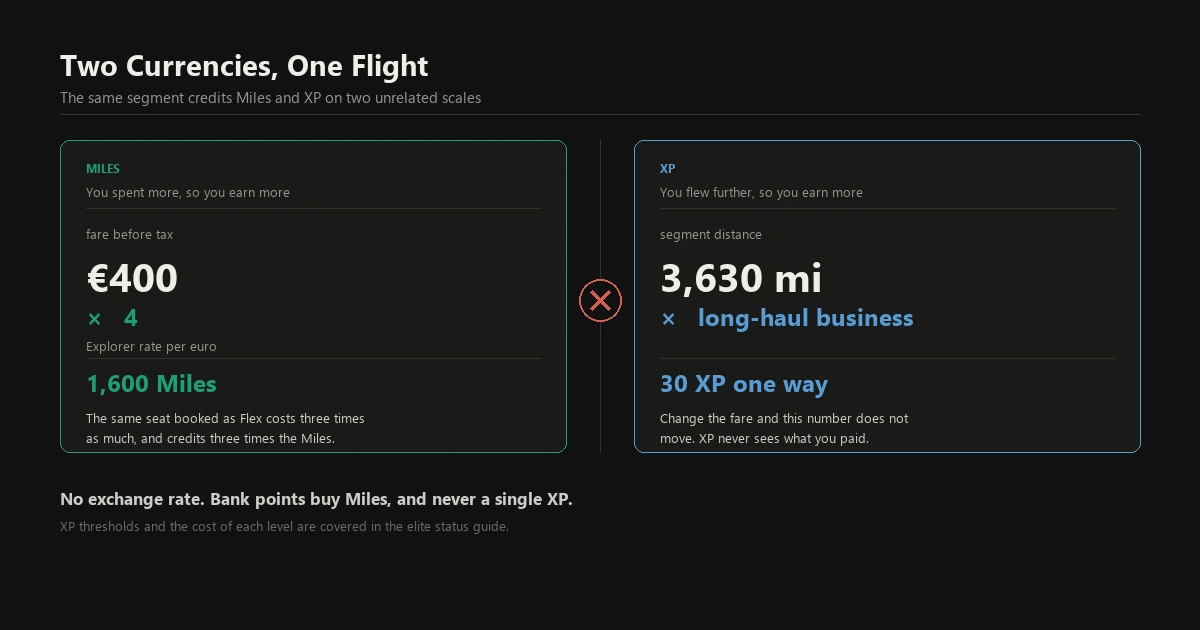
XP work the opposite way, and this is where most guides blur two separate systems into one. XP are scored on the distance of each segment and the cabin you sit in. A 3,630-mile long-haul segment in business earns 30 XP one way, and that number does not move when the fare moves. Book the same seat at a cheaper price and the Miles shrink while the XP stay exactly where they were. The two currencies are filled by different inputs, and there is no exchange rate between them, which is why no amount of transferring bank points will ever buy status. If the levels themselves are the puzzle, what each Flying Blue level costs in XP works through the arithmetic.
The multiplier is your status, not your cabin
The rate per euro is set by your elite level, and the spread is wider than most members realise.
| Level | Miles per €1 on Air France and KLM | Against Explorer |
|---|---|---|
| Explorer | 4 | — |
| Silver | 6 | 1.5× |
| Gold | 7 | 1.75× |
| Platinum | 8 | 2× |
| Ultimate | 9 | 2.25× |
An Ultimate member earns 2.25 times what an Explorer earns on identical spending, and that is the entire benefit of the multiplier. It is worth running the numbers before treating status as a Miles strategy, though. On €10,000 of annual airfare, the gap between Explorer and Ultimate is 50,000 Miles, which at a realistic 1.30 cents each is about $650 of value. Reaching Ultimate costs 900 UXP. That trade is a decision about travel and comfort rather than about Miles, and the status guide sets out the cost of each step.
The practical point for most readers is narrower: Silver, at 100 XP, lifts the rate by half and also removes the expiry problem entirely, because Miles never expire from Silver upwards. That combination makes it the cheapest meaningful improvement in the programme.
Partner airlines run the other way
Most airlines outside the Air France and KLM codes credit Miles as a percentage of the distance flown, with the percentage set by the fare class you bought. That inverts the logic. On a partner flight, a long cheap journey can out-earn a short expensive one.
| Airline | Maximum Miles credited | Basis |
|---|---|---|
| Delta Air Lines | Up to 300% of miles flown | Distance and fare class |
| Korean Air | Up to 175% of miles flown | Distance and fare class |
| Qantas | Up to 150% of miles flown | Distance and fare class |
| Aeromexico | Up to 150% of miles flown | Distance and fare class |
Paris to New York on Delta, credited to Flying Blue at the top of the Delta range, would credit over 10,000 Miles for a single one-way. The same route on an Air France economy Light fare credits about 1,000. The gap is not a mistake or a promotion; it is two different earning models sitting inside one programme.
Two cautions before anyone rebooks their life around this. The maximum applies to the most expensive fare classes, and a discounted Delta economy ticket may credit 50% or 100% rather than 300%. And Delta’s own SkyMiles programme credits on spend, so a high fare is worth a lot there too. The right move is to check the specific fare class against the Flying Blue partner table before booking, not to assume the partner route always wins. On an expensive long-haul Delta fare, it often does.
Hotels, cars and shopping pay per euro
This is the largest group of doors and the one most members ignore. The published partner rates are far higher than the rate on an Air France flight.
| Partner | Published rate | What it takes |
|---|---|---|
| Accor (ALL) | Up to 12 Miles per €1 | Stay booked through the Flying Blue link |
| Hertz | Up to 12 Miles per €1 | Rental booked through the Flying Blue link |
| Kolet eSIM | 10 Miles per €1 | Data plan bought through Flying Blue |
| Avis | Up to 5 Miles per €1 | Eligible rentals of three days or more |
| Booking.com | 2 Miles per €1 | Stay booked through the Flying Blue link |
| IHG | Up to 10,000 Miles per night | Booked as a Hotels for Miles stay |
| Hyatt | 500 Miles per stay | Any eligible stay |
Read “up to” as a ceiling rather than an average. A €300 Accor stay at the top of the range would credit 3,600 Miles, more than two transatlantic economy returns earn; the same stay at the bottom of the range credits a fraction of that, because the rate depends on the brand, the booking channel and the tier of the room, and Flying Blue does not publish the split for an individual booking. The ceiling is still the useful number, because it tells you which doors can move the balance and which cannot.
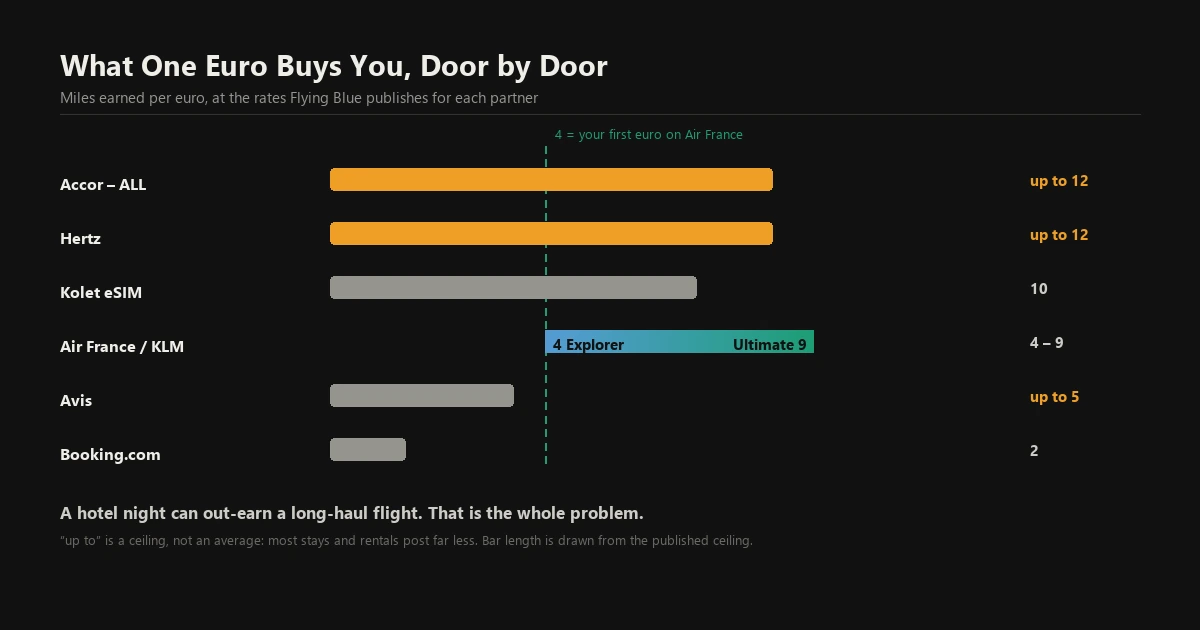
The mechanics matter as much as the rate. Every one of these routes requires you to book through the Flying Blue link rather than the hotel’s own site or a comparison engine. A stay booked directly credits the hotel’s points and nothing else. That single habit, booking Accor stays through the Flying Blue link instead of the hotel site, is worth more Miles per year than most people earn from flying.
- Shopping portal. Retail partners through Flying Blue pay between 2 and 10 Miles per euro, and the Apple and Bicester Collection routes sit at the top of that range.
- Event tickets. Concert and sport tickets bought through the Flying Blue partnership with Ticketmaster credit 10 Miles per €10 spent.
- Everyday transfers. Villa For You credits 30 Miles per €10, and the Booking.com rate stacks with its member discount rather than replacing it.
Transfers are the fastest door
Five bank programmes convert into Flying Blue at 1:1, which means a point leaves one account and arrives in the other without a haircut. Nothing else in this guide moves Miles at that speed or in that quantity. A single transfer of 18,750 points covers a transatlantic economy Promo award in minutes, while the same award would take twelve transatlantic returns to earn by flying.
The ratio is not the price, though, and that distinction is worth more than any other single idea on this page. A Capital One mile is worth about one cent as cash, a Chase point about 1.25 cents, an Amex point about 1.50 and a Bilt point about 1.60. All four convert at 1:1. What you give up differs by more than half, so the real cost per Flying Blue mile ranges from about 1.00 cent through Capital One and Citi to 1.60 through Bilt, with Marriott the most expensive route at 1.92 to 2.40 cents. The full arithmetic, including the Marriott 60,000 rule and the arrival times of each programme, sits in what transferring points to Flying Blue actually costs.
Two rules carry across from that guide. Transfers are one-way and cannot be reversed, so the order is award first, transfer second, and only the shortfall. And a transfer counts as an earn activity, which resets the expiry date on the entire balance by 24 months, something a Miles purchase does not do.
Cards, the only route that pays Miles directly
Co-branded cards are the one product that deposits Flying Blue Miles straight into the account without a conversion step. In the United States the card is issued by Bank of America as the Air France KLM Visa Signature; in Canada it is the Brim Financial World Elite Mastercard. Neither is a Miles machine in daily use, and it is worth being honest about why.
A co-branded card typically credits one to two Miles per euro on general spending. At a mile worth about 1.30 cents, that is a return of 1.3 to 2.6 percent, which is competitive with a cashback card and well behind a transferable-points card earning three points per euro on dining and travel, where the same point converts at 1:1 into Flying Blue. The card’s real value is the sign-up bonus, which lands once and can be larger than a year of flying, plus whatever benefits come with the specific product.
That makes the card a one-time event rather than an ongoing strategy. If a bonus is on offer and the award maths works, take it. Do not expect the card to build a balance through groceries.
Flying Blue Extra adds 5 Miles per €10
The paid subscription credits extra Miles on tickets and options for flights with an Air France or KLM code, as long as those flights depart inside the subscription period: five extra Miles per €10 on the Essential bundle and ten on Extended. On the Explorer rate of four Miles per euro, that is a lift of 12.5 percent on Essential and 25 percent on Extended, and it applies to retroactive claims and ticket changes within the window.
Neither percentage is the reason to subscribe, though. The subscription’s real value is elsewhere: Miles cannot expire while it runs, expiring balances are extended to the subscription’s end date rather than merely frozen, subscribers get two or four single-entry lounge vouchers depending on the bundle, a ten percent discount on the Miles portion of Cash & Miles bookings, and access to a set of Promo Rewards reserved for subscribers. The expiry rules in detail set out why the extension matters more than the bonus rate.
The programme also runs a family account under its terms, capped at eight people: two adults aged 18 or over and up to six children. Miles from every member pool into the main account, and activity on that main account keeps the whole pooled balance alive, which matters most when one member’s Miles would otherwise lapse. XP do not pool, so status stays individual.
How long each door actually takes
Putting the six doors on one timeline makes the ranking obvious, and it is not the ranking the programme’s own marketing implies.
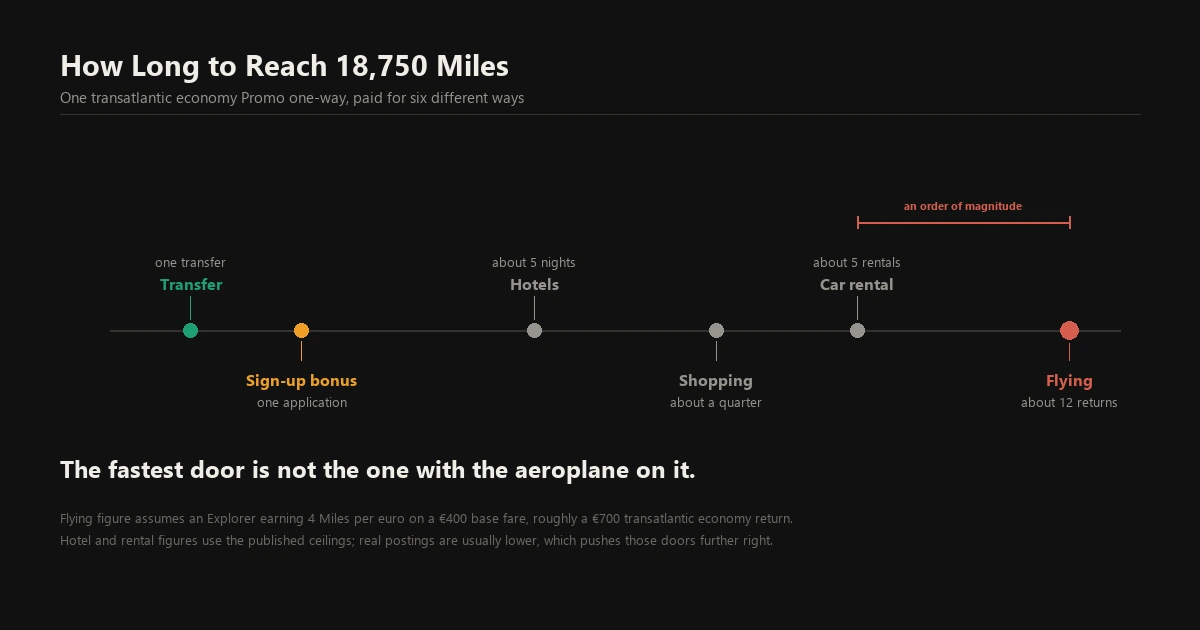
The hotel and rental positions on that timeline assume the published ceilings, so in practice they sit further right. The flying position assumes a €400 base fare and the Explorer rate, which is the median member rather than the worst case. Even with both caveats, the order does not change: the door with the aeroplane on it is the last one you should be planning around.
What does not count as earning
Three things look like earning and are not, and each one has cost real members real money.
Buying Miles. The standard rate runs $30.50 to $31.70 per 1,000 Miles, or 3.05 to 3.17 cents each, against a mile worth about 1.30 cents. Even the best promotional rate of 2026, at 1.24 cents through a Miles multiplier, only ever reaches break-even on a good award, and the multiplier windows are narrow. Buying Miles is a purchase, not an earning and the numbers on the buying guide make the case better than this page can.
Redeeming Miles. Spending does not reset the expiry clock. The 24-month timer runs from the last eligible earn activity, and a redemption is not one. Members who book an award and then wait two years have lost the balance.
Buying sustainable aviation fuel. SAF contributions earn XP rather than Miles, at 1 XP per €15 from 1 December 2026, down from 1 XP per €10, the rate that applied until 30 November 2026. XP are worth having if you are close to a level, and worthless if you are not, and none of it adds a single Mile.
One more exclusion is worth naming because it contradicts a common assumption: no Miles or XP can be earned on Flying Blue reward tickets themselves, at any fare level. A Promo award that costs 45,000 Miles in business credits nothing back.
The order that works
For anyone holding bank points, the sequence is short. Decide on a specific award first, check what it costs on the dates you want, and transfer only the shortfall from whichever programme gives up the least value. That is Capital One or Citi in almost every case, Chase when you need speed or a slightly better arrival, and Amex or Bilt only to top up an award that is otherwise out of reach. Then stop.
For anyone who flies Air France or KLM regularly, the sequence is different. The flying will happen anyway, so the work is in the surrounding spend: book hotels and cars through the Flying Blue link rather than direct, put the shopping through the portal, and let the subscription handle expiry if the balance is large. The one decision that pays for itself is Silver, at 100 XP, which fixes the rate at six and removes expiry permanently.
For anyone who simply wants one transatlantic business seat, the transfer is the whole plan. 60,000 Miles at the standard rate, or 45,000 in a Promo sale, is two or three transfers from a programme that costs a cent a point, and the rest of this page is a slower way to the same place.
Verdict: the fastest door is a bank transfer and the slowest is flying, by roughly an order of magnitude. Hotels and car rental sit in between and are the most underused, because the rates are high and the habit is easy to change. Flying is worth doing for XP and for the Miles that come with it, never as a plan for building a balance. And buying Miles is not earning at all, whatever the promotional framing says.
Last updated: 27 November 2026. Rates, partner ceilings and the XP threshold in this guide were checked against Flying Blue’s published terms on that date.
Frequently asked questions
What is the fastest way to earn Flying Blue Miles?
A transfer from a bank programme. Five of them convert at 1:1, the points arrive within minutes in most cases, and a single transfer of 18,750 points covers a transatlantic economy Promo award outright. Nothing else in the programme moves that much that quickly, including flying.
Do I earn Miles on a Light fare?
Yes, and the rate is the same as any other fare. What changes is the amount, because Flying Blue credits Miles on the fare rather than the cabin. A Light ticket costs less, so it credits fewer Miles, even though it sits in exactly the same seat as a Flex ticket that credits three or four times as much.
Why do partner flights sometimes earn more than Air France flights?
Because the two are calculated differently. Air France and KLM marketed flights credit a fixed number of Miles per euro of fare, so a cheap ticket earns little. Most partner airlines credit a percentage of the distance flown, so a long, cheap flight on Delta or Korean Air can credit more than an expensive short one on Air France.
Can I earn Flying Blue Miles without flying?
Yes, and most members do. Bank transfers, hotel stays, car rental, the shopping portal, event tickets and the Flying Blue Extra subscription all credit Miles, and none of them require a flight. The one thing that cannot be earned without flying is XP, which is what status is built from.
Do hotel stays earn Flying Blue Miles and hotel points at the same time?
Usually not both. A stay credited to the hotel’s own programme earns that programme’s points, and a stay credited to Flying Blue earns Miles instead. Accor is the partial exception, with a dual arrangement that credits both, which is why its published ceiling of 12 Miles per euro is higher than most partners offer.
How many Miles do I need before they are worth using?
A transatlantic economy Promo award starts at 18,750 Miles one way, and a business award on the same route starts at 45,000 in the Promo sale or 60,000 at the standard rate. Below roughly 6,000 Miles there is little worth booking on its own, so the practical target for a first award is 20,000.
More guides
- Flying Blue promotions: what is live and what is worth it
- Transferring points to Flying Blue: what each bank really costs
- Flying Blue elite status: what each level costs in XP
- Do Flying Blue Miles expire? The 24-month rule
- Are Flying Blue miles worth it? The value calculation
- Promo Rewards: how the monthly sale works
- Light, Standard or Flex: what each award fare includes
- Buying Flying Blue Miles: when the maths works