Credit card transfer partners are where flexible points become either a premium cabin or a 25% loss in transit. Five currencies — Amex Membership Rewards, Chase Ultimate Rewards, Citi ThankYou, Capital One Miles and Bilt Rewards — hold more than 100 partner links between them. The lists overlap heavily, and the overlap hides the only question worth asking: what does one partner mile cost you?
Most guides answer with a ratio. A ratio is not a price. It tells you how many miles land in the partner account, not what those miles are worth when you spend them. A 1:2 transfer to Hilton looks like double points and is one of the worst deals on this page. A 5:4 transfer to Cathay looks like a penalty and can still be the cheapest route to a oneworld first-class seat. The ratio is the exchange rate. The value is the destination.
The short version. Chase added Cathay and Qantas at 1:1 on 18 November 2026, but Cathay partner awards cost more from 5 January 2027. Citi is the only direct route to American. Amex is the only direct route to Delta and ANA. Bilt is the only bank currency that reaches Alaska. Hyatt is reachable from Chase and Bilt, but only Chase Sapphire Reserve still pays 1:1 after 1 October 2026, and Bilt drops to 4:3 on 1 January 2027. Everything else is a variation on 1:1, with four exceptions worth memorising.
The five currencies at a glance
Five programmes matter in the United States, and they differ less in size than in what they can reach. The table below names the one partner that makes each currency hard to replace, and the ratio that most often catches people out.
| Currency | Partners | The partner you cannot reach elsewhere | The ratio that hurts |
|---|---|---|---|
| Amex Membership Rewards | 21 | Delta SkyMiles, ANA Mileage Club | Cathay, Emirates and JetBlue at 5:4 |
| Chase Ultimate Rewards | 16 | United MileagePlus, Southwest Rapid Rewards, Cathay Asia Miles | Hyatt at 4:3 on Sapphire Preferred and Ink |
| Citi ThankYou | 20+ | American AAdvantage | 1:0.7 on no-annual-fee cards |
| Capital One Miles | 23 | Copa ConnectMiles, Finnair Plus, TAP Miles&Go | JetBlue at 5:3 |
| Bilt Rewards | 27 | Alaska Atmos Rewards | Hyatt at 4:3 from 1 January 2027 |
| Marriott Bonvoy (hotel side) | 38 airlines | 5,000 bonus miles per 60,000 points | 3:1 base ratio |
Two numbers in that table are counts of programmes, not of useful programmes. A partner you will never fly adds nothing, and a partner with no award availability on your route adds less. The rest of this page is about the difference between the two.
The ratio is the price, not the value
Start with the arithmetic every transfer hides. To receive 10,000 partner miles at 1:1, you move 10,000 bank points. At 5:4 you move 12,500. At 4:3 you move 13,333. At 1:0.7 you move 14,286. At 5:3 you move 16,667. At 3:1 you move 30,000.
None of those numbers says whether the transfer is good. They say what it costs. The second half of the calculation is what the partner mile is worth when you spend it, and that varies by more than the ratios do: a Hyatt point is worth several times a Hilton point, which is why a 1:1 into Hyatt beats a 1:2 into Hilton.
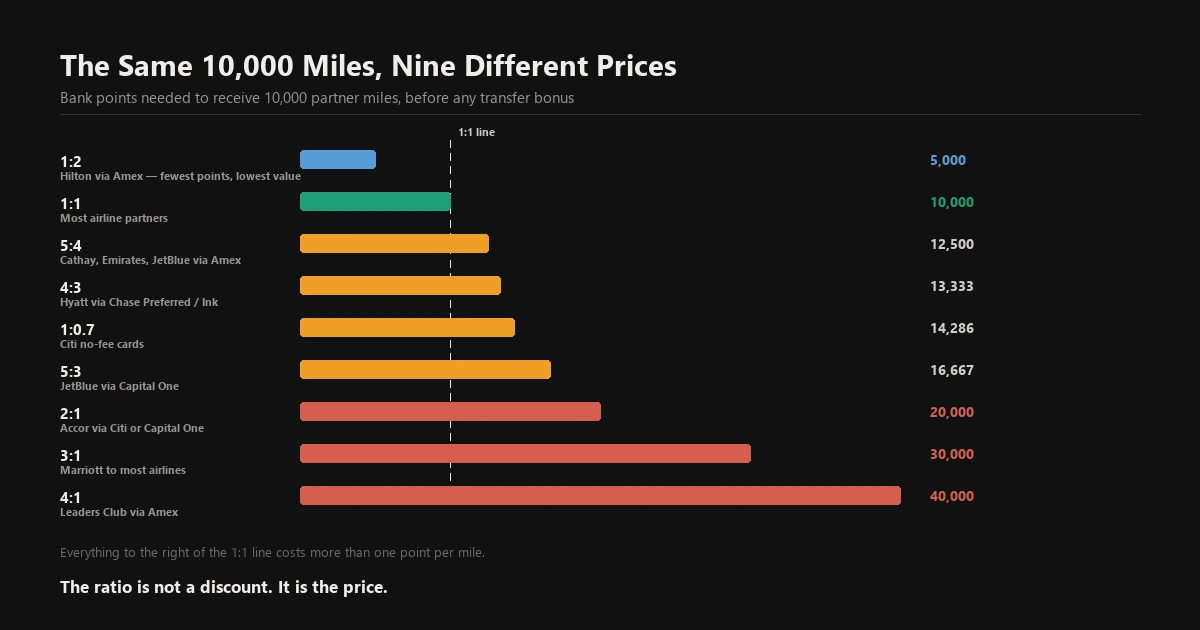
The practical rule is to price the award first, then choose the currency that gets you there at the lowest cost per mile. Doing it the other way round — collecting a currency, then looking for somewhere to spend it — is how people end up transferring 40,000 points to a programme they use once. Qatar’s Avios show the stakes: the same seat returns 1.4 to 4.0 cents depending on the fare it replaces, which is a wider range than the whole transfer table.
Which currency reaches which programme
Coverage is where the five currencies stop looking interchangeable. Ten programmes carry most of the value in this hobby, and only two of them are reachable from all five currencies.
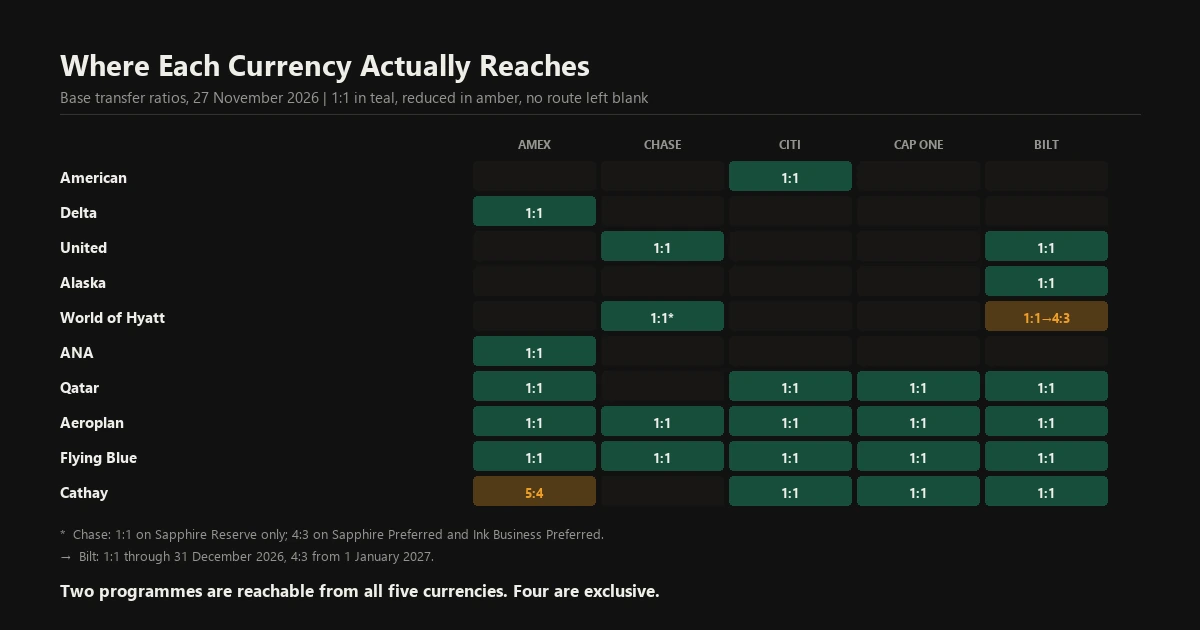
Three patterns sit inside that grid. First, Aeroplan and Flying Blue are universal: every one of the five currencies reaches them at 1:1, which makes them the default escape hatch when a transfer bonus appears or a specific Star Alliance or SkyTeam seat opens. Second, the exclusives are few and concentrated: American only from Citi, Delta and ANA only from Amex, Alaska only from Bilt. Third, the same programme can cost different amounts depending on the currency: Cathay is 1:1 from Chase, Citi, Capital One and Bilt, but 5:4 from Amex. Ten thousand Asia Miles cost 10,000 points or 12,500, depending on which card you hold. That price changed on 18 November 2026, when Chase added Cathay and Qantas at 1:1 — the first airline additions since Aeroplan in 2021, with no launch bonus.
That last point is the one most lists miss. A programme appearing in five columns does not mean it costs the same in five columns.
Amex: the widest net, three cuts
Membership Rewards reaches 21 partners: 16 airlines, four hotels and one retail programme. Fourteen of them pay 1:1, including Delta, Flying Blue, Aeroplan, ANA, Avianca, Aer Lingus, British Airways, Iberia, Qatar, Qantas, Singapore, Virgin Atlantic, Marriott and Choice.
Three of them pay 5:4 instead, and those are the ones to watch. Cathay Pacific, Emirates and JetBlue transfer at 5:4, so 10,000 Membership Rewards become 8,000 partner miles — a 20% loss before the award is priced. Aeromexico pays 1.6:1, Hilton pays 1:2, and Leaders Club pays 4:1. The Hilton ratio is the most misleading number on the page: it doubles the points and roughly halves the value, because Hilton points are worth about 0.4 cents each.
Two changes define the 2026 list. Etihad Guest was removed on 30 June 2026, and Leaders Club was added on 28 July 2026 at 4:1. Neither affects the core routes, but both are recent enough that older guides still show the previous lineup.
What Amex is genuinely for: Delta seats that no other bank currency reaches, ANA first class at 1:1, and Aeroplan or Flying Blue when a transfer bonus makes the effective cost lower than buying miles. What it is not for: speculative transfers to Cathay at 5:4, or Hilton at 1:2 unless a specific redemption already prices better than the cash rate.
Chase: the Hyatt door narrowed
Chase has 16 partners: twelve airlines and four hotels. All twelve airlines pay 1:1 — Aer Lingus, Aeroplan, British Airways, Cathay Pacific Asia Miles, Flying Blue, Iberia, JetBlue, Qantas, Singapore, Southwest, United and Virgin Atlantic. Cathay and Qantas joined on 18 November 2026; neither launched with a transfer bonus. The hotels are IHG, Marriott and Wyndham at 1:1, plus Hyatt, which is the reason most people hold the card.
Hyatt is no longer 1:1 on every Chase card. Since 1 October 2026, Sapphire Preferred, Ink Business Preferred, Ink Plus and Corporate Flex transfer at 4:3: 1,000 Ultimate Rewards become 750 Hyatt points. Sapphire Reserve and Sapphire Reserve for Business remain at 1:1. On a 60,000-point Hyatt stay, that is 80,000 points from a Preferred against 60,000 from a Reserve.
One partner left the list: Emirates ended on 16 October 2025. Two arrived on 18 November 2026 — Cathay Pacific Asia Miles and Qantas Frequent Flyer, both at 1:1. Neither changes the domestic case for United and Southwest, but Cathay arrives with a deadline attached, covered below.
What Chase is genuinely for: Hyatt on a Reserve, United for Star Alliance seats, and Southwest for the companion pass ecosystem. What it is not for: transferring to Hyatt on a Preferred without checking whether the same night prices better as a cash rate or through another currency.
Cathay: a new 1:1 door with a 5 January deadline
Chase added Asia Miles and Qantas Frequent Flyer at 1:1 on 18 November 2026, the first airline partners added to Ultimate Rewards since Aeroplan in 2021. Transfers move in 1,000-point steps and no launch bonus was attached. That makes Chase the fourth 1:1 bank route into Asia Miles, alongside Citi, Capital One and Bilt; Amex remains at 5:4.
Cathay confirmed on 25 November 2026 that from 5 January 2027, Airline Partner Awards cost more miles, depending on route and cabin. Nine of the 24 distance-and-cabin combinations rise, by up to 20 per cent: economy up to 750 miles goes from 10,000 to 12,000 Asia Miles, Los Angeles to London in first from 135,000 to 162,000, and the longest first-class awards from 170,000 to 204,000. Companion Ticket Awards end on the same date. Standard Awards and Upgrade Awards on Cathay’s own flights, and oneworld multi-carrier awards, are unchanged.
The cutoff is a ticketing date, not a travel date. A partner award ticketed by 23:59 Hong Kong time on 4 January 2027 — 10:59 a.m. Eastern that Monday — keeps the current price even for travel later in 2027. After ticketing, a date-only change keeps the old rate; changing route or cabin re-prices at the new table.
Is it worth transferring? Only against a specific booking. Points moved into Asia Miles cannot come back, and the partner side of the currency re-prices in five weeks. If the award is on Cathay metal or a partner ticket you can issue before 4 January, the new Chase door is useful. If it is a speculative balance for a partner flight you have not priced, wait: a 1:1 ratio does not protect you from a 20 per cent award increase.
Citi: the only route to American
Citi ThankYou is the only major bank currency that transfers directly to American Airlines AAdvantage, a partnership restored on 27 July 2025 after a four-year gap. That single line is the reason to hold a Citi transfer card: no other currency reaches AAdvantage, and American miles price Qatar Qsuites and Japan Airlines first class at rates the other alliances cannot match.
The ratio depends on the card, not on the points. Strata Premier, Strata Elite and Prestige transfer at 1:1 to AAdvantage and to most airline partners. No-annual-fee cards — Double Cash, Custom Cash, Rewards+, the Strata card — transfer at 1:0.7, which turns 10,000 points into 7,000 miles. Pooling points under a premium card fixes the rate; sharing points with another person ended on 17 May 2026, so the pooling has to happen between your own accounts.
The rest of the list is broad rather than deep. Japan Airlines was added on 20 September 2026 at 1:1, Copa ConnectMiles on 25 October 2026 at 1:1 on premium cards and 1:0.7 otherwise. Emirates pays 5:4. On the hotel side, Wyndham is 1:1, Choice is 1:1.5 on premium cards, and Accor is 2:1 — half the value disappears before the points land.
What Citi is genuinely for: American miles, Turkish Miles&Smiles for Star Alliance premium cabins, and Qatar Avios. Qatar is the partner where the ratio is the least of the problem: what a Qsuite award actually costs in Avios is decided by the carrier fees, not by the 1:1. What it is not for: any transfer from a no-fee card without first pooling the points.
Capital One: 23 partners, four at 4:3
Capital One Miles reach 23 partners: 19 airlines and four hotels. Fourteen airlines pay 1:1, including Aeroplan, Flying Blue, Avianca, British Airways, Cathay, Etihad, Finnair, Qantas, Qatar, Singapore, TAP, Turkish and Virgin Red. Copa ConnectMiles joined on 2 November 2026 at 2:1.5, the same effective rate as 4:3.
The reduced group is where the surprises sit. Emirates, EVA Air, Japan Airlines and Copa transfer at 4:3; JetBlue transfers at 5:3, the steepest airline ratio in the programme. On the hotel side, Choice and Wyndham are 1:1, Accor is 2:1 and I Prefer is 1:2.
The strength is Star Alliance and oneworld breadth without an annual-fee gate: VentureOne, a no-fee card, transfers at the same ratios as Venture X. The weakness is that the best partners are crowded. Turkish and Avianca are excellent, but so are they from Amex and Citi, so Capital One wins on earning rate rather than on exclusivity.
What Capital One is genuinely for: Turkish Miles&Smiles, Avianca LifeMiles, Aeroplan and Qatar Avios, all at 1:1. What it is not for: JetBlue at 5:3, or Emirates at 4:3 when Bilt still transfers to Emirates at 1:1.
Bilt: Alaska, United, and a deadline
Bilt Rewards reaches 27 partners: 19 airlines, seven hotels and Amtrak. It is the only bank currency that transfers to Alaska Atmos Rewards at 1:1, and one of only two that reaches United — the other is Chase. American is not on the list: AAdvantage left Bilt in June 2024 and has not returned, which is why Citi remains the only direct route to American.
Bilt pays 1:1 to JetBlue, Southwest, Japan Airlines, Qatar, Turkish, Cathay, British Airways, Iberia, Aer Lingus, Emirates, Etihad, Virgin Atlantic and Virgin Red. On hotels, Marriott, Hilton, IHG and Wyndham are 1:1, Accor is 3:2, and I Prefer is 1:2. Amtrak is 2:1. The minimum transfer is 2,000 points for Blue status and 1,000 for Silver and above.
The catch is dated. Hyatt is 1:1 only through 31 December 2026. From 1 January 2027 the ratio becomes 4:3 for every Bilt member and every card, including the $495 Palladium. That is covered in the next section.
What Bilt is genuinely for: Alaska seats, United seats, and any Hyatt stay you can book before the deadline. What it is not for: a speculative Hyatt transfer in December for a trip you have not priced.
The Hyatt deadline
Hyatt is the most valuable hotel transfer in the United States, and 2026 closed most of the cheap doors into it. Chase moved Sapphire Preferred and Ink Business Preferred to 4:3 on 1 October 2026. Bilt follows on 1 January 2027. After that date, the only widely available 1:1 route is Chase Sapphire Reserve, which carries a $795 annual fee.
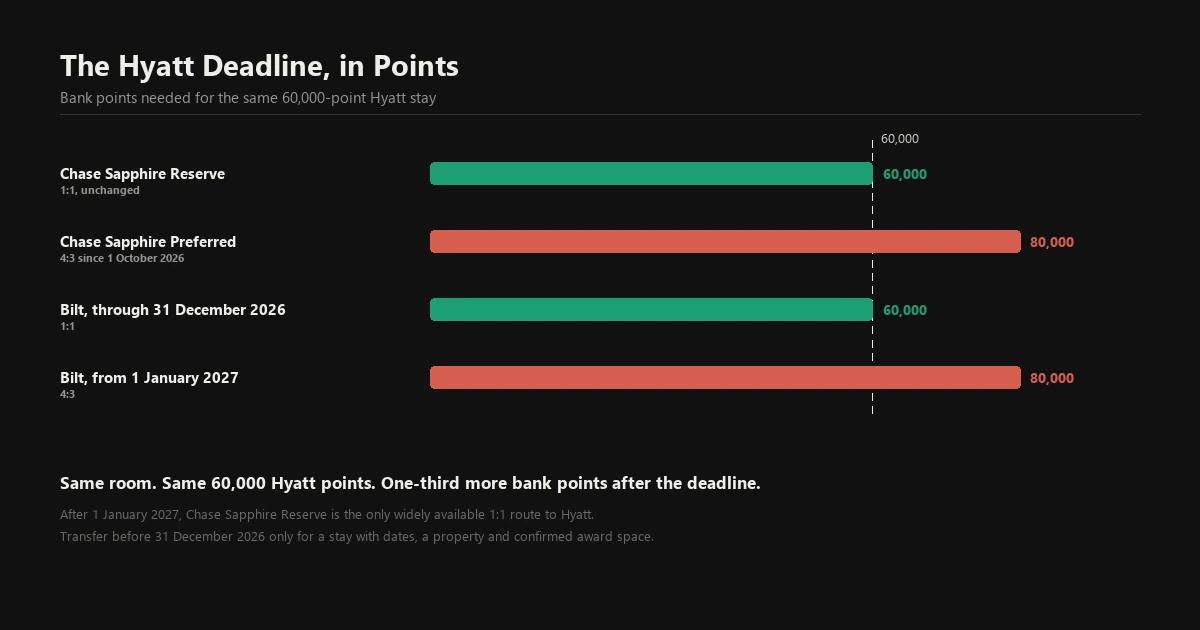
The arithmetic is the same on both sides of the deadline: a 60,000-point Hyatt stay costs 60,000 bank points at 1:1 and 80,000 at 4:3. The question is whether to move points before 31 December 2026 to lock the better rate.
The honest answer is narrower than the deadline suggests. Transfer only if you have a specific property, specific dates and confirmed award availability for 2027. Transfers are irreversible, Hyatt points expire after 24 months of account inactivity, and a locked-in balance you never spend is not a saving. If the stay is real, the pre-deadline transfer is a discount. If it is a maybe, it is a bet.
Marriott: the 3:1 route
Marriott Bonvoy is not a bank currency, but it is the largest hotel-to-airline pipeline in the market: 38 airlines, all at 3:1, with 5,000 bonus miles for every 60,000 points transferred. United pays 10,000 bonus miles per 60,000 instead of 5,000. American, Avianca and Delta are excluded from the bonus.
Run the numbers before using it. 60,000 Marriott points become 20,000 airline miles, plus 5,000 bonus, for 25,000 — an effective ratio of 2.4:1. At a mile value of about 1.3 cents, that is roughly $325 of airline value from points worth about $420–480 as hotel stays. The route only makes sense when you are short a specific number of miles for an award and have no bank currency left to move.
The exceptions matter: American, Avianca and Delta pay no bonus, so those three are a straight 3:1 and the worst of the group. United is the best, at an effective 2:1 when the full 10,000 bonus applies.
The transfers that look generous
Six transfers account for most of the value quietly lost in this hobby. Each one has a headline that sounds like a gain and a ratio that is a cost.
| Transfer | What the headline says | 10,000 points become | What it actually costs |
|---|---|---|---|
| Amex → Hilton Honors | 1:2, double points | 20,000 Hilton points | About 0.4 cents per Hilton point, so roughly a third less value than the same points sent to an airline |
| Marriott → most airlines | 3:1, plus 5,000 miles | 3,333 miles, 4,166 with the bonus at 60,000 | 2.4:1 effective, and no bonus on American, Avianca or Delta |
| Citi → Accor | Access to ALL | 5,000 Accor points | 2:1, half the balance gone before the stay is priced |
| Amex → Leaders Club | Access to Leading Hotels | 2,500 Leaders Club points | 4:1, the steepest ratio on the Amex list |
| Chase Preferred → Hyatt | Hyatt is a Chase partner | 7,500 Hyatt points | 4:3 since 1 October 2026; the Reserve still pays 1:1 |
| Capital One → JetBlue | JetBlue is a 1:1 partner | 6,000 TrueBlue points | 5:3, a 40% loss on every transfer |
The pattern is not that these programmes are bad. Hilton, Accor, JetBlue and Leading Hotels all have real uses. The pattern is that the ratio is doing the opposite of what it appears to do: it is charging you more, not giving you more.
The card-tier fine print
Four rules decide whether the ratio you read about is the ratio you get.
Chase. Hyatt is 1:1 only on Sapphire Reserve and Sapphire Reserve for Business. Sapphire Preferred, Ink Business Preferred, Ink Plus and Corporate Flex pay 4:3. The other 15 partners are 1:1 on every transferable Chase card.
Citi. Full 1:1 ratios require Strata Premier, Strata Elite or Prestige. No-annual-fee cards pay 1:0.7 to most partners. Points can be pooled between your own Citi accounts, which upgrades the rate; sharing with another person ended on 17 May 2026.
Bilt. All members receive the same ratios, but the minimum transfer differs: 2,000 points for Blue status, 1,000 for Silver, Gold and Platinum. The Hyatt 4:3 change applies to every card and tier from 1 January 2027.
Amex. Accounts whose only Membership Rewards product is a Rewards Checking or Business Checking account see a reduced partner list, limited to selected hotel and travel partners. A charge card or credit card opens the full 21.
How fast points move
Speed matters when an award seat is held and the clock is running. Most transfers are instant or land within a day; the exceptions are the ones that cost people the booking.
| Currency | Minimum | Typical posting time | Slowest partner |
|---|---|---|---|
| Amex Membership Rewards | 1,000 points | Instant to 48 hours | ANA, about four days |
| Chase Ultimate Rewards | 1,000 points, in 1,000-point steps | Instant to next business day | Up to seven business days |
| Citi ThankYou | 1,000 points | Instant to two days | Up to 14 days for some partners |
| Capital One Miles | 1,000 miles | Instant to two days | EVA and Aeromexico, about two days |
| Bilt Rewards | 1,000 points (Silver+), 2,000 (Blue) | Instant to 48 hours | Southwest, up to 72 hours |
| Marriott Bonvoy | 3,000 points | About 24 hours | Up to 3,000–240,000 points per day |
The Citi window is the one that catches people: Citi says some partners post within 24 hours and others can take up to 14 days, while the points leave the ThankYou account immediately. Never assume a Citi transfer will land in time for a seat you are holding.
How to transfer without losing them
Five steps, in this order, prevent almost every expensive mistake.
1. Price the award first. Find the seat or room, confirm availability, and write down the exact number of partner miles or points required. Do not transfer before this number exists.
2. Subtract what you already hold. The gap is the only amount worth transferring. Round numbers are how people end up with orphan balances in programmes they do not use.
3. Check the ratio on your own account. Card-tier rules mean the published ratio may not be yours. The transfer screen shows the rate that will actually apply.
4. Confirm the name match. The name on the bank account and the loyalty account must match. A middle initial or a hyphen is enough to fail a transfer, and failed transfers are slow to unwind.
5. Transfer only the gap, and keep the confirmation. Transfers are one-way. Once the points leave, the partner’s expiry rule, award chart and cancellation terms apply, and no bank will reverse the move.
Verdict
Choose the partner, then the currency. The reverse order is what produces drawers full of points that never became a seat.
For most United States readers the mapping is short. Chase Sapphire Reserve for Hyatt and United, because it is the last 1:1 door to Hyatt, and for Cathay awards ticketed before 5 January 2027. Amex for Delta and ANA, and for Aeroplan or Flying Blue when a bonus improves the rate. Citi Strata Premier for American, which nothing else reaches. Bilt for Alaska, United, and any Hyatt stay bookable before 31 December 2026. Capital One when the earning rate matters more than the partner list.
The programmes with the longest lists are not the most useful. The useful currency is the one that reaches the seat you are trying to book, at a ratio you have already checked on the screen.
Last updated: 29 November 2026. Ratios, partner lists and card-tier rules were checked against each programme’s own transfer page on that date; Cathay’s 5 January 2027 change comes from Cathay Pacific’s 25 November notice. Transfer bonuses are excluded from the tables and are covered separately when they run.
FAQ
Which credit card points transfer to American Airlines?
Citi ThankYou is the only major bank currency that transfers directly to American Airlines AAdvantage. The ratio is 1:1 on the Citi Strata Premier, Strata Elite and Prestige, and 1:0.7 on no-annual-fee cards such as Double Cash and Custom Cash. Amex, Chase, Capital One and Bilt do not transfer to AAdvantage.
Can I transfer Chase points to Delta?
No. Chase has no direct Delta transfer. The workaround is to move Ultimate Rewards to Air France-KLM Flying Blue or Virgin Atlantic at 1:1, then book the Delta seat as a partner award. The price comes from the programme you transfer to, not from Delta.
Is Amex or Chase better for transfer partners?
It depends on the partner, not the size of the list. Amex is the only direct route to Delta and ANA, and it has 21 partners in total. Chase has 16, but it is the only bank currency that reaches United and Southwest alongside Hyatt, and Hyatt remains the most valuable hotel transfer in the United States. Hold the currency that reaches the programme you actually book.
What happens to the Bilt to Hyatt transfer in 2027?
Bilt transfers to World of Hyatt at 1:1 through 31 December 2026. From 1 January 2027 the ratio drops to 4:3, so 1,000 Bilt Points become 750 Hyatt points and a 60,000-point stay costs 80,000 Bilt Points. The change applies to every Bilt card and status tier, including Palladium.
Do transferred points expire?
The partner programme’s rules apply from the moment the transfer lands. Transfers are one-way and cannot be reversed, so the receiving programme’s expiry clock, award chart and cancellation terms become yours. Check the partner’s expiry rule before moving a large balance, not after.
Which transfer ratio is the worst?
On raw ratio, Amex to Leaders Club at 4:1 and Citi to Leaders Club at 5:1 are the steepest, followed by Marriott to airlines at 3:1. On value, Amex to Hilton at 1:2 is worse than it looks: Hilton points are worth roughly 0.4 cents each, so 10,000 Membership Rewards become about $80 of Hilton points against roughly $120 of airline value.
Does Cathay Asia Miles cost more in 2027?
Yes. From 5 January 2027 Cathay raises the miles required for Airline Partner Awards on nine of 24 distance-and-cabin bands, by up to 20 per cent, and ends Companion Ticket Awards. A partner award ticketed by 23:59 Hong Kong time on 4 January 2027 keeps the old rate even for later travel. Cathay’s own Standard and Upgrade Awards and oneworld multi-carrier awards are unchanged.
More guides
The mechanics
- Buy hotel points and airline miles: every official link
- Airline alliances explained: Star Alliance, oneworld and SkyTeam
- Do points expire? Every programme’s rule
- What transferring points to Flying Blue actually costs
Programme guides
- Transferring Marriott points to airlines
- Alaska Atmos Rewards partners
- AAdvantage partner airlines
- How much are Aeroplan points worth?
Next step: open the transfer page for the currency you hold and check three ratios against your own account: the partner you use most, the one you have never tried, and Hyatt if you hold Chase or Bilt. If the screen shows a different number from the one in this article, the screen is right. Then price one award you would actually book this year and transfer only the gap.