1. Short version
Delta vs American is the comparison where two programmes that look identical on paper part company, and they do it where it matters most. Both run on the same idea, which is that a dollar spent is a dollar of status. Both count the fare and nothing else, both have four tiers, both reward the same mileage bonuses at the same rungs, and neither asks you to fly a minimum number of segments.
They part company in two places, and neither is the one the comparison tables usually pick.
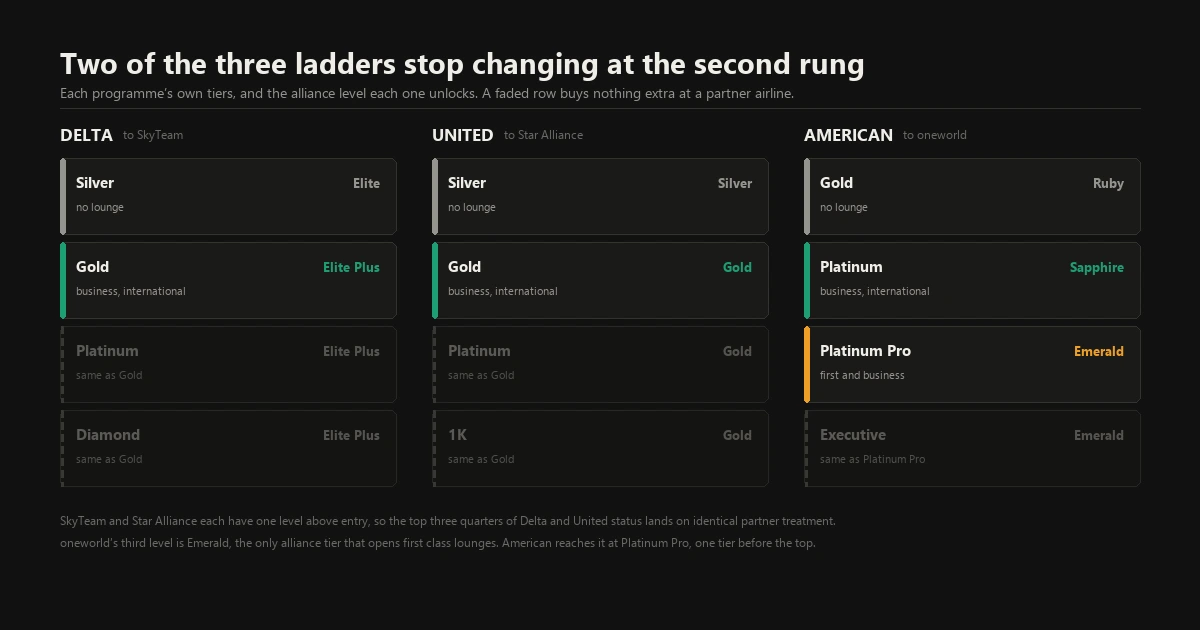
The first is the alliance ceiling. Delta Gold is SkyTeam Elite Plus, and so is Delta Platinum and Delta Diamond. SkyTeam has only one level above entry, which means three quarters of the Delta ladder buys nothing new at a partner airline. American Gold is oneworld Ruby, which does not open a lounge at all. American Platinum is Sapphire, and American Platinum Pro is Emerald, the only alliance tier in the world that opens first class lounges. Delta’s top tier cannot reach it at any price, because SkyTeam does not have that rung to sell.
The second is how the two programmes sell their way up. Delta sells a fixed allowance: four card types at $2,000 of annual fees produce $10,000 of Headstart, which is Gold. American sells an exchange rate: one point per dollar of card spending, uncapped, so Gold costs $40,000 of spending rather than $2,000 of fees. Delta is cheaper to buy and has a lower ceiling. American is ten to twenty times more expensive to buy and has a rung Delta cannot reach.

2. Three currencies that mean the same thing
Delta counts Medallion Qualification Dollars at one per dollar of ticket price, on a Delta-marketed flight, whether Delta or a partner operates it. There is no segment count and no waiver. Delta publishes four thresholds and nothing else sits alongside them.
American counts Loyalty Points. On an American-marketed fare the rate is five points per dollar of base fare and carrier-imposed surcharge, before government taxes, and the rate rises with your status: seven points at Gold, eight at Platinum, nine at Platinum Pro, eleven at Executive Platinum. That is the same ladder of bonuses Delta uses, to the point where both programmes pay a member with no status five miles per dollar and a member at the fourth tier eleven. The difference is what those numbers are attached to.
For a Delta member the bonus buys redeemable miles and nothing else, because MQD accrues at one per dollar regardless of status. For an American member the bonus buys redeemable miles and Loyalty Points, because Loyalty Points are calculated from the same figure. American’s ladder accelerates as you climb it. Delta’s does not.
That single asymmetry is why American’s four thresholds, which look enormous next to Delta’s, are not as far apart as they appear. It is also why the comparison has to be done in dollars rather than in the programmes’ own units, because 40,000 Loyalty Points and 10,000 MQD sound nothing alike and cost close to the same fare.
3. The thresholds, converted to dollars
Taking each programme at its face value, here is what the four tiers cost in airfare, with United included because it makes the third column of the market legible.
| Tier | Delta (MQD) | American (Loyalty Points) | United (PQP) |
|---|---|---|---|
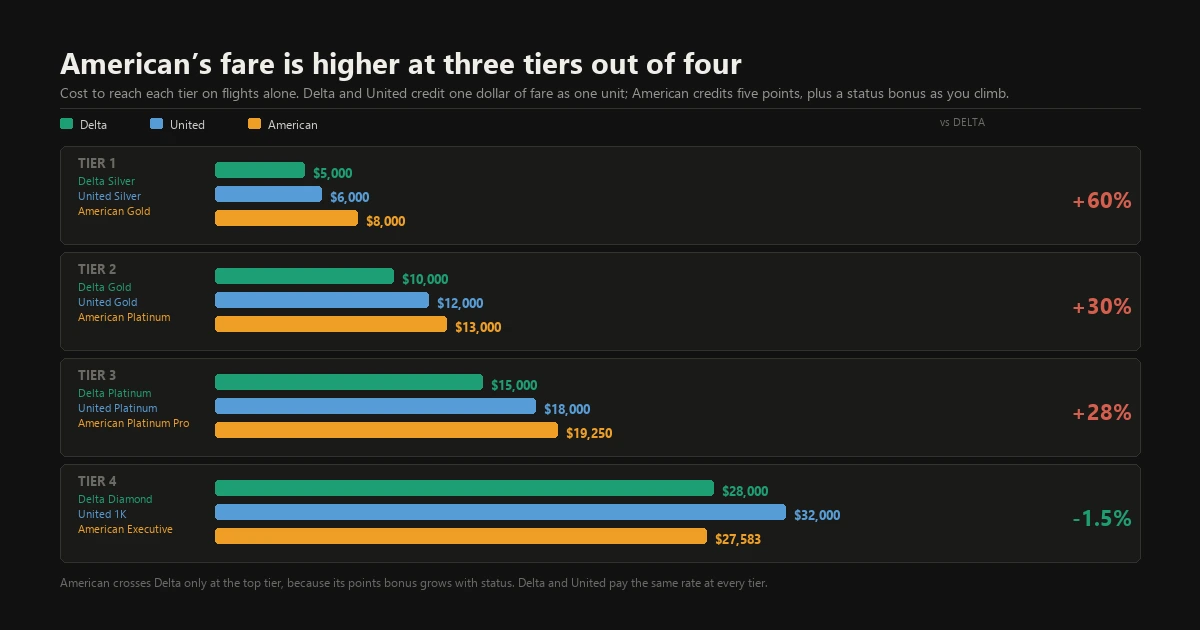
| First tier | 5,000 — $5,000 | 40,000 — $8,000 | 6,000 |
| Second tier | 10,000 — $10,000 | 75,000 — $13,000 | 12,000 |
| Third tier | 15,000 — $15,000 | 125,000 — $19,250 | 18,000 |
| Top tier | 28,000 — $28,000 | 200,000 — $27,583 | 32,000 |
The American column is not simply 40,000 divided by five. That arithmetic gives $8,000 for Gold and overstates every tier above it, because once you reach Gold the bonus starts compounding: the next 35,000 points accrue at seven per dollar rather than five, the 50,000 after that at eight, and the final 75,000 at nine. Working through it rung by rung produces $8,000, then $13,000, then $19,250, then $27,583.
Read down that column and the shape of the programme appears. American’s first tier is 60% dearer than Delta’s. The gap narrows to 30% at the second and 28% at the third. At the fourth it reverses: American Executive Platinum is $27,583 against Delta Diamond at $28,000. American’s ladder is the only one of the three that gets cheaper the further up you go, and by the top rung it is the cheapest of the three.
4. Why American is dearer at the same tier
A programme that pays five points per dollar and asks for 40,000 of them is asking for $8,000 of fares. A programme that pays one MQD per dollar and asks for 10,000 is asking for $10,000. On that comparison American should be the cheaper of the two at the entry tier, and it is not, because the thresholds do not sit at the same place on the ladder.
Delta’s Silver is the tier that costs $5,000. American’s equivalent is Gold, at $8,000, and the two are equivalent on more than price: both pay seven miles per dollar, both give one free checked bag, both give a 24-hour upgrade window, both map to the bottom rung of their alliance, and both open no lounge anywhere. American simply charges 60% more for the same position.
At the second tier the same comparison holds. Delta Gold costs $10,000 and American Platinum costs $13,000, and again the two are matched on benefits: eight miles per dollar, two free bags, the first alliance level that opens a business class lounge. The price difference is $3,000, and it buys nothing that Delta Gold does not also have.
The four Delta thresholds, and what each one opens beyond the fare, are set out in the Medallion status guide.
There is a defensible reason for the gap and it is not generosity. American’s tiers are calibrated against a card that earns one point per dollar without a cap, so the thresholds have to be set where a serious spender can reach them over a year. Delta’s are calibrated against a fare, and its card route is a separate fixed allowance bolted on top. The thresholds are doing different jobs, which is why they do not line up.
5. A ladder longer than the alliance
Both programmes have four tiers. The alliances they belong to do not.
SkyTeam has two effective levels, Elite and Elite Plus. Delta Silver is Elite, and Gold, Platinum and Diamond are all Elite Plus. Once a Delta member reaches Gold, nothing changes at a partner airline for the rest of the ladder. A Diamond member and a Gold member board the same group on a KLM flight, use the same check-in desk, and enter the same lounge under the same conditions.
Star Alliance is the same shape. United Silver is Star Alliance Silver, which buys almost nothing, and Gold, Platinum and 1K are all Star Alliance Gold. United’s top two tiers are also its middle two, as far as a partner is concerned.
oneworld is not. It has three levels, Ruby, Sapphire and Emerald, and oneworld maps American’s four tiers onto all three: Gold is Ruby, Platinum is Sapphire, and both Platinum Pro and Executive Platinum are Emerald. American’s third tier is a genuine step up at a partner airline rather than a repeat of the second.
That matters because of what the top level includes. Under the alliance’s lounge policy, Sapphire members use business class lounges and Emerald members use first class lounges as well. In practice that is the difference between the Qantas Business Lounge and the Qantas First Lounge, or the difference between a Cathay Pacific business lounge and The Pier First Class. There is no equivalent anywhere in SkyTeam or Star Alliance, because neither alliance has a level above the one Delta Diamond and United 1K already hold.
The three alliances differ in other ways too, and the alliance comparison sets out how the levels line up across all of them.
Put the two facts together and the marketing becomes clear. Delta sells four tiers and delivers two alliance outcomes. American sells four tiers and delivers three, one of which no other United States carrier can sell at all.
6. Three lounge tests, one door
Alliance level is an abstraction until you stand at a door. These are the three doors that decide whether a status is worth anything in a lounge, and the two programmes answer them almost identically until the third.
| Test | Delta Gold | American Platinum | American Platinum Pro |
|---|---|---|---|
| Own lounge, domestic flight | No | No | No |
| Own lounge, international economy | No, needs Delta One or Premium Select | Yes | Yes |
| Partner lounge, any cabin | Business class lounges, international only | Business class lounges, international only | First and business class lounges |
Domestic, own lounge: both fail. American restricts Admirals Club access for its own AAdvantage Platinum, Platinum Pro and Executive Platinum members to qualifying international flights. A Platinum flying Dallas to Chicago in Main Cabin enters nothing, and American states the restriction plainly. Delta is the same on its side: Sky Club access for SkyTeam Elite Plus is tied to international itineraries, and a Delta-issued Elite Plus needs Delta One or Premium Select on top of that.
International economy: American opens, Delta does not. This is the first real divergence and it is easy to miss. An American Platinum on a Main Cabin fare to London enters the Admirals Club at the departing airport, because Sapphire status plus an international itinerary is one of American’s published access routes. A Delta Gold on the same kind of fare enters no Sky Club, because Delta requires the premium cabin as well as the international itinerary for status-based access. The Delta member needs to be in Delta One or Premium Select; the American member only needs to be leaving the country.
Partner lounge: Emerald is a different category. Sapphire and Emerald both get in, but Emerald gets the first class side. On a Qatar Airways departure from Doha that is the Al Safwa lounge rather than Al Mourjan; on Cathay Pacific it is The Pier First rather than The Wing. Delta has no route to this at any tier, because SkyTeam does not distinguish between an Elite Plus member at Gold and an Elite Plus member at Diamond.
7. The rule American applies to its own members
American’s lounge policy contains a wrinkle that is worth stating separately, because it inverts the usual logic of loyalty.
A oneworld Sapphire member from British Airways can enter an Admirals Club before a domestic American flight in economy. A oneworld Sapphire member from American, holding American Platinum, cannot. The alliance rule for partner members is broad: any flight marketed and operated by a oneworld carrier, regardless of cabin. The rule American applies to its own members is narrower, limited to qualifying international itineraries, and American footnotes the difference on its own access page.
The likely reason is commercial rather than accidental. AAdvantage elites are the customers American wants to sell Admirals Club memberships and the Citi Executive card to, and partner elites are covered by an alliance agreement American cannot narrow unilaterally. Whatever the motive, the effect is that holding status with American buys less domestic lounge access than holding the same alliance level with a partner.
The American ladder, tier by tier, with the bonus rates and the reward milestones, is in the AAdvantage status guide.
Delta has a milder version of the same instinct. Its Sky Club rules for SkyTeam Elite Plus require Delta One or Premium Select when the status is Delta-issued, while an Elite Plus card issued by Air France or Korean Air enters on an international itinerary in economy. Both airlines have narrowed the benefit for the members they can narrow it for. Neither has narrowed it for anybody else’s.
8. What a lounge now costs at each airline
If status does not open the door, cash might. Here the two airlines have moved in opposite directions during 2026, and the numbers are the most useful part of this comparison for anybody who flies a handful of times a year.
| Product | Delta Sky Club | American Admirals Club |
|---|---|---|
| Single visit | Not sold | $79 |
| Individual annual | $695 or 69,500 miles, Medallion members only | $750, single membership, any status |
| Annual with guests | $1,495 or 149,500 miles, two guests included | $1,200 to $1,400 depending on status |
| Status discount | None by tier | $200 between no status and Executive Platinum |
Delta has closed the cash route. Single entries are no longer sold at the door, and the two annual memberships are sold only to Medallion members, which means a traveller with no Delta status cannot buy Sky Club access from Delta at all. The only route left is the Reserve card at $650 for fifteen visits a Medallion Year, which is the subject of the Sky Club access guide.
American has kept the cash route and repriced it. From 23 August 2026 the Admirals Club sells two products: a single membership at $750 for everybody regardless of status, with no guest privileges and no partner lounge access, and a full membership at $1,400 for a member with no status, $1,350 at Gold, $1,300 at Platinum, $1,250 at Platinum Pro and $1,200 at Executive Platinum. Household memberships are gone, and so is the renewal discount.
The arithmetic on that status discount deserves its own sentence. Reaching American Gold costs $8,000 of fares or $40,000 of card spending. Holding Gold reduces an Admirals Club membership by $50 a year, from $1,400 to $1,350. That is a 3.6% discount bought with a 0.125% return on the spending route. Nobody should reach Gold for the lounge discount, and American has clearly priced it on the assumption that nobody will.
9. Buying the second tier
Neither programme requires a single flight to award status, which separates both of them from United and its four-segment minimum. The routes differ in kind, though, and the prices differ by a factor of ninety.
Delta sells a fixed allowance. MQD Headstart pays $2,500 per eligible card type each Medallion Year, and four card types exist: Platinum, Platinum Business, Reserve and Reserve Business. Four deposits reach the $10,000 cap, which is exactly the Gold threshold, for $2,000 of annual fees and no flying. There is no spending requirement attached beyond holding the cards, and no way to buy more Headstart than the four deposits.
American sells an exchange rate. Every eligible dollar on an AAdvantage co-brand card produces one Loyalty Point, uncapped, and no status accelerator changes that rate. Gold therefore costs $40,000 of spending, Platinum $75,000, and Executive Platinum $200,000. Welcome bonuses do not count, because they are paid in redeemable miles rather than in Loyalty Points, and neither does spending in a category that earns two or three miles per dollar, because the Loyalty Point rate stays at one.
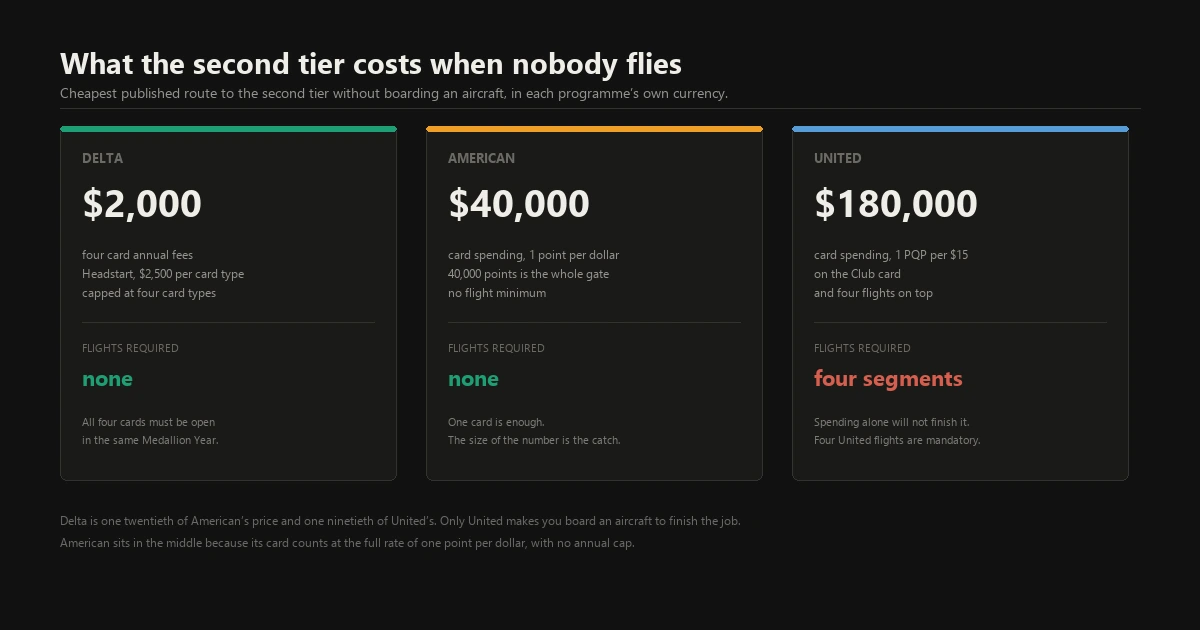
Two conclusions fall out of that structure. The first is that Delta’s route is cheaper by an order of magnitude and does not scale: whether you spend $50,000 or $500,000 on the cards, you get $10,000 of Headstart. The second is that American’s route scales linearly and is therefore only rational for somebody who was going to run that spending anyway, on a card that pays a full Loyalty Point per dollar with no cap. A business with $40,000 of unavoidable expenses and an AAdvantage card gets Gold for free. A leisure traveller manufacturing the same spend to reach Gold is paying $40,000 for a tier that Delta sells for $2,000.
10. The calendar nobody accounts for
Delta and United run on the calendar year. American runs from 1 March to the last day of February, and that difference is worth more than most of the benefit comparisons in this article.
Two practical consequences. The first is that January and February are American’s fourth quarter rather than its first, so a member who finishes the year short has two extra months to close the gap, while the same member chasing Delta has already been cut off on 31 December. The second is that a flight in February counts toward the American year that is ending and the Delta year that has just begun, which means a single trip can serve two campaigns if it is booked deliberately.
The cost is on the other side of the ledger. American status earned late in a qualification year expires sooner in calendar terms, because the year runs to 31 March rather than to 31 January, and the reset on 1 March arrives in the middle of the winter travel season rather than after it. Members who fly heavily in December and January are better served by Delta’s calendar. Members who fly heavily in February and March are better served by American’s.
One more timing detail: American has not published thresholds for the qualification year beginning 1 March 2027 as of November 2026. The current figures, 40,000 through 200,000, are the ones in force, and any guide quoting different numbers for 2027 is extrapolating rather than reporting.
11. Where American is genuinely better
Three things, and the first is not close.
The Emerald rung. American Platinum Pro reaches oneworld Emerald at 125,000 Loyalty Points, which by the arithmetic above is $19,250 of fares. From that point a member enters first class lounges on any oneworld carrier, in any cabin, on any international itinerary outside the excluded region. Delta has no product that does this. A Diamond member paying $28,000 of fares for the top Delta tier gets a level that is identical, at a partner airline, to what a Gold member got for $10,000.
Systemwide upgrades below the top tier. American’s Loyalty Point Rewards start at 15,000 points and run through a long list of milestones, and systemwide upgrades appear at 175,000. That is below Executive Platinum’s 200,000, so a member can hold upgrades without holding the top tier. Delta gates Global Upgrade Certificates behind Diamond Choice Benefits, which means the top tier is the only route.
The single membership. American will sell anybody a $750 Admirals Club membership with no status at all. Delta will not sell a Sky Club membership to a non-Medallion member at any price. For a traveller who flies Delta four times a year and American four times a year, the American side is the only one where cash alone solves the problem.
12. Where Delta is genuinely better
Four things, and the first two are structural.
It is buyable. $2,000 of annual fees for Gold, with no flights and no spending threshold, against $40,000 of card spending at American for the comparable tier. Whatever else is true, Delta is the only one of the two where a moderate outlay produces status outright rather than a fraction of it.
The ladder does not taper. Three quarters of Delta status lands on the same alliance treatment, which sounds like a criticism and is also a form of honesty: a Gold member gets the same partner experience as a Diamond member, so there is no reason to climb further for partner benefits. American’s ladder keeps promising more at a partner airline, and the promise is real, but it costs $6,250 of additional fares between Platinum and Platinum Pro to collect it.
The upgrade window is wider at every rung. Delta opens complimentary upgrades to First and Comfort 24 hours out at Silver, 72 hours at Gold and 120 hours at both Platinum and Diamond. American opens at 24 hours at Gold, 48 at Platinum, 72 at Platinum Pro and 100 at Executive Platinum. At the second tier Delta gives you three days and American gives you two; at the third Delta gives you five and American gives you three. For a member whose travel is domestic and frequent, that difference is felt on every trip.
The qualification clock is more forgiving for December travellers. A Delta year ends on 31 December, after the December travel peak has been counted. An American year ends on the last day of February, which means January and February flying counts toward the year that is closing, but also means a member who stops flying in November has three months of dead time in which nothing can be added.
13. Which ladder to climb
The decision reduces to one question: do you want the second tier, or the third?
If the answer is the second tier, take Delta. Gold costs $10,000 of fares or $2,000 of annual fees, it opens business class lounges on international itineraries, it comes with a three-day upgrade window, and it is the cheapest second tier in the United States. American’s equivalent costs $13,000 of fares or $40,000 of spending and buys a slightly narrower lounge rule and a two-day upgrade window. There is no calculation in which American Platinum beats Delta Gold for a member who is indifferent between the two airlines.
If the answer is the third tier, take American. Platinum Pro costs $19,250 of fares and delivers oneworld Emerald, which is the only alliance level that opens first class lounges. Delta’s third tier costs $15,000 and delivers Elite Plus, which is what Gold already delivered. The $4,250 difference buys a category of lounge that Delta cannot sell at any price, and for a member who flies to Asia or Europe on oneworld carriers it repays itself in two trips.
If the answer is the top tier, take American. Executive Platinum is $27,583 of fares against Delta Diamond’s $28,000, and it sits on Emerald rather than Elite Plus. American’s accelerating bonus overtakes Delta’s flat rate somewhere between the third and fourth rungs, and it stays ahead.
If the answer is none of the above, buy the lounge instead. For a member flying four or five times a year, a $750 American single membership or a $650 Delta Reserve card buys more usable lounge time than any status in this article, and neither requires a single flight.
14. What changed, and when
| Date | Change | What it did to the comparison |
|---|---|---|
| 23 August 2026 | American reprices Admirals Club membership, adds a $750 single tier, ends household memberships | The status discount shrinks to $50 at Gold, and cash becomes the only route that works without flying |
| 2026 | Delta ends single-visit Sky Club sales and restricts annual memberships to Medallion members | Cash alone stops solving lounge access at Delta |
| 2025, 17 December | American stops awarding miles and Loyalty Points on Basic Economy tickets | Removes the cheapest fare from every status calculation on the American side |
| 2024 | Delta removes the MQD waiver and the segment requirement, leaving one number | Makes the two programmes comparable for the first time |
Last updated 26 November 2026. Thresholds, lounge rules and membership prices verified against delta.com, aa.com and oneworld.com on that date. American has not published 2027 qualification thresholds; Delta’s 2026 figures carry into 2027 unchanged.
15. Frequently asked questions
Is Delta or American status easier to earn?
Delta, at every tier below the top. Its second tier costs $10,000 of fares against American’s $13,000, its first tier costs $5,000 against $8,000, and it can be bought outright with four card types for $2,000 of annual fees. American becomes cheaper only at the fourth tier, where its accelerating points bonus overtakes Delta’s flat rate.
Does American Platinum really give less lounge access than a British Airways Silver card?
On a domestic American flight in economy, yes. A non-AAdvantage oneworld Sapphire member enters an Admirals Club on any departing flight regardless of cabin, while AAdvantage Platinum is restricted to qualifying international itineraries. American states both rules on its own access page and footnotes the difference.
Which tier gets into a first class lounge?
American Platinum Pro and Executive Platinum, through oneworld Emerald. Delta and United have no equivalent, because SkyTeam’s highest level is Elite Plus and Star Alliance’s is Gold, and neither distinguishes first class from business class lounges. American’s third tier is the cheapest published route to a first class lounge on a United States airline.
Can I reach American Gold with a credit card alone?
Yes, at $40,000 of card spending. AAdvantage co-brand cards earn one Loyalty Point per dollar without an annual cap, and 40,000 points is the Gold threshold. Welcome bonuses do not count, because they are paid in redeemable miles, and neither does spending in a category that earns bonus miles, because the Loyalty Point rate stays at one per dollar.
Is the Admirals Club membership cheaper with status?
Marginally. From 23 August 2026 a full membership costs $1,400 with no status, $1,350 at Gold, $1,300 at Platinum, $1,250 at Platinum Pro and $1,200 at Executive Platinum. The $750 single membership is the same price at every status level and excludes guests and partner lounges. Reaching the status that saves $50 costs $8,000 of fares.
Do either of these programmes require a minimum number of flights?
No. Delta has no segment minimum and no waiver, and American publishes no flight requirement alongside its Loyalty Point thresholds. This is the main structural difference from United, which requires four United or United Express segments at every tier and does not accept card spending in place of them.
Sources
Delta Medallion thresholds, MQD earning and Headstart terms: delta.com. Delta upgrade windows by tier: delta.com. Delta Sky Club access rules and membership pricing: delta.com. American Loyalty Point thresholds and earning rates: aa.com. American lounge access categories, including the international restriction on AAdvantage members: aa.com. oneworld tier mapping for AAdvantage: oneworld.com. oneworld lounge policy by tier and the regional exclusions: oneworld.com.