You earn TrueBlue points on two counters at once, and the two do not follow the same rules. Every eligible dollar you spend adds points to your balance and tiles to your Mosaic progress. Flights earn both. Card spending earns both, at a different rate. Partner flights earn points, and only United earns tiles as well. Buying points earns neither, because you are not spending on travel. Once you separate the two, the question “how do I earn TrueBlue points fastest” splits into two questions with two different answers.
This guide covers every route into the balance as of 29 November 2026, what each one actually returns, and the three routes that look productive and are not.
On this page
- Every route, and what it pays
- Flying JetBlue: the fare tier sets your rate
- What Mosaic adds, and what it does not
- Partner flights: points yes, tiles no
- The cards, where most points come from
- Transfers: the ratio decides it
- Pooling, shopping and the small stuff
- Three routes not worth the effort
- Verdict
- Questions
Every route, and what it pays
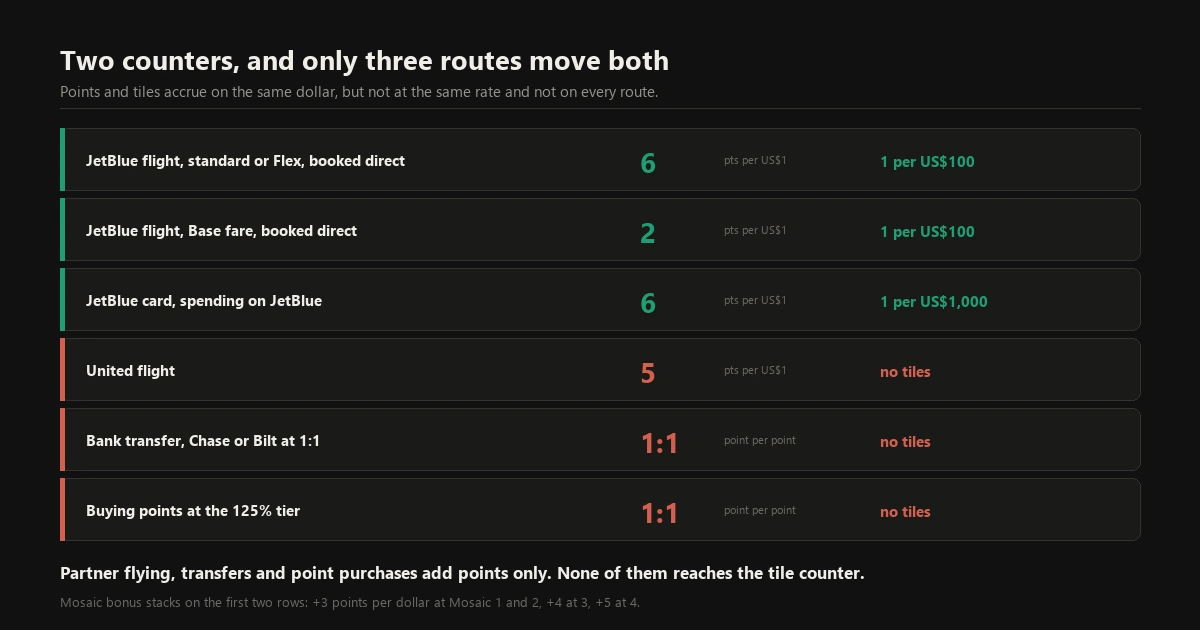
The table below is the whole programme in one view. The tile column is the part most guides leave out, and it is the reason two people spending the same money end up in different places.
| Route | Points per US$1 | Tiles | What it is for |
|---|---|---|---|
| JetBlue flight, standard or Flex fare, booked direct | 6 | 1 per US$100 | The base case |
| JetBlue flight, Base fare, booked direct | 2 | 1 per US$100 | Cheapest cash, slowest earning |
| Same flight, Mosaic 4 | 11 | 1 per US$100 | +5 on top of the 6 |
| JetBlue card on JetBlue spend | 6 | 1 per US$1,000 | Same points rate, ten times the tile threshold |
| Card welcome offer, Premier | 80,000 once | 0 | Largest single deposit available |
| United flight, booked on jetblue.com | 5 | Yes | 8 to 10 for Mosaic members; the only partner that adds tiles |
| Qatar, Etihad, Icelandair | 25% to 150% of miles flown | 0 | Distance and cabin, not dollars |
| Bank transfer | 1 per 1 transferred | 0 | Chase, Bilt and Wells Fargo at 1:1 |
| Buying points | 1 per 1 bought | 0 | 1.43 cents at the 125% tier |
Two things follow from that table. The first is that a bought point is the only point in the list that costs you cash and moves neither counter. The second is that the tile column is almost entirely a flying and card-spending story, which is why the people who reach Mosaic 4 are usually the ones who fly JetBlue often and put their card spend behind it, not the ones who transfer in from Chase.
Flying JetBlue: the fare tier sets your rate
Since the fare restructure in late July 2026, JetBlue sells three cabins (Main, EvenMore, Mint) across three tiers (Base, standard, Flex). Earning follows the tier, not the cabin.
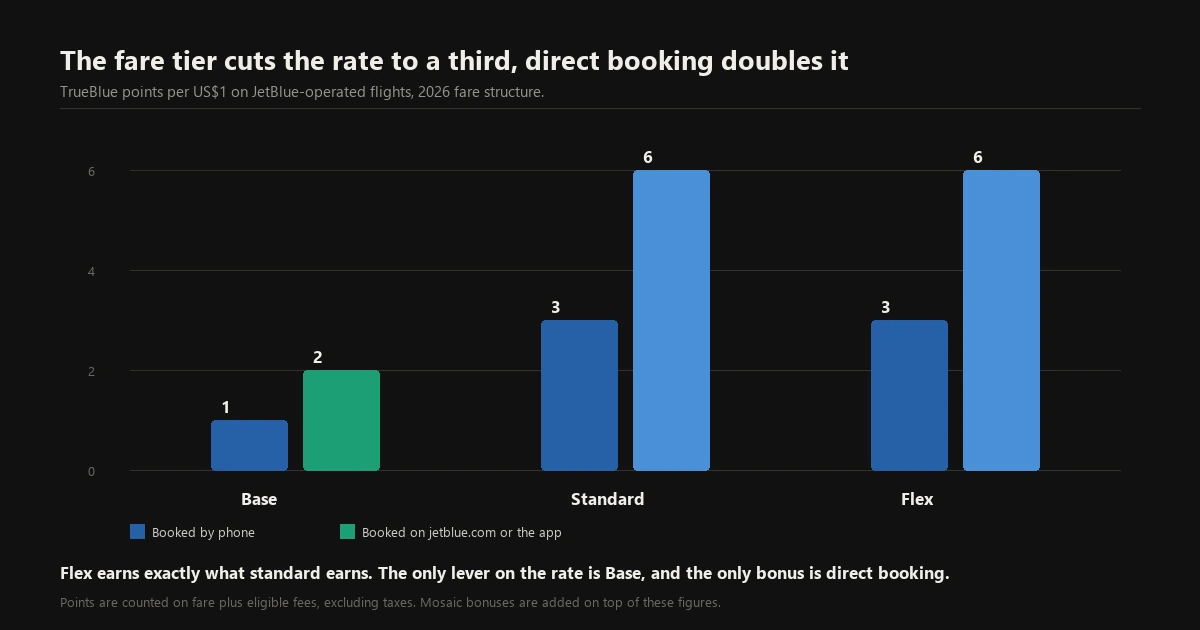
Base fares earn 1 point per dollar. Standard and Flex fares earn 3. Booking on jetblue.com or in the app doubles either figure, so a standard fare booked direct returns 6 points per dollar and a Base fare returns 2. Booking by phone earns the base rate with no bonus, which makes the phone a genuinely expensive way to buy the same seat.
Points are calculated on fare plus eligible fees, excluding taxes. A US$400 return in standard Main booked direct therefore returns 2,400 points, worth about US$32 at 1.34 cents. The same trip on a Base fare returns 800 points, worth about US$11. The gap between the two tiers is not a rounding difference, and it is the single most common place where people under-earn without noticing.
Every US$100 of eligible spend also adds one tile. That threshold applies to the fare you actually pay, so a US$400 return is 4 tiles whether you booked Base or Flex. Flying expensive fares earns points faster; it does not earn status faster.
What Mosaic adds, and what it does not
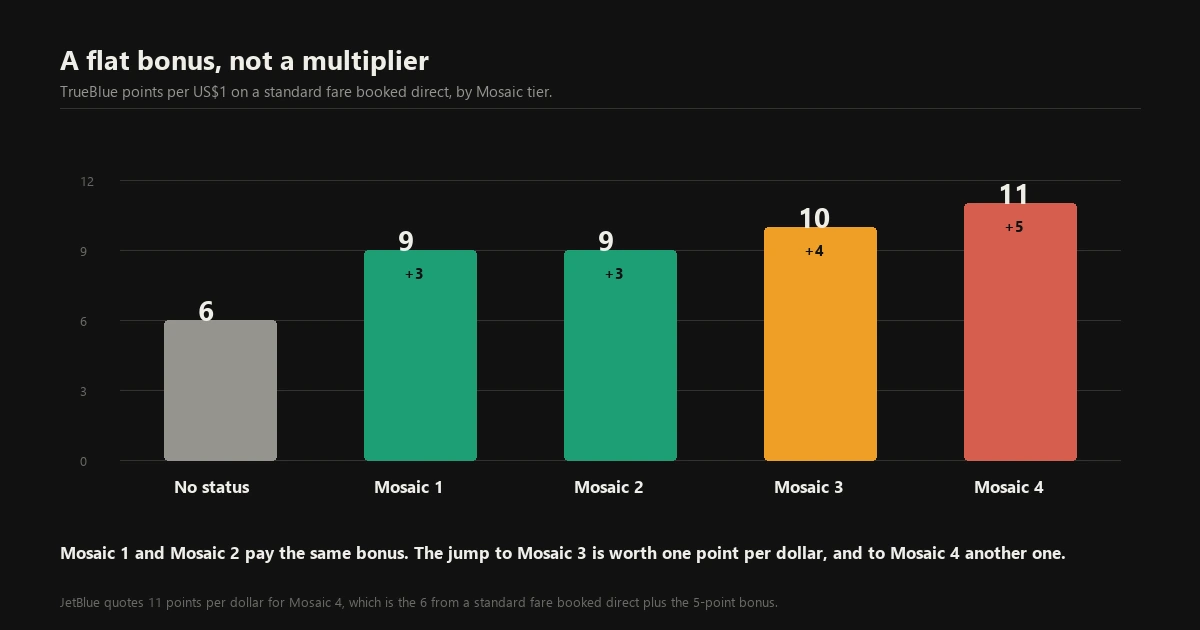
Mosaic adds a flat number of points per dollar rather than a multiplier, and the distinction matters when you are doing the arithmetic. The bonus is 3 points per dollar at Mosaic 1 and Mosaic 2, 4 at Mosaic 3, and 5 at Mosaic 4, on top of whatever the fare tier already pays.
Stacked on a standard fare booked direct, that produces 9 points per dollar at Mosaic 1 and 11 at Mosaic 4, which is the figure JetBlue itself quotes for the top tier. Stacked on a Base fare it produces 5 and 7. The bonus is the same size in both cases; what changes is how much of your total it represents, which is why the bonus feels generous on a cheap ticket and marginal on an expensive one.
What Mosaic does not do is change the tile rate. Tiles accrue at one per US$100 of eligible spend at every tier, so status does not accelerate status. The Mosaic advantages that do move the counter are the annual head starts and the Perks You Pick tile bonuses, both of which are one-off deposits rather than a higher rate — the tier structure and the 2027 changes are set out in the Mosaic status guide.
Partner flights: points yes, tiles no
This is the trap in the earning rules. JetBlue’s partner list is longer than most people assume — United, Qatar Airways, Etihad, Icelandair, Condor, Cape Air, Singapore Airlines and South African Airways all credit TrueBlue points — and none of them credit tiles.
JetBlue states it plainly in its own partner pages: spend on a partner-operated flight is not eligible to earn tiles, and on a codeshare booked through jetblue.com only the JetBlue-operated segment counts. A US$6,000 Qatar Airways business-class return to Doha therefore adds a meaningful number of points and zero progress towards Mosaic. Anyone building a status plan around partner flying is building it on the wrong counter.
The earning rates differ by partner, and they are not comparable to JetBlue’s own. United pays 5 points per dollar of pre-tax fare and carrier surcharges, rising to 8, 9 and 10 for Mosaic 1 through 4. Qatar, Etihad and Icelandair pay a percentage of miles flown by cabin and booking class instead: Qatar runs from 25% in the deepest economy buckets to 150% in first, Etihad from 25% to 400% for the Residence, and Icelandair from 25% to 150%. On a long premium cabin those percentages can beat anything JetBlue pays on its own metal, which is exactly why the missing tiles are easy to overlook.
The cards, where most points come from
For most members the largest single deposit into a TrueBlue balance is not a flight. It is a welcome offer.
Barclays issues four cards. The no-fee JetBlue Card earns 3 points per dollar on JetBlue purchases and carries a modest 10,000-point offer. The JetBlue Plus, at US$99, earns 6 on JetBlue and 2 at restaurants and grocery stores, with a public offer in the 60,000 to 70,000 range, 5,000 points each anniversary, a 10% rebate on award flights, and a free first checked bag for the cardholder plus three companions. The JetBlue Business matches the Plus on JetBlue spend at the same fee. The Premier, at US$499, earns 6 on JetBlue and TrueBlue Travel purchases, carries a 15% award rebate, 25 tiles each card year, lounge access and travel credits, and its welcome offer has moved around through 2026 between 80,000 and 100,000 points — at 80,000 on Barclays’ own page in late November — against US$5,000 of spend in 90 days.
Put the Premier offer next to the flying maths, using the 80,000 currently on offer. That is worth about US$1,072 at 1.34 cents. To earn the same from flying alone, a Mosaic 4 member booking standard fares direct would need US$7,273 of eligible spend; a member with no status would need US$13,333. One application replaces a year of flying, which is why the card is the correct answer to “how do I earn points fast” and a poor answer to “how do I earn status fast” — a card dollar generates one tile per US$1,000, ten times the spend a flight dollar needs for the same tile.
Card spending does count towards Mosaic, unlike partner flying. That makes a card useful for closing a small tile gap late in the year, and useless for closing a large one. The card comparison, including which of the four fits which traveller, belongs in its own guide and is not repeated here.
Transfers: the ratio decides it
Five bank currencies convert into TrueBlue, and the ratios are not close enough to treat as interchangeable. Chase Ultimate Rewards, Bilt and Wells Fargo Rewards move at 1:1. American Express Membership Rewards moves at 5:4, so 1,000 points become 800. Capital One moves at 5:3, so 1,000 become 600. IHG One Rewards moves at 5:1.
A 1:1 transfer costs nothing beyond points you already hold, and it is the only route on this page that converts an existing balance into TrueBlue without spending cash. At 5:4 and 5:3 the effective cost rises: transferring 1,000 Amex points to get 800 TrueBlue points at 1.34 cents returns US$10.72, or 1.07 cents per Amex point, which is a poor use of a currency that routinely clears 1.5 cents elsewhere. The full ratio table sits in the transfer partners guide.
Transfers earn no tiles and never will, because they are not travel spend. They also do not count towards a welcome offer’s minimum spend.
Pooling, shopping and the small stuff
Points Pooling lets two to seven TrueBlue members share one balance at no cost. The pool leader must be 21 or older; other members can be any age, and children under 13 are enrolled by a parent or guardian. The rule that surprises people is the contribution requirement: once you join, 100% of the points you earn go into the pool, with no option to hold some back. You can still see your own activity, and you leave with your remaining balance, but a member who wants a private reserve alongside a family pool has picked the wrong tool. The spot left by a departing member is locked for six months.
TrueBlue Shopping pays points through a portal at rates set by the retailer, which range from 1 point per dollar to multiples that beat any flight. It earns no tiles and the rates change without notice, so it is worth a look before a large purchase and not worth building a strategy around.
JetBlue Vacations and TrueBlue Travel earn both points and tiles, because they count as eligible travel spend. A package that bundles flight and hotel therefore does more for status than the hotel booked separately.
Points On Repeat, launched in March 2026, is a subscription from about US$144 a year that deposits 1,000 points a month. That is 12,000 points for US$144, or 1.2 cents a point — cheaper than buying at the 125% tier’s 1.43 cents, and dearer than the points are worth. It is a convenience product, not an earning strategy.
Three routes not worth the effort
Buying points. The only route here that costs cash and earns no tiles. At the top 125% tier a point costs 1.43 cents, against a valuation of 1.34, and the purchase moves neither counter. It is defensible when a specific award is short by a known amount; the official purchase page shows the tiers your account is actually offered, and the break-even maths sits in the buy-points guide.
Flying partners for status. Covered above, and worth repeating because it is the most expensive mistake in the programme: a partner premium cabin earns a lot of points and not one tile.
Chasing Base fares to save cash. A Base fare saves real money and returns a third of the points. On a US$400 ticket the saving might be US$60 while the points forgone are 1,600, worth about US$21 — so Base still wins on cash. The point is to know which trade you are making rather than assuming the cheapest fare is the best one. The full comparison of what each tier buys is in the redemptions guide, which also covers the US$150 cancellation charge that Base awards carry.
Verdict
If you want points quickly, the answer is a welcome offer, then a 1:1 transfer, then flying. If you want status, the answer is only flying JetBlue and spending on a JetBlue card, because nothing else moves the tile counter. Those two sentences are the whole guide, and they are different sentences.
For a typical member flying a few times a year, the realistic order is: hold a Plus or Premier card, book standard fares direct rather than by phone, put the card behind JetBlue spend, and ignore partner flights when planning status. That combination earns 6 points per dollar on flights and 6 on card spend against JetBlue, plus a tile per US$100 flown and per US$1,000 charged — enough to reach Mosaic 1 in a normal year without buying a single point.
If you are short of a specific award rather than short of status, price the top-up before you commit: check what a bought point costs at your tier and compare it with the award you have already found, not with a valuation in the abstract. Points never expire as long as the account is active, so there is no deadline forcing the decision — the programmes that do run a clock are listed in our expiry overview.
Last updated: 29 November 2026. Earning rates verified against JetBlue’s own fare, partner and card pages.
Questions
How many TrueBlue points do you earn per dollar?
Six on a standard or Flex fare booked on jetblue.com or in the app, and two on a Base fare booked the same way. The underlying rates are 3 and 1 point per dollar, and direct booking doubles both. Phone bookings get the undoubled rate.
Do partner flights count towards Mosaic status?
Not on most partners. United flights booked on jetblue.com earn points and tiles, because Blue Sky is a reciprocal sales agreement rather than an ordinary codeshare. Qatar Airways, Etihad, Icelandair, Condor, Cape Air, Singapore Airlines and South African Airways earn TrueBlue points but no tiles.
Can you earn TrueBlue points without flying?
Yes, through four routes: JetBlue credit cards, transfers from Chase, Bilt, Wells Fargo, American Express, Capital One or IHG, the TrueBlue Shopping portal, and Points Pooling contributions from other members. Only the cards also earn tiles.
Do TrueBlue points expire?
No. Points stay in the account as long as it is active, with no expiry date and no blackout dates on awards. Tiles are different: they reset on 1 January each year.
Does buying points count towards status?
No. A points purchase is processed by Points.com, earns no tiles, and does not count as JetBlue card spend. It is the one route into the balance that moves neither counter.
What is the fastest way to earn TrueBlue points?
A card welcome offer. The Premier card’s 80,000-point offer is worth about US$1,072 at 1.34 cents, which is the equivalent of US$7,273 of standard-fare flying for a Mosaic 4 member or US$13,333 for a member with no status.
More guides
- JetBlue TrueBlue promotions: what is live, and what is worth it
- JetBlue Mosaic status: the four tile tiers and what each one now returns
- JetBlue fare tiers: what each ticket includes, and what it costs to change
- Transfer routes into TrueBlue, and why none of them earns a tile
- Buying TrueBlue points: the four bonus tiers and the break-even maths
- What a TrueBlue point is worth, and why Mint is not the sweet spot
- The best ways to redeem TrueBlue points, ranked by what you can undo
- JetBlue credit cards: the four cards, and what each one earns per dollar
- JetBlue Mint and BlueFirst: points earned per dollar on each fare tier
- Every bank and hotel transfer ratio, priced in cents per mile
Already short of a specific award rather than short of points? Price a top-up against the award you have found, then decide. A bought point at 1.43 cents only makes sense when the redemption in front of you clears that number.