The JetBlue TrueBlue point value sits in an unusually narrow band: 1.30 to 1.40 cents, with a typical figure of 1.34. Four publishers land inside that range and none of them moved far in 2026, which is not a coincidence. TrueBlue prices awards off the cash fare, so a point buys roughly the same share of a ticket whether you fly a Tuesday shuttle or a Mint seat to London.
That stability cuts both ways. It means you will never log in to find your balance worth 0.7 cents because the airline repriced an award chart. It also means there is no hidden sweet spot to hunt, and the two claims you read most often about this programme both need correcting: that Mint is where the value is, and that a revenue-based currency is inherently worse than a chart-based one.
The short version. A TrueBlue point is worth about 1.34 cents when you redeem it, and about 1.49 cents if you hold a JetBlue Plus card, because cardholders get 10% of redeemed points back. Mint is the largest saving in dollars but not the best return per point. The number to watch is the one you calculate on the specific fare in front of you.
On this page
The published range, and why it is narrow
The four figures that make up the consensus were all published in September 2026. NerdWallet puts a TrueBlue point at 1.40 cents, drawn from the median of 80 economy awards booked between 15 and 180 days out. The Points Guy says 1.35. Upgraded Points and One Mile at a Time both say 1.30.
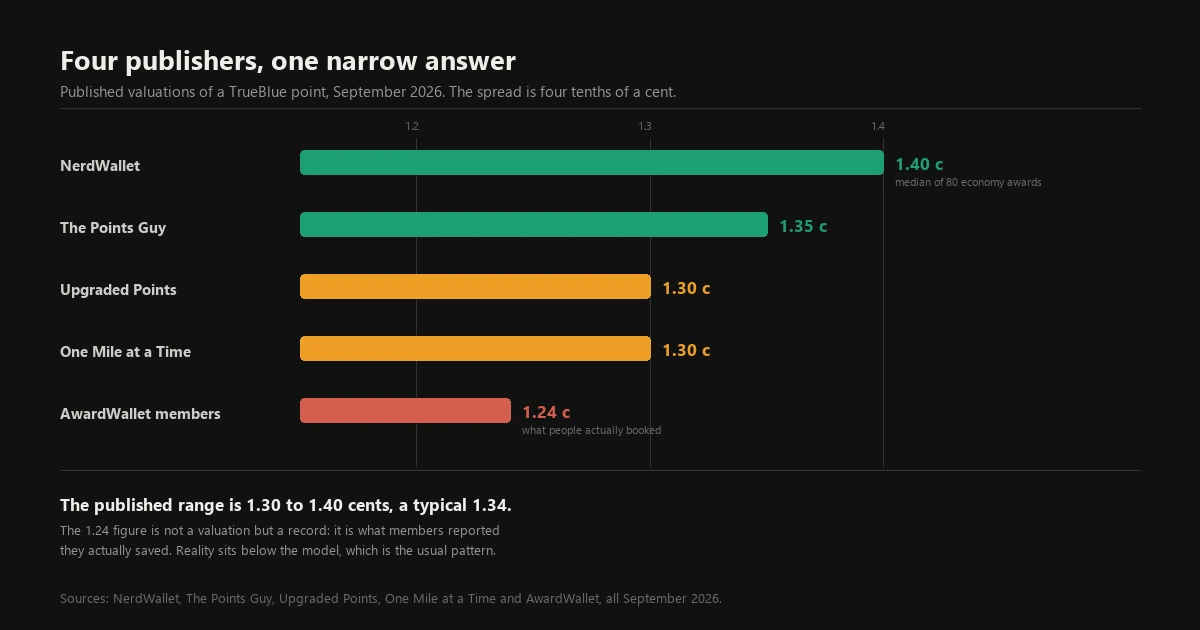
There is a fifth number worth knowing, and it is the least flattering. AwardWallet’s member-reported average is 1.24 cents, because it records what people actually booked rather than what a model says they could book. That gap between the model and the record is the normal pattern in every programme, and it is the reason to treat 1.34 as a benchmark rather than a promise.
The narrowness has a mechanical cause. JetBlue does not publish an award chart. It prices an award seat from the base fare of that flight at the moment you book, which means the ratio between points and cash stays close to constant across routes, cabins and dates. In a chart-based programme the ratio swings wildly: the same 60,000 miles might buy a US$300 economy seat on one route and a US$3,000 business seat on another, which is why valuations for those currencies cover a wider range and why enthusiasts hunt for the outliers.
The trade is explicit. You give up the chance of a three-cent redemption and you give up the risk of a half-cent one. For anyone who flies when they need to rather than when the chart is friendly, that is a reasonable exchange.
How to value a specific redemption
Published valuations are for planning. The number that decides a booking is the one you calculate yourself, and the formula is short:
cents per point = (cash fare avoided − award taxes and fees) ÷ points required × 100
The subtraction matters more than people expect. JetBlue award tickets still carry taxes starting at about US$5.60 one way, and forgetting to deduct them inflates every result slightly. Work through three quotes shaped like real bookings:
| Booking | Cash fare | Points + taxes | Cents per point |
|---|---|---|---|
| Economy, mid-price | US$305.60 | 18,000 + US$5.60 | 1.67 cents |
| Economy, cheaper fare | US$205.60 | 15,000 + US$5.60 | 1.33 cents |
| Mint, lie-flat | US$905.60 | 75,000 + US$5.60 | 1.20 cents |
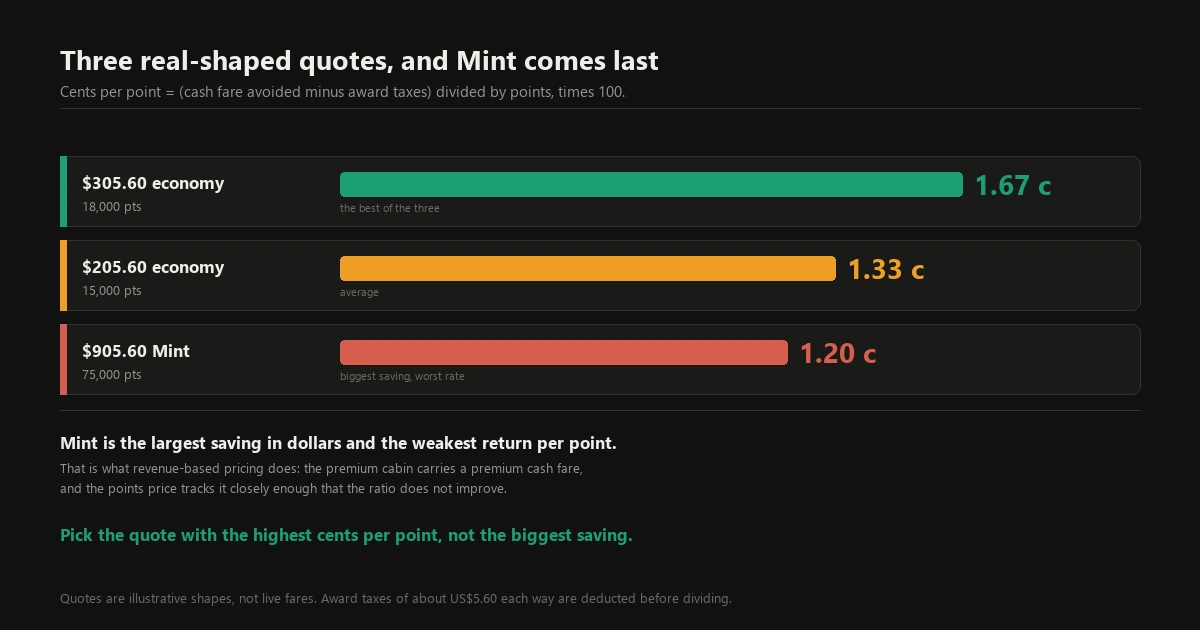
The first quote returns 1.67 cents, the second 1.33, the third 1.20. Nothing about the booking process caused that spread: it is the ordinary variation you get when a fare’s cash price and its points price move on slightly different schedules. The practical consequence is that you cannot value this programme once and apply the answer forever. You value the fare you are about to book.
You can run the same arithmetic on a route you are actually flying by opening the buy-points page in your TrueBlue account and reading the points price next to the cash price on the same search results screen.
Mint is not the sweet spot
Almost every guide to this programme says the best use of TrueBlue points is Mint, JetBlue’s lie-flat business class. The advice is half right, and the half that is wrong is the half about value.
Mint does produce the biggest saving in dollars. A transcontinental Mint seat that sells for US$900 in cash and prices at 70,000 points saves you roughly US$900, against perhaps US$200 on an economy award. But the return per point is not better, and in the quotes above it is worse: 1.20 cents against 1.33 for a mid-price economy fare. Because JetBlue prices the award off the fare, the premium cabin’s higher cash price comes with a proportionally higher points price. The ratio does not improve simply because the seat is nicer.
Independent data agrees. Published Mint redemption figures come out at or below economy on a per-point basis, and the mechanisms are easy to see once you look: Mint fares carry a premium that the points price tracks, taxes are the same US$5.60 regardless of cabin, and Mint inventory that prices cheaply in points is the inventory that was pricing cheaply in cash.
That does not make Mint a bad use of points. It makes it a different decision. If you were going to pay US$900 for the seat, redeeming 70,000 points for it is excellent. If you were going to pay US$300 for economy and are upgrading for the experience, you are not extracting more value per point, you are spending more points to buy a better trip. Both are legitimate. Confusing them is how people talk themselves into redemptions they would not make with cash.
The question to ask is not “which cabin gives the best cents per point” but “would I pay this cash fare”. Cents per point measures efficiency. It does not measure whether the trip is worth taking.
If you hold a JetBlue card, the number changes
This is the part most valuations leave out, and for a specific group of readers it changes the answer by more than any redemption trick.
The JetBlue Plus and JetBlue Business cards return 10% of the points you redeem. The Premier card returns 15%. That rebate does not change the published value of a point, but it changes what a point costs you to spend: if 10% comes back, an award that would have consumed 20,000 points effectively consumes 18,000.
Run that through the range and the numbers move up. At a 1.34 cent baseline, a 10% rebate lifts the effective return to about 1.49 cents, and at the top of the range, 1.40, it reaches 1.56. On the Premier card’s 15%, the same figures become roughly 1.58 and 1.65. Across the published range, cardholders are getting between 1.44 and 1.65 cents a point rather than 1.30 to 1.40.
That is a meaningful shift, and it has a direct consequence for anyone reading this alongside a buy-points promotion. A 125% bonus that brings a bought point to 1.43 cents is a losing trade at a 1.34 cent valuation. At 1.49 cents with a Plus card in the drawer, it is roughly break-even, and at the Premier card’s 1.58 it is a small gain. The same sale is a different decision depending on which card you hold.
The same cards also feed the other currency in the programme. Card spending earns tiles towards Mosaic status, and the Premier card starts each year with 25 of them — half of the entry tier before a single flight is taken. The tile and tier mechanics are here.
Where TrueBlue sits against other currencies
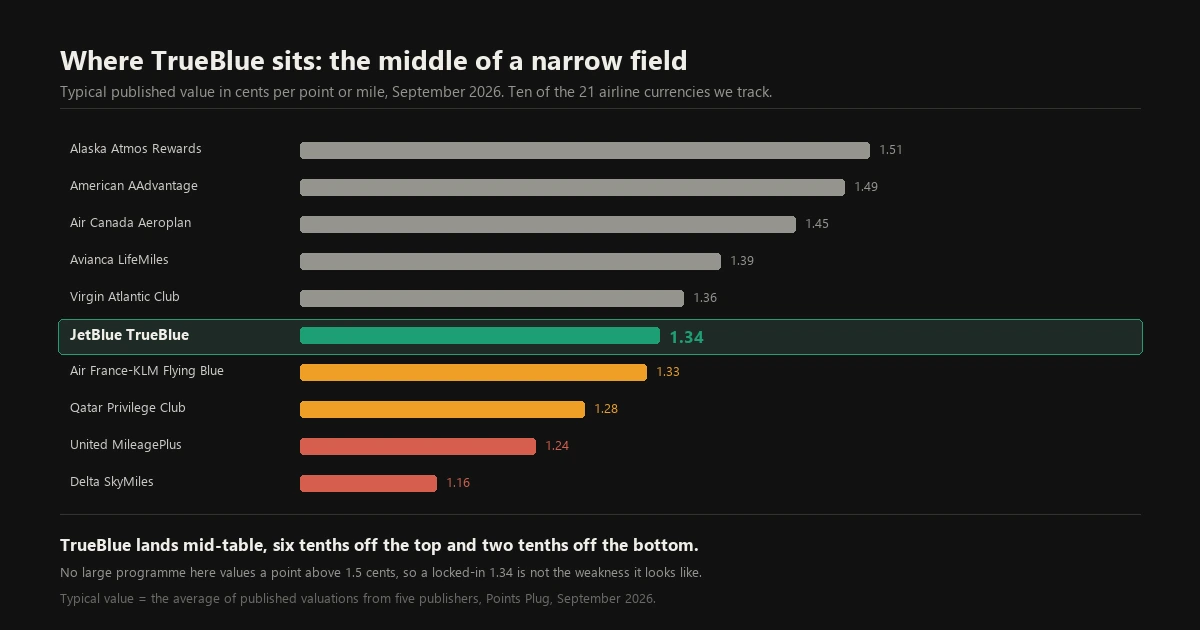
TrueBlue lands mid-table among airline currencies, and the more useful observation is how compressed the table is.
| Programme | Typical value | What drives the number |
|---|---|---|
| Alaska Atmos Rewards | 1.51 cents | Partner awards, wide redemption menu |
| American AAdvantage | 1.49 cents | Web Specials and partner breadth |
| Air Canada Aeroplan | 1.45 cents | Distance-based chart with stopovers |
| Avianca LifeMiles | 1.39 cents | Star Alliance premium cabins |
| JetBlue TrueBlue | 1.34 cents | Revenue-based, no chart to exploit |
| Air France-KLM Flying Blue | 1.33 cents | Promo Rewards, monthly discount month |
| United MileagePlus | 1.24 cents | Dynamic pricing since 2019 |
| Delta SkyMiles | 1.16 cents | Fully dynamic, no published chart |
Two things stand out. First, no large programme in the table values a point above about 1.5 cents, so a currency locked at 1.34 is not the weakness it appears to be next to Aeroplan’s 1.45. Second, the two programmes that moved to fully dynamic pricing, United and Delta, sit at the bottom. That is the direction of travel for revenue-based currencies, and it is an argument for spending TrueBlue points while the ratio is still 1.3 rather than assuming it will hold indefinitely.
The programmes above TrueBlue earn their position through partner access. Alaska and American can put you on a partner’s premium cabin where the cash fare is high and the award price is set by a chart, which is exactly the arbitrage TrueBlue does not offer. If that specific play is what you want, the honest answer is that TrueBlue is the wrong currency for it, not that TrueBlue is bad.
What the valuation does not cover
Three gaps are worth stating so you do not over-trust the number.
Partner awards are unpriced. TrueBlue points can book eligible United, Qatar Airways, Etihad, Icelandair and Condor flights, but JetBlue does not publish what those awards cost in points. You cannot value a partner redemption in advance the way you can value a JetBlue one, and the published 1.34 says nothing about them.
Cash + Points splits the calculation. You can part-pay with points from as few as 500, and the ratio on the points portion is not necessarily the same as on a full award. Check the two components separately rather than assuming the blended figure matches the headline valuation.
Points can be pooled but not transferred out. TrueBlue lets you pool points with up to six other members, which is useful for family bookings. There is no route out to another airline programme; transfers run one way, in from bank currencies. That matters for anyone treating a TrueBlue balance as a store of flexible value, because it is not flexible in that direction.
None of it is on a timer, at least. TrueBlue points carry no expiry date and no activity requirement, so 1.34 cents is a target you can wait for rather than a deadline you have to beat. The two things in the programme that do run down are the tile counter and Travel Bank credit, and the three clocks are set out here.
What this means if you are buying points
Everything above resolves into one line. A bought point at 1.43 cents against a 1.34 cent redemption value is a small loss, and it only becomes a gain if the specific award you are buying toward clears 1.43 cents or you hold a card that rebates 10% or 15% of redemptions.
That is a narrower set of circumstances than the size of a 125% bonus suggests. Our guide to buying TrueBlue points works through the four bonus tiers and the break-even arithmetic, and the buy-points guide tracks what every programme is charging this month if you want the comparison.
If you want to see how your own booking prices before committing, run the numbers on a flight you are actually taking rather than on an award someone else found.
The wider point is that a currency worth 1.34 cents rewards a different behaviour than one worth 1.5. It rewards spending on a fare you would have paid rather than hunting for a chart anomaly, it rewards holding a co-brand card over perfecting a booking technique, and it rewards redeeming rather than stockpiling.
That preference for ordinary spending over technique has an earnings side as well: every route into a TrueBlue balance is ranked here, including the three that cost cash and move no counter at all.
Verdict
Value a TrueBlue point at 1.34 cents for planning, and expect your own bookings to land between 1.2 and 1.7 depending on how the fare and the points price happen to line up on the day. If you hold a JetBlue Plus, Business or Premier card, raise that to 1.44 through 1.65, because the redemption rebate is real money and most published valuations ignore it.
Do not chase Mint expecting a better rate. Do not write the programme off because the number is lower than Aeroplan’s. And do not buy points at 1.43 cents unless you have priced the specific award and it clears that bar, or unless a card rebate closes the gap. Which redemptions actually clear it is the subject of our ranked list of TrueBlue redemptions.
The full picture of what is live across the programme, including the current buy-points window, sits on our JetBlue TrueBlue promotions hub. If you want the mechanics behind dynamic pricing, how loyalty points work covers the difference between chart-based and revenue-based currencies.
Last updated 29 November 2026.
Questions
What is a JetBlue TrueBlue point worth?
Between 1.30 and 1.40 cents, with a typical figure of 1.34. NerdWallet puts it at 1.40, The Points Guy at 1.35, and Upgraded Points and One Mile at a Time at 1.30. AwardWallet’s member-reported average is lower at 1.24 because it records what people actually booked.
Are TrueBlue points worth more on Mint?
No. Mint produces the largest saving in dollars because the cash fare is higher, but the return per point is the same or slightly lower, since JetBlue prices the award off that same fare. A worked Mint quote at US$905.60 for 75,000 points plus tax returns 1.20 cents, against 1.33 for a US$205.60 economy fare.
How do you calculate what a redemption is worth?
Subtract the award taxes from the cash fare you would otherwise pay, divide by the points required, and multiply by 100. Award taxes start at about US$5.60 one way. A US$305.60 fare booked for 18,000 points plus US$5.60 returns 1.67 cents a point.
Does holding a JetBlue card change the value?
Yes, meaningfully. The JetBlue Plus and Business cards rebate 10% of redeemed points and the Premier card rebates 15%, which lifts the effective return to roughly 1.44 to 1.65 cents across the published range. Most valuations do not account for this.
Why is the TrueBlue value so stable?
Because JetBlue has no award chart. It prices an award seat from that flight’s base fare at the time of booking, so the ratio between points and cash stays close to constant regardless of route, cabin or date. You cannot find an outsized redemption, and you cannot stumble into a bad one either.
Can you transfer TrueBlue points to another programme?
No. Transfers run one way: bank currencies such as Chase Ultimate Rewards, Bilt and Wells Fargo convert into TrueBlue, but TrueBlue points cannot be sent out to another airline or hotel programme. Pooling with up to six other members is available for bookings, which is a different thing.
JetBlue TrueBlue guides
- JetBlue TrueBlue promotions: what is live and what it is worth
- Buying TrueBlue points: the bonus tiers and the break-even maths
- JetBlue fare tiers: what the fare buys before the points maths starts
- Where the 1.34 cents comes from, against the cost of transferring points in
- JetBlue credit cards: how the 10% and 15% redemption rebates price a point
- JetBlue Mint: what a premium redemption returns per point
Next step
Take one flight you are actually considering and run the formula on it before booking anything. The answer will be somewhere between 1.2 and 1.7 cents, and where it lands tells you whether to use points, pay cash, or buy points to close a gap.