Buying JetBlue TrueBlue points looks like a straightforward calculation until you notice the two prices involved. During the sale that runs to 11:59 p.m. ET on 31 December 2026, the top tier brings a point down to about 1.43 cents with tax included. Without a bonus, JetBlue charges about 3.23 cents for the same point.
That gap is real, and it is still not enough on its own. A TrueBlue point is worth roughly 1.3 cents when you redeem it, because JetBlue prices awards off the live cash fare rather than a fixed chart. Buying at 1.43 cents to redeem at 1.3 cents loses money by design. The question worth answering is narrower: does this purchase finish an award you have already found, and does that award return more than 1.43 cents a point?
On this page
What the 125% sale actually costs
The window opened at 12:00 a.m. ET on 18 November 2026 and closes at 11:59 p.m. ET on 31 December 2026. JetBlue adds bonus points rather than cutting the headline price, so the standard three cents a point stays put and the bonus does the work. Four tiers apply:
| Purchase | Bonus | You pay (incl. 7.5% tax) | Points received | Cost per point |
|---|---|---|---|---|
| 1,000 – 4,000 | none | US$32.25 per 1,000 | 1,000 | 3.23 cents |
| 5,000 – 9,000 | 100% | US$161.25 for 5,000 | 10,000 | 1.61 cents |
| 10,000 – 19,000 | 115% | US$322.50 for 10,000 | 21,500 | 1.50 cents |
| 20,000 – 300,000 | 125% | US$645.00 for 20,000 | 45,000 | 1.43 cents |
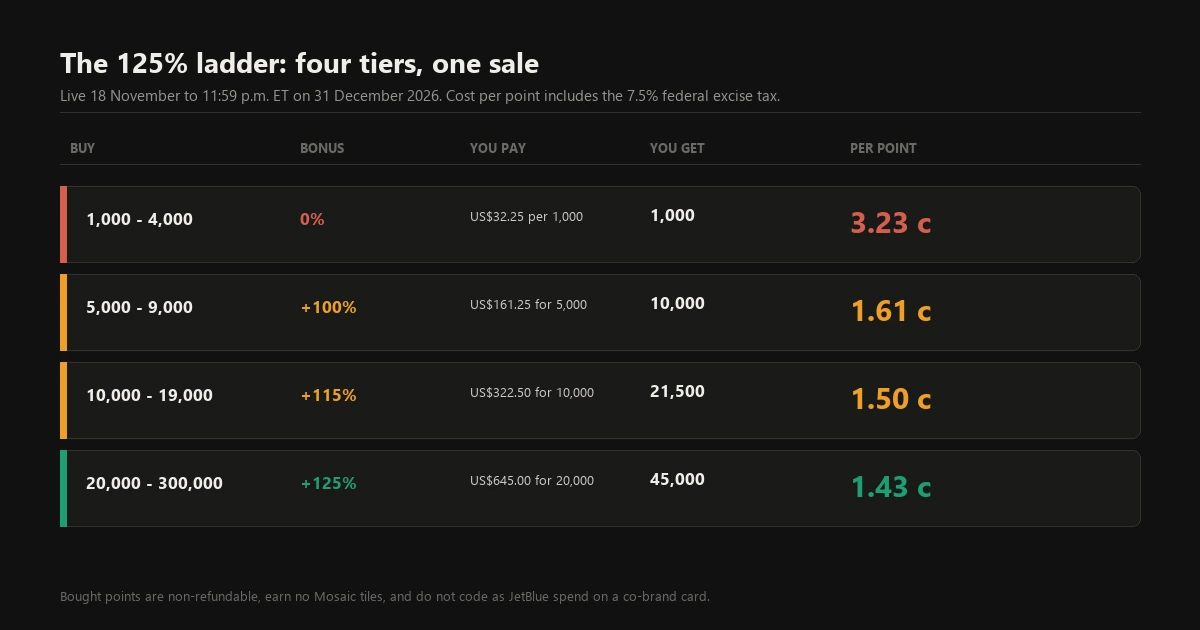
The arithmetic is worth walking through once. Twenty thousand points at three cents costs US$600, and the 7.5% federal excise tax takes it to US$645. The 125% bonus turns those 20,000 points into 45,000. Divide US$645 by 45,000 and the answer is 1.433 cents. Every row in the table works the same way, which is why the fourth tier is the only one worth buying at volume and the first tier is a trap: below 5,000 points you pay 3.23 cents for something worth 1.3.
The four tiers are not the whole offer. JetBlue targets bonus levels by account, so some members see a different ladder on JetBlue’s buy-points page than the one below. Treat this table as the public baseline, not as your price.
Two smaller details matter. The tiers are applied to the purchase amount, not to your account balance, so splitting one order into two smaller ones can drop you a tier. And offers can be targeted, so read the ladder shown inside your own account before you pay rather than assuming this one applies.
The price when no bonus is running
Outside a sale, JetBlue sells TrueBlue points at three cents each with no volume discount at any amount, and the 7.5% federal excise tax is added at checkout. That puts the all-in cost at US$32.25 per 1,000 points, or about 3.225 cents a point, whether you buy 1,000 or 200,000.
This is the number that makes the bonus sales look better than they are. A 125% bonus sounds enormous until you see that it recovers roughly half of a price that was never competitive. At full price, a bought TrueBlue point costs about two and a half times what a typical redemption returns, which means buying without a bonus is only defensible when you are a few thousand points short of an award you are about to lose.
What a point is worth to you
TrueBlue has no award chart. The points a seat costs move with the cash fare for that seat, which keeps the value of a point inside a narrow band no matter how cleverly you book. Independent valuations cluster between 1.30 and 1.40 cents, with a typical figure of 1.34: NerdWallet’s median of 80 economy awards is 1.40, TPG is 1.35, Upgraded Points is 1.30, and Frequent Miler’s April 2026 sample of more than a million searches is 1.30. The outliers sit below that band rather than above it, and we take the full range apart in what a TrueBlue point is worth.
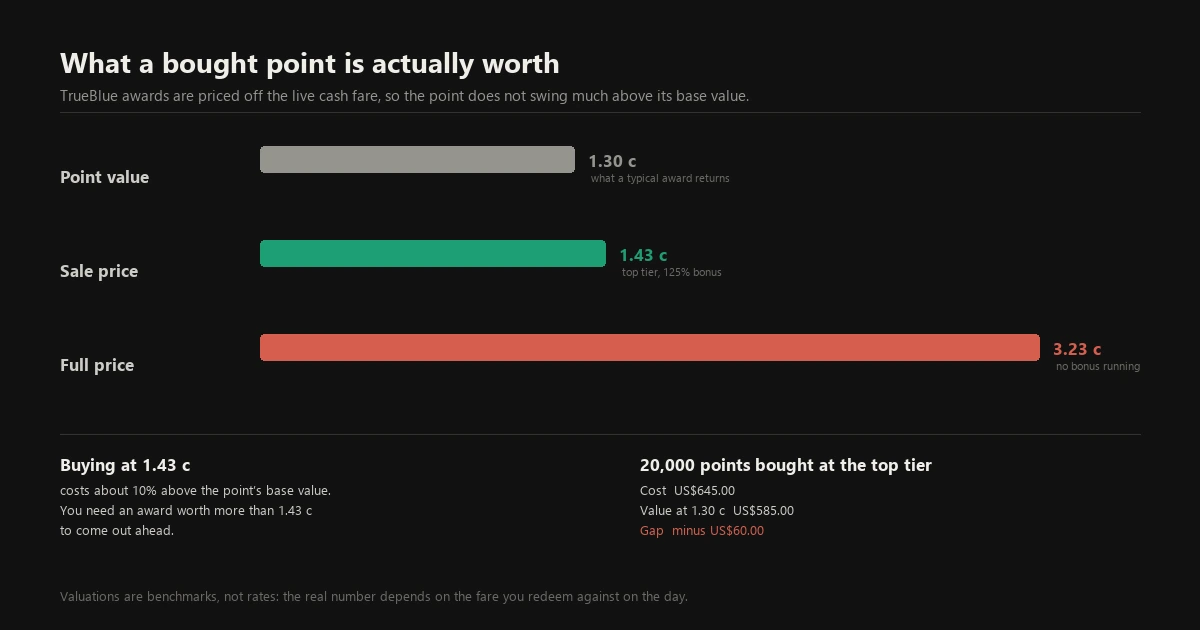
Set the two numbers side by side and the verdict is unromantic. Buying 20,000 points at the top tier costs US$645 and delivers 45,000 points worth about US$603 at 1.34 cents. That is a US$42 loss before you book anything. To come out ahead you need a redemption that returns more than 1.43 cents a point, and because the currency is revenue-based, the way to find one is not a trick or a sweet spot. It is a specific fare where the points price has not kept up with the cash price.
Those situations do exist. A peak-date transatlantic in cash fare terms, or a last-minute coast-to-coast where the cash price has jumped but the points price has not moved as far, can clear the bar. A generic weekend trip will not. The test is arithmetic, not instinct: pull up the award you want, divide the cash fare by the points required, and if the answer is under 1.43 cents, pay cash and keep your money.
The same logic rules out the strategy that works in other programmes. With Aeroplan or LifeMiles you can hunt a redemption that returns three or four cents a point, because those programmes price by region and cabin. TrueBlue prices by fare, so a bought point cannot be made to work harder. You are buying a discount on a ticket you have already chosen, nothing more.
One thing does move the baseline: the card in your wallet. The JetBlue Plus and Business cards return 10% of the points on every award, and the Premier returns 15%, which makes the real cost of a point 1.44 to 1.65 cents rather than 1.30 to 1.40. At that level a 125% bonus is closer to break-even than to a loss — the cardholder maths is here.
The rules that decide whether it works
Four terms do the actual work here, and three of them are reasons not to buy.
Bought points never count toward Mosaic. Mosaic is earned on tiles, one per US$100 of eligible travel or per US$1,000 of spending on a JetBlue card. A points purchase adds none of them, so the transaction does nothing for status even at the 300,000 cap.
The charge is processed by Points.com. That means it does not code as a JetBlue purchase, so it will not earn the elevated category rate on a JetBlue co-brand card. If you were counting on six points per dollar on the purchase, you will not get it.
Purchases are non-refundable. There is no cooling-off window and no reversal if you change your mind, which is the strongest argument for buying only against a fare you have already priced.
The fourth term runs in your favour: TrueBlue points do not expire while the account stays open and in good standing, and there is no activity requirement to keep them alive. Bought points sit alongside earned ones with no separate clock. If you are going to hold a balance, this is one of the more forgiving currencies to hold it in. What does run down is the tile counter and Travel Bank credit, and the expiry rules separate the three clocks.
How the annual cap works
JetBlue limits purchases to 200,000 points per calendar year at the standard rate. During a bonus window the cap rises to 300,000, and this sale runs on the raised limit through 31 December 2026.
Two things trip people up. The cap counts points bought, not points received, so a 125% bonus does not eat your allowance three times faster, it simply means a 300,000-point purchase delivers 675,000 points. And the cap is per calendar year, so a purchase in late December and another in early January are counted against two separate allowances even though only days apart.
Most buyers never approach either number. The realistic ceiling is the size of the award you are trying to reach, and a transatlantic Mint seat is generally the largest single redemption in the programme.
Buying versus the alternatives
Before paying 1.43 cents a point, three other routes are worth a minute each.
Transferring from a bank programme. Several credit card currencies convert to TrueBlue, and the ratios differ enough to matter: Chase Ultimate Rewards, Citi ThankYou and Bilt move at 1:1, American Express Membership Rewards at 5:4, and Capital One at 5:3. A transfer costs you nothing beyond points you already hold, so it beats a purchase whenever the ratio is at or near 1:1. Our transfer partners guide has the current table, and the airline alliances explainer covers which TrueBlue partners sit inside which grouping.
Earning on the flight instead. JetBlue restructured its fares in late July 2026 into three cabins (Main, EvenMore, Mint) and three tiers (Base, standard, Flex). Base fares earn 1 point per dollar plus 1 for booking direct; every other tier earns 3 plus 3 for booking direct. A US$400 return in standard Main earns 2,400 points, which is about US$34 of buying power at the sale price, earned without buying anything. That figure assumes a standard fare booked direct, and the earning guide sets out what every other route pays, including the ones that add no tiles at all.
Paying cash and keeping the points for later. Because award prices track the fare, a cash purchase during a fare sale often beats a points redemption at the same moment. The two prices move together, and the cash sale has no acquisition cost attached.
None of the three moves the status counter, and neither does buying points: a purchase earns no tiles at all, so it cannot close a gap towards Mosaic however large the balance. How tiles are earned and what each tier now returns is set out in the Mosaic status guide.
How to buy, step by step
Everything below assumes the public ladder. If you would rather see your own numbers first, what the ladder looks like on your account take precedence over any table published here.
- Sign in to your TrueBlue account and open the buy-points page. The tiers shown there are the ones that apply to you; targeted offers are common.
- Check the ladder before choosing an amount. Crossing from 4,000 to 5,000 points roughly halves your cost per point.
- Decide the amount from the award, not from the bonus. Work backwards from the points the fare requires.
- Pay by card. Points usually post within minutes and within 72 hours at the outside.
The purchase is made at jetblue.com rather than through a partner, and Points.com handles the transaction behind the scenes. Our buy-points and miles guide tracks what every programme is charging this month if you want to compare before you commit.
Verdict
A 125% bonus is JetBlue’s normal ceiling, not an event. The programme has run windows at 120% and 125% three times in 2026, and the cap rises to 300,000 every time one opens. There is no scarcity argument for buying in November rather than waiting.
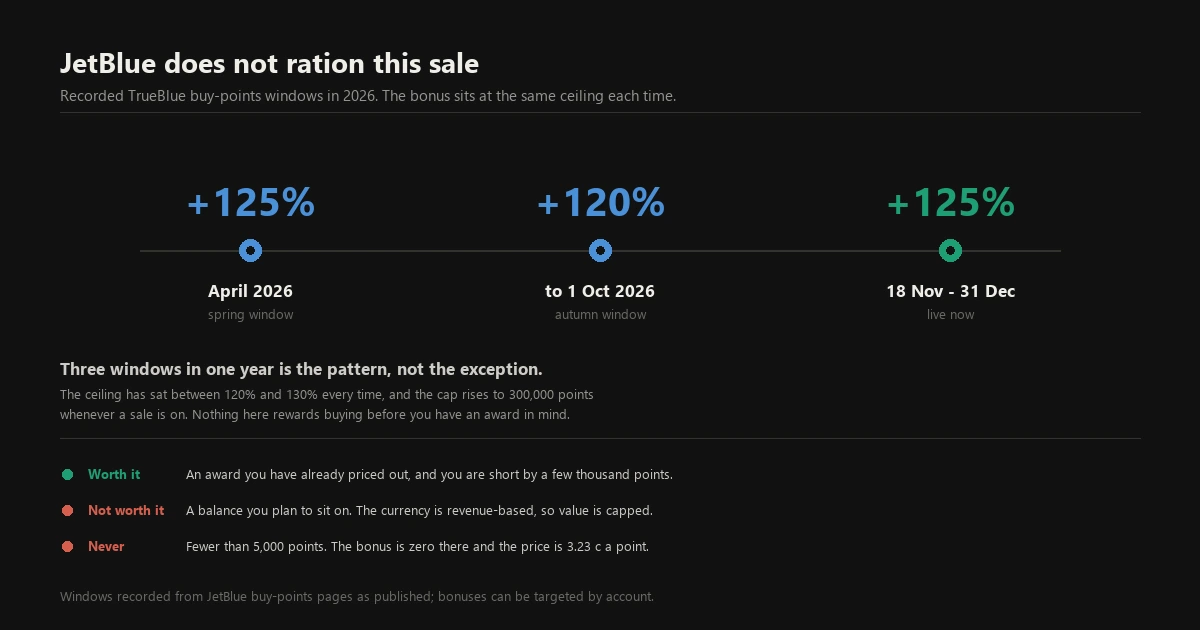
What the sale does offer is the cheapest legal way to close a gap. At 1.43 cents against a 1.34 cent baseline, you are paying about a 7% premium for the convenience of having the points now. That is a fair price for finishing an award you have already found and a bad price for building a balance on speculation.
Buy if you have a specific redemption in mind that returns better than 1.43 cents and you are short by a defined amount. Skip it if the plan is to hold the points, if you are buying under 5,000, or if the award you want has not been priced yet. The full picture of what is live across the programme sits on our JetBlue TrueBlue promotions hub.
The redemptions that reliably clear 1.43 cents are ranked in the best ways to redeem TrueBlue points, and there are fewer of them than the fare sales suggest.
Previous buy-points windows
| Window | Top bonus | Cost per point | Purchase cap |
|---|---|---|---|
| 18 Nov – 31 Dec 2026 | 125% | 1.43 cents | 300,000 |
| Through 1 Oct 2026 | 120% | About 1.46 cents | 300,000 |
| April 2026 | 125% | 1.43 cents | 300,000 |
Last updated 28 November 2026.
Questions
Can you buy JetBlue TrueBlue points?
Yes. JetBlue sells TrueBlue points directly from the buy-points page inside your TrueBlue account, in increments of 1,000 with a minimum of 1,000. Points.com processes the payment, and points normally appear immediately and within 72 hours at the outside.
How much do TrueBlue points cost?
Three cents a point plus a 7.5% federal excise tax, which comes to about 3.225 cents all in. During the sale running to 31 December 2026 the top tier brings that down to about 1.43 cents for purchases of 20,000 points or more.
Is a 125% bonus worth buying at?
Only against an award you have already priced. A TrueBlue point is worth roughly 1.3 cents on redemption, so buying at 1.43 cents loses money unless the specific redemption returns more than 1.43 cents a point. Buying to hold a balance does not work in a revenue-based programme.
Do bought TrueBlue points count toward Mosaic status?
No. Mosaic is earned on tiles, one per US$100 of eligible travel or per US$1,000 of card spending, and a points purchase generates none. Buying points cannot move you toward any Mosaic tier, including Mosaic 1 at 50 tiles.
Do TrueBlue points expire?
No. TrueBlue points do not expire while the account remains open and in good standing, and there is no activity requirement. Bought points follow the same rule as earned ones, so a purchase does not start a separate expiry clock.
How many TrueBlue points can you buy in a year?
200,000 points per calendar year at the standard rate. The limit rises to 300,000 during a bonus window, and it counts points purchased rather than points received, so a 125% bonus does not reduce your allowance faster.
JetBlue TrueBlue guides
- JetBlue TrueBlue promotions: what is live and what it is worth
- JetBlue fare tiers: what the cash ticket includes, before points enter the picture
- The eight transfer routes, priced against buying points instead
- Credit cards as a points source: what the four JetBlue cards pay per dollar
- JetBlue Mint: buying points to cover a lie-flat seat, and what it costs
Next step
Work out what your award actually returns before you buy. Price the fare in cash, price it in points, and divide. If a TrueBlue point comes out under 1.43 cents on that route, the sale is not for you.