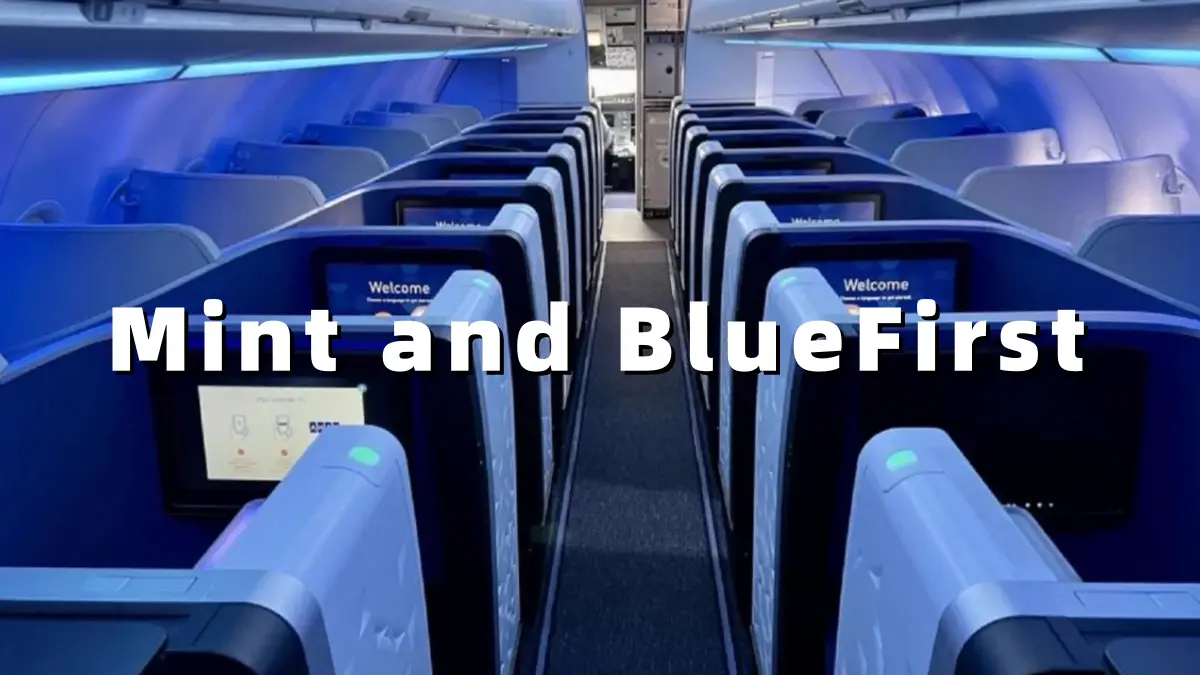
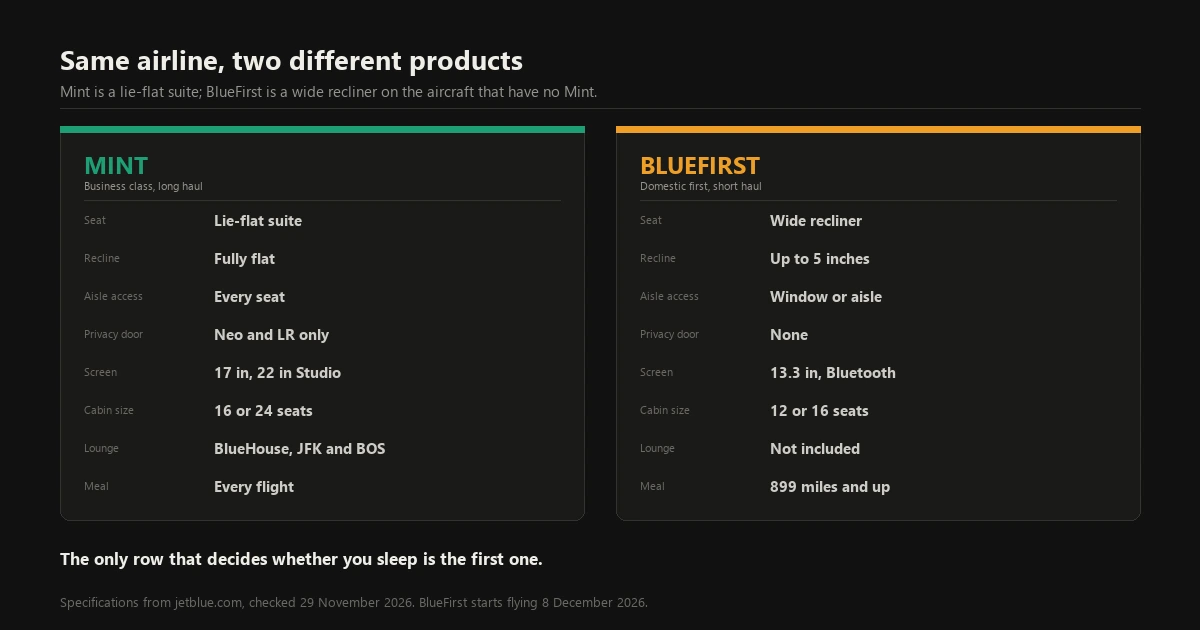
JetBlue sells two premium cabins, and they are not two grades of the same thing. Mint is a lie-flat suite with a door, installed on the aircraft that fly long. BlueFirst is a wide recliner, installed on the aircraft that have no Mint cabin at all. One is a business-class product; the other is domestic first class, and the gap between them is the difference between sleeping and sitting comfortably.
The distinction decides more than the price. It decides which product you are even being offered on the flight in front of you, how much of the fare you get back in points, and whether the premium is worth paying in cash or in TrueBlue points. The short version: both cabins price off the cash fare, so neither is a place to hunt for value per point — Mint returns about 1.20 cents against the 1.34 a Main cabin seat returns. What you are buying is time, and the only honest yardstick is dollars per hour in the air.
On this page
- Which one you are actually being sold
- Mint is three different cabins
- BlueFirst is a recliner, and that is the point
- Where each one flies
- The fare ladder inside each cabin
- Why the premium cabin is the worst use of a point
- Upgrading instead of buying
- Dollars per hour, the only fair comparison
- Verdict
- Questions
Which one you are actually being sold
The two products are separated by aircraft, not by route. Mint is fitted to the A321 Classic, the A321neo and the A321 Long Range. BlueFirst is being retrofitted into everything else — the A220 and the A320 — plus the A321s that carry a single-class layout. JetBlue’s brief to Business Travel News puts the BlueFirst cabin at 12 seats on the A220 and A320 and 16 on the A321, with the retrofit running through 2028.
That produces the first trap. Several city pairs are served by both cabins on different departures, because the airline flies more than one aircraft type on them: Fort Lauderdale to Los Angeles, New York to Liberia in Costa Rica, Aruba, San Juan, Cancún. Book “first class” on one of those and you may get a lie-flat suite with a door, or a recliner that does not recline much further than the seat you would have had in EvenMore. The only way to know is the seat map at the moment of booking, and the assignment can still change if the aircraft is swapped.
BlueFirst enters scheduled service on 8 December 2026 on Boston to Fort Lauderdale, having gone on sale on 15 October 2026 with introductory fares of US$299 on that route and US$249 from LaGuardia. By April 2027 it is scheduled to reach more than 30 routes, almost all of them touching Fort Lauderdale, which is where JetBlue is concentrating its domestic build-out.
Mint is three different cabins
“Mint” describes a seat standard, not a single seat. Three aircraft carry it, and they are not interchangeable experiences.
| A321neo with Mint | A321 Classic with Mint | A321 Long Range | |
|---|---|---|---|
| Mint seats | 16 (14 suites and 2 Mint Studio) | 16 | 24 |
| Layout | 1-1, every seat direct aisle access | 2-2, with single suites in rows 2 and 4 only | 1-1, every seat direct aisle access |
| Privacy door | Yes, every suite | No | Yes, every suite |
| Screen | 17 inches, 22 in the Studio | 15 inches and up | 17 inches, 22 in the Studio |
| Where it flies | Transcontinental, Caribbean, Latin America, some Europe | Transcontinental and Caribbean | Transatlantic |
The row that matters is the second one. On the A321 Classic, four of the sixteen seats are the single “throne” suites in rows 2 and 4; the other twelve are in pairs, and the person in the aisle seat steps over the person at the window. On the neo and the Long Range, every seat is its own suite with a door, so there is no bad seat in the cabin and no reason to pay a premium for a particular row. Frequent flyers who compare Mint reviews and come away confused are usually reading about two different aircraft.
Mint Studio exists only on the neo and the Long Range, in row one. It is the largest bed and the largest screen on a US airline at 22 inches, with a mirrored vanity and a guest seat. Whether it is worth the extra depends entirely on the fare: at a low Mint fare the Studio surcharge is small money, at a peak fare it pushes the total into territory where a widebody business class on another airline starts to look rational.
Everything else is consistent. Lie-flat bed with Tuft & Needle foam, pillow and comforter, a small-plates menu from Crown Shy for lunch and dinner and Birdee for breakfast, cocktails from PDT, a wine list from Parcelle, and an express Savor & Sleep service on US transcontinental flights leaving after 8pm. On the ground: dedicated Mint check-in, priority security, Group 1 boarding, two free checked bags with priority delivery, and entry to the BlueHouse lounges at JFK and Boston.
BlueFirst is a recliner, and that is the point
BlueFirst is a 2-2 cabin at the front of aircraft that otherwise have no premium cabin. The seat is a wide recliner with up to five inches of recline and up to seven inches more legroom than Main, built on Tuft & Needle’s T&N Flex foam. Every seat has a 13.3-inch screen with Bluetooth, so you can pair your own earphones, and power at AC, USB-A and USB-C.
It is not a bed, and JetBlue is not selling it as one. What it sells is the top of a three-hour flight: a wide seat, a meal, and the airport sequence stripped of friction — Group 1 boarding, dedicated bin space, priority check-in, an expedited security lane at more than 30 airports, and bags that come off early.
The 899-mile line
One detail decides whether the food is part of the product. The FirstFare box — an entrée, a side and a dessert in a bento-style container — is served on flights of 899 miles or longer. Below that line you get the premium snack selection, which is better than Main cabin’s but is not a meal service. Because BlueFirst was built around Fort Lauderdale, most of its network clears the threshold comfortably: Fort Lauderdale to Washington is about 900 miles, to New York about 1,070, to Boston about 1,240. The shortest markets do not, and a passenger who books “first class” expecting lunch on a 700-mile hop will be disappointed by a box of snacks.
What it does not include
No lounge access. BlueHouse entry at JFK and Boston comes with a Mint fare, or with Mosaic 4 status, and BlueFirst provides neither. No lie-flat seat, no suite door, no dedicated check-in lane of its own beyond the priority lane. And no automatic upgrade path on the cheapest fare: JetBlue’s terms exclude Main Base and EvenMore Base fares from space-available upgrades, so the fare you buy determines whether the status you hold can do anything for you.
Where each one flies
Mint is on every transatlantic flight and on selected coast-to-coast, Caribbean and Latin American routes. From the Northeast that means London Heathrow, Gatwick, Paris, Amsterdam, Dublin, Edinburgh, Madrid, Barcelona and Milan, plus the transcontinental markets from JFK and Boston to Los Angeles, San Francisco, San Diego, Seattle, Vancouver, Las Vegas, Phoenix and Bozeman, and the Florida runs from Fort Lauderdale to Los Angeles and San Francisco. In the Caribbean and Latin America it appears on Aruba, Barbados, Grenada, St. Lucia, St. Maarten, St. Thomas and Liberia.
BlueFirst starts at Fort Lauderdale and grows outward: Boston, Buffalo, Washington National, New York LaGuardia and JFK, Austin, Nashville, Charlotte, Houston, New Orleans, Hartford, West Palm Beach, Westchester, Denver, plus Cancún, San Juan, Aruba, Cartagena, Medellín, Liberia, San José and Santo Domingo. The pattern is deliberate. Mint serves the long, thin, premium-heavy routes where a lie-flat seat can carry a fare. BlueFirst serves the dense leisure markets where the front row was previously just Main cabin with more legroom.
The fare ladder inside each cabin
Both cabins are sold in tiers, and in both cases the cheapest tier quietly takes away more than it appears to. Mint has two tiers; BlueFirst has three.
| Fare | Changes | Cancellation | Seat selection | Checked bags | Points per US$1 booked online |
|---|---|---|---|---|---|
| Mint | Free | Travel credit | Included | 2 | 6 |
| Mint Flex | Free | Refund to original payment | Included | 2 | 6 |
| BlueFirst Base | Fee plus difference | Travel credit minus fee | Not available | 1 | 2 |
| BlueFirst | Free | Travel credit | Included | 2 | 6 |
| BlueFirst Flex | Free | Refund to original payment | Included | 2 | 6 |
The last column is the one nobody prints. On either cabin, a Standard or Flex fare earns three base points per dollar plus a three-point direct-booking bonus, so six. BlueFirst Base earns one plus one, so two. A US$299 BlueFirst Base fare therefore returns 598 points; the same route on a Standard fare at, say, US$399 returns 2,394. The gap of roughly 1,800 points is worth about US$24 at 1.34 cents — and on top of that, Base cannot select a seat in the premium cabin at all, which for a two-by-two cabin means you may be seated next to a stranger in an aisle seat while a window sits empty.
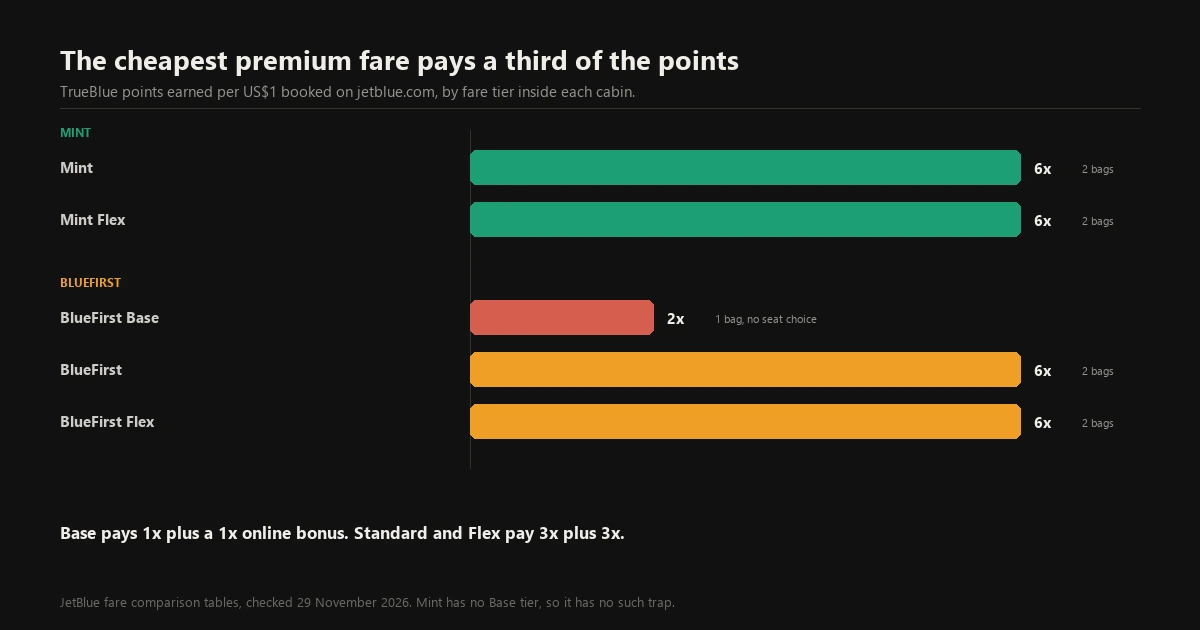
Mint has no equivalent trap because there is no Mint Base fare. Both Mint tiers earn six points per dollar, both allow changes at no charge, and the only difference is whether a cancellation returns a travel credit or your money. That makes Mint the cleaner of the two products to buy, and it makes BlueFirst Base a fare to avoid unless the saving is large and the flight is short.
Why the premium cabin is the worst use of a point
TrueBlue prices every award from the cash fare of the flight, so a point buys the same share of a Mint seat that it buys of a Main seat. The measured result is slightly worse than the headline, not better. Across published valuations the point is worth about 1.34 cents in the Main cabin. On Mint redemptions the observed figure sits nearer 1.20.
Work through the arithmetic on a real shape of booking: a US$905.60 Mint fare priced at 75,000 points plus US$5.60 in taxes returns (905.60 − 5.60) ÷ 75,000 × 100, which is 1.20 cents. Nothing went wrong. The cash fare and the points price simply do not move on the same schedule, and the premium cabin is where that mismatch is largest in absolute dollars.
The consequence is a rule about which currency to spend, not which cabin to fly. If you are transferring from a bank programme, the ratio compounds the loss: American Express at 5:4 turns 93,750 Membership Rewards points into those 75,000 TrueBlue points, which values the Amex points at about 0.96 cents against the 1.8 to 2.0 they are usually worth. Chase, Citi, Bilt and Wells Fargo transfer at 1:1 and lose less, but they still lose. The transfer partner index prices every programme-to-programme route against what the source currency is worth elsewhere. Mint is the largest saving in dollars on the whole programme and simultaneously the weakest return per point, and both statements are true because the fare is large.
What that means in practice: pay cash for Mint when the fare is on sale, and treat points as a way to cover a fare you cannot discount. If the cash fare is under about US$900 return on a transcontinental route, buying it and keeping the points is the better trade — and a sale fare is the only reliable route to Mint at a fair price. For anyone short of the balance, the buy-points tiers are worth pricing against the fare, because 1.43 cents at the top tier against a 1.20-cent redemption is a losing trade and the arithmetic says so before you click.
Upgrading instead of buying
The cheaper route into either cabin runs through status rather than the fare box. In October 2026 JetBlue renamed its Move to Mint certificates as Premium Upgrade Certificates and extended them to BlueFirst, so one instrument now covers both products, at a cost that varies by route, date and time of day: one to four certificates per segment.
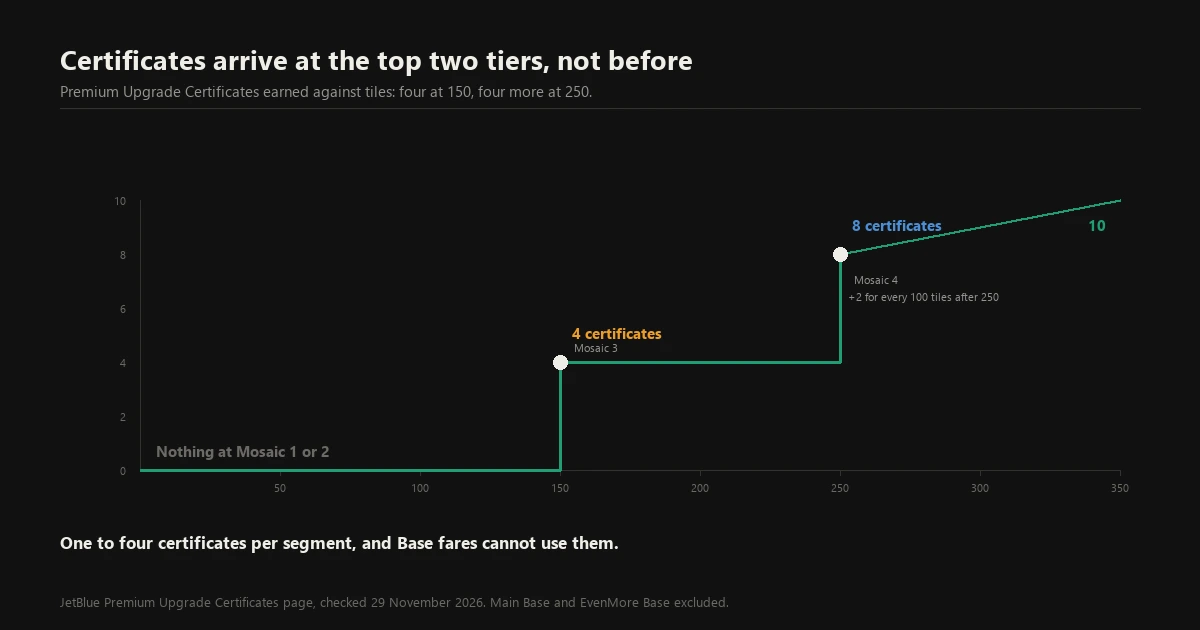
They are earned at the top of the programme. Mosaic 3 at 150 tiles receives four; Mosaic 4 at 250 tiles receives four more, for eight; every additional 100 tiles after that adds two. The certificate confirms a seat while one is still for sale, so it is not a standby queue — but the number required moves with demand, which is why a peak transcontinental Mint seat can absorb all four of a Mosaic 3 member’s annual allowance.
Three terms decide whether the certificate works at all. It must be applied to a Main, Main Flex, EvenMore or EvenMore Flex booking — Main Base and EvenMore Base are excluded, along with group bookings. It can be applied from the moment of booking until two hours before departure. And full points bookings and Cash + Points bookings are both eligible, which produces the strongest play in the programme: book Main with 18,000 points, then apply a certificate, and pay taxes rather than a Mint fare.
The tax bill is the whole cost, which is what makes this the only cheap route into the front cabin. A Mint seat bought with points still consumes 75,000 of them; a Main award plus a certificate consumes about 18,000 and leaves the rest of the balance intact. For anyone without 18,000 sitting idle, the cost of topping up a balance is at its lowest at the top tier, and it is still the cheaper half of the trade — but only because the certificate is doing the work.
There is a second, softer path arriving on 1 February 2027, when every Mosaic tier — including Mosaic 1 at 50 tiles — becomes eligible for space-available upgrades to BlueFirst, with one companion in the queue. That is a first-class upgrade for the entry tier, and it is the reason the 25-tile bonus on the Premier card is worth more from next year than it was in 2026.
Dollars per hour, the only fair comparison
Mint and BlueFirst cannot be compared on fare, because they are not sold for the same trips. They can be compared on what an hour of the premium costs, which is the number that survives the difference in stage length.
| Typical stage | Example fare | Per hour in the air | Points return | |
|---|---|---|---|---|
| BlueFirst, Boston to Fort Lauderdale | 3h 20m | US$299 introductory | About US$90 | 1,794 points on a Standard fare |
| Mint, New York to Los Angeles | 6h | US$905.60 | About US$151 | 1.20 cents per point redeemed |
| Mint, Boston to London | 6h 45m | Varies with season | Highest of the three | Same ratio, larger fare |
Read down the fourth column and the products sort themselves. BlueFirst is the cheapest premium hour in the network because it is the shortest flight and the least seat; Mint on a transcontinental is roughly one and a half times the cost per hour, and it buys a bed and a door. Neither is a bargain in the abstract. The test is what the same money buys elsewhere on that date: if the premium over a Main Standard fare on the same flight exceeds about US$50 an hour, the seat is being sold at a price the product does not support, and the same money applied to a discounted Mint fare on a longer route buys more.
Verdict
Decide by flight length, then by fare tier, then by currency. Under four hours, the honest question is whether BlueFirst costs less than about US$150 more than a Main Standard seat, because what you are buying is a wider chair and a faster airport, not sleep. Above five hours, Mint is the only product in the fleet that changes the trip, and the fare tier to buy is Mint rather than Mint Flex unless your plans are genuinely uncertain.
Pay cash when the fare is discounted and points when it is not, because both cabins redeem at or below the programme average. If you hold Mosaic 3 or above, do not buy Mint at all: a certificate applied to a Main Standard booking delivers the same seat for the price of Main plus taxes, and the four certificates are the most valuable thing the tier gives you. If you are buying BlueFirst, avoid Base — the 2 points per dollar and the missing seat selection cost more than the difference in fare at almost any stage length. And if you are topping up a balance to reach a premium award, price the gap against a cash fare, because 1.43 cents in and 1.20 cents out is a guaranteed loss.
Last updated 29 November 2026.
Questions
Is JetBlue Mint first class or business class?
Business class, in the sense that matters: a lie-flat seat. JetBlue calls it Mint and sells it on transatlantic flights and selected coast-to-coast, Caribbean and Latin American routes. BlueFirst is the domestic first-class product, and it is a recliner rather than a bed. The two are separated by aircraft, so the same city pair can offer either one depending on which plane is scheduled.
Is BlueFirst lie-flat?
No. BlueFirst is a wide recliner with up to five inches of recline and up to seven inches more legroom than Main, arranged two by two. It is aimed at flights of two to four hours where a bed is not the point. Only Mint has lie-flat seats.
Can I book Mint or BlueFirst with TrueBlue points?
Yes, both. Awards are priced from the cash fare, so the return per point is similar to a Main cabin award — about 1.20 cents on a typical Mint redemption against 1.34 for Main. Transferring bank points at 5:4 to reach a Mint award usually destroys more value than the upgrade creates.
Do Mint and BlueFirst include lounge access?
Mint includes entry to the BlueHouse lounges at JFK and Boston. BlueFirst does not. The other route in is Mosaic 4 status, which carries complimentary BlueHouse access plus one eligible companion, regardless of the cabin booked.
How do I get an upgrade to Mint or BlueFirst without paying the fare?
Premium Upgrade Certificates, earned at Mosaic 3 (four) and Mosaic 4 (eight, plus two for every additional 100 tiles). They cost one to four per segment depending on demand, must be applied to a Main or EvenMore booking in a Standard or Flex tier rather than Base, and can be applied up to two hours before departure. From 1 February 2027 every Mosaic tier also becomes eligible for space-available BlueFirst upgrades.
Does BlueFirst include a meal?
On flights of 899 miles or longer, yes: a FirstFare box with an entrée, a side and a dessert. Shorter flights get the premium snack selection instead. Mint serves a small-plates menu on every flight, with an express service on US transcontinental departures after 8pm.
More guides
- JetBlue TrueBlue promotions: what is live, and what is worth it
- Buying TrueBlue points: the tiers, the price, and when topping up beats a cash fare
- What a TrueBlue point is worth, and why Mint is not the sweet spot
- The best ways to redeem TrueBlue points, ranked by what you can undo
- JetBlue Mosaic status: the four tile tiers and what each one now returns
- How to earn TrueBlue points: every route, and which ones reach the tile counter
- Do TrueBlue points expire? The points do not, and the status clock is not the one you expect
- JetBlue fare tiers: the twelve options, and when Base costs more than Standard
- Transfer partners: the eight routes into TrueBlue, and which balance to spend
- JetBlue credit cards: which of the four pays off, and which sells status
Check the seat map before you pay, because the cabin you get depends on the aircraft rather than the route. JetBlue publishes the Mint product page and the BlueFirst page with the current seat specifications, and the certificate rules are on the Premium Upgrade Certificates page.