Do JetBlue points expire? No. TrueBlue points carry no expiry date and no activity requirement, so a balance earned years ago is still there in full, whether or not you have flown the airline since. JetBlue removed expiration in 2013 and has not reinstated it.
That answers the question, but it is not the whole answer, because three other things in the programme do run on a clock: the tiles that decide your Mosaic status, the status itself, and the cash you paid in taxes on an award ticket. This guide separates them, lists the only ways a balance can actually disappear, and explains why no expiry is not the same thing as no risk.

On this page
The rule, and when it changed
JetBlue’s own TrueBlue page states it without qualification: your TrueBlue points never expire. The terms add the condition that matters, which is that the account has to stay open and in good standing. There is no annual activity test, no maintenance fee, no minimum redemption and no cap on how long a balance can sit.
The rule was not always this. Before 2013, TrueBlue points lapsed after a period of inactivity, and older guides still describe a 12-month clock. That is where most of the contradictory advice online comes from: a real rule, retired more than a decade ago, still being repeated as current. If you have read that JetBlue points expire after 12 months, or that you must earn or redeem once a year to keep them, the source is out of date.
Points behave identically whichever route they arrived by. A point from a flight, a point from a card, a point transferred from Chase, a point bought from Points.com and a point pooled in by a family member all land in the same balance and inherit the same rule. None of them carries its own expiry date, and none is segregated from the rest.
The only ways to lose a balance
There are two, and neither involves time.
You close the account. The terms terminate the points with the account, so a member who closes a TrueBlue profile to tidy up, or to start again with a new email address, forfeits whatever was in it. If you are leaving the programme, spend the balance on an award before the account goes, even if the redemption is not the one you would have chosen with more time.
JetBlue closes it. Fraud, misrepresentation, abuse or a violation of the programme rules lets the airline terminate an account and the points in it. This is the clause that catches manufactured spending, resold awards and duplicate accounts, and it is the only route to forfeiture that a well-behaved member can ignore entirely.
What is not on the list is worth stating, because it is where most people expect to find a trap. Inactivity is not a route to forfeiture. Neither is cancelling an award: points redeposit when you cancel a JetBlue award booking, so changing your mind about a trip does not cost you the currency. And there is no paid reinstatement scheme, unlike American, because there is never an expired balance to reinstate.
Tiles: the clock that does run
Everything above is about points. The status currency is a different instrument with a different calendar, and conflating the two is what makes this question confusing in the first place.
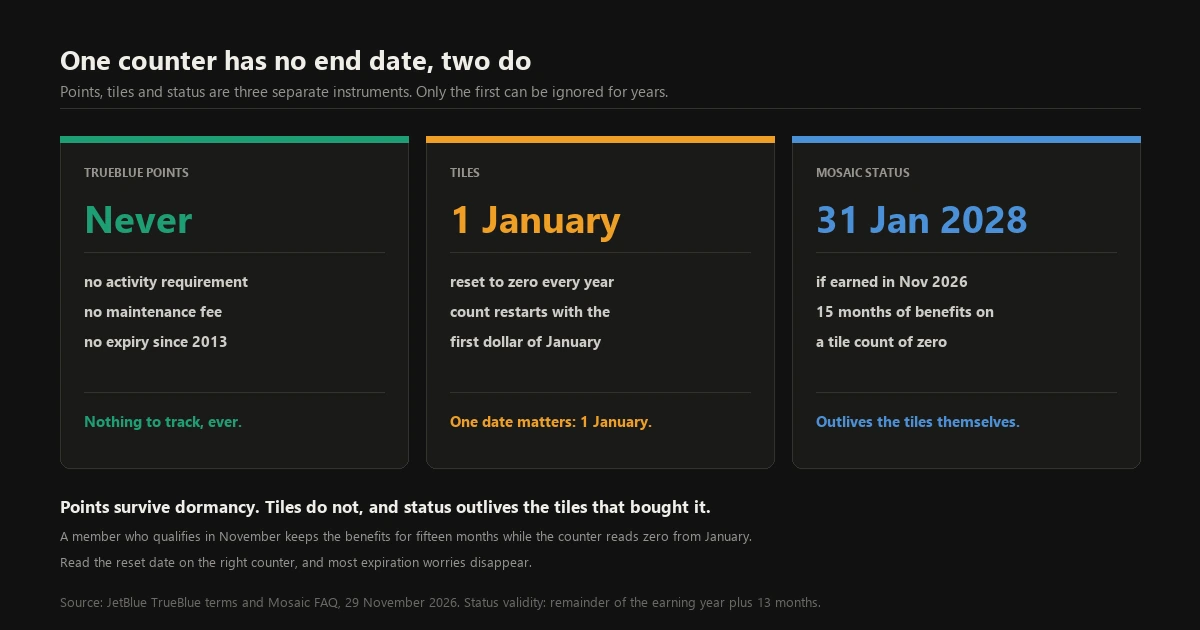
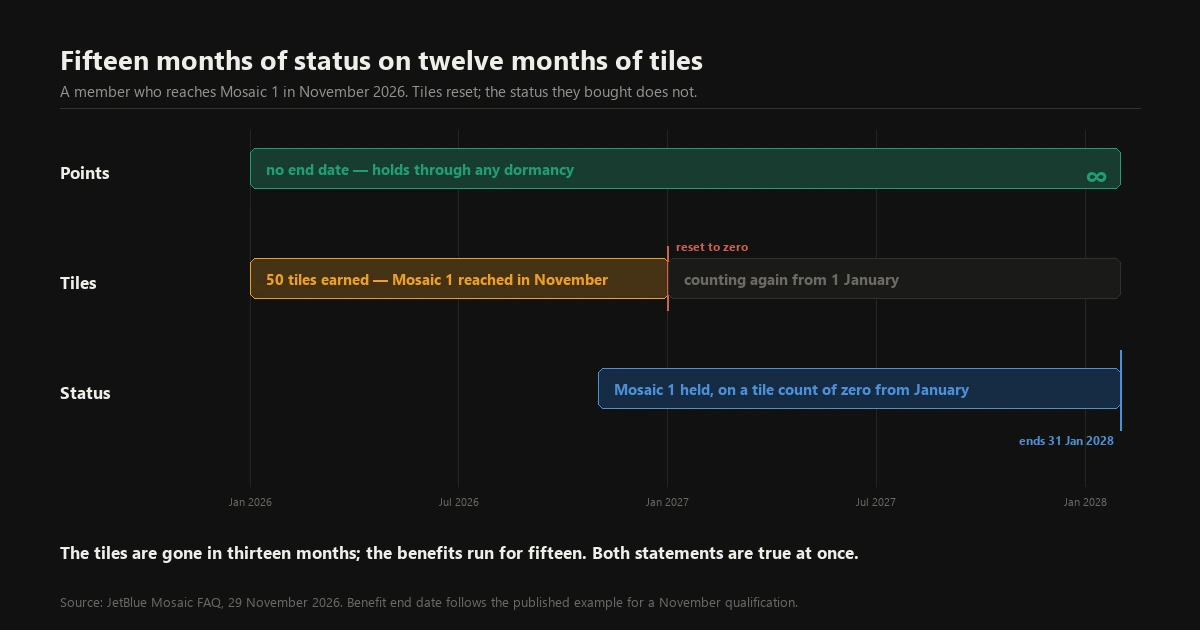
Tiles are earned on qualifying spend, one per US$100 on JetBlue travel and one per US$1,000 on card spending, and they are counted within the calendar year. On 1 January the tile count goes back to zero and the next qualification year starts. The status those tiles bought does not reset with them: Mosaic status runs for the remainder of the year in which it was earned plus thirteen months, which in practice means through 31 January of the year after next.
| What it is | When it expires | What resets it |
|---|---|---|
| TrueBlue points | Never | Only account closure |
| Tiles (progress towards status) | 1 January each year | New qualification year |
| Mosaic status | 31 January, two calendar years after the year it was earned | Earning it again |
| Travel Bank credit | 12 months from issue | Nothing, normally |
Put a date on it. A member who reaches Mosaic 1 in November 2026 holds the status until 31 January 2028, which is fifteen months of benefits, while the 50 tiles that bought it disappear on 1 January 2027. For thirteen of those months the member is flying on a zero tile count with full status. Anyone who reads “tiles reset annually” and concludes that status disappears with them has the two clocks backwards.
One recent change is easy to miss. From 2026, Mosaic status and benefits continue through 31 January rather than ending with the calendar year, which is where the extra month comes from. Qualification still depends on spend completed by 31 December, so the extension buys time to use the status, not time to earn it.
None of the changes announced for 1 February 2027 touch expiry. They reshape perks, tile bonuses and upgrade priority, all of which are covered in the Mosaic status guide. The clock described above stays as it is.
The part of an award that really does expire
Here is the expiry that catches people who have read that nothing expires and stopped there. Book an award, pay the taxes and fees in cash, then cancel, and the points come back to the balance within minutes while the cash does not come back to your card. It is issued as a Travel Bank credit, valid for twelve months from the date it was issued, and JetBlue does not normally extend it.
The twelve months is not a grace period on booking, either. Travel has to be completed before the credit expires, so a credit issued in March 2026 has to be flown by March 2027, and a booking made in February 2027 for a flight in May is worth nothing. The same clock applies to credit from a cancelled cash ticket.
So the honest summary of the programme is that the points are the safe part. A balance can sit through years of not flying, but the cash component of any cancelled booking is on a one-year fuse from the moment it is issued. If you cancel a US$180 award and forget about it, the US$180 is the money you lose, not the 30,000 points.
How JetBlue compares
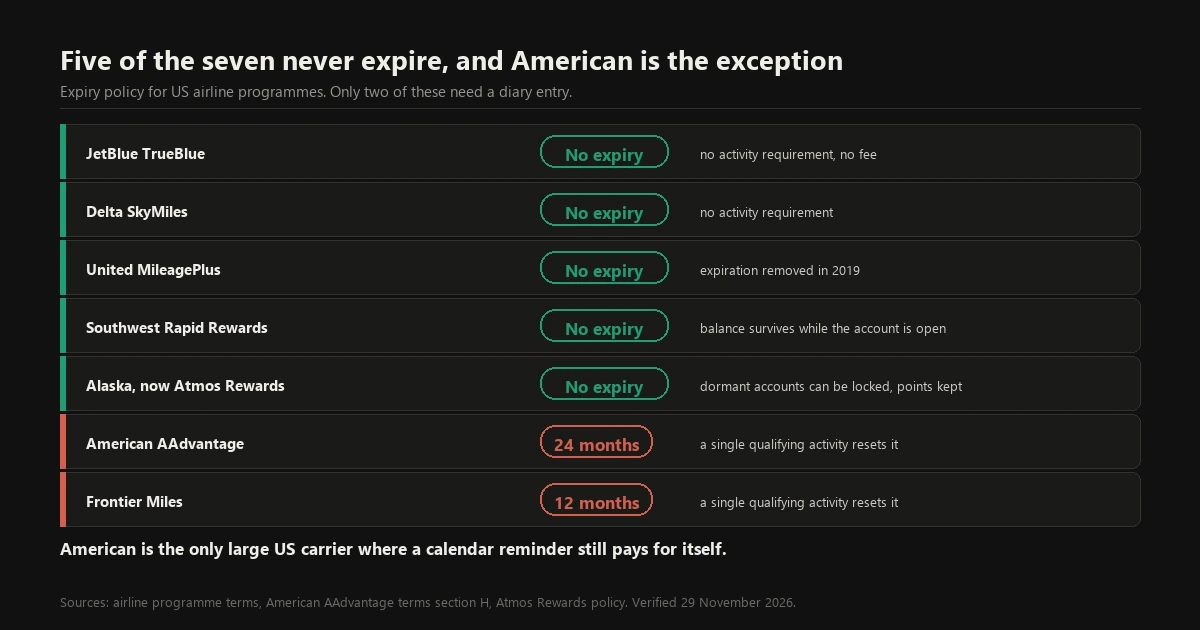
No expiry is unusual but not unique, and the comparison is the fastest way to see where a calendar reminder is actually needed.
| Programme | Points or miles expire? | The rule |
|---|---|---|
| JetBlue TrueBlue | No | No activity requirement, no fee |
| Delta SkyMiles | No | No activity requirement |
| United MileagePlus | No | Expiration removed in 2019 |
| Southwest Rapid Rewards | No | Balance survives while the account is open |
| Alaska, now Atmos Rewards | No | No expiry since April 2023, though a dormant account can be locked |
| American AAdvantage | Yes | 24 months with no qualifying activity |
| Frontier Miles | Yes | 12 months with no activity |
American is the outlier among the large US carriers, and the only one where a diary entry earns its keep. A single qualifying transaction extends the whole balance by another 24 months, and primary cardholders and members under 21 are exempt from the rule altogether, which is the cheapest way to make the question go away permanently. United, Delta and Southwest sit with JetBlue in the no-expiry group.
Alaska deserves its own line because the wording is easy to misread. Since April 2023 its miles have had no expiry date, and the August 2025 rename to Atmos Rewards carried that forward. But an account with no earning or redeeming for roughly two years can be locked for security, and an account left locked for long enough can eventually be closed, which is where the balance goes. The points do not expire; the account can, and that distinction is set out in full here.
No expiry is not the same as no risk
The absence of a deadline removes one kind of loss and leaves another in place. TrueBlue award pricing is dynamic: the points price of a seat tracks the cash fare, with no published chart and no fixed ceiling. That design means a balance does not lose value through time in the way a fixed chart does, but it does lose value when fares on the routes you fly rise.
Run the arithmetic. A balance of 60,000 points is worth about US$804 of award travel at our 1.34 cent valuation. If fares on your route rise 10% before you book, the same seat costs 10% more points, and the balance covers about US$731 of it. Nothing expired, no rule changed, and you are US$73 worse off. The loss is real; it simply is not a deadline, which is why it is easier to ignore until it has happened.
The second risk is the programme itself. 2026 brought a fare restructure that renamed every fare and changed how points are earned, and 2027 brings a revamp of Mosaic perks. Terms move. A balance that cannot expire is still a balance denominated in a currency whose issuer can redefine what it buys, which is the argument for redeeming on value rather than on a calendar.
That is the whole framework: there is no expiry deadline to manage, so the only deadline worth managing is the award in front of you. Our point valuation sets the threshold at 1.34 cents, and the ranked list of redemptions shows which awards clear it.
What to do with a dormant balance
Six moves, in order, for anyone holding a balance they have not touched in a year or more.
Check the account is reachable. You do not need activity to keep points alive, but you do need to be able to log in, and the email on file is how JetBlue reaches you about programme changes. Members who discover a balance years later usually discover it alongside an address they no longer use.
Price a real award, not a hypothetical one. Search the route you would actually fly on the dates you would actually fly it, and compare the points price with the cash fare on the same screen. That ratio, not a valuation table, is the number that decides the booking.
If it clears 1.34 cents, book it. Holding a balance that has already cleared the threshold is a bet that fares will fall faster than they rise, and the option has no expiry date to force the decision for you.
If it does not clear, hold, and stop worrying about it. This is the practical benefit of no expiry: a balance you cannot use well today costs nothing to keep. The member with 12,000 points and no imminent trip is not losing anything by waiting.
Spend small balances on extras. Since March 2026 points can be used for seat assignments, checked bags, pet fees and priority security, with awards starting from 500 points. A 4,000-point balance that cannot buy a flight can still buy a bag and a better seat, which is a better outcome than leaving it sit indefinitely.
Do not buy points to beat a deadline that does not exist. The worst reason to top up is a belief that the balance is about to lapse, because it is not. Buying is worth doing only when a specific award is short by a defined amount, and the price of a top-up at the current tier is below the value of the seat it unlocks.
Verdict
The question is settled and the answer is no. TrueBlue points do not expire, there is no activity requirement, and the only ways to lose a balance are closing the account yourself or having it closed for breaking the rules. Ten years of not flying JetBlue costs you nothing in points.
What does not expire is narrower than the headline suggests. Tiles reset every 1 January, status runs to 31 January two years out, and Travel Bank credit from a cancelled booking dies after twelve months. Those are the clocks worth knowing, and none of them is the balance itself.
So the useful version of the question is not whether the points expire but what they still buy. Price the award you want, check it against 1.34 cents, and treat the fare as the deadline, because that is the only one the programme actually enforces.
Last updated: 29 November 2026. Expiration rules, tile reset dates and status validity verified against JetBlue’s TrueBlue terms and FAQ, and against American’s AAdvantage terms for the comparison table.
Questions
Do JetBlue TrueBlue points expire?
No. There is no expiry date, no activity requirement and no maintenance fee. A balance stays in the account indefinitely while the account is open and in good standing, and JetBlue has not required activity to keep points alive since it removed expiration in 2013.
What happens to my points if I close my TrueBlue account?
They are terminated with the account. Closing a profile forfeits whatever balance is in it, so redeem before you close, even if the award is not the one you would have chosen with more notice.
Do Mosaic tiles expire?
Yes. Tiles count within the calendar year and reset to zero on 1 January. The status they earned does not reset with them, which is why a member can hold full Mosaic benefits on a tile count of zero for more than a year.
How long does Mosaic status last?
Through 31 January of the year after next. Status earned in 2026 is valid to 31 January 2028, and from 2026 the benefits run to 31 January rather than ending with the calendar year.
Do JetBlue Travel Bank credits expire?
Yes, twelve months from the date the credit is issued, and they cannot normally be extended. Travel has to be completed before the expiry date, so a booking made inside the window for a flight outside it does not preserve the value.
Do bought or transferred points expire?
No. Purchased points, transferred points, points from a card welcome offer and points pooled in by another member all enter the same balance and follow the same no-expiry rule as points earned by flying.
More guides
- JetBlue TrueBlue promotions: what is live, and what is worth it
- How to earn TrueBlue points: every route, and which ones reach the tile counter
- JetBlue Mosaic status: the four tile tiers and what each one now returns
- Buying TrueBlue points: the four bonus tiers and the break-even maths
- What a TrueBlue point is worth, and why Mint is not the sweet spot
- The best ways to redeem TrueBlue points, ranked by what you can undo
- Which airline and hotel programmes still expire points, and after how long
- JetBlue fare tiers: the change fees and Travel Bank credits each level carries
- The eight transfer routes, and why moved points sit on the same clock as earned ones
- JetBlue credit cards: the anniversary points each card pays, and what they are worth
- JetBlue Mint: whether a premium award runs on the same clock
Holding a balance you have not touched in years? Check what your balance covers on the route you actually fly, then compare it with the cash fare on the same date. There is no deadline pushing you, so the decision should rest on the award in front of you rather than on the calendar.