Flying Blue Miles do expire, and the rule is narrower than the anxiety around it suggests. An Explorer member loses the balance after 24 months without an eligible earn activity. One flight, one hotel night, one transfer of a thousand points from a bank programme is enough to reset the clock, and since 4 May 2026 a single activity resets the entire balance rather than the corner of it earned the same way.
What costs people money is the part that does not count. Buying Miles does not extend their validity, and neither does spending them. A member who panics three weeks before the date and buys 2,000 Miles to “keep the account active” has spent money and moved nothing, because a purchase is not an earn activity in the sense the terms use. The same is true of the instinct to redeem something small: spending is not earning, and the expiry date does not notice.
Short version: 24 months, counted from your last eligible earn activity, with the whole balance sharing one date. Any earn activity resets it — a flight, a co-branded card purchase, a night booked through a partner, a transfer of 1,000 points from American Express, Chase, Citi, Capital One or Bilt. Buying Miles and redeeming Miles do not. The balance expires in one piece, with no partial expiry and no grace period. Silver members and above never have to think about any of this, and neither do cardholders, subscribers to Flying Blue Extra or members under 18. Accounts registered in Germany keep a three-year rule instead.
The rule, in the airline’s own words
Flying Blue writes the mechanic plainly in its general terms, and the wording is worth reading twice because two words carry the whole thing. For Explorer members aged 18 or over, Miles are valid for 24 months from the date of the last earn activity on the member’s account, and each recorded earn activity shall extend the validity of the member’s entire Miles balance for an additional period of twenty four (24) months from the date of that activity.
“Last earn activity” is the phrase that decides everything. There is one date on the account, not one per batch of Miles. Miles earned in 2019 and Miles earned last week expire together, on the same day, and every new activity pushes that single date forward by another two years. Members can read the exact date in their online account at any time, which is the only figure worth planning around.
| If your last earn activity was | The balance expires on |
|---|---|
| 14 March 2026 — a paid Air France flight | 14 March 2028 |
| 2 November 2026 — 1,000 points transferred from a bank programme | 2 November 2028 |
| 20 January 2027 — one night through a hotel partner | 20 January 2029 |
The design is generous in one direction and unforgiving in the other. It is generous because a member who flies once every two years will never lose a Mile, however small the balance and however rarely they travel. It is unforgiving because the mechanism has no memory: 24 months of silence removes everything at once, and a balance built over a decade of careful collecting is worth exactly as much as a balance built last month.
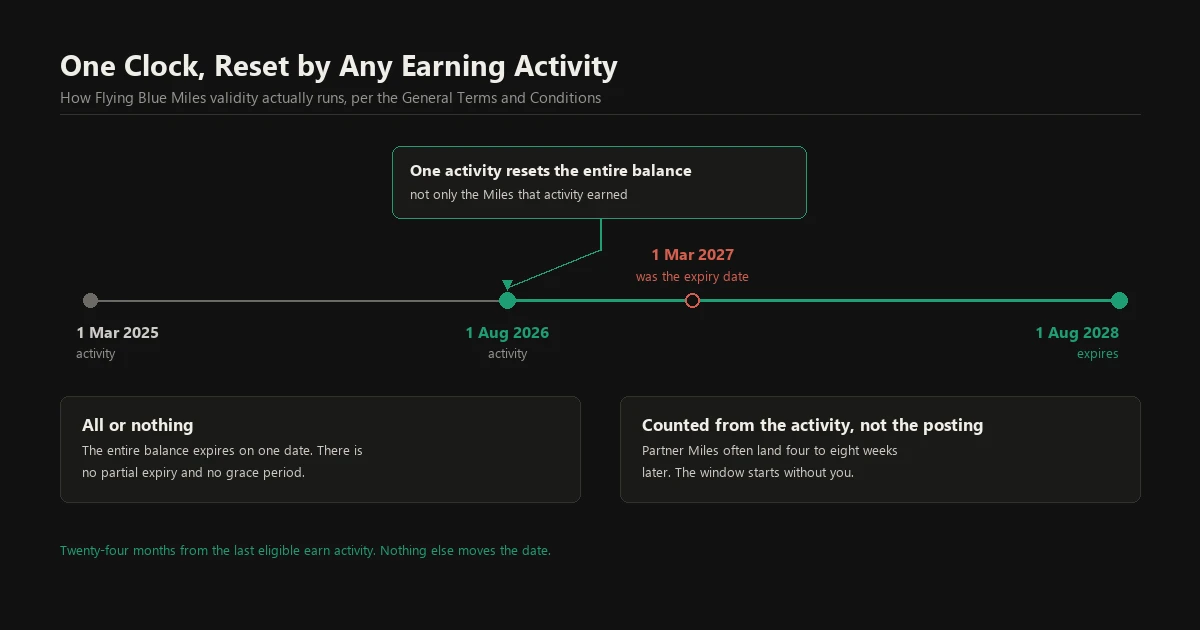
The clock starts on the activity, not the posting
The terms are specific that validity runs from the date of that activity, not the date the Miles land. For flights on Air France or KLM the gap is usually days and nobody notices. For partner activity it is routinely four to eight weeks, and occasionally longer when a hotel or a shopping portal batches its submissions at the end of a month.
The practical consequence is that the 24 months can start without the member knowing it has started. Somebody who stays one night at a partner hotel on 20 November and waits for the Miles to appear in mid-January has been running on a clock since 20 November. Two months of the window are gone before the activity shows up on the statement, and a member who counts backwards from the posting date will plan for a date that is already wrong. The date printed in the account is the authority; the date on the hotel invoice is the one the terms use.
This matters most for members who rely on a single annual action to keep a balance alive. Booking it in the final fortnight of the window is the one way to get this wrong even after reading the rule: an activity that happens before the expiry date but posts after it is not a recorded activity at the point the balance is cleared. Sixty days of margin costs nothing and removes the risk entirely.
What changed on 4 May 2026
Until that date Flying Blue ran two extending tracks, and the difference between them was the source of most of the confusion still circulating. Flights and co-branded card spending were “overall extending” activities: they refreshed the whole balance. Hotels, car rental, experiences and transfers from bank programmes were “partial extending”: they refreshed only the Miles earned through those same partners, and left the flying balance untouched.
That structure produced a failure mode that looked like a glitch but was working as designed. A member with 40,000 Miles from flying and 3,000 from a hotel stay could book a night, watch 3,000 Miles gain two more years, and lose the 40,000 on schedule, because a hotel stay never reached the flying balance. Two dates, two sets of Miles, one account page that showed neither clearly. Plenty of guides still describe it, which is why the question keeps getting answered wrongly.
Since 4 May 2026 there is one track. Any eligible earning activity — flight, card, hotel, car, shopping portal, bank transfer — extends the entire balance by 24 months from the date of that activity. Existing balances were merged at implementation and given the most favourable of the old dates, so nobody lost validity in the changeover.
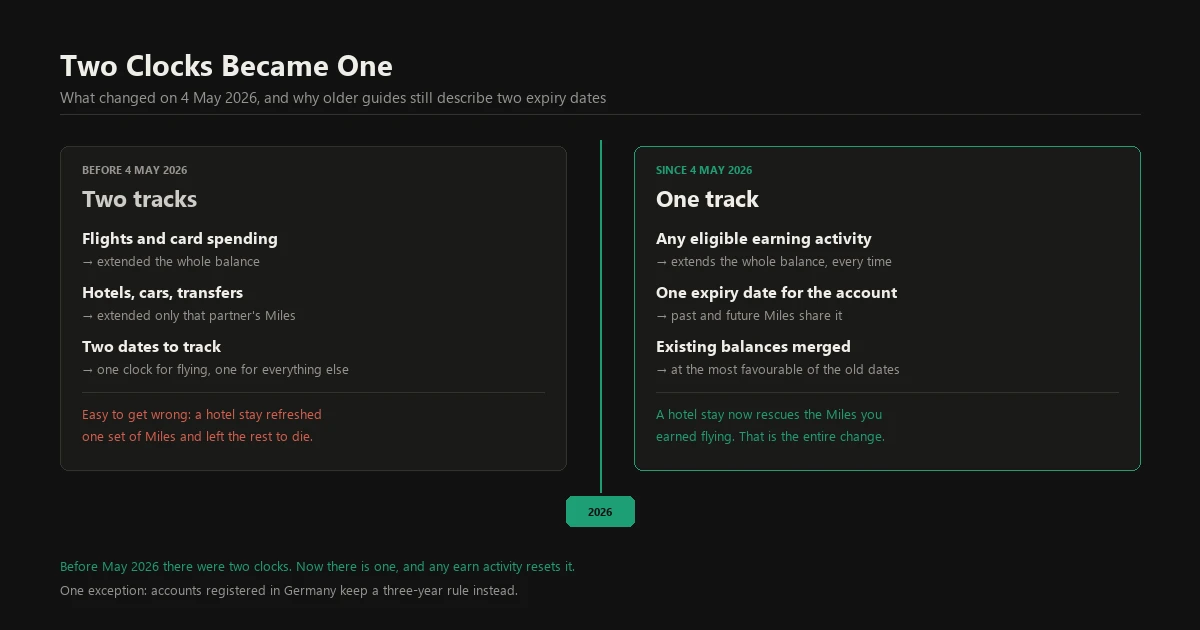
One market was left out. Accounts registered in Germany keep a three-year rule rather than moving to 24 months, and the German exception is stated on the programme’s own announcement rather than in the general terms. Members who registered in Germany and later moved should check which rule their account follows before assuming either.
What resets the date, and what does not
This is the table worth keeping. The left column is longer than most members expect, and the right column contains the two items that cost real money.
| Extends the whole balance | Does not extend anything |
|---|---|
| A flight on Air France, KLM, Transavia or any SkyTeam partner, in any cabin that earns Miles | Buying Miles, in any quantity, at any price |
| Spending on a Flying Blue co-branded credit card | Redeeming Miles for a ticket, an upgrade or an experience |
| A purchase through the Flying Blue Shopping Portal | Donating Miles to a charity partner |
| A hotel stay or car rental booked through a Flying Blue partner | Reinstating Miles that have already expired |
| A transfer of points from American Express, Chase, Citi, Capital One, Bilt or Marriott | Logging in, checking the balance, updating a profile |
| A purchase of sustainable aviation fuel against a booking | Buying a fare that earns no Miles, such as a reward ticket |
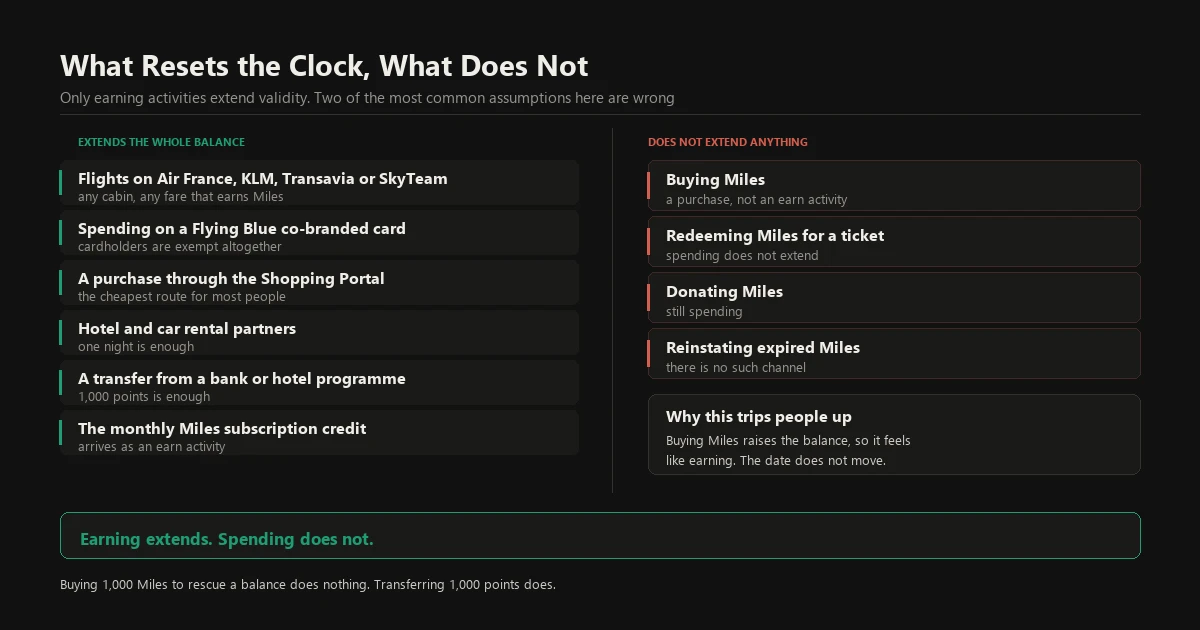
Buying Miles is the expensive mistake. It is the most natural response to an expiring balance, it is heavily promoted, and it does nothing. The purchase is a cash transaction with the programme’s Miles partner, not an earn activity recorded against a flight or a partner stay, and the terms do not list it among the activities that extend validity. A member spending the standard rate to rescue 30,000 Miles adds 2,000 Miles and keeps the same expiry date, then discovers the balance gone anyway.
Redeeming is the second. Plenty of advice suggests spending a few Miles to “keep the account active”, on the reasonable-sounding logic that movement must count. It does not. The mechanism is built around earning, and a redemption is spending; the balance drops, the date stays, and the member has converted Miles into something they did not especially want in exchange for nothing. If the balance is genuinely about to go, spending it on a ticket is a better outcome than losing it, but it is a salvage operation rather than a rescue.
The legitimate cheap fix is a transfer. American Express Membership Rewards, Chase Ultimate Rewards, Citi ThankYou, Capital One and Bilt all convert into Flying Blue at 1:1 for most US cardholders, and Marriott Bonvoy converts at 3:1. A thousand points is enough to register an earn activity and reset the whole balance for two years, and most of those transfers post within a day or two. Against a cash purchase that achieves nothing, a transfer that costs roughly ten to fifteen dollars of forgone value is the whole answer to the question.
A single hotel night is the other reliable route, and the one that comes with a bed attached. Hotel partners credit Miles for stays booked through the programme, and one night is sufficient regardless of rate, chain tier or length of stay. For anyone with a trip already planned inside the window, booking that night through a partner does the job and pays for itself in accommodation rather than in admin.
Nothing expires in instalments
Some programmes retire Miles in batches, so a balance erodes gradually and a member can watch it happen. Flying Blue does not. When the 24 months pass without an eligible activity, the entire balance goes on one date, and there is no partial expiry, no grace period and no published reinstatement process.
Two practical notes follow. The first is that a small balance is not safer than a large one; both die together, which means the calculation of whether to bother saving a balance is about the value of the whole thing rather than the risk to any part of it. The second is that the date is worth diarising rather than trusting to a reminder email, because the only figure that matters is the one in the account and it moves every time an activity posts.
The absence of a reinstatement route is worth stating plainly, because the internet is full of advice about asking nicely. Flying Blue does not publish a process for restoring expired Miles, and customer service has no discretionary tool for it. Once the date passes, the balance is gone, and the only options are the ones that existed before it passed.
Who never has to think about this
Four groups are outside the 24-month rule entirely, and a fifth is outside it according to the programme’s announcement rather than the terms. The distinction is small but worth knowing, because it is the kind of thing that gets quoted back at you in a dispute.
| Group | Rule | Where it is stated |
|---|---|---|
| Silver, Gold, Platinum and Ultimate members | Miles never expire | General terms, and the programme announcement |
| Flying Blue Extra subscribers | Miles never expire while the subscription runs; anything due to expire during it is pushed to the end date | General terms, including a dedicated clause |
| Members under 18 | Miles never expire | General terms |
| Holders of a Flying Blue co-branded card | Miles never expire | Programme announcement only |
| Accounts registered in Germany | Three years, not 24 months | Programme announcement only |
Silver is the cheapest route out. It costs 100 XP, which is one and a half business returns across the Atlantic, and it removes expiry permanently rather than for a year — the exemption follows the level, and the level is renewed by flying rather than by remembering a date. For a member who flies enough to hold Silver but not enough to spend the Miles quickly, the status is doing quiet work that never appears on a benefits page. If the level itself is the puzzle, what each Flying Blue level actually costs in XP covers the arithmetic.
Flying Blue Extra is the paid version of the same guarantee. It is an annual subscription that keeps the balance alive for as long as it runs, and the terms add a useful detail: Miles scheduled to expire during the subscription are extended to the subscription’s end date rather than merely frozen. For a member holding a large balance they cannot spend yet, the subscription is a way of buying time without buying Miles — and unlike a Miles purchase, it is the thing the programme actually sells for this purpose.
Family pooling covers eight people with one flight
The most efficient structure in the programme is one most members never set up. A Flying Blue Family pools the Miles of up to eight people onto a single account, and the composition rule is more restrictive than the “eight members” shorthand suggests: a maximum of two adults aged 18 or over, and up to six children under 18. It is built for households, not for groups of friends.
What makes it worth the paperwork is the interaction with validity. The pool sits on the family leader’s account, which means one activity by any member refreshes the whole pool for 24 months. A family where one adult flies twice a year and the other never flies at all keeps every Mile alive, including the children’s, from a single set of flights. Without pooling, the non-flying adult’s balance would need its own activity every two years, which in practice means either a transfer or a loss.
Two conditions are worth knowing before setting one up. The family leader must have been enrolled for more than 24 hours and be at least 18, and a member can belong to only one family at a time. The structure also concentrates risk: all the Miles sit on one account, so a leader who stops travelling and lets the pool lapse takes everyone’s balance with it. Given that any single member’s activity is enough to prevent that, the risk is easy to manage and the arrangement is still worth having.
Ranking the fixes by what they cost
Ordered by cost, with the effective options at the top. The cheapest is not the most obvious, which is the point.
| Action | What it costs | How fast it posts |
|---|---|---|
| Transfer 1,000 points from a bank programme | Roughly $10 to $15 of forgone value | A day or two for most partners |
| Buy something through the Shopping Portal | Whatever you were going to spend anyway | Usually a few weeks |
| Book one hotel night through a partner | The room rate, which buys a room | Four to eight weeks |
| Fly any eligible segment | The fare | Days |
| Buy Miles | The full purchase price | Does not work at all |
The ranking explains why the “just buy some Miles” advice persists despite being wrong: it is the option the programme promotes hardest, it is the fastest to complete, and the failure is invisible for two years. A member who does it sees the balance rise, feels the problem solved, and only discovers the truth when the date arrives unchanged.
The second row of that table is the one to use if a trip is already in the diary. A room booked through a hotel partner for a night you were going to pay for anyway costs nothing extra and posts the activity in the same motion, which makes reserving the stay through the programme a better use of the money than any transfer would be of the points.
For members with a genuinely large balance and no travel planned, there is a fourth option that is not on the list because it is not a rescue. If the Miles cannot be extended, they can be used, and a reward ticket booked before the date is a better outcome than a balance that disappears. The complication is that which fare brand you book decides what the ticket can do afterwards, so a last-minute salvage is worth pricing in Standard rather than Light if the dates are soft. If the balance is short of any award and the only question is what a Mile is worth, the value calculation is the place to start rather than the cash price of topping it up.
The clause that is worse than expiry
Losing Miles is a waste. Losing the membership is worse, and the terms allow it on a schedule that few members have read. Flying Blue reserves the right to close an account unilaterally in two situations: no XP and no Miles accrued for five years, or no earn activity within two years after enrolment.
The second is the sharper of the two, because it applies to new members who have not yet started. Somebody who joins to collect a sign-up bonus, never flies, never transfers and never shops has a two-year window from the day they enrolled, and the account can be closed at the end of it — not merely emptied. The five-year rule catches the dormant long-term member; the two-year rule catches the person who signed up and forgot.
Both are easy to avoid and both are easy to miss, because neither produces a reminder and neither is mentioned at enrolment. The same 1,000-point transfer that resets a balance also resets both clocks, which makes it the single most useful piece of account hygiene in the programme.
Is it worth saving at all
The reflex is to save every balance, and the reflex is wrong often enough to be worth a rule. The question is not whether the Miles can be saved — they almost always can, for about the price of a transfer — but whether the balance is worth the trouble of a two-year cycle that has to be repeated forever.
A useful test is whether the balance can already buy a flight you would take. Fifteen thousand Miles buys a short-haul economy award on a promo reward at the low end of the sale, which makes a transfer worth making; the same fifteen thousand Miles is worth roughly two hundred dollars at typical redemption value, against a transfer cost of ten to fifteen. Two thousand Miles buys nothing on its own and will not buy anything in two years either, and a member who spends a transfer to keep it alive is paying to maintain a rounding error.
The middle case is the common one: a balance large enough to be worth keeping and too small to book the trip you actually want. Those balances are worth extending, but they are better spent than hoarded, because dynamic pricing means the award that price buys now is not guaranteed to be available at the same price in two years. If the balance is going to be extended anyway, checking what the Miles cost to buy is a reasonable last step: a member topping up to reach a specific award should know the per-Mile rate before deciding whether the transfer or the purchase is the cheaper route to it — while remembering that only one of those two moves the expiry date.
Frequently asked questions
Do Flying Blue Miles expire?
Yes, for Explorer members aged 18 or over. Miles are valid for 24 months from the last eligible earn activity on the account, and every new earn activity extends the entire balance by another 24 months from the date of that activity. Silver members and above, Flying Blue Extra subscribers, co-branded cardholders and members under 18 have Miles that never expire, and accounts registered in Germany keep a three-year rule.
Does buying Miles extend their validity?
No. A Miles purchase is a cash transaction, not an earn activity recorded against a flight or a partner stay, and it is not among the activities that extend validity. A member who buys 2,000 Miles three weeks before the expiry date adds 2,000 Miles and keeps the same date, so the whole balance still expires on schedule.
Does redeeming Miles keep the account active?
No. The rule is built around earning, and a redemption is spending. The balance falls and the expiry date stays exactly where it was. Spending a balance that is about to expire is a better outcome than losing it outright, but it does not extend anything.
What is the cheapest way to extend Flying Blue Miles?
Transfer 1,000 points from a bank programme that converts into Flying Blue, such as American Express Membership Rewards, Chase Ultimate Rewards, Citi ThankYou, Capital One or Bilt at 1:1, or Marriott Bonvoy at 3:1. A thousand points is enough to register an earn activity, it costs roughly ten to fifteen dollars of forgone value, and most transfers post within a day or two. A purchase through the Shopping Portal or one hotel night works as well, but posts more slowly.
Do Flying Blue Miles expire if you have status?
No. Miles never expire for Elite members from Silver upwards, which is the cheapest permanent exemption in the programme at 100 XP. It also covers Flying Blue Extra subscribers, holders of a co-branded card and members under 18. The exemption follows the level rather than the balance, so it lapses if the level does.
What happens when Flying Blue Miles expire?
The entire balance is removed on one date. There is no partial expiry, no grace period and no published reinstatement process, so a balance built over ten years goes the same way as one built last month. The way to avoid it is an earn activity before the date, not a conversation with customer service after it.
More guides
- Earning activity, the 24-month clock and what resets it
- Turning an expiring balance into a funded award
- Flying Blue promotions: what is live and what is worth it
- Flying Blue elite status: what each level costs in XP
- Buy Flying Blue Miles: the real cost per Mile
- Promo Rewards: how the monthly sale works
- Light, Standard or Flex: what each award fare includes
- Airline alliances explained, including where Flying Blue sits
Last updated: 27 November 2026.