Flying Blue Promo Rewards are the discount table Air France and KLM publish on the first of every month: up to 25% off the standard mileage price on a short list of routes, bookable only inside that month. The discount is genuine. What it buys is not what it used to be. Since 8 September 2026 the price quoted in that table is a Light award, which in economy means no checked bag, no changes and no refund, and in business means one 32kg bag and a lounge you pay for separately. Most write-ups report the 25% and stop there. This page reports the 25%, then prices what it takes off the ticket.
Short version: the table is replaced on the first of each month, the booking window is that same calendar month, and travel runs to roughly five months past it. Four cabin floors carry almost every route: 7,500 miles for short-haul economy, 18,750 for long-haul economy, 45,000 for long-haul business, and 63,750 for the deeper business discounts. Those are Light prices. A meaningful share of the routes are marked Extra Exclusive and require a paid subscription of €379 or €699 a year. Reward tickets earn no miles and no XP, and taxes and carrier surcharges are not covered by the mileage price. The one judgement worth carrying away: on business class, the 15,000 miles a Promo saves is roughly what the inclusions you lose are worth, so the discount and the fare brand mostly cancel out.
What Promo Rewards actually is
Start with what it is not. Promo Rewards is not a sale on miles. It is a discount on the miles a seat costs, which means the thing being sold is a seat, and the currency is a balance you already hold. That distinction matters because the two promotions run on different clocks and are routinely confused: a buy-miles bonus changes what a mile costs you, while Promo Rewards changes what a seat costs in miles. Buying miles to fund a Promo ticket is a way of paying cash for a discount that was already denominated in a currency you did not have. The official miles page shows what such a top-up costs today, and the arithmetic further down this page explains why it rarely closes the gap.
The programme’s own wording is narrow and worth reading twice. Promo reward tickets are reward tickets with up to a 25% discount, and new ones are released on the first day of each month. Three constraints follow from the terms, and each one removes routes from the list you think you are shopping.
| Constraint | What the terms say | What it removes |
|---|---|---|
| Operating carrier | Flights operated and marketed by Air France and KLM | Partner metal. No Delta transatlantic, no SkyTeam connection flown by someone else. |
| Geography on long-haul | Prices shown are for flights to and from Europe, at the lowest available price | Fifth-freedom and beyond-Europe itineraries, which price differently or not at all. |
| Availability | Subject to availability, with the lowest price tied to the lowest open booking class | The dates you actually want. A route on the list is a route that exists, not a seat that exists. |
Long-haul Promo tickets include one connecting flight within Europe through Paris or Amsterdam, in either direction. That is more generous than it sounds: a Promo to New York can end in Milan for the same mileage, which is why the discount is sometimes worth more as a way to reach a second city than as a way to reach the one in the headline.
One table, one month, three deadlines
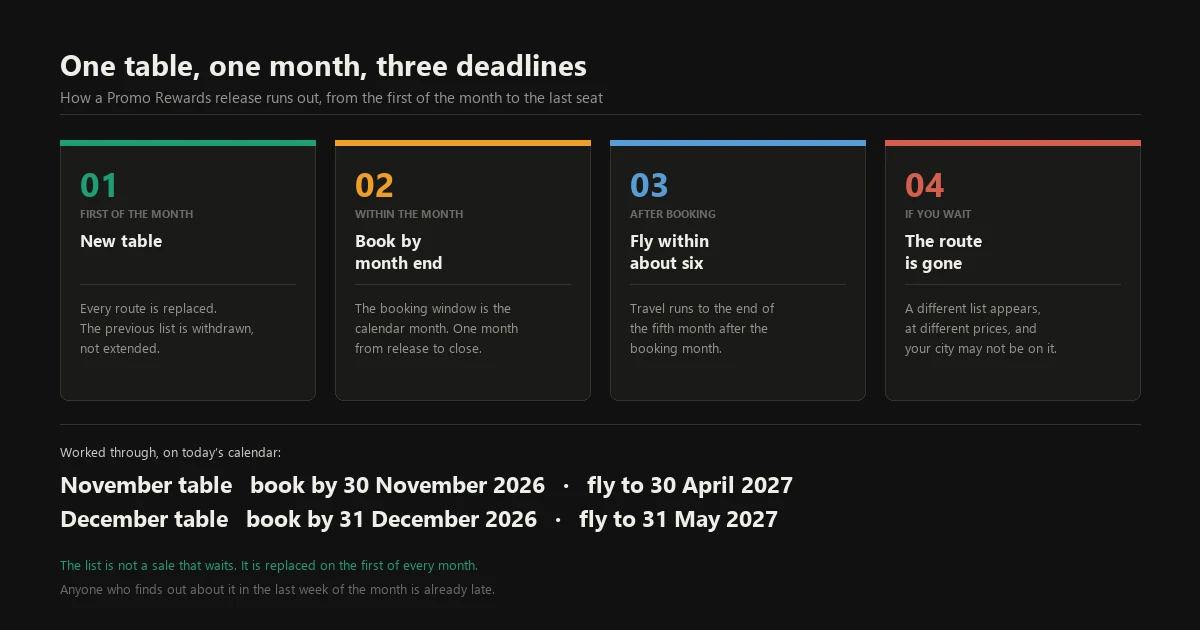
Every Promo Rewards release is governed by three separate clocks, and missing any one of them costs you the discount in a different way.
The first is the table itself. It is withdrawn, not extended. On the first of the following month a different list appears at different prices, and your city may not be on it. There is no grace period and no waiting list. This is not a sale that runs until stock clears; it is a monthly publication with a one-month shelf life.
The second is the booking window, which is the calendar month of release. On 27 November 2026 the live table is the November one: book by 30 November 2026, fly to 30 April 2027. The December table, released on 1 December 2026, will be bookable to 31 December 2026 for travel to 31 May 2027. The pattern is consistent enough to plan around: travel runs to the end of the fifth month after the booking month.
The third clock is availability, and it is the one that quietly does the damage. The advertised price is tied to the lowest open booking class, so a route can sit on the list all month while the cheap buckets for the dates you want are gone by the second week. Anyone who discovers the promotion in its final week is reading a list of routes whose best seats have already been taken by people who read it on day one.
That last point is the practical takeaway of this section. The value of Promo Rewards is not in the percentage, which is the same every month. It is in being early enough to book the dates you want at the price the table quotes.
What the 25% is 25% of
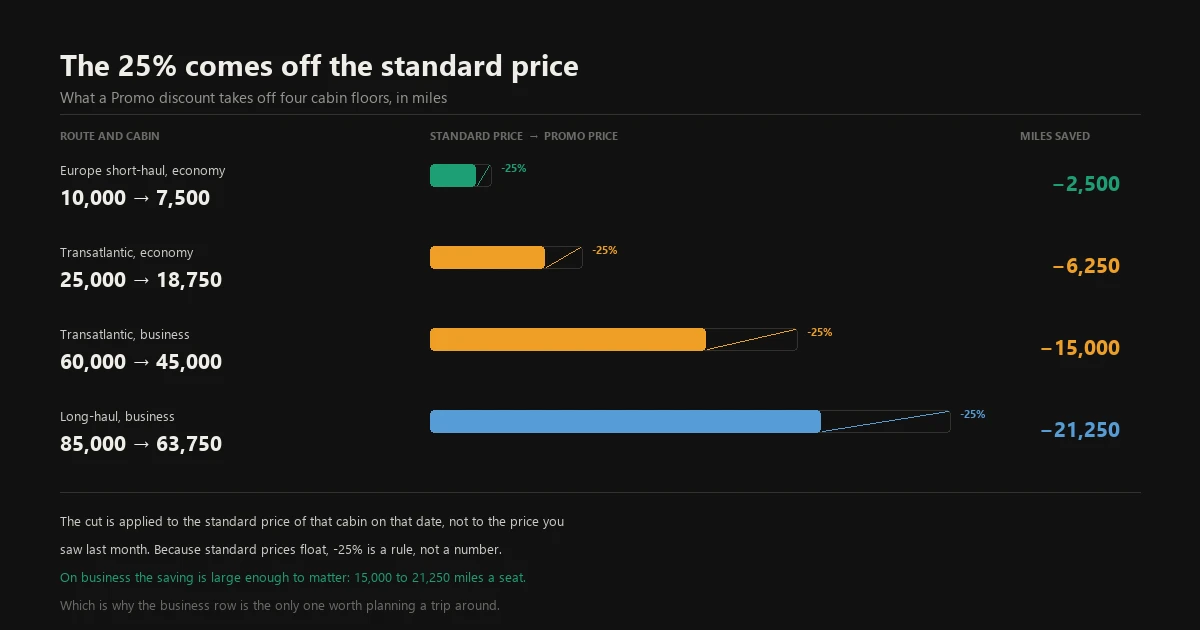
The discount is applied to the standard mileage price of that cabin on that date. It is not applied to the price you remember from last month, and it is not applied to a published award chart, because Flying Blue does not publish one. Fares are priced dynamically against demand and cash fare, which produces an awkward but honest consequence: −25% is a rule, not a number. The same route can show a Promo price this month that is higher than last month’s Promo price, with the discount correctly applied both times.
Four floors carry almost every route in a typical release. The table below shows the Promo price, the standard price it implies, and the miles the discount removes. The standard figures are derived by dividing by 0.75, which is arithmetic rather than a quote: the real standard price on a given date moves, and the derived figure is only there to show the size of the cut.
| Route and cabin | Promo price | Implied standard price | Miles saved |
|---|---|---|---|
| Europe short-haul, economy | 7,500 | about 10,000 | 2,500 |
| Long-haul, economy | 18,750 | about 25,000 | 6,250 |
| Long-haul, business | 45,000 | about 60,000 | 15,000 |
| Long-haul, business, deeper cut | 63,750 | about 85,000 | 21,250 |
The wording is “up to” 25% for a reason. Every route in a normal release is shown at −25%, but because the underlying standard price floats, the floor can move between releases. What does not move is the arithmetic: whatever the standard price is on the day you book, the Promo takes a quarter off it. Judge the offer by the miles it saves, never by the percentage, because 25% of a small number is still a small number.
Where the saving is large enough to reorganise a trip around is business class. At 15,000 to 21,250 miles a seat, the discount is not a rounding error. At 7,500 miles on a European hop, it is a coffee’s worth of value and should not change where you go.
The price is a Light fare, and that is the whole story
This is the part of Promo Rewards that changed, and the part most coverage has not caught up with. The programme states plainly that starting prices are for the Light fare, and that since 8 September 2026 reward tickets on Air France and KLM operated flights are issued in three fares. The price in the Promo table is the bottom of that ladder, and the bottom of the ladder lost its inclusions in September.
| What the award includes | Light | Standard | Flex |
|---|---|---|---|
| Checked bag, economy | None | 1 × 23kg | 1 × 23kg |
| Checked bag, business | 1 × 32kg | 2 × 32kg | 2 × 32kg |
| Seat selection | Paid | Paid | Included |
| Business lounge | Paid | Included | Included |
| Change | Not permitted | €70 | Free |
| Refund | Not permitted | €70 | Free |
Run the business-class case, because that is where readers assume the discount pays. A transatlantic business Promo at 45,000 miles is a Light award: one 32kg bag, lounge access charged at the door, and no changes or refunds. The Standard version of the same seat is about 60,000 miles and includes a second bag, the lounge and a €70 change. The gap is 15,000 miles.
At the published valuations of 1.3 to 1.4 cents, 15,000 miles is roughly $195 to $210. A lounge pass for two, a second 32kg bag and the right to move the date are worth more than that on a trip where any of them is actually used, and worth less than that on a solo trip with one carry-on where nothing changes. So the discount is not simply good or bad: it is a trade of inclusions for miles, priced at about $200, and whether it is a bargain depends entirely on whether you were going to buy those inclusions anyway.
Two details worth knowing. Business Light awards are drawn from the O and Z buckets only, which is why availability at 45,000 miles is patchier than the headline suggests. And a single booking cannot mix fare brands: you can combine cabins across a journey, but not a Light outbound with a Standard return.
In economy the trade is simpler and harsher. A Light economy award includes no checked bag at all. Add a return bag at typical airline rates and the 6,250 miles the Promo saved can be worth less than the fee you pay at the airport. If you travel with luggage, price the bag before you celebrate the discount.
What €379 of Extra actually buys
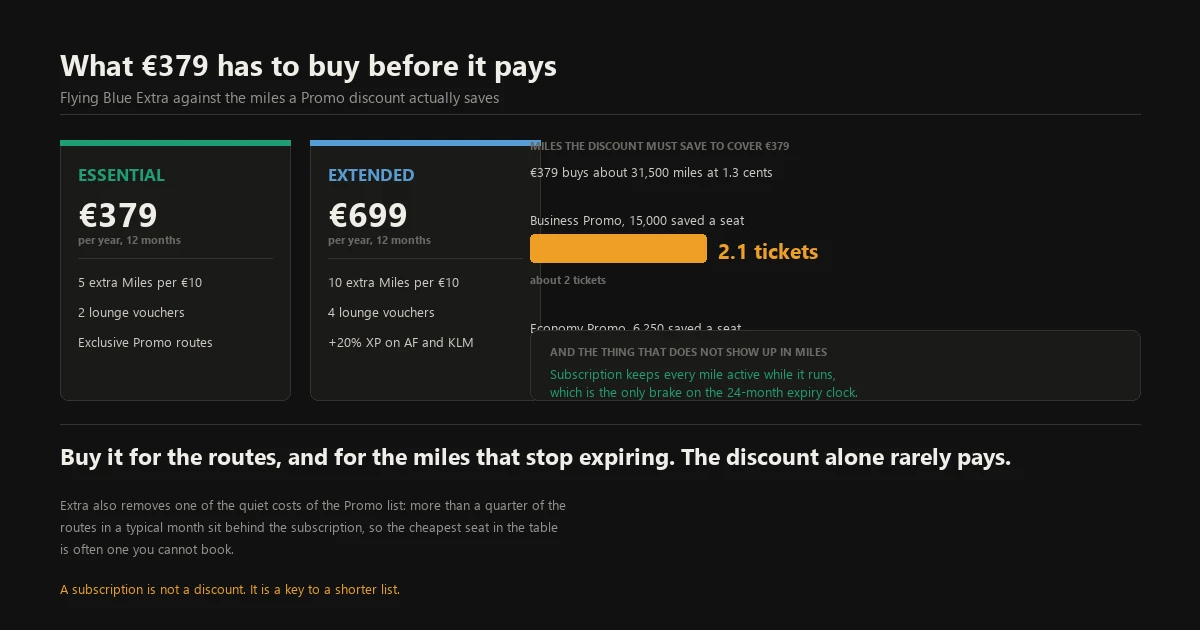
Two tiers exist, both annual, both personal and non-transferable. What they share matters more than what separates them: a selection of Promo routes that only subscribers can book, a 10% discount on the mileage price when paying with Cash & Miles, and the suspension of the expiry clock for as long as the subscription runs.
| Benefit | Essential, €379 a year | Extended, €699 a year |
|---|---|---|
| Bonus miles on paid flights | 5 per €10 spent | 10 per €10 spent |
| Exclusive Promo routes | Yes | Yes |
| Lounge vouchers | 2, at Amsterdam, Paris or Munich | 4, same airports |
| Cash & Miles rate | 10% off the mileage price | 10% off the mileage price |
| Miles validity during subscription | All miles stay active | All miles stay active |
| Reward upgrade discount | 10% | 10% |
| Discount on reward tickets | None | 10% on the first two |
| Extra XP | None | 20% on Air France and KLM |
Now the arithmetic that decides it. €379 buys roughly 31,500 miles of value at 1.3 cents. A business Promo saves about 15,000 miles a seat, so the subscription needs slightly more than two business redemptions to pay for itself in discount alone. An economy Promo saves about 6,250 miles, which needs five. Very few people book five discounted awards in twelve months.
Which is why buying Extra for the discount is usually a mistake, and buying it for two other reasons is usually sound. The first is access: a meaningful share of the routes in a normal release carry the Extra Exclusive label, and the cheapest seat on the page is frequently one a non-subscriber cannot book. The second is the expiry clock. Flying Blue miles expire after 24 months of inactivity on a single rolling clock, and a subscription freezes that clock for its full term. If you are sitting on a balance you cannot spend this year, €379 is a cheaper way to keep it than a speculative redemption you did not want.
The lounge vouchers are the tiebreaker rather than the argument. Two passes at Amsterdam or Paris have real cash value, but they are also the sort of benefit people buy and then fail to use, because the voucher has to be selected as the payment method online before the flight.
Three things the route list leaves out
You can add a stopover. Flying Blue prices an award by the origin and destination of the whole journey, so a stop of 24 hours or more at the connecting city can be included without extra miles. It is one of the most useful features of the programme and one of the least advertised. The conditions are strict enough to matter: every flight around the stop has to be operated by Air France or KLM, the onward flight has to continue in the same direction rather than double back, the lowest booking class has to be open on all segments for the entry price to hold, and the booking has to be made by phone. In practice this means a Promo to Bangkok can include several days in Paris for the same mileage, provided nothing in the itinerary touches partner metal.
Children cost 25% less in miles. Reward tickets booked for children aged 2 to 11 travelling with an adult carry a 25% discount, and the booking has to be made on the Air France or KLM website to get it. On a family trip this stacks against a discount that is already 25%, which is where the arithmetic starts to look genuinely different from the headline.
Nothing is earned, and cash is still due. Reward tickets earn no miles and no XP, so a Promo trip does nothing for status. Taxes, airport charges and carrier surcharges are not covered by the mileage price and are collected separately, and on a transatlantic business award those charges run into the hundreds of dollars. La Première is bookable with miles only by Platinum and Ultimate members, capped at one reward seat per flight. Infants under two and unaccompanied minors cannot be booked online at all.
When to book, when to walk away
The discount is identical every month, so the decision is never about the percentage. It is about whether the specific seat, on the specific date, at the specific fare brand, beats the alternatives you actually have.
| Situation | Verdict | Why |
|---|---|---|
| Business Promo on a trip you had already planned, no changes expected | Book it | 15,000 to 21,250 miles saved on a seat you were going to take anyway, with inclusions you would not have used. |
| Business Promo where you need the lounge, a second bag or a change option | Price Standard first | The 15,000-mile gap is roughly what those inclusions cost. Taking the discount and paying for them separately usually ends up behind. |
| Economy Promo, carry-on only | Book it | The missing checked bag costs you nothing, so the 6,250 miles are pure gain. |
| Economy Promo with checked luggage | Add the bag fee before deciding | Light economy includes no checked bag. A return bag can consume most of the saving. |
| Choosing a different city or date to catch a Promo | Walk away | A discount on a trip you did not want is a cost, not a saving. |
| Miles acquired by transfer at about 0.83 cents | Lower bar | Cheap miles make a thin redemption acceptable. The same seat is a worse deal on miles bought at 1.24 cents or more. |
The last row is the one people skip. A Promo ticket is only as good as the cost of the miles inside it, and the range in 2026 is wide: a transfer bonus can put a mile near 0.83 cents, the best cash promotion of the year came in near 1.24 cents, and the standing purchase price is 3.05 cents. The same 45,000-mile business seat is a strong deal funded one way and a poor one funded the other. If you are short of miles and considering a top-up, check the current buy-miles rate before you assume the price you remember still applies.
How to check a month in ten minutes
The whole exercise is faster than reading this section, provided you do it in the right order.
- Search with miles, one-way, one passenger. Round trips hide which half is discounted and make the taxes harder to read.
- Open the calendar view rather than the date list. It shows the cheapest available price per day, which is the fastest way to see whether the low bucket exists on your dates at all.
- Note the cabin before the number. A 45,000-mile price is business only if the cabin selector says business; mixed-cabin itineraries show the long-haul cabin and fly you in economy on the connection.
- Check for the Extra Exclusive label. If the cheapest row carries it, the price is not available to you without a subscription, and the real comparison is the next row down.
- Write down the taxes and surcharges. They are not in the mileage price and they vary by direction, often by a factor of two between a US departure and a European one.
- Price the same seat as Standard. One extra search. It tells you what the discount is actually taking off.
- Run the arithmetic once. Cash fare minus award taxes, divided by miles required. If the result is below what the mile cost you, the discount is irrelevant.
If you want the longer version of step seven, the thresholds and worked examples sit in what a Flying Blue mile is actually worth, including the three bands that separate a sensible redemption from an expensive one.
The verdict
Promo Rewards is the most useful thing Flying Blue does and the most misreported. The 25% is real, applied honestly to a standard price that floats, and on business class it removes enough miles to change a decision. But since September 2026 the price it discounts buys a Light fare, and the inclusions that vanished are the ones people pay a business-class premium to get. That does not make the promotion bad. It makes it narrower than the coverage suggests: a monthly window, one month to book, about six months to fly, a portion of the routes behind a subscription, and a product at the bottom of a three-step ladder.
Use it the way it is built. Find the route you were already going to fly, book early enough that the low bucket still exists, compare Standard once before you commit, and check whether the bag or the lounge you gave up costs more than the miles you saved. Done in that order, the discount is worth having. Done as a reason to choose a trip, it is a full-price ticket with a smaller number printed on it.
One last distinction, because it decides more redemptions than the discount does. A Promo reduces the miles a seat costs; it does not reduce what those miles cost you. If a balance is short and a top-up is the only way to reach 45,000, the relevant number is what a mile costs today, not the 25% printed next to the route. Bought at the standing price, the top-up can cost more than the seat saves.
Last updated: 27 November 2026.
FAQ
What are Flying Blue Promo Rewards?
A monthly discount on the miles a reward seat costs, published by Air France and KLM on the first day of each month. Selected routes are shown at up to 25% off the standard mileage price for that cabin, and the table is bookable only during the month it is released. It is a discount on seats, not a sale on miles, so it changes what a redemption costs rather than what a mile costs.
How often do Promo Rewards change?
Every month. A new table is released on the first day and the previous one is withdrawn rather than extended, so the booking window is the calendar month of release. Travel dates run to roughly the end of the fifth month after the booking month: the November 2026 table books to 30 November 2026 for travel to 30 April 2027, and the December 2026 table books to 31 December 2026 for travel to 31 May 2027.
Is the 25% discount worth it?
On business class, usually only if you were going to fly that route anyway and would not have used the lounge, the second bag or the change option. A business Promo is a Light award with one 32kg bag, lounge access charged separately, and no changes or refunds. The Standard version costs about 15,000 miles more, which is roughly what those inclusions are worth, so the discount and the fare brand largely cancel out. On economy with carry-on only, the 6,250 miles saved are close to pure gain.
Do Promo Rewards include a checked bag?
Not in economy. Since 8 September 2026 the prices in the Promo table are Light awards, and Light economy includes no checked baggage at all. Light business keeps one 32kg bag but does not include lounge access. Add the bag fee before deciding, because on a return trip it can consume most of the miles the promotion saves.
Do I need Flying Blue Extra for Promo Rewards?
For some routes, yes. A share of each month’s table carries an Extra Exclusive label and is bookable only by subscribers, who pay €379 or €699 a year. The subscription also freezes the 24-month expiry clock for its full term, which is often the stronger reason to hold it than the discount: at 15,000 miles saved per business ticket, it takes slightly more than two redemptions to recover €379.
Can I change or cancel a Promo Rewards ticket?
Not on a Light award, which is what the Promo price buys. Neither changes nor refunds are permitted, and Platinum and Ultimate members retain separate flexibility under their own benefits. If your dates might move, price the Standard fare at about 60,000 miles for transatlantic business, which allows a change or refund for €70, or the Flex fare, where both are free.
More guides
- The 18,750-mile award everything here is measured against
- Funding a Promo Rewards booking with bank points
- Keeping a balance alive between Promo Rewards months
- How much flying each Flying Blue level actually takes
- Why a Promo price is a Light fare, and what that removes
- Flying Blue promotions: what is live, what ended, what is worth it
- What a Flying Blue mile is actually worth
- Buy Flying Blue miles: what a mile costs and when it pays
- Airline alliances explained, including where Flying Blue sits in SkyTeam
- Every official buy-points link in one place
- Do points expire? The programmes that run a clock, and the ones that do not