Airline alliances are the layer of the loyalty world that most people learn last and use least. Three of them exist, and together they cover 60 airlines: Star Alliance, oneworld and SkyTeam. Between them they decide whether your miles work on a partner’s flight, whether your status opens a lounge in another country, and whether a two-airline trip arrives as one ticket or two.
What they do not decide is the part people assume they decide. No alliance moves miles from one programme to another, and no alliance sets the price of an award. Those two limits explain almost everything else on this page, including why two alliances can look identical on paper and behave nothing alike when you try to book.
This page is the map rather than the territory: what each alliance is actually good at, what membership changes, the three misconceptions that cost people the most, and which large airlines sit outside all of it on purpose.

The three alliances at a glance
Three numbers decide most of the comparison: how many airlines each alliance has, which region it is densest in, and which status tier unlocks the good lounges. The table below uses the membership each alliance will have from 17 December 2026, the date Asiana completes its move from Star Alliance to SkyTeam. Until 16 December, Star Alliance counts 26 and SkyTeam 18.
| Star Alliance | oneworld | SkyTeam | |
|---|---|---|---|
| Members | 25 | 16 | 19 |
| Founded | 1997 | 1999 | 2000 |
| Strongest region | Europe and Asia | North America, Middle East and the Pacific | Transatlantic and East Asia |
| Anchor airlines | United, Lufthansa, ANA, Singapore Airlines | American, British Airways, Qatar Airways, Japan Airlines, Qantas | Delta, Air France-KLM, Korean Air |
| Elite tier that matters | Star Alliance Gold | oneworld Sapphire and Emerald | SkyTeam Elite Plus |
| Best if you fly | Europe internally, or connect through Asia | From North America, or want premium cabins and a Gulf hub | Across the Atlantic, or connect through Seoul and Shanghai |
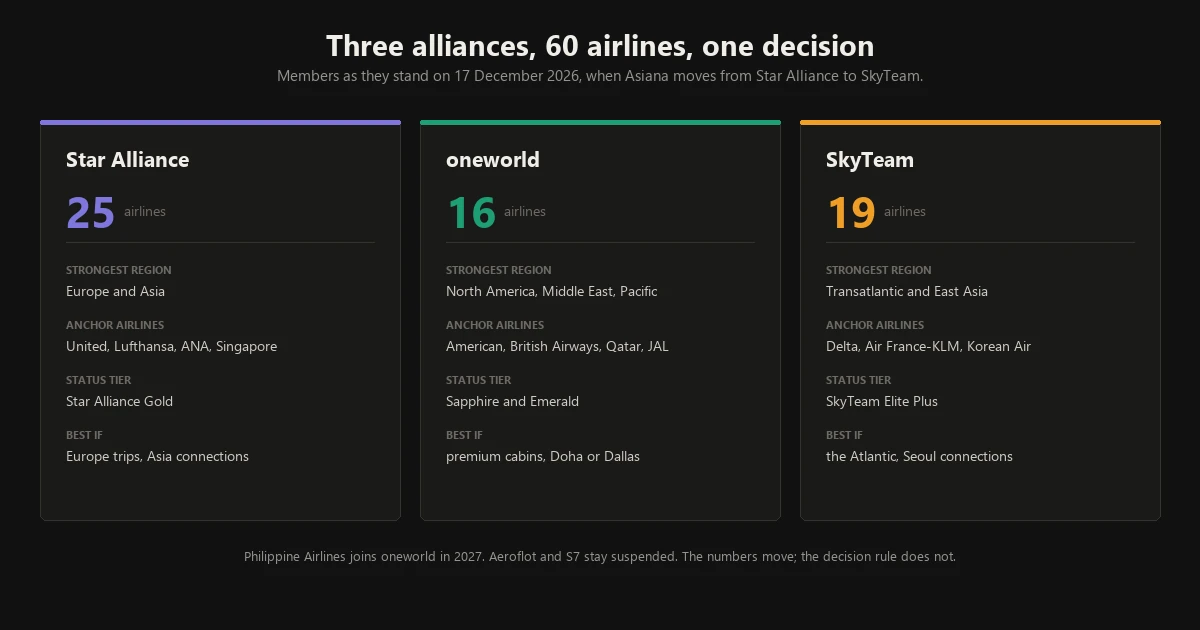
Two caveats belong next to that table. The first is that membership is not quality: an alliance with more airlines is not more useful, because a member you will never fly adds nothing. The second is that the numbers move. Philippine Airlines joins oneworld in 2027, Aeroflot and S7 remain suspended, and the table has already been rewritten once this year.
What an alliance does, and what it does not
An alliance is a set of reciprocal commitments between airlines that have agreed to treat each other’s passengers and each other’s elite members as their own. In practice it delivers four things, and it is worth being precise about each, because the limitations inside them are where most disappointments start.
Earning
Fly one member and credit the flight to another member’s programme. That is the baseline. What the alliance does not do is guarantee a rate: earning is calculated by the programme you credit, using the fare class and often the ticket price, so the same seat can earn full miles in one programme and a fraction in another. A discounted economy fare that earns 100% in one member’s scheme can earn 25% in a partner’s.
Redeeming
Spend programme A’s miles on a seat operated by programme B. This works across every member, but the price comes from A’s award chart, not from the alliance. There is no alliance-wide price for a route. That single fact produces the largest price gaps in the hobby: the same business class seat between the same two cities can cost twice as much in one programme as in another, and neither price is wrong.
Status recognition
Elite tiers map onto an alliance tier, and the alliance tier is what a partner recognises. Star Alliance has one meaningful tier, Gold. oneworld has two, Sapphire and Emerald, and Emerald is the only alliance tier that gets you into a first class lounge while flying economy. SkyTeam has Elite and Elite Plus, and Elite Plus is the one that opens lounges. Your own programme’s top tier does not automatically translate into the top alliance tier, which is why the mapping table matters more than the tier name on your card.
Connections
Alliance partners interline by default: one ticket, bags checked through to the final destination, and protected rebooking if a connection is missed. This is the benefit members use most and notice least. It is also the one that survives schedule changes, which is why a two-airline itinerary inside one alliance is usually worth more than a cheaper one built from two unrelated carriers.
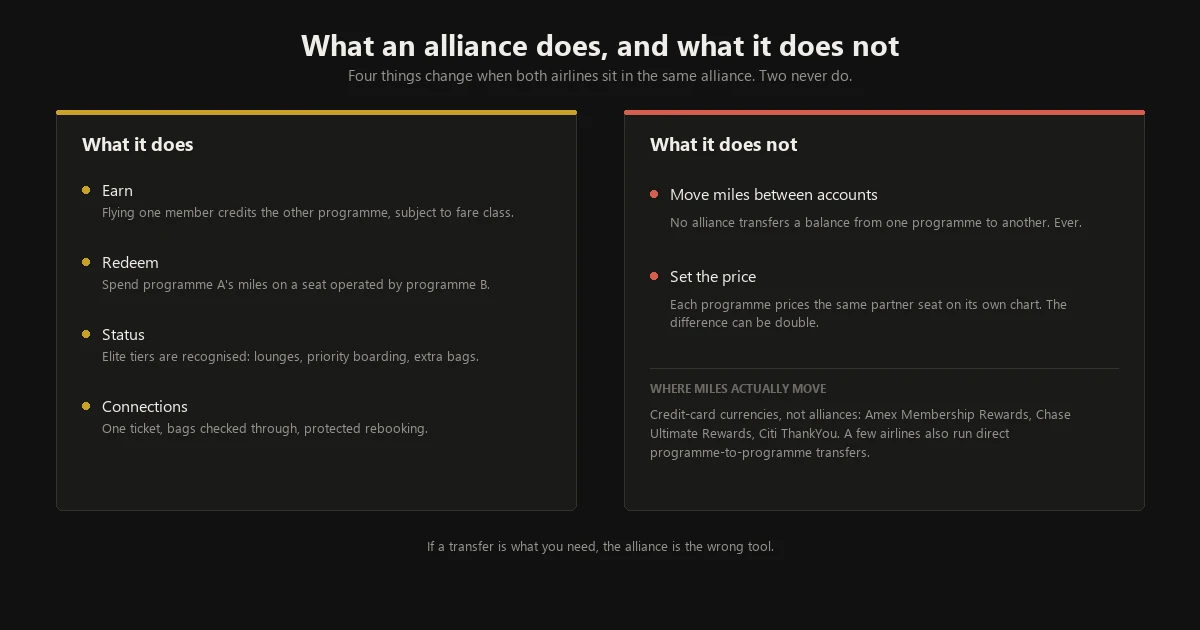
And the two things it does not do. It does not move a balance from one programme to another, ever, under any alliance. And it does not set prices. Everything else that sounds like an alliance benefit is one of these four, restated.
Star Alliance: the biggest, not the most consistent
Star Alliance is the largest of the three with 25 members from 17 December, and the broadest in the two regions where most long-haul itineraries are built: Europe and Asia. Ten of its members are European carriers, which is why an intra-European trip on a Star ticket tends to have more routing options than the equivalent on either rival. In Asia it holds ANA, Singapore Airlines, Thai, Air China, Shenzhen Airlines, EVA Air and Air India, a spread that covers every major market except Korea once Asiana leaves. It also holds Avianca and Copa in Latin America, and Air New Zealand, which no rival alliance has: for a South Pacific routing, Star is the only one of the three with an answer.
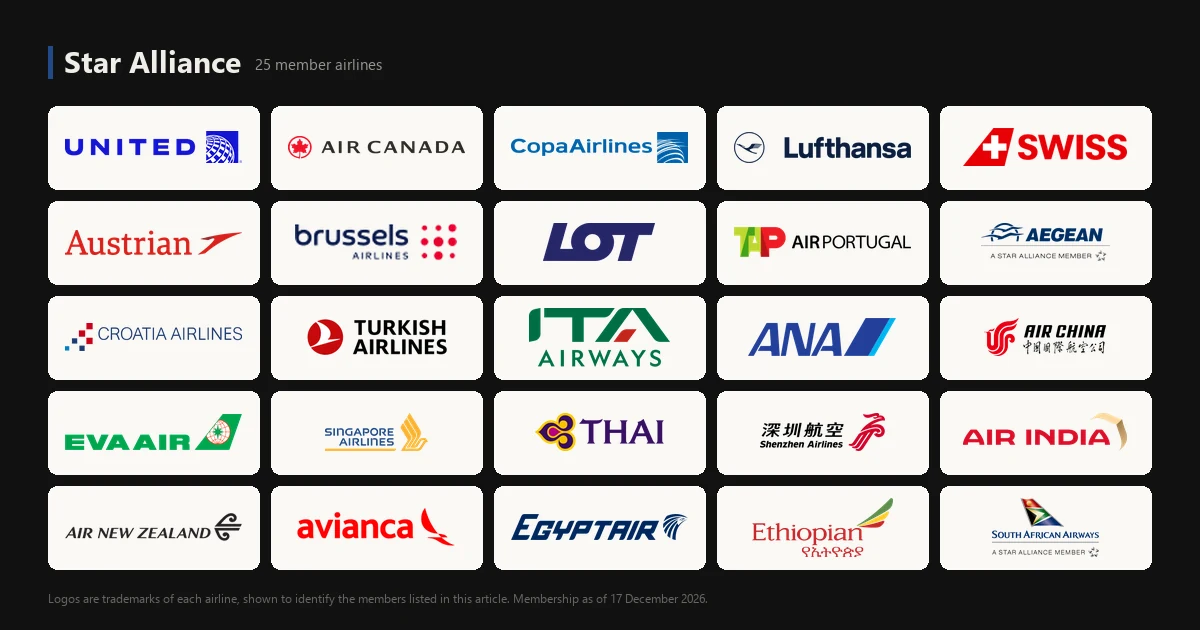
The member most worth knowing is Turkish Airlines. It flies to more countries than any other airline, which makes Istanbul the single most useful connection point in the alliance for anyone building an award between two secondary cities. The member most worth understanding is Lufthansa, because the Lufthansa Group alone holds five Star seats: Lufthansa, SWISS, Austrian, Brussels Airlines and ITA Airways. That is one corporate group occupying a fifth of the alliance.
The weakness is consistency. Twenty-five members means a wide range of products and a wide range of reliability on partner awards, and the alliance’s rules are enforced by each member rather than by the alliance. If you fly United and Air Canada regularly, the two programmes are covered in detail in the United MileagePlus promotions guide and the Aeroplan promotions guide; between them they cover earning, redemptions and the partner rules that actually bind.
oneworld: premium cabins and the Emerald lounge
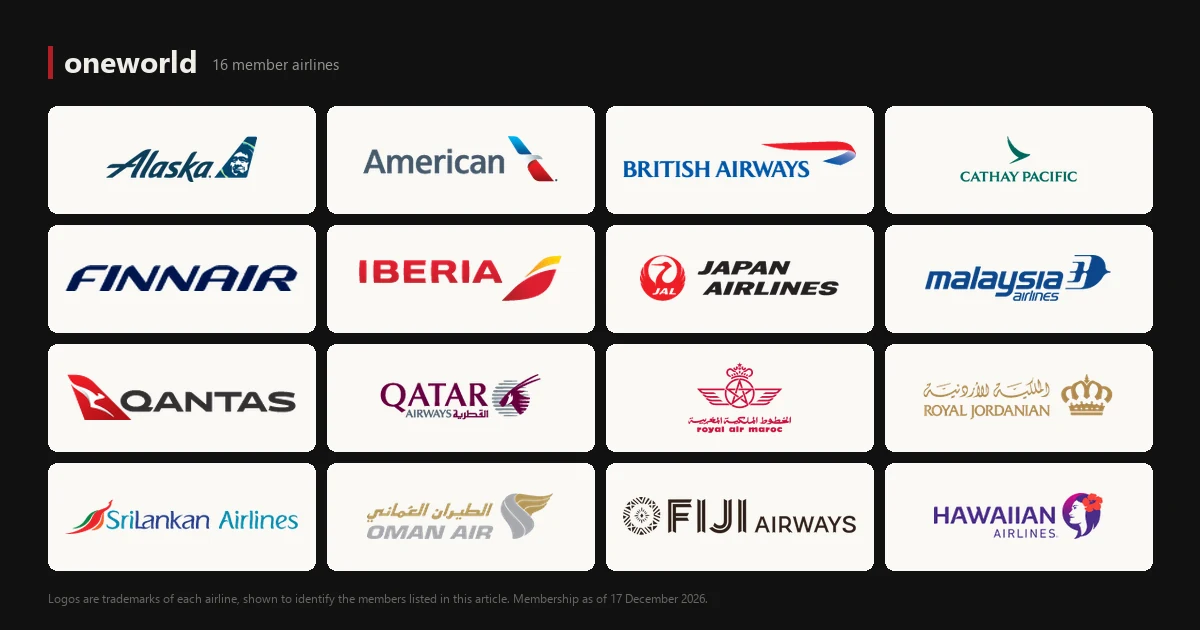
oneworld has 16 members and the smallest footprint of the three, but it concentrates them where the money is. Three of its members are North American (American, Alaska and Hawaiian), four are in the Gulf and North Africa (Qatar, Royal Jordanian, Oman Air, Royal Air Maroc), and six cover Asia and the Pacific (JAL, Cathay Pacific, Qantas, Malaysia Airlines, SriLankan and Fiji Airways). Add British Airways, Iberia and Finnair in Europe and the shape becomes clear: it is an alliance built around long-haul premium cabins rather than domestic density.
The structural advantage is the Emerald tier. oneworld is the only alliance whose top tier grants first class lounge access regardless of the cabin you fly. Neither Star Alliance Gold nor SkyTeam Elite Plus does that. For anyone who flies a lot of economy on long-haul, Emerald is the single most valuable status in the alliance system, and it is reachable through American Executive Platinum, British Airways Gold or Qantas Platinum.
oneworld is also the only alliance with three round-the-world products, which is a niche benefit until the year you actually want one. Hawaiian became the 16th member on 23 April 2026, after its merger into Alaska Air Group, and it keeps a separate membership even though both airlines now sit under one parent: the alliance counts airlines, not groups. Alaska’s own view of the network, including which partners it can and cannot book, is in the Atmos Rewards partners guide, and American’s equivalent is the AAdvantage partner airlines guide.
SkyTeam: the transatlantic alliance
SkyTeam reaches 19 members on 17 December, when Asiana joins through its merger into Korean Air. Its centre of gravity is the North Atlantic: Delta, Air France, KLM and Virgin Atlantic operate the most integrated transatlantic joint venture in the industry, coordinating schedules, fares and revenue across four carriers. If your travel is between the United States and Europe, this is the alliance whose structure does the most work for you without your having to think about it.
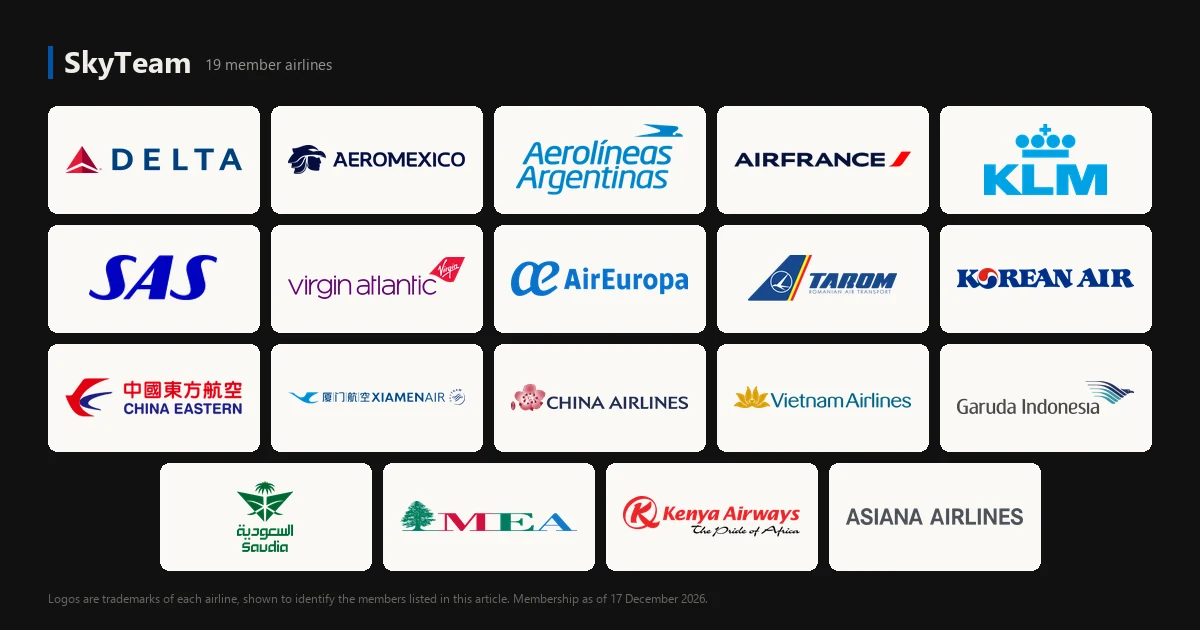
The second strength is East Asia. Korean Air, China Eastern, China Airlines, XiamenAir, Vietnam Airlines and Garuda Indonesia give SkyTeam the densest coverage of the region’s secondary hubs, and Seoul Incheon is one of the best connection airports in the world. The addition of Asiana consolidates rather than expands that position: Asiana’s flights become Korean Air flights on 17 December, so the alliance gains a member and loses a competing network at the same time.
SkyTeam is also the alliance where the group structure is easiest to misread. Air France and KLM merged their parent companies in 2004 and have never merged the airlines: two brands, two operating certificates, two hubs, two seats in the alliance. Both sell under Flying Blue, whose promotions sit outside anything the alliance runs. The same pattern holds at Lufthansa Group in Star Alliance and at IAG in oneworld, and it is the subject of the second misconception below.
Which alliance fits which trip
There is no best alliance, and any page that ranks them is answering a question nobody actually has. What people have is a route. Four shapes cover most of it.
| If your travel is | The alliance that does more | Why |
|---|---|---|
| US to Europe, both directions | SkyTeam or oneworld | Delta’s joint venture with Air France, KLM and Virgin is the tightest transatlantic structure; American and British Airways cover the same market from the other side. |
| US to Asia | Star Alliance | United flies the routes and ANA, Singapore and EVA carry the connections beyond them. |
| Europe to the Gulf or India | oneworld | Qatar’s network is the densest in the region, and Doha connects to more Indian cities than any European hub. |
| Domestic US only | None of them, really | The alliance adds nothing on a single-carrier itinerary; your own programme’s domestic network is the whole answer. |
The order of the decision matters more than the answer. Start with the routes you actually fly, then check which alliance those carriers belong to, then look at the programmes you already hold miles in. Starting from the alliance and working backwards produces a status you cannot use.
Three things almost everyone gets wrong
These three account for most of the confusion around alliances, and each one changes what you do rather than just what you know.
Myth one: miles transfer between alliance partners
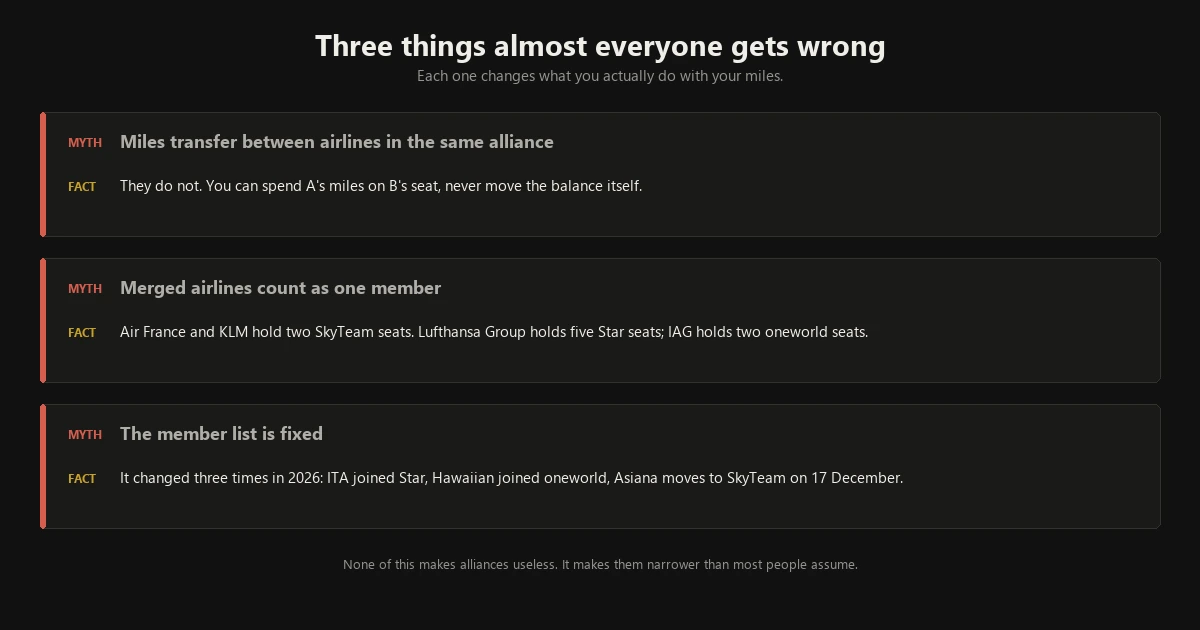
They do not. An alliance lets you spend programme A’s miles on a seat operated by programme B. It never lets you move the balance from A to B. There is no alliance-level transfer mechanism, and no member is obliged to accept another member’s miles into its own account. The thing that does move between programmes is bank points: Amex, Chase, Citi, Capital One and Bilt each reach a different slice of these airlines at a different price, and the transfer partner list with every ratio priced is the map.
The exception people are thinking of is Avios, which really does move between British Airways Executive Club, Iberia Plus, Qatar Privilege Club and Aer Lingus AerClub. Qatar is where that single currency is most valuable right now, and what Privilege Club charges in Avios and fees is the practical test of it. But that is not an alliance feature: it is one currency held in four accounts by airlines that happen to share an owner or a commercial agreement. Three of the four are oneworld members and Aer Lingus is not, which is exactly why the confusion happens. Genuine transfers happen through credit card currencies — Amex Membership Rewards, Chase Ultimate Rewards, Citi ThankYou — or through a small number of direct programme-to-programme agreements. Not through the alliance. The mechanics of the earning side are covered in the guide to how loyalty points work.
Myth two: merged airlines count as one member
Air France and KLM merged their parent companies in 2004 and still hold two separate SkyTeam seats, because alliance membership is granted to an airline with its own operating certificate, not to a corporate group. The pattern repeats everywhere once you look for it: Lufthansa Group holds five Star Alliance seats (Lufthansa, SWISS, Austrian, Brussels Airlines, ITA Airways), and IAG holds two oneworld seats (British Airways, Iberia) while Aer Lingus, also part of IAG, holds none.
Alaska and Hawaiian show the same rule from the opposite direction. They are one company, and between the merger and April 2026 they held one seat between them. Hawaiian joined oneworld on 23 April 2026 as the 16th member and kept that seat through the operational merger, because the brand and the certificate survived. So the alliance counts 16 airlines where a naive group count would say 15.
Myth three: the member list is fixed
It changed three times in 2026 alone. ITA Airways joined Star Alliance in April as Lufthansa took control of it. Hawaiian joined oneworld on 23 April. Asiana leaves Star Alliance on 16 December and becomes part of Korean Air, and therefore SkyTeam, the next day. Three changes in eight months, in an alliance system that had been stable for years.
This is why no honest guide prints the full member list as body text. The list is a snapshot, the snapshot expires, and the reader who saved it has no way to know. The alliances maintain their own member pages, and those are the only version worth trusting on the day you book.
The big airlines that belong to no alliance
Some of the largest carriers in the world are deliberately unaligned, and “no alliance” does not mean “no partners”. Three different arrangements get confused here, and the difference decides what you can actually do.
Southwest is the clearest case. It belongs to no alliance and has spent most of its history refusing to sell seats on other airlines at all. That changed: it now holds eleven interline partnerships, so you can book a connecting itinerary across Southwest and a partner on one ticket. What you still cannot do is move Rapid Rewards points to any of them. The Southwest partners guide separates the eleven doors from the three loyalty relationships, and the Southwest promotions page covers what is live now.
JetBlue is unaligned and relies on bilateral agreements. Emirates and Etihad are unaligned by choice and partner case by case, which is why Emirates has a deep arrangement with Qantas despite sitting outside oneworld. China Southern and Hainan are outside the three alliances as well, which matters more than it used to for anyone routing through mainland China.
The hierarchy worth remembering: an alliance is automatic and alliance-wide; a codeshare is a bilateral deal between two airlines and can exist with or without an alliance; an interline is the thinnest version, covering bags and connections but no miles. Southwest has interline partners and no alliance. Emirates has codeshares and no alliance. Both are “partners” in ordinary speech and neither behaves like an alliance member.
What changed in 2026
| Date | Change | What it means for a booking |
|---|---|---|
| April 2026 | ITA Airways joins Star Alliance | ITA flights now earn and redeem across Star partners, and ITA status is recognised alliance-wide. |
| 23 April 2026 | Hawaiian Airlines joins oneworld as the 16th member | Hawaiian flights earn and redeem across oneworld, and oneworld elite status works on Hawaiian. |
| 16 December 2026 | Asiana leaves Star Alliance at 23:59 KST | Star Alliance benefits on Asiana end; Asiana miles on Star partners must be ticketed by carrier-specific deadlines. |
| 17 December 2026 | Asiana becomes part of Korean Air and joins SkyTeam | Asiana flights operate as Korean Air, and the network sits inside SkyTeam from that day. |
| 2027 | Philippine Airlines joins oneworld | Announced, not yet effective; do not plan an award around it. |
Two members are suspended rather than gone: Aeroflot from SkyTeam since 2022, and S7 from oneworld since 19 April 2022. Neither counts toward the totals above, and neither is expected back in the near term.
Last updated 25 November 2026. Membership figures are the ones in force from 17 December 2026.
Verdict
Choose the alliance last, not first. The alliance is a consequence of the airlines you already fly, and picking one in advance produces status you cannot spend.
If you do get to choose, the three have genuinely different shapes. Star Alliance is the broadest and the most useful for Europe and Asia, at the cost of consistency. oneworld is the smallest and the best value for premium cabins, because Emerald is the only top tier that opens first class lounges on an economy ticket. SkyTeam is the most integrated across the Atlantic and the least useful if you never cross it.
And keep the two limits in view. An alliance moves seats, not balances, and it does not price anything. Everything an alliance appears to promise beyond those four benefits is marketing on top of them.
Frequently asked questions
How many airline alliances are there?
Three global alliances: Star Alliance, oneworld and SkyTeam. They cover 60 airlines between them, counting Asiana in SkyTeam from 17 December 2026. Several regional groupings exist, such as Value Alliance and U-Fly Alliance, but they do not carry the alliance-wide earning, status and lounge commitments that define the big three.
Which alliance is the biggest?
Star Alliance, with 25 members from 17 December 2026. It was 26 until Asiana left for SkyTeam. Biggest is not the same as most useful: what matters is whether the members fly the routes you actually take.
Can I transfer miles between airlines in the same alliance?
No. Alliances let you spend one programme’s miles on another member’s flight, never move a balance between accounts. Transfers happen through credit card currencies such as Amex Membership Rewards, Chase Ultimate Rewards and Citi ThankYou, or through specific programme-to-programme agreements. Avios moves between British Airways, Iberia, Qatar and Aer Lingus, but that is one currency in four accounts, not an alliance feature.
Is Alaska Airlines in oneworld?
Yes, since 2021. Hawaiian joined the same alliance on 23 April 2026, so oneworld now has three North American members: American, Alaska and Hawaiian. All three earn and redeem across the alliance, and elite status is recognised on each other’s flights.
Which alliance is United in?
Star Alliance, as a founding member since 1997. United miles can be redeemed on any Star Alliance member, subject to each programme’s own award chart and availability, and United elite status maps to Star Alliance Gold.
What is the difference between an alliance and a codeshare?
An alliance is automatic and applies across every member: earning, redemption, status recognition and through-checked bags. A codeshare is a bilateral deal between two airlines to sell seats on each other’s flights under their own flight numbers, and it can exist with or without an alliance. Emirates and Qantas codeshare despite Emirates belonging to no alliance.
Do airline alliances still matter?
Yes, for four things: earning on partner flights, redeeming on partner seats, elite status recognition and protected connections. They do not matter for price, and they never move miles between programmes. If your travel is domestic and single-carrier, the alliance does nothing for you at all.
Which alliance is best for flying to Asia?
Star Alliance for breadth, because United flies the routes and ANA, Singapore Airlines, EVA Air and Thai carry the connections beyond them. oneworld is the better choice if premium cabins are the priority, since JAL, Cathay Pacific and Qatar all sit inside it. SkyTeam covers East Asia well but is thinnest on South and Southeast Asia.
More guides
This page is the map. Each airline’s own programmes, and the partner rules that bind them, are covered in full below.
Star Alliance
- United MileagePlus promotions
- Aeroplan promotions
- The best way to use United miles
- The best way to use Aeroplan points
oneworld
SkyTeam and the unaligned
- Southwest Rapid Rewards promotions
- Southwest Rapid Rewards partners
- The best way to use Southwest points
The fundamentals
- How loyalty points work
- Buy hotel points and airline miles: every official link
- Do points expire? Every programme’s rule
Next step: write down the three routes you fly most and the airline that operates each. Look up which alliance those airlines belong to. If two of the three land in the same alliance, that is the one worth building status in, and the programme guides above tell you which member prices it best. If they land in three different alliances, stop chasing alliance status and earn on the airline you fly most.