The best way to use United miles is on a Star Alliance partner business-class award booked at the Saver level, or on a Polaris transcontinental flight when the cash fare is high. Those two uses regularly return 3 to 5 cents per mile, against an independent baseline of about 1.2 to 1.3 cents. Cash back, gift cards and peak-date United metal sit at the other end, often below 1 cent. This guide ranks the options, gives the current 2026 mile levels, and flags the outdated advice you should ignore.
At a glance
| Use | Typical miles | Value per mile | Verdict |
|---|---|---|---|
| Polaris transcon (LAX/SFO to JFK) | 35,000–45,000 | 4–5 cents | Best overall |
| Star Alliance partner business to Europe | 80,000 Saver | 3 cents+ | Best international |
| Star Alliance partner business to Asia | 100,000 Saver | 3 cents+ | Best long-haul |
| Off-peak domestic economy | 5,000–8,000 | ~1.2 cents | Baseline |
| Peak-date United metal Polaris | 200,000+ | Under 1 cent | Avoid |
| Cash back and gift cards | Fixed rate | Under 1 cent | Avoid |
Redemptions ranked by value
Not all miles are equal once you spend them. The same mile can return five cents on one booking and half a cent on another, so the choice of award matters far more than the size of your balance. The ranking below runs from worst to best.
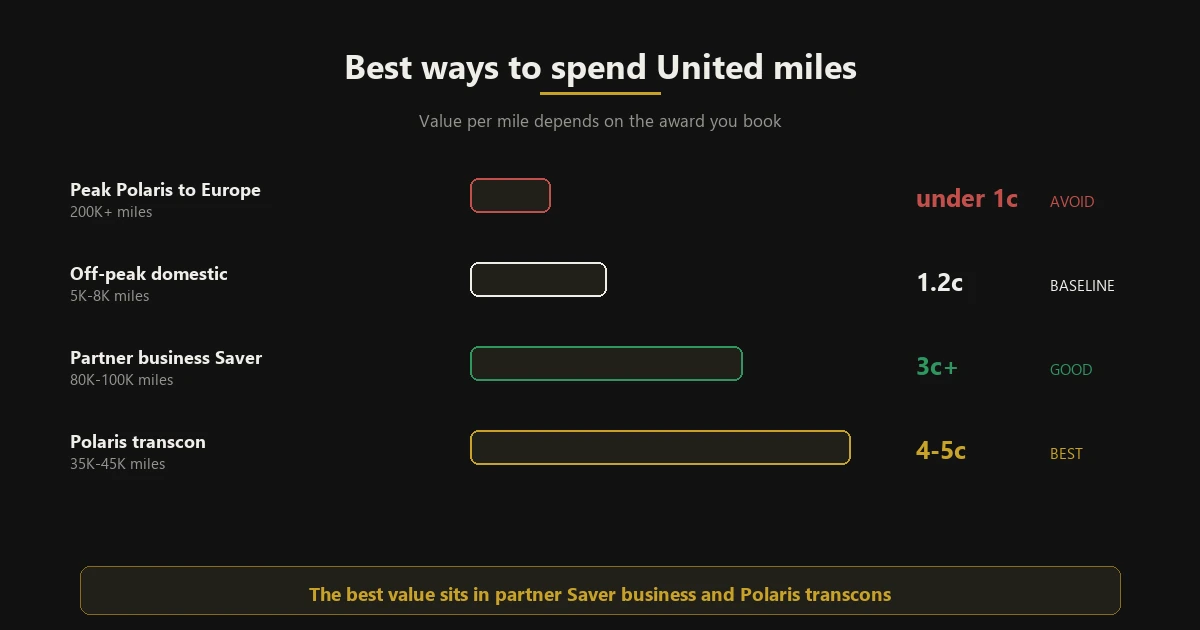
Peak Polaris to Europe — avoid. United prices its own flights dynamically, so a last-minute or holiday Polaris seat to Europe can demand 200,000 miles or more against a cash fare that does not justify it. This is the single most common way to waste a MileagePlus balance.
Off-peak domestic economy — baseline. United’s own short flights can fall to about 5,000 miles on quiet dates, sometimes less than a fixed-chart program would charge. That returns roughly the 1.2-cent independent baseline: acceptable, not exciting.
Partner business Saver — good. Booking a Star Alliance carrier at the Saver level returns 3 cents or more with no fuel surcharges passed on. These are the awards that make a United balance worth holding.
Polaris transcon — best. A coast-to-coast Polaris seat between Los Angeles or San Francisco and New York books at 35,000 to 45,000 miles on many dates against a cash fare of $1,500 or more. At 4 to 5 cents per mile, this is the strongest everyday use of the currency.
Why partner Saver wins
United stopped publishing an award chart for its own flights in 2019 and prices them dynamically. Partner awards are different: they still cluster around fixed Saver levels, and United lowered those levels again in November 2025. That predictability is why partners dominate the best-value examples.
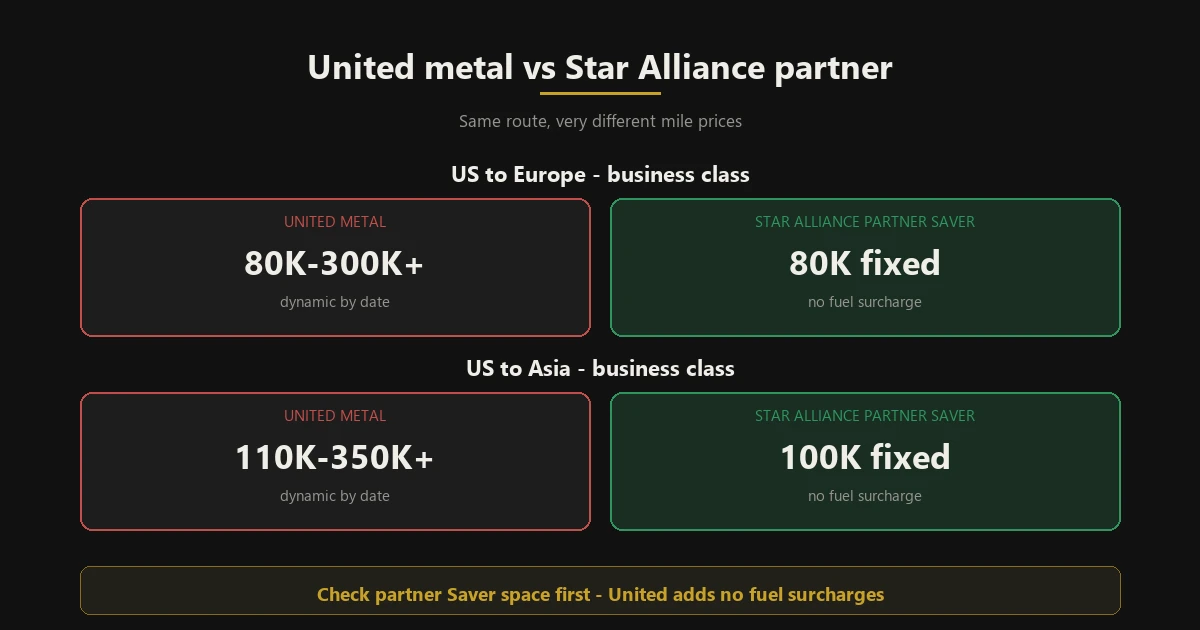
On a US-to-Europe business-class trip, United metal can range from 80,000 miles on a good day to well over 300,000 at peak. The same trip on Lufthansa, SWISS, Austrian or Turkish at the partner Saver level is a fixed 80,000 miles one way. To Asia, partner Saver is 100,000 miles on ANA, EVA, Asiana or Singapore against a far wider range on United metal. In both cases United does not pass on the partner’s fuel surcharges, so you pay taxes only.
Compare before you commit. Aeroplan and Avianca LifeMiles are also Star Alliance programs, and for the same partner seat one of them may price lower than United. United’s advantages are no fuel surcharges, a strong award search tool, and 1:1 transfers from Chase Ultimate Rewards and Bilt — not always the lowest mileage price. Check two programs before moving a balance.
The Polaris transcon sweet spot
The best all-round redemption is the one that needs no international planning. Polaris lies-flat seats on the Los Angeles and San Francisco to New York routes frequently price at 35,000 to 45,000 miles each way. The same seat often sells for $1,500 to $2,500 in cash, which puts the value at roughly 4 to 5 cents per mile — several times the baseline.
Transcons work because the competitive cash fare is high while United’s dynamic award price on many dates stays modest. Availability is better than on international Polaris routes, dates are easier to move, and the miles required are low enough to fund from a single premium-card sign-up bonus. If you want one concrete target for a MileagePlus balance, this is it.
One caveat: dynamic pricing cuts both ways. The same route can jump sharply around holidays and on high-demand days. Search the calendar view and book the low-price dates rather than assuming the 35,000-mile figure always holds.
Current Saver levels
These are the one-way partner Saver levels in force after the November 2025 reduction. Use them as a target when deciding whether to transfer bank points into MileagePlus.
| Partner Saver route | Economy | Business |
|---|---|---|
| US to Europe | 40,000 | 80,000 |
| US to Asia and Oceania | ~45,000 | 100,000 |
The levels fell from 88,000 to 80,000 in business to Europe and from 110,000 to 100,000 to Asia, first for Premier members and then for all accounts. They are usable on Lufthansa, SWISS, Austrian, Turkish, ANA, EVA, Asiana and other Star Alliance carriers, subject to award space. Saver inventory is limited and can disappear quickly, so confirm the seat exists before you transfer.
What to avoid
Cash back and gift cards. These convert at a poor fixed rate, usually under 1 cent per mile. If you cannot find a good award, holding the miles costs nothing — they do not expire.
Low-fare domestic economy on a fixed partner chart. A $250 ticket for 25,000 miles returns 1 cent, below the baseline. Pay cash and keep the miles for a premium seat.
Peak-date United metal. When the cash fare is low and the miles required are high, you are paying a premium for the convenience of points. Compare the two numbers before booking.
Buying miles without a target award. United sells miles at a standard 3.76 cents and sales bring the top tier to about 1.88 to 1.98 cents. That is still above the value most redemptions return. Top up for a specific 4-cent Polaris or partner award; do not buy speculatively. The full price structure and both purchase caps are in our guide to buying United miles.
Outdated advice to ignore
A lot of United advice online is out of date, and two points trip people up most often.
The Excursionist Perk is gone. The free one-way segment that used to sit inside a multi-city award ended for tickets issued on or after 21 August 2025, with no direct replacement. Multi-region trips now price as separate awards. If an article still builds a “free stopover” into its value calculation, that calculation is wrong.
Older Saver numbers are too high. Guides still quoting 88,000 miles to Europe or 110,000 to Asia in business predate the November 2025 reduction. The current figures are 80,000 and 100,000. For the live list of what is actually running, see our United MileagePlus promotions tracker.
How to book well
Find space first, transfer second. Chase Ultimate Rewards and Bilt transfer to United at 1:1 and usually post quickly, but transfers are one-way. Confirm the award is bookable in your MileagePlus account before you move bank points.
Search with the calendar view. Because United metal is dynamic, shifting a date by one or two days can cut the miles required substantially. Flexibility is worth more than any booking trick.
Use the cardholder discount. Since April 2026, United cardholders receive at least 10% off many United-operated awards, and Premier elites often more. That lowers the miles needed for the same seat and raises the value you get from each one.
Mind the cabin and the fees. Award tickets have no change or cancellation fees, and United does not add partner fuel surcharges. To judge any specific booking, subtract the taxes from the cash fare and divide by the miles — the method set out in our United miles valuation guide.
Verdict
The best way to use United miles is a Polaris transcon at 35,000 to 45,000 miles, or a Star Alliance partner business award at the 80,000-mile Europe or 100,000-mile Asia Saver level. Both return several times the 1.2-to-1.3-cent baseline. Ignore peak-date United metal, cash back and outdated stopover advice, and you will consistently get far more from the balance.
United miles do not expire, so there is no reason to force a weak redemption. Wait for a Saver seat or a low-price transcon, check a second Star Alliance program before transferring, and book when the maths is clearly in your favour. For the framework behind all of this, read how loyalty points work.
Last updated: 21 November 2026. Award levels and availability change with United’s dynamic pricing and partner inventory; confirm current figures before transferring or booking.
Frequently Asked Questions
What is the best way to use United miles?
The highest everyday value comes from a Polaris transcontinental flight at 35,000 to 45,000 miles, returning about 4 to 5 cents per mile. For international travel, a Star Alliance partner business award at the Saver level — 80,000 miles to Europe or 100,000 to Asia — regularly returns 3 cents or more.
Which redemption gives the most cents per mile with United?
Polaris transcons between California and New York often return 4 to 5 cents per mile, and partner business or first class can reach 3 to 5 cents. Both beat the 1.2-to-1.3-cent independent baseline by a wide margin.
Are Star Alliance partner awards better than United flights?
Often, for premium international travel. Partner Saver levels are fixed at 80,000 miles to Europe and 100,000 to Asia in business, and United adds no fuel surcharges. United metal is dynamically priced and can cost far more on peak dates, though its own short-haul flights can be cheaper off-peak.
Does the Excursionist Perk still exist?
No. United ended the free one-way segment benefit for tickets issued on or after 21 August 2025, with no direct replacement. Multi-city and multi-region awards now price as separate segments, so any value calculation that includes a free stopover is outdated.
How many miles does a partner business-class award cost now?
Since the November 2025 reduction, the one-way partner Saver level is 80,000 miles to Europe and 100,000 miles to Asia and Oceania in business class. Economy to Europe is 40,000. These are fixed levels, but award space is limited.
Should I buy United miles for a redemption?
Only for a specific, high-value award. The best sale price is roughly 1.88 to 1.98 cents per mile, which is above the 1.2-to-1.3-cent value most redemptions return. Buying to top up for a 4-cent Polaris or partner business award can work; buying speculatively does not.
Do United miles expire?
No. MileagePlus miles have no expiry and no activity requirement. That means you can wait for a Saver seat or a low-price transcon instead of being pushed into a poor redemption by a deadline.
What should I avoid when redeeming United miles?
Avoid cash back and gift cards under 1 cent per mile, low-fare domestic economy below the baseline, and peak-date United metal that costs far more miles than the ticket is worth. Check a second Star Alliance program before transferring bank points.
More United MileagePlus Guides
- United credit cards ranked, the four Chase cards compared on fees, earning and PQP.
- Does United have an award chart, how dynamic pricing works and the partner Saver floor.
- Do United miles expire, why MileagePlus miles never lapse and the six forfeiture exceptions.
- How much United miles are worth, the independent baseline and how to value any award yourself.
- United MileagePlus elite status, all four tiers, 2026 thresholds and what changes in 2027.
- How to earn United miles, flight rates, bank and hotel transfers and the routes to avoid.
- Buying United miles, the real price bands, both purchase caps and when a top-up pays.
- United MileagePlus promotions, every live offer and which accounts should act on it.
- All United Airlines coverage, every guide and offer we have published.
Pick one target award — a Polaris transcon or a partner business Saver seat — confirm the space, and compare the cents per mile before you transfer or buy. The best United redemptions are found, not assumed.