AAdvantage partner airlines are where the program’s real value lives — and the most common mistake is treating every partner the same way. Some you can redeem with but cannot earn on. Some earn at odd rates that ignore what you paid. Some add hundreds of dollars in fuel surcharges that erase the value of the award. This guide separates all of it: who the partners are, which ones earn versus redeem, and how to avoid the traps. If you are building toward a specific premium award, it also helps to know what a points transfer costs — price what a Marriott transfer into AAdvantage actually costs before you commit to a funding plan.
The short version: there are 15 oneworld partners plus a short list of non-alliance airlines; earning is distance × booking code (not what you paid); redeeming uses a fixed regional chart that has no equivalent on American Airlines’ own dynamic pricing; and British Airways and Iberia are the two names that quietly make a cheap award expensive. If you only remember one thing, make it this — earning and redeeming are two different lists, and a partner can be on one but not the other.

AAdvantage partners at a glance
Before the detail, here is the frame. American’s partner network has two layers and two separate rulebooks, and mixing them up is what costs people miles.
| Question | Short answer |
|---|---|
| How many oneworld partners? | 15 current members, including Alaska / Hawaiian as one group; American itself is the operator, not a partner |
| How many non-alliance partners? | A short list including Etihad, China Southern, Gulf Air, Cape Air and WestJet — each with different earn/redeem rights |
| How do you earn on a partner? | Flight distance × booking code. Elite bonuses apply. Basic Economy earns nothing |
| How do you redeem on a partner? | A fixed regional award chart — no dynamic pricing, which is the whole appeal |
| Biggest trap | British Airways and Iberia long-haul surcharges can exceed $700 per ticket; check before you transfer |
The three numbers worth holding on to are 15 partners, two rulebooks, and one surcharge warning. Everything below expands those. One more distinction sets up the rest of the guide: a partner can be useful for earning, useful for redeeming, or both, and the two columns of the non-alliance table are deliberately separate. Reading a partner as “on the list, therefore fully usable” is the single most expensive assumption in this program.
The 15 oneworld partners
These are the current oneworld members as of 2026. The list changes slowly, but old versions of it survive on credit-card blogs for years — you will still see Air Berlin, S7 and Jet Airways listed in some places. All three are gone: Air Berlin went bankrupt in 2017, S7 was removed after 2022, and Jet Airways ceased operations in 2019. None can be booked as of 20 November 2026, and a guide still recommending them is a guide that was written years ago and left to rot.
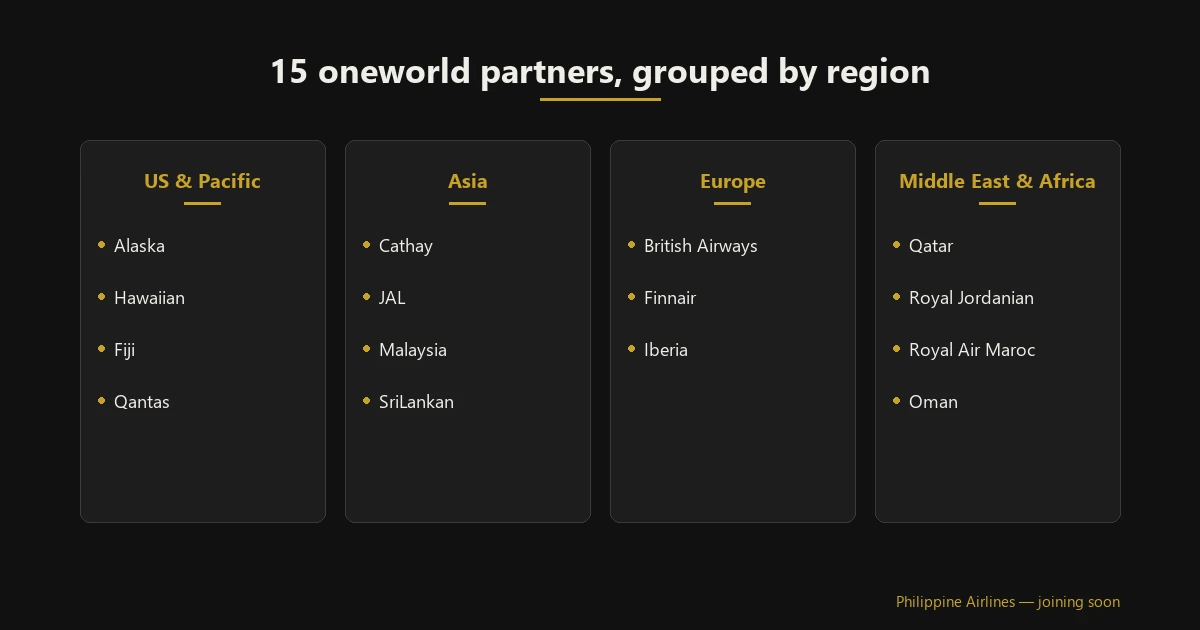
The table below groups the same 15 by the region you are most likely to fly them. Alaska and Hawaiian appear once because oneworld counts the two — now one group under Alaska Air Group — as a single member. American itself is absent by design: it is the operating carrier whose miles you are spending, not a partner.
| Region | Partners | Common use |
|---|---|---|
| US & Pacific | Alaska / Hawaiian, Fiji Airways, Qantas | Domestic feeder on Alaska, transpacific to Australia on Qantas, island routes on Fiji |
| Asia | Cathay Pacific, Japan Airlines, Malaysia Airlines, SriLankan Airlines | The highest-value redemptions in the program, especially JAL and Cathay business class |
| Europe | British Airways, Finnair, Iberia | Extensive short-haul network plus transatlantic — watch the surcharges on the latter two |
| Middle East & Africa | Qatar Airways, Royal Jordanian, Royal Air Maroc, Oman Air | Qatar’s Qsuite is a headline redemption; the others are regional connectors into Africa and the Gulf |
A few distinctions inside this list matter more than the count. Fiji Airways joined in 2025 and is a genuine oneworld member now, not a “coming soon” entry like some blogs still label it. Royal Air Maroc and Oman Air are likewise full members, useful mainly for North Africa and Gulf connectivity. Malaysia Airlines and SriLankan are the quieter Asian options — less glamorous than JAL or Cathay, but often easier to find space on, which matters more than prestige when you are trying to book four seats in a cabin.
One name is nearly there but not yet in. Philippine Airlines signed a memorandum in June 2026 to join and is expected to become the 16th member. Until a joining date is confirmed it belongs in a coming-soon note, not in the live list. Treating it as a oneworld partner on 20 November 2026 would be wrong, and it would be wrong for the same reason on any date before the announced change.
The non-alliance partners
oneworld is the headline, but American also keeps a separate set of bilateral partners. These matter because a few of them cover routes oneworld does not, and because the earn/redeem rights differ airline by airline. The table marks each one explicitly rather than leaving you to infer it.
| Airline | Earn AAdvantage? | Redeem AAdvantage? | Note |
|---|---|---|---|
| Etihad Airways | Yes | Yes | Abu Dhabi-based non-alliance partner; a useful supplement to Qatar on Gulf routes |
| China Southern | Yes, on eligible fares | Yes | Covers mainland China routes and domestic connections that few oneworld carriers serve |
| Gulf Air | Yes, on eligible routes | Yes | Bahrain-based regional supplement; check route eligibility before counting the miles |
| Cape Air | Yes | Yes | Regional northeast feeder, mainly useful for reaching smaller airports on a connecting itinerary |
| WestJet | Yes, on eligible fares | Yes | Canadian network; confirm earn eligibility by fare class before booking |
Two common misconceptions are worth killing here. First, JetBlue is no longer a partner — the Northeast Alliance between American and JetBlue was dismantled by regulators in 2023, and the reciprocal AAdvantage rights ended with it. People still write JetBlue into partner lists because the announcement years ago was widely covered and the reversal was not. Second, Air New Zealand and Singapore Airlines are Star Alliance members, not American partners; you cannot earn or redeem AAdvantage miles on either, no matter how natural they look next to a Qantas or Cathay booking.
The general test is simple: if an airline is not in the oneworld table above or the bilateral table here, assume it is not a partner until American’s own partner page says otherwise. Partner lists are a place where an outdated source does real damage, because the miles are spent before the mistake becomes obvious.
Earning miles on partners
This is where the two rulebooks first diverge. On a partner flight, the miles you earn are not based on what you paid. They are based on distance flown multiplied by the cabin’s booking code — the fare class letter printed on your ticket.
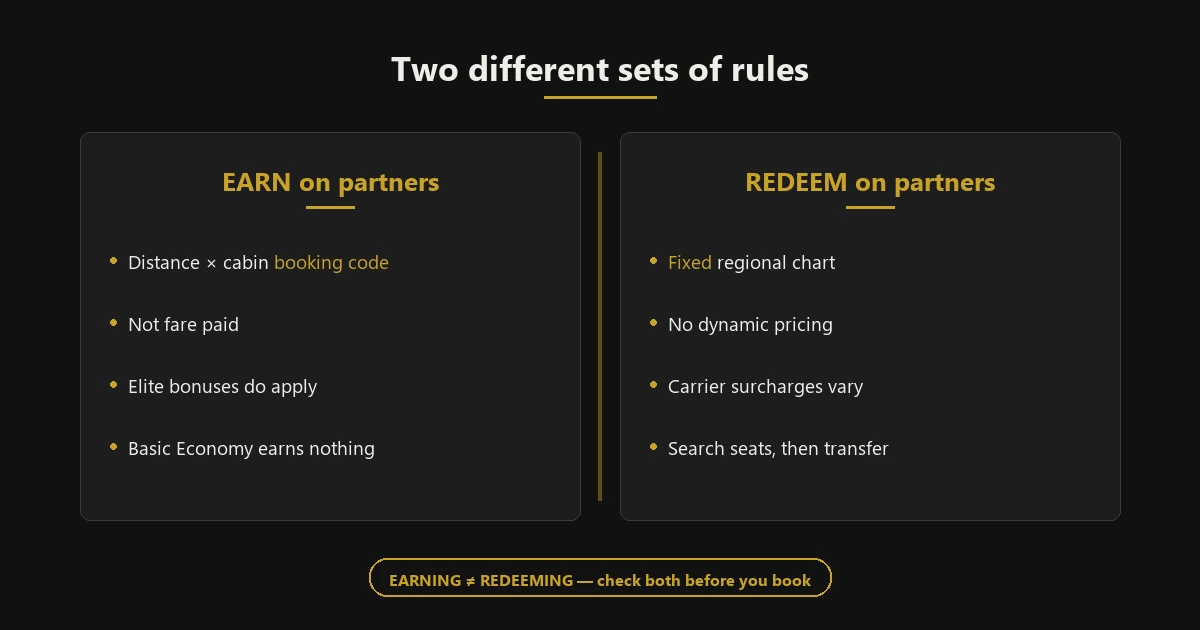
That difference has three consequences worth spelling out.
First, a deeply discounted business fare and a full-fare business ticket in the same booking code earn the same miles. The airline’s revenue does not enter the calculation. This is the opposite of American’s own flights, where the 2026 system ties miles to the fare paid plus Loyalty Points. A partner flight can therefore earn more than you expect on a cheap ticket, or less than you expect on an expensive one — the price is simply not the input.
Second, elite bonuses do apply to partner flights. A 100% or 40% cabin bonus is calculated on the distance-based miles, so a higher status meaningfully changes what a long partner trip earns. If you are close to a loyalty threshold, the partner leg of an itinerary can be the difference between reaching it and missing it, which is a reason to route onto a oneworld carrier rather than away from one.
Third, Basic Economy earns nothing. On tickets purchased from 17 December 2026, Basic Economy fares on partners earn neither miles nor Loyalty Points. If the fare class on your ticket starts with the basic code, assume zero until the earnings calculator says otherwise — and note that the same applies on American’s own metal, so this is not a partner quirk you can route around.
The practical habit follows directly. Before booking any partner flight to earn, look up the fare class letter, not the price. A slightly more expensive ticket in a better booking code can earn substantially more, and that gap is invisible if you only compare cash fares. If the trip is also being counted toward elite status, the Loyalty Points attached to partner flights follow the same distance-and-booking-code basis, so the same check protects both the mile balance and the status progress.
The fuel surcharge trap
Award prices on the regional chart are only half the story. Some partners add a carrier-imposed surcharge to every award ticket, and on long-haul flights it can reach hundreds of dollars. Two names dominate the complaints.
British Airways and Iberia are the expensive ones. A long-haul transatlantic award on either can carry a surcharge above $700 per passenger. At 57,500 miles for a business seat, that surcharge can double the effective cost of the award and push it past what the same trip would cost in cash. The award chart did not lie — the surcharge lives outside it, added at ticketing, which is why a “cheap” 57,500-mile redemption can arrive with a bill that looks like a paid fare.
The other major partners are much lighter. Japan Airlines, Qatar Airways and Cathay Pacific generally add little or nothing on their own metal. This is a large part of why those three dominate any sensible shortlist of AAdvantage redemptions, and it is a better reason than cabin quality alone — a slightly less flashy seat with no surcharge is often the better deal once the taxes are added.
The useful rule is not to avoid British Airways outright. It is to price the surcharge before you transfer any points. If a BA or Iberia award is the only seat that works for your dates, check the same route with Avios, the currency of British Airways’ own loyalty program, where surcharge treatment differs. Sometimes the Avios price plus taxes comes out below the AAdvantage price plus a carrier surcharge. Run both before committing, because points moved into AAdvantage cannot be moved back out.
There is a second-order point here that is easy to miss. A surcharge changes which currency you should be saving for. If most of your travel is transatlantic on BA or Iberia, dumping every flexible point into AAdvantage may be the wrong call — a stash in a program with lower surcharges on those specific routes can be worth more, even at a worse headline ratio. The surcharge is not a detail at the end of the calculation; for a meaningful slice of routes it is the calculation.
Redeeming on partners
Redemption is where AAdvantage earns its reputation. Partner awards use a fixed regional chart: a given route in a given cabin costs a fixed number of miles, and that number does not change when the cash fare spikes. American’s own flights, by contrast, use dynamic pricing that floats with demand. That fixed chart is the structural reason a well-timed partner award can be worth several cents per mile while a last-minute domestic ticket on American is not.
That fixed chart is why 60,000 miles for Japan Airlines business to Tokyo, or 70,000 for Qatar Qsuite to Doha, can be extraordinary value — the mileage price stays put while the cash price climbs. We keep a working list of the specific sweet spots in the best ways to use AAdvantage miles; this guide is about the rules that make those awards possible, not a route-by-route catalogue.
Three habits follow from the fixed chart. Search for the seat on the operating airline’s own site first, because American’s website does not show all partner availability — a JAL award that appears unavailable on aa.com can be sitting open on JAL’s own system. Be flexible on the departure day, because fixed-chart space is released in batches and the difference between finding and not finding a seat is often one calendar day. And once you find the seat, decide how to fund the miles rather than assuming a cash purchase is the only route.
On transfers, one number must be exact. Marriott Bonvoy converts to AAdvantage at 3:1, so 60,000 Marriott points become 20,000 AAdvantage miles. Marriott’s usual offer of 5,000 bonus miles on a 60,000-point transfer explicitly excludes AAdvantage, along with Delta SkyMiles and Avianca LifeMiles — a fact that a remarkable number of secondhand guides still get wrong by quoting 25,000. Citi ThankYou points move at 1:1 on the premium Citi cards, which is a cleaner rate when you hold one. World of Hyatt converts at 2.5:1 and IHG at 5:1; there is no transfer path from Chase Ultimate Rewards, Amex Membership Rewards, Capital One or Bilt.
None of these routes is cheap in absolute terms. Against a 1.45-cent estimate for an AAdvantage mile — the benchmark developed in the AAdvantage valuation guide — a transfer only makes sense when it completes a specific premium award you have already priced and found available. Buying miles outright is a narrower case still, usually reserved for topping off an award that is otherwise within reach. The order matters: find the seat, price the award, then fund it. Working backward from a transfer is how people end up with miles they cannot use well.
Verdict
The partner network is the reason to hold AAdvantage miles, and it rewards a small number of disciplined habits rather than broad familiarity. Learn the 15 oneworld members, remember that earning and redeeming follow different rules, and price the surcharge before you move any points. Do those three things and the fixed chart becomes one of the better-value tools in the program. Ignore them and the same chart quietly costs you hundreds.
If you are deciding whether a stash of Marriott points should become AA miles at all, start with the award, not the transfer — and check what the Marriott 3:1 transfer would cost you against the seat you actually found. For the offers running at any given moment, including the current buy-miles tiers, see AAdvantage promotions.
Frequently asked questions
How many oneworld partners does AAdvantage have?
Fifteen current members, counting Alaska Airlines and Hawaiian Airlines together as one group under Alaska Air Group. Philippine Airlines has signed to join and is expected to become the sixteenth, but is not yet a member.
Can you earn AAdvantage miles on all partner airlines?
No. Earning and redeeming are separate lists. Most oneworld partners allow both, but a few bilateral partners allow one and not the other, and fare class matters — Basic Economy tickets earn no miles and no Loyalty Points.
How are miles calculated on a partner flight?
By flight distance multiplied by the cabin’s booking code, not by the price you paid. Elite status bonuses apply on top. This is different from American’s own flights, where the 2026 system uses the fare paid plus Loyalty Points.
Which partners charge the highest fuel surcharges?
British Airways and Iberia are the usual culprits on long-haul awards, where a carrier-imposed surcharge can exceed $700 per ticket. Japan Airlines, Qatar Airways and Cathay Pacific generally add little. Price the surcharge before transferring any points.
Does Marriott give a bonus for transferring to AAdvantage?
No. Marriott Bonvoy transfers to AAdvantage at 3:1, so 60,000 Marriott points become 20,000 AAdvantage miles. The common offer of 5,000 bonus miles on a 60,000-point transfer explicitly excludes American Airlines, along with Delta SkyMiles and Avianca LifeMiles.
Is JetBlue still an AAdvantage partner?
No. The Northeast Alliance between American and JetBlue was dismantled by regulators in 2023, and the reciprocal AAdvantage earning and redemption rights ended with it. JetBlue is not a current partner.
More American Airlines guides
- The best ways to use AAdvantage miles, including the specific partner sweet spots worth building toward.
- How much AAdvantage miles are worth, and the 1.45-cent benchmark used throughout this guide.
- AAdvantage promotions, for the offers live as of 20 November 2026.
- Buying AAdvantage miles, when a cash purchase makes more sense than a transfer.
Next step
Find the seat before you fund the miles. Search the operating airline for partner availability, price the fixed-chart award and the surcharge together, and only then decide whether a transfer closes the gap — and what that transfer actually costs you.