The best way to use Aeroplan points is to target fixed-price partner awards, where a published chart sets the price and a stopover adds a second city for 5,000 points. The strongest redemptions in 2026 are short North American flights under 500 miles for 6,000 points, business class to Europe from 60,000 points, and business class to Asia from 55,000 points. What makes these valuable is not just the low number, but the absence of fuel surcharges that inflate comparable awards in other programmes.
The short version: treat the advertised “starting at” price as a floor, not a quote. Aeroplan itself publishes a median beside each floor, and in premium cabins the gap is large — the 60,000-point business seat to Europe has a published median of 133,800 points. Fixed-price partner awards are the exception: there the chart price is the price, if you find availability. Stopovers, no fuel surcharges and four US bank partners transferring at 1:1 make Aeroplan unusually flexible — and unusually easy to use badly if you book the wrong flight.

Why starting-at prices mislead
Aeroplan uses a hybrid award system. Air Canada and a group of select partners use dynamic pricing, which moves with the cash fare. Most other partners use a fixed distance-based chart. When you see a headline such as “business class to Europe from 60,000 points,” that number is a starting point inside a distance band — not the price most people pay.
Aeroplan actually publishes a median beside each starting price, which is unusually honest. For transatlantic business class the floor is 60,000 but the median is 133,800. Across the Pacific the floor is 55,000 and the median is 170,700. Even short-haul economy in North America rises from a 6,000-point floor to a 13,000-point median. The gap is smallest on short economy routes and largest in premium cabins.
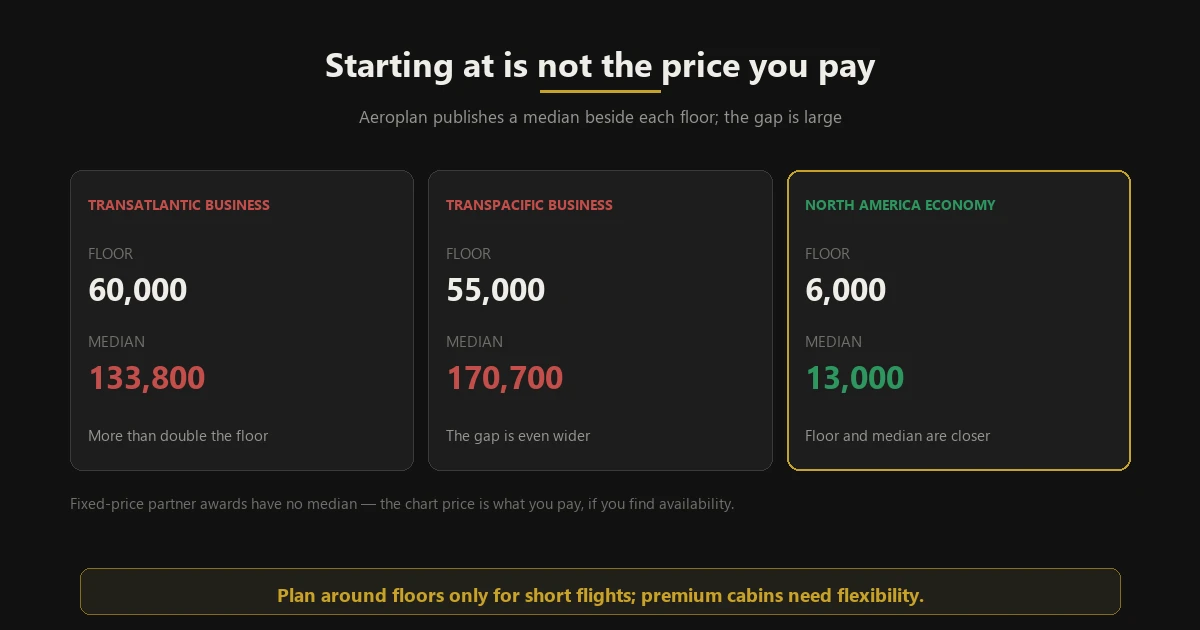
This does not make premium cabins a bad deal — it means you need flexibility. The 60,000-point seat exists, but it rewards flexible dates and early searching. Fixed-price partner awards are different: they have no median because the chart price is fixed. If a partner seat is available at 60,000 points, that is what you pay.
1. Short North American flights
The most reliable value in Aeroplan is the short-haul band. Flights of 500 miles or less within North America start at 6,000 points one-way in economy on Air Canada and non-select partners. Routes such as Montreal to Washington Dulles fall into this band. Cash prices on these routes are often a couple of hundred dollars, so the points return well above the 1.4 to 1.5 cent baseline.
Just above it, flights under 1,500 miles — Toronto to Halifax, or Vancouver to Los Angeles — start at 10,000 points in economy or 20,000 in business. These are practical awards: the fares can be high, the award prices are predictable, and availability is usually broader than on long-haul premium routes. This is where the floor and the median are closest, so the advertised price is most likely to be the real one.
One caveat: United is now a select partner and uses dynamic pricing, so its awards are no longer necessarily fixed at the chart’s starting price. Check the “operated by” column when you search — the same route on a non-select partner can cost far less.
2. Business class to Europe
This is Aeroplan’s headline redemption. Fixed-price partner awards from the East Coast to Western Europe start at 60,000 points in business class; longer flights from the West Coast start at 75,000. From Canada, Toronto and Montreal are natural gateways. The route is especially good value because Aeroplan adds no fuel surcharges — you pay taxes and a flat CA$39 partner booking fee, rather than the hundreds of dollars a European programme might add.
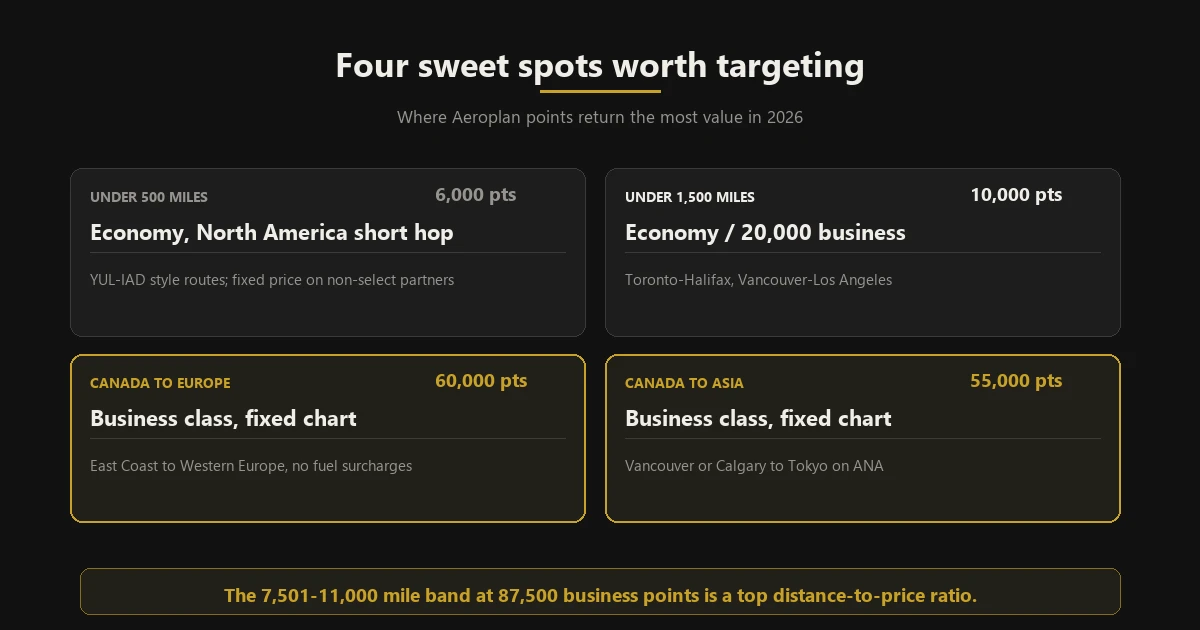
The 60,000-point figure is a floor on the dynamic-pricing side. On fixed-chart partners it is the real price. Search flexible dates, look at Lufthansa and SWISS availability, and be prepared to book when a seat appears rather than waiting for a specific date.
3. Business class to Asia
Westbound awards can be even better. Fixed-price partner flights between North America and the Pacific run from 55,000 to 115,000 points in business class, depending on distance. A Seattle to Tokyo Haneda flight on All Nippon Airways is just under 5,000 miles and prices at 55,000 points when partner space is available. Cash fares on that route often exceed $3,000 each way, which puts the value of those points above five cents.
Vancouver and Calgary are especially well placed for Asia. Vancouver to Tokyo or Osaka on ANA starts at 55,000 points in business, and Vancouver to Tahiti can be booked from 55,000 in business on the same chart. From a Canadian perspective, the North America-to-Pacific chart tends to be more favourable than the transatlantic one, simply because the distances are shorter for the same region bands.
4. The long-distance band
One of the best distance-to-price ratios on the entire chart is the 7,501 to 11,000 mile band, priced at 87,500 points in business class. Because 11,000 miles is enough to route through Europe or the Middle East on your way to Asia, this band can turn a single award into a very long trip. It is a sweet spot for travellers willing to build an itinerary rather than book the simplest route.
Family travel is another strength. Aeroplan charges some of the lowest fees for lap infants: infant awards are free within Canada and between Canada and the US, and cost just CA$25 or 2,500 points elsewhere. Existing Family Sharing accounts let up to eight members pool points, though new Family Sharing accounts are currently unavailable.
5. Add a stopover
For 5,000 points you can add a stopover to an award — one per one-way trip, or two per round-trip. The stopover can last up to 45 days, and it counts once you stay more than 24 hours between flights. It turns a single point-to-point ticket into a two-city trip for a small add-on.
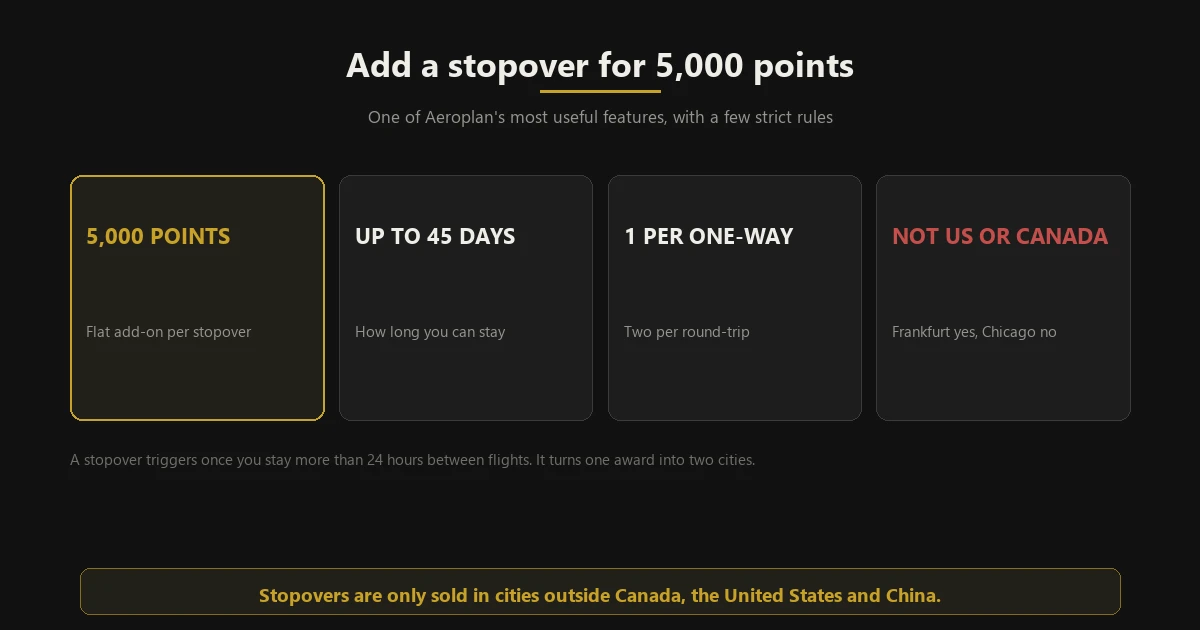
The catch is geographic: stopovers are only permitted in cities outside Canada, the United States and China. A stopover in Frankfurt or Tokyo is fine; one in Chicago is not. Plan the routing around that rule, and the 5,000-point add-on becomes one of the best-value features in the programme.
What to avoid
The weakest redemptions are the cash-like ones. Gift cards and merchandise return roughly 0.5 to 0.8 cents per point, well below the baseline. Hotel bookings through Aeroplan are also poor value even with the advertised HotelSavers discount. Air Canada’s own popular nonstop long-haul routes can be terrible value at peak times, when dynamic pricing pushes an economy ticket above 100,000 points — under one cent per point.
Avoid planning around a floor you have not verified in live search. Check availability first, price the full ticket including the CA$39 partner fee, and only then transfer points from a bank programme — transfers are one-way and cannot be reversed. For help deciding whether to top up a balance, our guide to buying Aeroplan miles covers the price ladder, and the Aeroplan valuation guide explains how to price an award yourself.
Verdict: the order to search in
Start with short North American flights, where the floor and the median are close and the value is reliable. Then look for fixed-chart business class to Europe or Asia, being flexible on dates to approach the starting price. Build a stopover into the itinerary if the routing allows it. Avoid dynamic-priced Air Canada long-haul and all cash-like redemptions. Aeroplan rewards planning and flexibility — used that way, it is one of the most valuable programmes in the Star Alliance.
Last updated: 22 November 2026. Aeroplan changed its award chart on 1 June 2026. Check current prices and availability before transferring points.
Frequently asked questions
What is the best way to use Aeroplan points?
Target fixed-price partner awards: short North American flights under 500 miles for 6,000 points, business class to Europe from 60,000 points or to Asia from 55,000 points, ideally with a 5,000-point stopover added.
Why is my Aeroplan award more expensive than the chart says?
Starting-at figures are floors, not quotes. Aeroplan publishes medians far above them in premium cabins — 133,800 points for transatlantic business versus a 60,000-point floor. Dynamic pricing on Air Canada and select partners also raises prices.
Does Aeroplan charge fuel surcharges?
No. You pay taxes and third-party charges, plus a flat CA$39 partner booking fee per ticket when a partner airline is on the itinerary. This is why partner awards often cost far less in cash than similar awards in European programmes.
How does the Aeroplan stopover work?
Add 5,000 points for one stopover per one-way award, or two per round-trip, for up to 45 days. Stopovers are only available in cities outside Canada, the United States and China, and trigger after a stay of more than 24 hours.
Are Aeroplan points good for economy or business class?
Both, for different reasons. Short-haul economy offers the most reliable value because floor and median are close. Premium cabins offer the highest ceiling but require flexibility to find awards near the starting price.
Which banks transfer to Aeroplan?
American Express Membership Rewards, Chase Ultimate Rewards, Capital One miles and Bilt Rewards all transfer at 1:1; Marriott Bonvoy transfers at 3:1. Confirm the award you want before transferring, because transfers cannot be reversed.
More Aeroplan Guides
- Aeroplan promotions, what is live and which offers are worth taking.
- How much are Aeroplan points worth, the 1.4-1.5 cent baseline and real redemption returns.
- Buy Aeroplan miles, the full price ladder and when a purchase makes sense.
- All Air Canada and Aeroplan coverage, every guide and offer we have published.