Choice Privileges has more partners than most members realise and fewer that pay than the partner page suggests. The list runs from fifteen airlines and Amtrak through rental cars, cruises, casinos and a luxury hotel collection, and the returns range from a full point per dollar to nothing at all once you count what the exchange costs you.
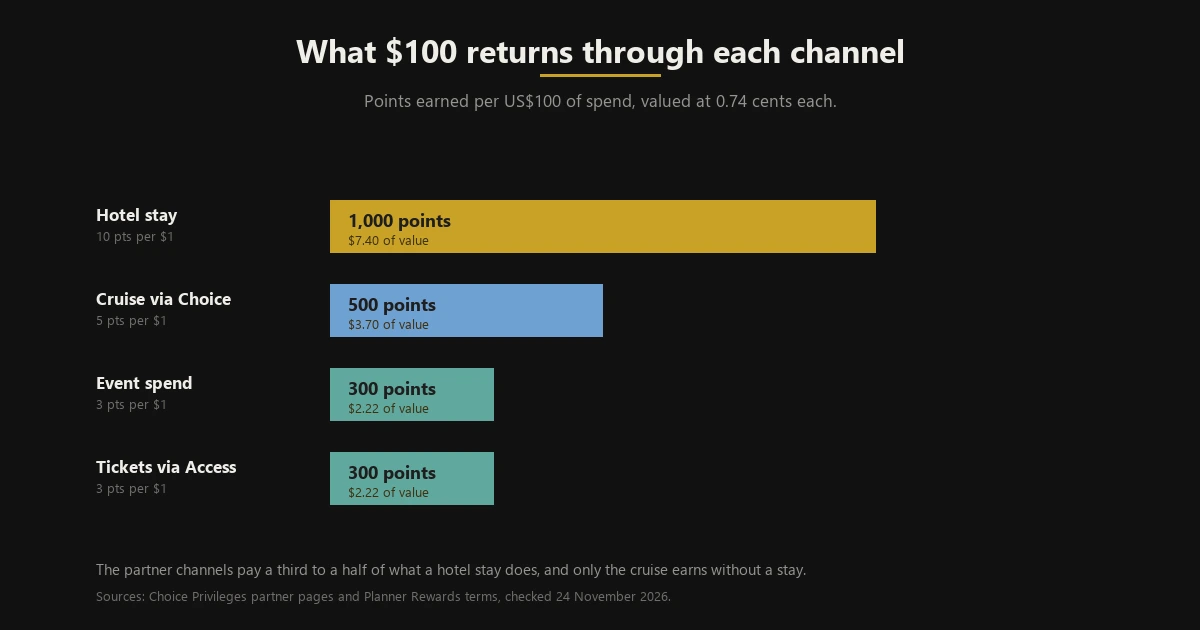
The short version: the only partner channel that pays a full hotel rate is a hotel stay; cruises pay half, events and tickets pay a third. Every airline sits at a 5:1 exchange, which turns $44 of hotel value into about $18 of flight value. Car rental is worth 1,000 points a rental and nothing more. And the transfer that actually makes sense runs the other way: bank points into Choice, never Choice points out. The official transfer links for every programme are collected in one buying guide.

At a glance
| Partner channel | What it pays | Worth on $100 |
|---|---|---|
| Choice hotel stay | 10 points per $1 of room rate | 1,000 points, about $7.40 |
| Choice Privileges Cruises | 5 points per $1 of cruise price | 500 points, about $3.70 |
| Planner Rewards events | 3 points per $1 of eligible event spend | 300 points, about $2.22 |
| Access tickets | 3 points per $1 of ticket spend | 300 points, about $2.22 |
| Avis or Budget rental | 1,000 points per qualifying rental | About $7.40, whatever the rental costs |
| Airline miles on a stay | 250 to 400 miles per stay, or 600 points outside Australia | Usually less than the points you give up |
| Rewards Exchange to airlines | 5,000 points for 1,000 miles | Loses about 59% of the value |
| Preferred Hotels & Resorts | Redemption only, typically 25,000 to 87,000 points a night | No earning, but the best use of a large balance |
Two patterns follow from that table. Every channel other than a hotel stay and a rental car pays a per-dollar rate below the base stay rate, so no partner is worth a detour. And the only partner programme where the value flows towards you is the banking side, where American Express, Capital One, Citi and Wells Fargo points come in at a far better rate than they leave.
Fifteen airlines and the 5:1 wall
Rewards Exchange converts Choice points into miles at a rate that has barely moved in a decade: 5,000 points for 1,000 miles across almost the whole list, with a 5,000-point minimum and 1,000-point steps. Transfers go only to an account in your own name, and they are not instant, so a transfer against a live award is a gamble on posting times rather than a booking. The reverse direction is where ratios bite hardest: bank points into hotel points, and which of those transfers are worth making is the other half of this calculation.
| Airline programme | Exchange | Notes |
|---|---|---|
| Aer Lingus AerClub | 5,000 points = 1,000 Avios | Standard ratio |
| Aeromexico Rewards | 5,000 points = 1,000 miles | Standard ratio |
| Air Canada Aeroplan | 5,000 points = 1,000 points | The most useful target for a small top-up |
| Air France-KLM Flying Blue | 5,000 points = 1,000 miles | Promo Rewards make this the least bad exchange |
| Alaska Airlines and Hawaiian, Atmos Rewards | 5,000 points = 1,000 points | Standard ratio |
| Avianca LifeMiles | 5,000 points = 1,000 miles | Standard ratio |
| British Airways Club | 5,000 points = 1,000 Avios | Standard ratio |
| Iberia Club | 5,000 points = 1,000 Avios | Standard ratio |
| LATAM Pass | 5,000 points = 1,000 miles | Standard ratio |
| Qantas Frequent Flyer | 2,000 points = 800 points | 2.5:1, a worse rate than the standard tier |
| Saudia AlFursan | 5,000 points = 1,000 miles | Standard ratio |
| Southwest Rapid Rewards | 6,000 points = 1,800 points | Effectively 3.33:1, the best of the airline rates |
| Turkish Airlines Miles&Smiles | 5,000 points = 1,000 miles | Standard ratio |
| United MileagePlus | 5,000 points = 1,000 miles | Standard ratio |
| Virgin Australia Velocity | 2,000 points = 800 points | 2.5:1, same as Qantas |
| Amtrak Guest Rewards | 32,000 points = 5,000 points | 6.4:1, the worst ratio on the list |
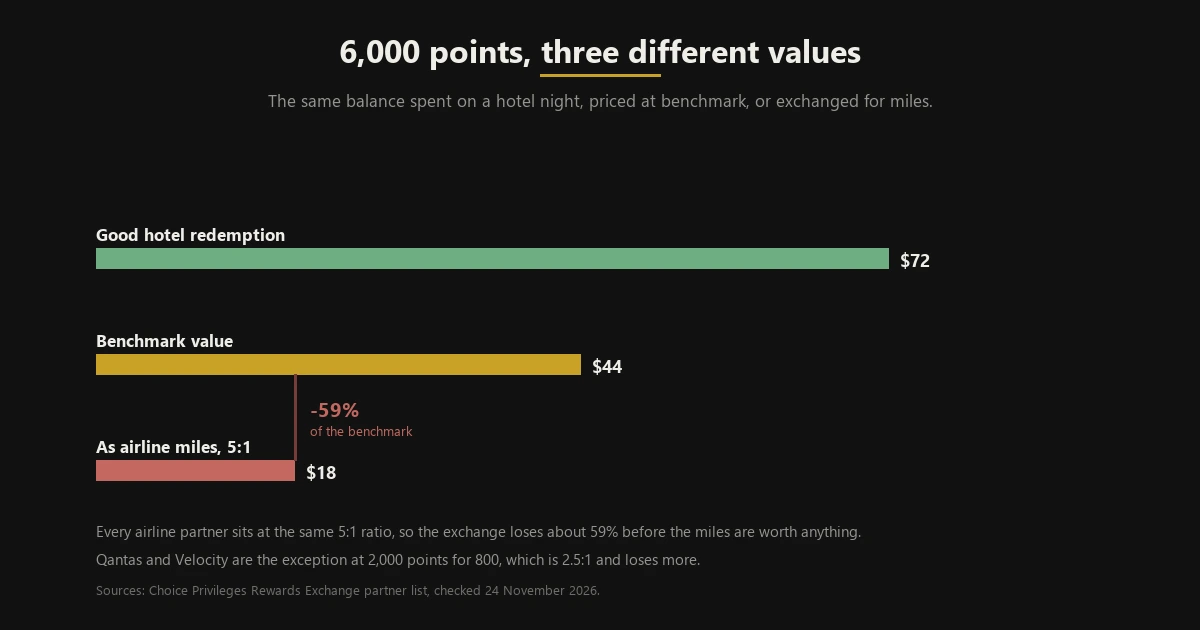
Run the arithmetic once and the conclusion is hard to escape. At the 0.74-cent benchmark that this cluster uses for Choice points, 6,000 points are worth $44. Exchanged at 5:1 into an airline programme and valued at 1.5 cents a mile, they become 1,200 miles worth $18. The exchange destroys 59% of the value before the miles do anything, and that assumes a decent airline valuation rather than a mediocre one.
The rate is worth watching, though, because Choice runs periodic transfer bonuses that halve the loss. One ran from 24 March to 24 April 2026 for Flying Blue, paying 2,000 miles per 5,000 points, an effective 2.5:1. At that ratio the same 6,000 points become 2,400 miles, worth about $36, and the exchange stops being obviously wrong. A bonus is the only circumstance in which a transfer deserves a second look, and it still requires a specific award you intend to book.
Where the exchange does earn its keep: a small top-up into an account that is a few thousand miles short of an award. Aeroplan and Flying Blue both price partner awards in ranges where 1,200 or 2,000 extra miles finish a booking, and the alternative is buying miles at two to three times the price. That is a repair, not a strategy.
Earning miles instead of points on a stay
Choice also lets you earn airline currency instead of points on a qualifying stay, by setting a frequent flyer programme as your earning preference and giving the number at check-in. It is presented as flexibility and it is almost always a downgrade.
| Programme | Earn on a stay | Worth on a $100 night |
|---|---|---|
| Aeromexico Rewards | 400 miles per stay | About $6 |
| Spirit Airlines | 250 miles per stay | About $3 |
| Atmos Rewards | 250 points per stay | About $4 |
| Qantas Frequent Flyer | 3 points per AUD$ in Australia, 600 points per stay elsewhere | About $9 outside Australia |
| Virgin Australia Velocity | 3 points per AUD$ or NZD$ in Australia and New Zealand, 600 points per stay elsewhere | About $9 outside Australia |
Compare the two columns against the 1,000 points a $100 night earns normally, worth $7.40. Qantas and Velocity beat it slightly outside Australia, and the Australian per-dollar version runs well ahead. Aeromexico, Spirit and Atmos all pay less than the points you surrender, and on a cheap $45 night the flat-rate programmes do better than a per-dollar rate would, which is the one case where the maths flips.
The catch is what you give up besides points: elite qualifying credits come from stay base points, so a member earning miles is not building status at the same pace. Unless a specific award is close and the stay is cheap, leave the earning preference on points.
Car rental: 1,000 points a rental
Avis and Budget pay 1,000 Choice points per qualifying rental when you give your member number at the counter, which is about $7.40 of value on a booking you were making anyway. Choice frequently layers a promotion on top: a 2,000-point bonus for rentals of three days or more has run repeatedly, and the partner page usually carries a discount of up to 35% alongside it.
Three exclusions matter. Free rentals, tour rates and several travel-industry rates earn nothing. A rental can only credit one frequent traveller programme, so the companion who puts it on their airline account takes the value instead. And the 1,000 points are flat rather than per dollar, which means a one-day rental near the airport is the best return in the programme and a two-week rental is not.
The discount is the part worth checking first. A 35% saving on a week-long rental is worth far more than 1,000 points, and the two usually come attached to the same booking code.
Cruises: 5 points a dollar, and the credit trap
Choice Privileges Cruises pays 5 points per $1 of cruise price, booked through the programme’s own cruise site, for members resident in the United States. Port charges, taxes and travel protection do not earn, and points post six to eight weeks after the sailing ends. On a $4,000 cruise that is 20,000 points, worth about $148 at the benchmark, which is a real return on a booking most people make once every few years.
The trap is on the other side of the same page. Redeeming points for cruise credit prices badly: 85,000 points buys $250 of credit and 160,000 buys $500, which works out at roughly 0.29 cents a point. The same 85,000 points are worth about $630 against a hotel award at the benchmark. Earn on the cruise, never pay for it with points.
Preferred Hotels, casinos and Westgate
Three partner collections exist purely on the redemption side, and all three are worth knowing about because they extend where a large balance can go.
Preferred Hotels & Resorts is the one that matters. Choice points are redeemable across several hundred independent luxury properties worldwide, typically between 25,000 and 87,000 points a night, and the awards can now be booked online rather than by phone. One quirk catches people out: Preferred properties only appear in a search if your balance already covers the award, so a member 3,000 points short sees nothing and concludes the hotel does not participate. Top up first, then search.
Penn Gaming adds reward nights at more than twenty casino hotels and resorts, plus a status match into PENN Play Rewards at the Advantage level for Gold members. Westgate Resorts adds more than twenty resorts on the same redemption basis. Neither is a reason to collect Choice points, and both are decent ways to spend a balance you would otherwise leave idle.
If a Preferred stay is the goal, the cheapest way to close a gap is buying the shortfall during a discount round rather than transferring anything in: the current price of Choice points is usually well under the per-point value of the award you are chasing.
The small earners that still count
The rest of the partner list is small, and two of the entries are worth more than their size suggests because they cost nothing but attention.
- e-Rewards surveys. A 500-point welcome bonus for joining the opinion panel, then points per completed survey. Slow, but it is the only partner channel that pays without spending money, and it counts as qualifying activity against the 18-month expiry clock.
- Refer a friend. 500 points once the referral completes a first stay at a point-earning rate. The cheapest points in the programme if you have friends who travel.
- Planner Rewards. 3 points per $1 on eligible event spend at Cambria and Radisson properties in the US, Canada, Latin America and the Caribbean, including meeting space, guest rooms and catering, capped at 150,000 points per event and requiring at least ten rooms for one night. The largest single partner earn available to anyone who books meetings.
- Eat & Earn. Dining at participating restaurants, in the US only. A rounding error on its own.
- GetYourGuide. A discount on tours and activities rather than points, currently 5% off through 31 December 2026. Cash, not currency.
None of these changes a decision about where to stay. All of them are free activity, and activity is what keeps a balance alive, which is the subject of how long Choice points last before they are forfeited.
Bank points: the transfer that runs the other way
Four bank currencies convert into Choice, and the ratios are far better than anything Choice pays out, which is the clearest signal that the programme knows which direction value should flow.
| From | Rate into Choice | What it costs you |
|---|---|---|
| Wells Fargo Rewards | 1 point = 2 Choice points | The best ratio available, and the only one that beats buying |
| Citi ThankYou | 1,000 points = up to 1,500 Choice points | 1.5:1 on premium cards, 1.05:1 on the rest |
| American Express Membership Rewards | 1,000 points = 1,000 Choice points | Spends about two cents to receive 0.74 |
| Capital One Miles | 1,000 points = 1,000 Choice points | Same problem as Amex |
Only the Wells Fargo rate survives the arithmetic, and even that depends on which redemption the Choice points fund. At 1:2, 10,000 Wells Fargo points become 20,000 Choice points worth about $148, against roughly $100 of Wells Fargo value if redeemed as cash back. That is a genuine gain, provided the 20,000 points land on an award priced well rather than a 0.5-cent redemption.
For Amex and Capital One the honest comparison is against buying. A member short of an award can buy Choice points at 0.74 cents in a bonus round or transfer Amex at an effective cost near two cents. The purchase is roughly a third of the price, which is why buying the points you are short of is the standard answer to a gap in this programme and transferring is not.
Points Sharing, and what changed in October
The newest addition is not an earning partner at all, and it changes what a household can do. Points Sharing went live on 1 October 2026: any member can send points to any other member, free, on the website only.
| Rule | Limit |
|---|---|
| Per transfer | 5,000 to 100,000 points, in 1,000-point steps |
| Per calendar year, sent | 200,000 points |
| Per calendar year, received | 100,000 points into any one account |
| Account age | Both accounts open and active for at least 30 days |
| Fee | None, though Choice reserves the right to add one |
| Posting time | Usually within 24 hours |
| Qualifying activity | No. It does not extend an expiry date or advance elite status |
The receiving cap is the number that shapes a family plan: three relatives can each send, but the account that will make the booking can only take 100,000 points a year. Pool into the account of whoever is booking, send only what the award needs, and leave a day of buffer before the reservation.
And do not mistake a transfer for activity. Points arriving in an account that is close to forfeiture do not save it, which is the single most common misreading of the feature.
Verdict
Choice Privileges partners split cleanly into three groups, and only one of them deserves planning.
The first is worth using: hotel stays, car rentals you were booking anyway, and a cruise every few years. These pay without changing your behaviour. The second is worth using only as a repair: the airline exchange, when a transfer bonus is live and a specific award is a few thousand miles short. The third is not worth using at all: transferring Choice points to airlines at 5:1 without a bonus, and paying for a cruise with points.
Then there is the direction that actually matters. Points flow into Choice far better than they flow out, which tells you what the programme thinks its own currency is worth. Bank points at 1:2, bought points at 0.74 cents and a Preferred Hotels award at 25,000 points a night are all the same trade seen from different angles, and all of them beat moving Choice points anywhere else. Before you move anything, price the award first: Choice’s points purchase page is the benchmark every transfer should be measured against.
Last updated: 24 November 2026. Partner rates and exchange ratios checked against the Choice Privileges partner pages and Rewards Exchange list on the same date.
Frequently asked questions
Can I transfer Choice points to any airline?
To fifteen airline programmes plus Amtrak, through Rewards Exchange. Almost all of them use a 5,000 points to 1,000 miles ratio, with Qantas and Virgin Australia at 2,000 to 800, Southwest at 6,000 to 1,800 and Amtrak at 32,000 to 5,000. Points can only go to an account in your own name.
Is transferring Choice points to airline miles worth it?
Rarely. At 5:1 you trade about $44 of hotel value for roughly $18 of flight value, a loss near 59%. The exception is a live transfer bonus, which can halve the loss, combined with a specific award you are a few thousand miles short of. Without both, redeem the points for a hotel night.
How many points do I earn renting with Avis or Budget?
1,000 points per qualifying rental when your Choice Privileges number is on the booking, worth about $7.40. Promotions frequently add a 2,000-point bonus for rentals of three days or more. Free rentals, tour rates and several travel-industry rates earn nothing, and a rental can only credit one loyalty programme.
Can I earn Choice points on a cruise?
Yes, 5 points per $1 of cruise price when booked through Choice Privileges Cruises by a US member, with points posting six to eight weeks after the sailing. Port charges, taxes and travel protection do not earn. Do not redeem points for cruise credit: 85,000 points buys $250 of credit, about 0.29 cents a point.
What can I do with Choice points at Preferred Hotels?
Redeem them for nights at several hundred independent luxury properties, typically 25,000 to 87,000 points a night, bookable online. Preferred properties only appear in search results when your balance already covers the award, so top up before searching rather than concluding the hotel is unavailable.
Can I send my Choice points to a family member?
Yes, since 1 October 2026. Points Sharing is free, moves 5,000 to 100,000 points per transfer in 1,000-point steps, and caps at 200,000 sent and 100,000 received per calendar year. Both accounts must be at least 30 days old. The transfer does not count as qualifying activity, so it will not stop points expiring.
More Choice Privileges Guides
- Every Choice Privileges promotion live in 2026, with the registration deadline for each one.
- What Choice points cost at every bonus tier, and the price at which buying stops working.
- What a Choice point is worth on a specific night, rather than the industry average that answers nothing.
- Where Choice points return the most on a single night, and the four redemptions that quietly destroy value.
- Whether Choice elite status is worth chasing, tier by tier, with the bonus priced in dollars per night.
- How a single $100 night becomes 3,500 points, and the four layers that stack on the base rate.
- How long a balance survives without activity, and the cheapest transaction that resets the clock.
- whether the card earns on partner spend, and the channels that pay the 1X rate.