Choice Privileges issues exactly two credit cards, and the choice between them is not the usual one. The $0 card is not the consolation prize: it grants Gold status, and Gold status is the thing that stops a balance expiring. The $95 card is the better earner and refunds its own annual fee in points before you spend a dollar, so it wins on any year you actually redeem.
The short version: take the free card if you stay a few nights a year or simply want your points protected from the 18-month clock. Take the Select card if you will redeem 30,000 points a year, because its anniversary bonus alone covers the fee at every redemption except the cruise credit. Neither card belongs in your wallet outside its bonus categories, where both earn 1 point per dollar and lose to a flat 2% cash card. Compare the currency itself with the 2026 hotel points value chart before committing to the fee.

At a glance
| Choice Privileges Mastercard | Choice Privileges Select Mastercard | |
|---|---|---|
| Annual fee | $0 | $95 |
| Welcome bonus | 60,000 points after $1,000 in 3 months | 60,000 points after $3,000 in 3 months |
| Choice stays and point purchases | 5 points per $1 | 10 points per $1 |
| Gas, grocery, home improvement, phone plans | 3 points per $1 | 5 points per $1 |
| Everything else | 1 point per $1 | 1 point per $1 |
| Status granted | Gold, automatic | Platinum, automatic |
| Elite nights credited | 10 a calendar year | 20 a calendar year |
| Anniversary points | None | 30,000 every account anniversary |
| Other benefits | Cell phone protection | Cell phone protection, $120 Global Entry or TSA PreCheck credit every four years |
| Foreign transaction fee | None | None |
| Best for | Protecting a small balance from expiry | Anyone who redeems 30,000 points a year |
The table makes the fee look trivial, and at the benchmark valuation it is. What it hides is the asymmetry in the bonuses: the free card asks for a third of the spending and pays the same 60,000 points. On year-one value alone the free card is the better sign-up, by $95 and $2,000 of required spend. The Select card only takes the lead from year two, when the anniversary points start arriving.
What the two cards actually are
Both are issued by Wells Fargo on the Mastercard network, both are consumer cards with no business edition, and both carry the World Elite tier of Mastercard benefits. Neither charges a foreign transaction fee, which matters more than usual here because Choice’s densest clusters of high-value redemptions sit outside the United States, in Scandinavia, Japan and southern Europe.
The earn structures are the same shape at two different sizes. Every dollar goes into one of three buckets, and the only difference between the cards is the size of the first two. That simplicity is the point: there is no rotating category, no quarterly activation, and no portal to book through. You pay with the card, and the points post with the stay.
What separates them is not the multiplier but the two things attached to the plastic. The free card deposits 10 elite night credits into your account each calendar year and makes you Gold. The Select card deposits 20 and makes you Platinum, then adds 30,000 points every anniversary and a trusted traveller credit. Those four extras are what the $95 buys, and each one is worth pricing separately rather than as a bundle.
The $95 is refunded in points
Start with the anniversary bonus, because it is the only benefit on either card that converts to dollars without any behaviour from you. Thirty thousand points land on every account anniversary with no spending requirement attached. At the 0.74 cents a point this site uses for Choice redemptions, that is $222 of hotel value against a $95 fee, a net gain of $127 a year for holding a card you do not have to use.
| Value from the card alone | No-fee card | Select card |
|---|---|---|
| Welcome bonus, at 0.74 cents a point | $444 | $444 |
| Anniversary points, year one | $0 | $0, first anniversary |
| Annual fee | $0 | -$95 |
| Year-one value, before any spending | $444 | $349 |
| Value every year after | $0 | $127 |
| Spend required for the bonus | $1,000 in 3 months | $3,000 in 3 months |
The interesting number is the break-even, not the profit. Thirty thousand points need to be worth $95, which works out at 0.32 cents a point. Every standard Choice redemption clears that bar comfortably, from the 6,000-point roadside night to a Preferred Hotels award at 25,000 points. The one redemption that fails is the cruise credit, where 85,000 points buy $250 of cabin credit, or 0.29 cents each. Redeem the anniversary points that way and the fee is not quite covered, which is a useful reminder that the card is only as good as the redemption you point it at. Our guide to what a Choice point is worth prices the alternatives night by night.
One timing detail: the anniversary points post on the account anniversary, not the calendar year, so the first batch arrives after twelve months of holding. Year one on the Select card is the bonus minus the fee and nothing else. If you are testing the card for a single year, you are testing the earning rate, not the anniversary.
Earning: 22.5 points per dollar at Choice
The headline rate on the Select card is 10 points per dollar at Choice properties, and it stacks on top of what the programme already pays rather than replacing it. A base member earns 10 points per dollar on the room rate. Platinum adds a 25% bonus, taking that to 12.5. The card adds 10 more, for 22.5 points per dollar in total. On a $100 night that is 2,250 points, worth $16.65 at the benchmark, or 16.65% back on a hotel bill you were going to pay anyway.
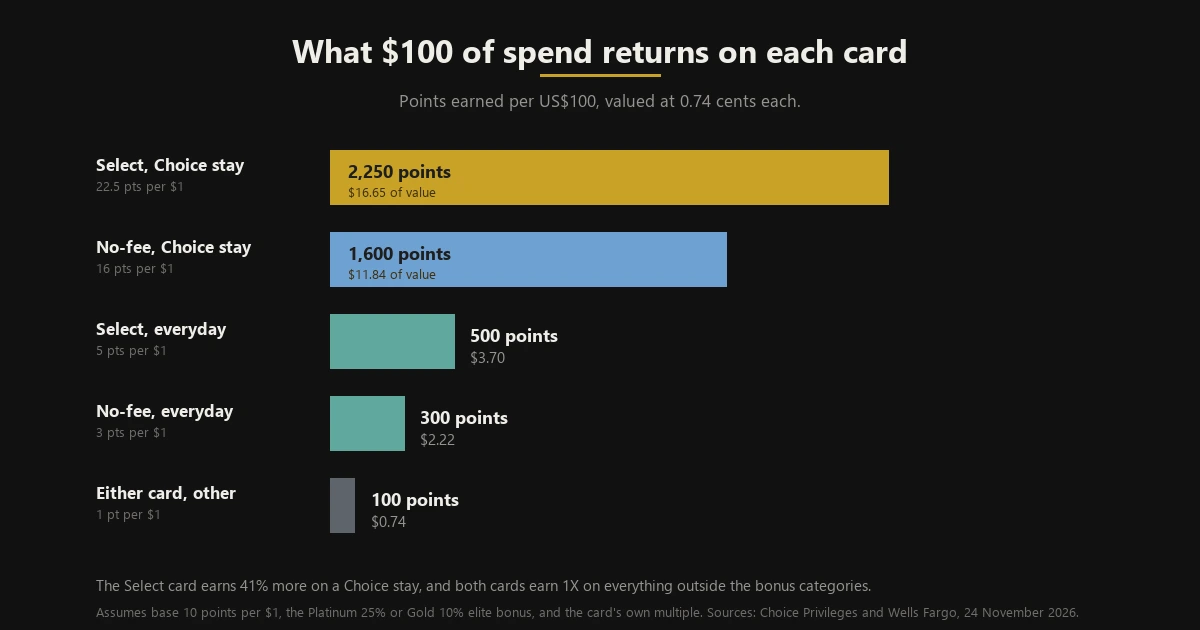
The free card runs the same arithmetic at a smaller size. Five points from the card, plus 11 from the base rate with the Gold 10% bonus, gives 16 points per dollar, or 1,600 points and $11.84 per $100. That is still a 41% gap in favour of the Select card on stays, and the gap widens if you spend more nights. The four layers that stack on a Choice night explains where the base rate comes from.
| Spend | No-fee card | Select card | Value per $100 |
|---|---|---|---|
| Choice stay, paid with the card | 16 points per $1 | 22.5 points per $1 | $11.84 / $16.65 |
| Buying Choice points | 5 points per $1 | 10 points per $1 | $3.70 / $7.40 |
| Gas, grocery, home improvement, phone plans | 3 points per $1 | 5 points per $1 | $2.22 / $3.70 |
| Everything else | 1 point per $1 | 1 point per $1 | $0.74 |
Two lines in that table deserve more attention than they usually get. The first is point purchases: both cards pay their top hotel multiple when you buy Choice points, so the Select card rebates 7.4% of what Choice charges for its own currency. Buy 1,000 points for $12.80 on the Select card and 128 points come back, cutting the effective price to about $11.85. That does not make buying points a good deal on its own, but it shifts the arithmetic at the margin, and it is the only category where a hotel card pays you to buy the hotel’s currency.
The second is the 1 point per dollar line, which is the same on both cards and is the reason a Choice card should never be your default. At 0.74 cents a point, 1X is a 0.74% return. A plain 2% cash card returns $2 on the same $100, nearly three times as much. Even the 3X tier on the free card only reaches $2.22, barely ahead of cash. These cards are worth holding for the status, the anniversary points and the stay multiplier; they are not worth using at the supermarket checkout unless the category is live.
Ten elite nights free, twenty for $95
Elite night credits are the least understood benefit on the card and, for anyone chasing Diamond, the most valuable. Choice counts status in nights, and 2026 lowered every threshold by five: Gold at 5 nights, Platinum at 15, Diamond at 35, Titanium at 55. The cards deposit credits straight into that count, so the free card pays for Gold outright and leaves you five nights short of Platinum, while the Select card pays for Platinum outright and leaves fifteen nights to Diamond.
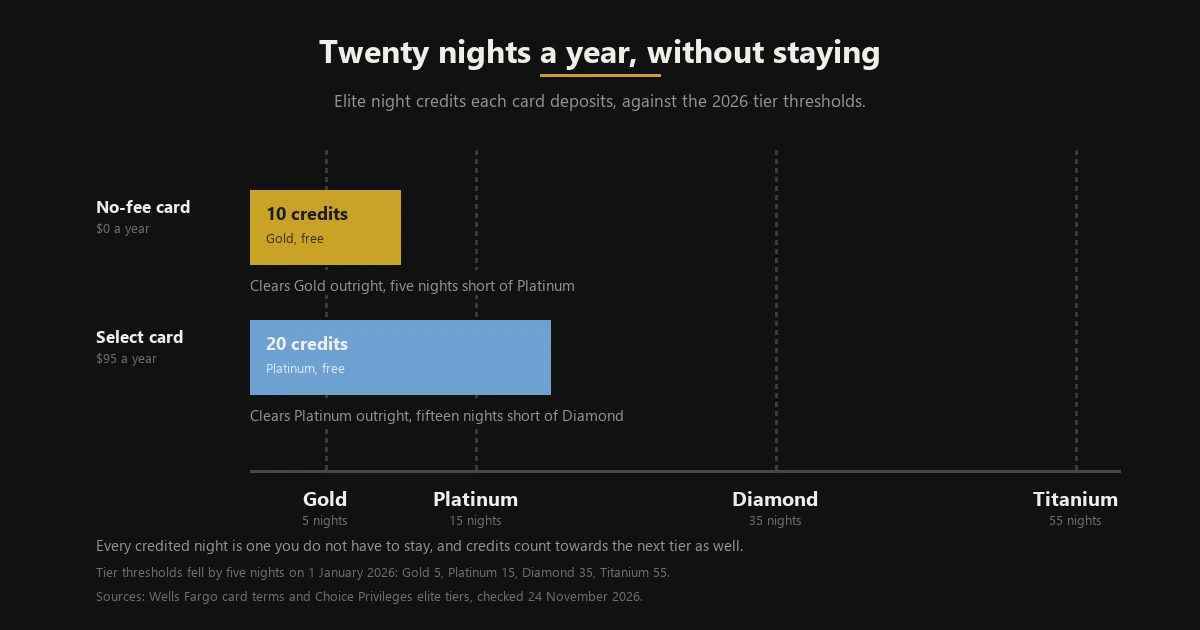
Fifteen paid nights is a realistic target for someone who travels for work a few times a month, and Diamond is the first Choice tier where a benefit can be measured in cash: a 50% points bonus instead of 25%, complimentary breakfast for two at participating Radisson brands, and guaranteed room availability on paid stays booked at least 48 hours ahead. Breakfast for two runs $20 to $30, so twenty mornings covers the annual fee several times over. Without the card, Diamond takes 35 nights and you would not start the year with twenty of them already banked.
| Tier, 2026 | Nights needed | With the free card | With the Select card |
|---|---|---|---|
| Gold | 5 | Already yours | Already yours |
| Platinum | 15 | 5 paid nights | Already yours |
| Diamond | 35 | 25 paid nights | 15 paid nights |
| Titanium | 55 | 45 paid nights | 35 paid nights |
Two caveats. The credits are nights, not Elite Qualifying Credits, so they do not help the alternative route to status through hotel spend. And they are granted for the calendar year in which you hold the card, which means cancelling mid-year can take the credits back with it. The tier-by-tier breakdown of what each status pays prices the difference between Gold, Platinum and Diamond in dollars per night.
The real reason to hold the free card
Here is the argument that does not appear on the application page. Choice Privileges points expire after 18 consecutive months without qualifying activity, and the one exemption is elite status: Gold, Platinum, Diamond and Titanium members keep their balances indefinitely while they hold the tier. The free card grants Gold automatically, every year, for nothing. That makes it an expiry insurance policy with a $0 premium.
Price the alternative. The cheapest way to reset the clock without the card is to buy the minimum 1,000 points for $12.80, once every 18 months, forever. That is $8.53 a year in expected cost and a recurring chore with a hard deadline attached. A member holding 50,000 points, worth $370, is one missed deadline away from losing all of it. The card removes that risk permanently and pays 60,000 points for the privilege of doing so.
This is also why cancelling is more expensive than it looks. Drop the card, drop below Gold, and the 18-month clock restarts from your last qualifying activity, not from the day you cancelled. If the balance has been sitting idle, the deadline may already be close. Our explanation of how the 18-month clock is counted covers the check-in, check-out edge case that catches people out.
What neither card does
Both cards are narrow instruments, and the limits are worth stating plainly before you apply. There is no introductory 0% APR on either, and the ongoing rate runs from 19.99% to 28.74% variable depending on creditworthiness. Carrying a balance on a hotel card to earn 0.74-cent points is a losing trade at any of those rates.
Neither card issues free night certificates. The points are points, which is better in practice because they can be topped up and spent on any award, but it also means there is no fixed annual free night to count against the fee. The Select card’s anniversary bonus is the closest equivalent, and it is more flexible than a certificate.
The insurance benefits are modest but real. Both cards carry cell phone protection of up to $800 per claim with a $25 deductible when the monthly bill is paid with the card, limited to two claims in twelve months. The Select card adds a statement credit of up to $120 every four years for Global Entry or TSA PreCheck. Those two benefits alone justify the $95 for anyone who was going to pay for either programme anyway.
Finally, the points are only worth what Choice says they are worth. They cannot be transferred to airlines at a decent rate, and the partner channels that do accept them mostly pay less than a hotel night. The card is a tool for earning a closed-loop currency, and the loop closes at Choice’s own hotels, Preferred Hotels and PENN casinos.
Which card fits which member
Never stay, but hold a balance. Take the free card and keep it. You are buying expiry protection and 10 elite nights for nothing, and the 60,000-point bonus is the same as the paid card’s. Use it only at Choice properties and for point purchases, and leave it at home otherwise.
Five to fifteen nights a year. Start with the free card. It clears Gold on its own and your stays push you toward Platinum, which is the tier where the points bonus doubles from 10% to 25%. If you later find yourself redeeming more than 30,000 points a year, upgrade: Wells Fargo product changes usually preserve the account history, though not the bonus eligibility.
Fifteen nights or more, or heavy grocery and gas spend. The Select card, without much debate. Platinum arrives free, 15 paid nights reach Diamond, and the anniversary points cover the fee before you spend anything. The 5X everyday categories are the strongest part of the card for a household that puts $1,000 a month through groceries and fuel: that is 60,000 points a year, another $444.
Anyone who carries a balance. Neither card. The interest at 25% will outrun the points within two months, and the bonus does not survive a year of it.
Hitting the bonus without carrying a balance
The free card needs $1,000 in three months, which is $334 a month, and most households clear it by moving the phone bill, the fuel and the weekly shop onto the card. The Select card needs $3,000 in three months, or $1,000 a month, which takes a plan. Insurance premiums, a car repair, a quarterly tax bill and a home project all count; rent and mortgage payments usually do not, because they are processed as transfers rather than purchases.
Do the interest arithmetic before you stretch for the last few hundred dollars. Three thousand dollars carried for three months at 25.74% costs about $193 in interest, which eats 43% of a $444 bonus. The break-even is not close: spending money you would not otherwise spend to reach a bonus is a worse trade than earning a smaller bonus honestly.
Points post with the statement after the threshold is crossed, usually within one or two cycles, and they land in the Choice Privileges account linked at application. Check that link before you spend, because retroactive crediting is the one part of this process that regularly goes wrong. If you are short of an award after the bonus, topping up with bought points on the Select card costs about $11.85 per 1,000 after the 10X rebate.
Verdict
Buy the free card first. It is the only card in the programme that solves a problem you already have, and it solves it permanently: Gold status, no expiry, 10 elite nights, 60,000 points after a thousand dollars of ordinary spending. Nothing about that requires a stay, a redemption or a decision later in the year.
Add the Select card when the anniversary points have somewhere to go. If you redeem 30,000 points a year, the $95 is refunded at 0.32 cents a point and the rest is profit; if you do not, the card is a $95 subscription to Platinum benefits that Gold already covers most of. The honest test is simple: look at last year’s redemptions. Under 30,000 points, stay free. Over it, pay the fee and take the 20 elite nights with it.
Whichever you hold, the card should be a specialist rather than a workhorse. Put Choice stays, point purchases, fuel and groceries on it, and put everything else on a flat-rate card that pays more than 0.74%. The price of Choice points at each bonus tier is the number that decides whether the balance you are building is worth more than the cash you are forgoing.
Last updated: 24 November 2026. Card terms, bonus amounts and elite thresholds checked against the Wells Fargo product pages and the Choice Privileges programme terms on the same date. Offers change without notice; verify the current bonus before applying.
Frequently asked questions
How many Choice Privileges credit cards are there?
Two, both issued by Wells Fargo: the Choice Privileges Mastercard with no annual fee, and the Choice Privileges Select Mastercard at $95 a year. Both earn Choice points, grant elite status automatically and charge no foreign transaction fee. There is no business version.
Is the $95 Choice Privileges Select card worth the annual fee?
Yes if you redeem at least 30,000 points a year. The card deposits 30,000 points on every account anniversary, which is $222 at 0.74 cents a point against a $95 fee, so the fee is covered at any redemption above 0.32 cents a point. Below 30,000 points of annual redemptions, the free card is the better buy.
Does the Choice Privileges credit card stop my points expiring?
Yes. Points expire after 18 consecutive months without qualifying activity, but Gold, Platinum, Diamond and Titanium members keep their balances indefinitely. The no-fee card grants Gold automatically, so holding it removes the expiry risk at no cost. Cancel the card, fall below Gold, and the 18-month clock starts again from your last qualifying activity.
How many points do I earn on a Choice stay with the card?
22.5 points per dollar on the Select card and 16 on the free card. That is the base 10 points per dollar, plus the 25% Platinum or 10% Gold elite bonus, plus 10 or 5 points from the card itself. On a $100 night that is 2,250 or 1,600 points, worth $16.65 or $11.84.
Do the cards give elite status without staying?
Yes. The no-fee card grants Gold and credits 10 elite nights each calendar year; the Select card grants Platinum and credits 20. The credits count towards the next tier, so a Select cardholder needs 15 paid nights for Diamond and a free-card holder needs 5 for Platinum. The credits are nights, not Elite Qualifying Credits, so they do not help the spend-based route to status.
Can I earn Choice points by buying them with the card?
Yes, and at the top rate. Both cards pay their hotel multiple on Choice Privileges point purchases, so the Select card earns 10 points per dollar on the purchase itself. Buying 1,000 points for $12.80 returns 128 points, cutting the effective price to about $11.85 per 1,000.
More Choice Privileges Guides
- Every Choice Privileges promotion live in 2026, with the registration deadline for each one.
- What Choice points cost at every bonus tier, and the price at which buying stops working.
- What a Choice point is worth on a specific night, rather than the industry average that answers nothing.
- Where Choice points return the most on a single night, and the four redemptions that quietly destroy value.
- Whether Choice elite status is worth chasing, tier by tier, with the bonus priced in dollars per night.
- How a single $100 night becomes 3,500 points, and the four layers that stack on the base rate.
- How long a balance survives without activity, and the cheapest transaction that resets the clock.
- Which partner channels pay, and which quietly lose 59%, with the airline exchange ratios priced in dollars.