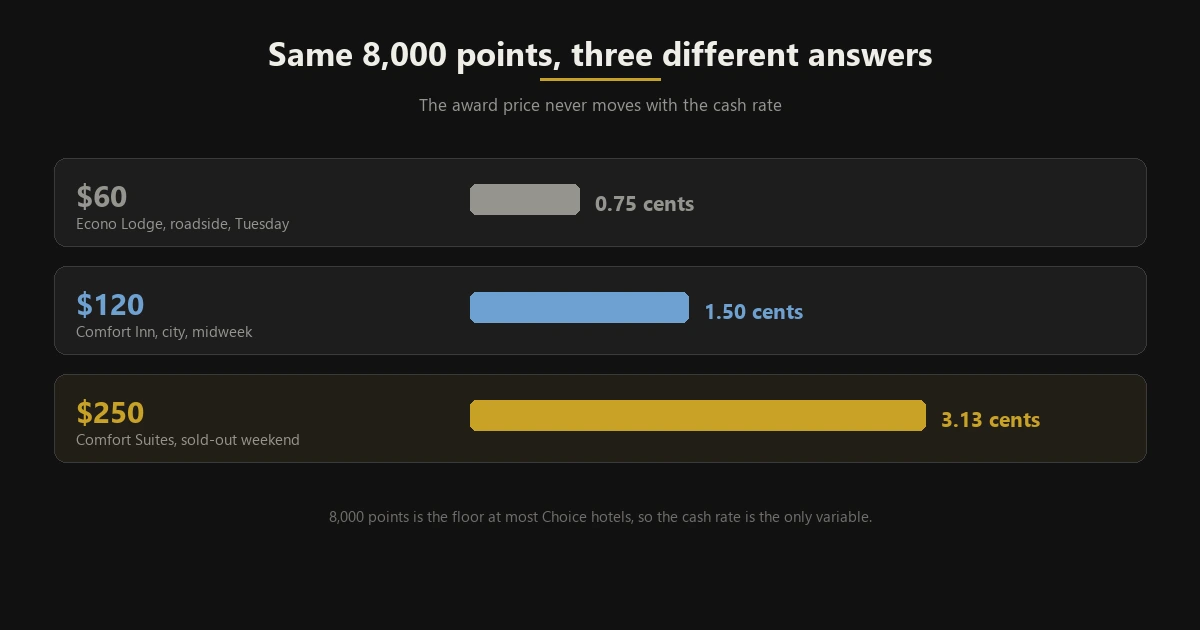
How much Choice Privileges points are worth is normally answered with one number — 0.6 cents, or 0.8, or 1.3 — and that number is useless for the decision you are actually making. Choice does not price awards off the cash rate the way Hilton and Marriott do. It prices them per hotel, with a floor at 8,000 points, and lets the cash rate float underneath. The same 8,000 points are worth 0.75 cents at a roadside Econo Lodge and 3.1 cents at a Comfort Suites on a sold-out football weekend, and no average of the two tells you whether to book.
So this page answers the question three times, for the three different decisions people bring to it. For a specific night, value is the cash rate divided by the points required, and nothing else. For a decision about buying points, value is the cheapest price Choice has sold them at recently, which was 0.57 cents in July 2026. For a decision about whether to chase Choice points at all, the honest figure is 0.8 cents — the valuation NerdWallet uses — which turns a 10-points-per-dollar stay into an 8 per cent return.
The short version: the industry average is a portfolio number and you do not redeem a portfolio. Price the exact award, then compare it with the two prices that set your floor — what the room costs in cash, and what Choice would sell you the points for. Most Choice redemptions land between 0.7 and 1.5 cents. Anything below 0.62 cents is worse than buying points in a discount round, and anything above 1.5 cents is a night where cash rates spiked and points did not.

Three answers, three different decisions
The confusion around Choice points comes from mixing three questions that need three different numbers. Keep them apart and the arithmetic gets simple.
| Method | Answer | Use it when |
|---|---|---|
| Industry average | 0.6 to 0.8 cents per point | Deciding whether to chase Choice points at all, or comparing programs |
| Replacement cost | 0.57 to 0.76 cents, the range Choice sold at in 2026 | Deciding whether to buy points or transfer them in |
| This night | Cash rate divided by points required | Deciding whether to redeem for a stay you have already found |
The first number is a survey result. The second is a price you can actually transact at. The third is the only one that describes a real decision. Most published valuations quote the first and stop, which is why two people holding the same balance can both be right about its value and disagree by a factor of four.
The four point levels, and the cash rate each one needs
Choice award nights start at 8,000 points at most properties, with a handful of economy hotels from 6,000 and upscale brands reaching 35,000 and above. Points-plus-cash starts at 6,000 points plus a cash top-up. There is no binding public chart: the award price is set per hotel and moves with season, which is exactly why you have to work from the ratio rather than a category list.
Read the table below right to left. Decide what the point is worth to you — 0.8 cents if you are buying at the current sale, 1.0 cents if you want a redemption worth the effort — then find the cash rate the night has to clear for the award to be rational.
| Points required | Cash rate needed for 0.8 cents | For 1.0 cent | For 1.5 cents |
|---|---|---|---|
| 8,000 | $64 | $80 | $120 |
| 12,000 | $96 | $120 | $180 |
| 20,000 | $160 | $200 | $300 |
| 35,000 | $280 | $350 | $525 |
Two things fall out of that grid. The first is that the 8,000-point floor is where Choice points earn their reputation: at that level a perfectly ordinary $120 midweek rate already returns 1.5 cents, a number no other midscale program reaches. The second is that the same value gets harder to find as the award price rises — a 35,000-point Cambria needs a $525 cash rate to hit 1.5 cents, which only happens on the worst nights of the year.
Why the average lies
Because the award price does not track the cash price, a single night can change value by 300 per cent without a single point moving. That is the whole mechanism, and it is worth stating plainly: at a hotel that charges 8,000 points, the award cost is fixed while the cash rate swings with demand. A Tuesday in February and a Saturday in October cost the same number of points. One is worth 0.75 cents, the other 3.1.
The industry average flattens that into a number that describes nobody’s actual behaviour. It is computed across every redemption in a sample — gift cards, points-plus-cash bookings, airport hotels, aspirational weekends — and it assumes members redeem in proportion to what is available rather than what is good. Real members redeem against a trip they have already decided to take. That single fact moves the relevant number up or down by a cent, which is more than the entire spread between Choice and Marriott.
There is a second distortion. Choice points are cheap to buy and expensive to earn, because the base rate is 10 points per dollar at most brands but the point is worth under a cent. A $150 room earns 1,500 points, worth about $12 at the 0.8-cent average — an 8 per cent return, before any elite bonus. That is a decent midscale return and a poor one against a 15 per cent member discount on the same room. The average conceals the fact that the earning side and the redeeming side of this program are two different economies.
The replacement-cost rule
The cleanest way to value a Choice point is to ask what it would cost you to get another one. Choice answered that question eight times in 2026: the rounds ran from a 40% bonus in January to a 50% bonus in May to a 45% discount in July, and the best price in each round ranged from 0.57 to 0.76 cents. The current round, which closes on 26 November, sits at 0.74 cents — near the top of the year’s range.
That gives you a hard floor. A point you can buy for 0.74 cents is worth 0.74 cents to you, whatever a valuation site says, because buying is the alternative to redeeming. Two consequences follow, and they cut in opposite directions.
The first is that redemptions below 0.74 cents are not redemptions at all. Paying 8,000 points for a $55 roadside room returns 0.69 cents — you would have been better off buying points and paying cash, and better off again just paying cash. The second is that you should never buy points to fund an award that returns 0.8 cents: the spread is six hundredths of a cent, less than the risk that the award disappears before you book. Buy at the price Choice is currently charging only when the award you have priced returns well above it.
Where the rule really bites is the aspirational case. Members buy points to reach an expensive redemption, on the theory that a $400 room for 20,000 points is 2 cents of value. It is — but the 20,000 points cost $148 at the current sale, so the true saving is $252 against cash, not $400 against a valuation. That is still a good trade. It stops being one when the cash rate for the same night is $180, which happens more often than the story suggests.
Which redemption routes clear the bar
Five routes, priced with the arithmetic in the open. Two of them fall below the buy price, which is the easiest way to see why the average is not the answer.
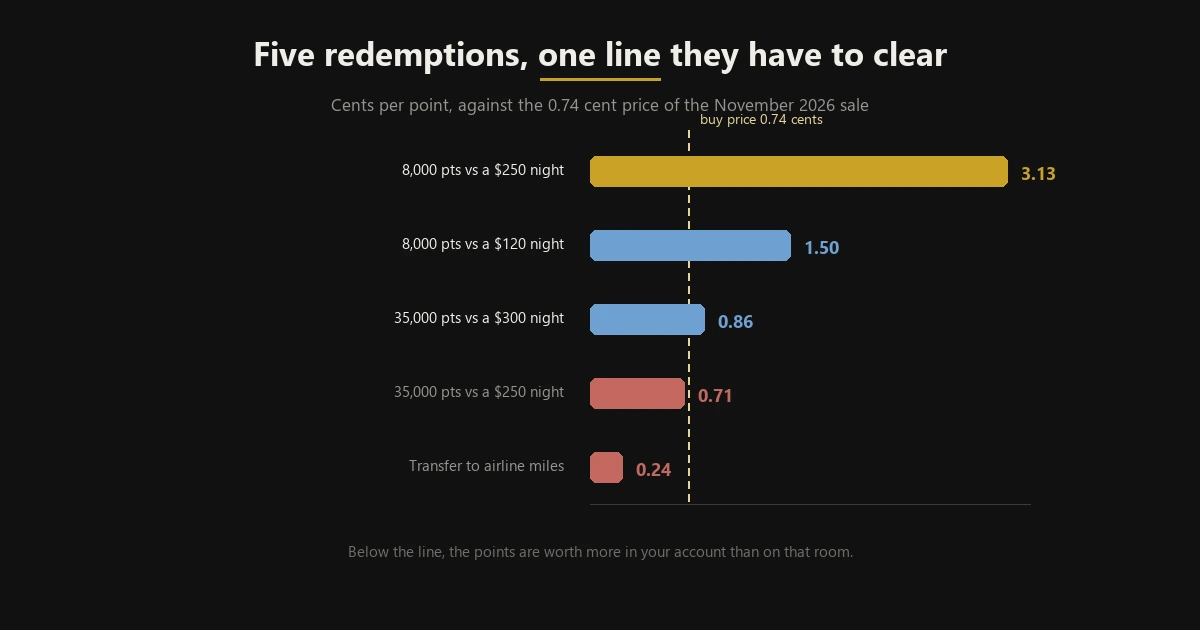
Award nights are where the value is, and the spread inside them is the point. The 8,000-point floor against a spiked cash rate is the best case the program offers; the same 35,000 points against a $250 rate returns 0.71 cents and would have been better bought. Preferred Hotels & Resorts redemptions sit in a similar band — the cash rates at those 380-plus properties are high, which lifts the return, but the point costs are set individually, so price each one rather than assuming.
Points plus cash is the weakest of the legitimate routes. It exists to close a gap when you are short, priced from 6,000 points with a cash top-up, and the cash portion is set from the room rate rather than the award rate. Use it to finish an award you have already decided on, not as a way to stretch a balance.
Airline miles are the worst conversion in the program: five Choice points buy one mile. At a 1.2-cent value per mile that is 0.24 cents per point — a third of what the points are worth as a hotel night, and less than half what Choice would sell them to you for. If you want airline miles, earn airline miles.
Four redemptions that look like value
1. The cheap roadside night. An Econo Lodge at 8,000 points and $60 cash returns 0.75 cents, which reads as a pass until you notice you could have paid $60 and kept the points. Below the buy price, an award is a way of converting a liquid asset into a worse one.
2. The short-haul mileage transfer. Moving 20,000 Choice points to 4,000 airline miles feels like diversifying. At 1.2 cents per mile you have turned about $148 of buying power into $48. There is no bonus, no transfer partner multiplier, and no way back.
3. The off-season award. Using 8,000 points on a night that costs $80 returns 1.0 cents, which sounds acceptable. But the same 8,000 points on the same hotel in high season return 2 or 3 cents, so the real cost of the off-season booking is the option you spent. Choice has no blackout dates; the constraint is your calendar, not their inventory.
4. The points-plus-cash top-up. It is the route members reach for when they are 2,000 points short. The cash portion is priced off the room rate, so the blended value of the points you do spend lands near or below the buy price. If you are short, buying 2,000 points in a discount round is usually the cheaper repair.
Choice against the other hotel programs
Choice points are worth less per point than Hyatt’s and more than Hilton’s, but per point is the wrong unit — what matters is the return on a dollar spent. On that measure Choice is closer to the top of the midscale field than its 0.8-cent valuation suggests, because it pays 10 points per dollar where several competitors pay five.
| Program | Point value | Points per $1 | Return on room spend |
|---|---|---|---|
| World of Hyatt | 1.6 to 1.8 cents | 5 | 8 to 9 per cent |
| Choice Privileges | 0.8 cents | 10 | 8 per cent |
| Marriott Bonvoy | 0.7 cents | 10 | 7 per cent |
| Wyndham Rewards | 0.6 to 0.7 cents | 10 | 6 to 7 per cent |
| IHG One Rewards | 0.6 cents | 10 | 6 per cent |
| Hilton Honors | 0.4 cents | 10 | 4 per cent |
The comparison also exposes the ceiling. Elite bonuses add 10 per cent at Gold, 25 at Platinum and 50 at Diamond and Titanium, so a top-tier member earns 15 points per dollar and a 12 per cent return — still short of a 15 per cent member discount on the same room. Choice points are a good currency in a program that gives away cash discounts more generously than points.
The verdict
If you are deciding about one night, use the ratio and ignore every valuation you have read, including this one. Divide the cash rate by the points. Above 1.0 cent, book the award. Between 0.74 and 1.0, book it only if you were going to stay there anyway. Below 0.74, pay cash — the points are worth more in your account than on that room.
If you are deciding whether to buy, work backwards from the award. Take the points you need, multiply by 0.74 cents, and see whether the total beats the cash rate. If it does not, the sale is irrelevant. The current round closes on 26 November, and the discount rounds that follow usually price lower, so there is no penalty for waiting unless the room is already booked.
If you are deciding whether to chase Choice points at all, the honest answer is that they return about 8 per cent on room spend and rather more on a small number of redemptions at the 8,000-point floor. That is a good reason to keep a balance for the right night and a bad reason to route spend through Choice for its own sake. Check the price your account is offered before you buy, because the round is targeted and the top band is the only one worth using.
How the valuation has moved
Two numbers have drifted in opposite directions since 2024. The price Choice charges for points has fallen, and published valuations have risen, which means the gap between buying and redeeming has narrowed for anyone who buys to redeem.
| Period | Cheapest points on sale | Published valuation |
|---|---|---|
| December 2024 | 0.64 cents (60% bonus round) | 0.6 cents |
| September 2025 | 0.57 cents (45% discount round) | 0.6 cents |
| July 2026 | 0.57 cents (45% discount round) | 0.7 cents |
| November 2026 | 0.74 cents (40% bonus round, to 26 November) | 0.8 cents |
The pattern is stable enough to plan around: bonus rounds price between 0.69 and 0.76 cents, discount rounds between 0.57 and 0.72, and the best price of any given year has landed at or below 0.57 cents for three years running. This page is checked each Monday and whenever Choice changes a round. Last updated 24 November 2026.
Frequently Asked Questions
How much are Choice Privileges points worth?
Between 0.6 and 0.8 cents each on the published averages, but the number that matters is the cash rate for the night you are booking divided by the points it costs. At 8,000 points that runs from 0.75 cents against a $60 room to 3.13 cents against a $250 one. Most real redemptions land between 0.7 and 1.5 cents.
Are Choice points worth more than Marriott or Hilton points?
Per point, slightly more than Marriott at about 0.8 cents against 0.7, and twice Hilton at 0.4 cents. Per dollar spent they are close to identical, because all three programs pay 10 points per dollar on room charges. Choice wins on award availability at the 8,000-point floor rather than on the value of the point itself.
How many Choice Privileges points do I need for a free night?
Reward nights start at 8,000 points at most participating hotels, with some economy properties from 6,000 and upscale brands such as Cambria and Ascend reaching 35,000 or more on peak dates. Choice does not publish a fixed chart, so the price is set per hotel and moves with demand. Points plus cash starts at 6,000 points with a cash top-up.
Is it worth buying Choice points to redeem them?
Only when the award returns clearly more than the 0.74 cents the current round charges. Buying to fund a redemption worth 0.8 cents leaves a margin of six hundredths of a cent, which the risk of the award disappearing will eat. Buying against a 1.5-cent night at the 8,000-point floor is a different calculation and usually works.
What is the worst way to use Choice points?
Transferring them to airline miles at five points to one mile, which converts a point worth about 0.8 cents into about 0.24 cents. Gift cards and merchandise sit in the same territory. Points plus cash is the weakest of the legitimate hotel routes, because the cash portion is priced from the room rate rather than the award rate.
Do Choice Privileges points expire?
Yes, after 18 months without qualifying activity. Any earning or redemption resets the clock, including a points purchase, so a small top-up is a legitimate way to keep a balance alive. Buying points during a promotion is often the cheapest form of activity available.
More Choice Privileges Guides
- Where the points come from before they are spent, ranked by what each earning route actually pays.
- Why elite bonuses barely move the value of a point, and the one tier benefit that actually does.
- Which nights Choice points actually beat cash, with the breakeven grid and the two strategies that clear it.
- Every Choice Privileges promotion running now, with deadlines and what each one pays.
- Buy Choice Privileges points: the real price ladder, including the full tier table for every bonus format.
- The Choice timeshare package, and what 40,000 points are actually worth after the sales pitch.
- How much are hotel points worth, the cross-program baseline this page is measured against.
- Radisson Rewards vs Choice Privileges, for anyone deciding which of the two programs deserves the stays.
- when an unused balance is forfeited, and what that deadline is worth in dollars.
- what a partner redemption is worth in dollars, against the same points spent on a night.
- what a card bonus is worth at 0.74 cents, before the annual fee is subtracted.