Choice Privileges pays 10 points per dollar on a stay, and that is what almost every member actually collects. The base rate is not the variable in this programme. What separates a member who earns 1,000 points from one who earns 3,500 on the same $100 night is everything stacked on top of the base rate: elite bonus, a promotion window, and which card the room was charged to.
The short version: the earning side of Choice is unusually generous in multipliers and unusually strict in exclusions. Ten points per dollar becomes 28 points per dollar with three layers applied, and zero the moment you book through an online travel agency. Below is every route ranked by what it pays, the four-layer stack on a single night, and why moving bank points into Choice is a losing trade no matter which bank you use. The three earning routes are explained in how loyalty points work.

At a glance
| Question | Answer |
|---|---|
| Base earning rate | 10 points per US$1 of room rate, before taxes and fees. Not per dollar spent including tax. |
| Elite bonus on top | 10% at Gold, 25% at Platinum, 50% at Diamond and Titanium. Applied to base points only. |
| Best realistic night | About 3,500 points on a $100 room: Titanium bonus, a double-points promotion and a co-branded card at 10x. |
| Cheapest way to add points | Buying during a bonus window at 0.57 to 0.76 cents each, capped at 180,000 base points a year. |
| Worst lever available | Transferring American Express or Capital One points in at 1:1, which spends roughly two cents to receive 0.8. |
| What earns nothing | Online travel agency bookings, travel-agent bookings, award and Points Plus Cash stays, rates under $40 a night, group blocks, employee and friends-and-family rates, master-billed accounts. |
Two things follow from that table. The first is that the base rate is close to irrelevant as a differentiator, because every member gets it. The second is that the exclusion list is where most balances actually go missing: a member who books the same hotel on a third-party site earns nothing at all and usually does not find out until the points fail to post.
Every earning route, ranked by what it pays
The order below is by return on a $100 outlay, not by how the programme advertises each channel. Values assume a point is worth 0.8 cents, which is the top of the realistic range.
| Route | Points per $100 | Worth | Verdict |
|---|---|---|---|
| Co-branded card at a Choice hotel (Select, 10x) | 1,000 | $8.00 | The single highest multiplier in the programme, and it stacks on the stay earn. |
| Stay plus Titanium bonus plus a double-points promotion | 2,500 | $20.00 | Only available in a promotion window, which is why the window matters more than the hotel. |
| Stay with elite bonus only | 1,100 to 1,500 | $8.80 to $12.00 | The baseline any regular guest should expect. |
| Bonus points package added to a booking | 1,000 to 5,000 extra per night | $8 to $40 | A paid add-on. Prices out near 0.8 cents, so it is a convenience, not a bargain. |
| Buying points in a 40% bonus round | 135,000 for about $1,000 | 0.74 cents each | The cheapest route to a large balance, and the benchmark every redemption is measured against. |
| Rental cars through the programme | 2,000 per rental | $16 | Roughly one award night for a rental you were booking anyway. Never choose the rental for the points. |
| Cruise bookings | 5 points per $1 | Varies | The largest single earn available, and the easiest way to overpay for a cruise. |
The pattern is that Choice pays best for behaviour it wants and pays nothing for behaviour that costs it margin. A card swipe at the front desk is worth ten times a dollar spent anywhere else. A booking made through an agency that takes a commission earns zero. Neither is an accident.
Stays: the rates that pay and the ones that do not
A qualifying stay earns 10 points per dollar on the room rate. Taxes, resort fees and incidental charges are excluded, which knocks roughly 12% to 18% off the effective rate in most US markets before any other rule applies.
At Radisson properties in the Americas, qualifying dining charged to the room also earns, which almost nothing else in the programme does. Outside the Americas that benefit does not exist, so a Radisson breakfast billed to the room in Europe earns nothing.
The long-stay brands run a different schedule. Everhome Suites, MainStay Suites and Suburban Studios pay 10 points per dollar for the first six nights, drop to 5 points per dollar from night seven to night thirty, and pay nothing from night thirty-one onward. WoodSpring Suites does not participate at all. A thirty-night extended-stay booking therefore earns less than a six-night one, which is the opposite of what most guests assume.
Two rules decide how much of a multi-room booking counts. Base points accrue on up to four rooms per night. Promotion bonuses and elite bonuses apply to one room only. A family booking three rooms gets triple base points and single bonus points, so the marginal value of the second and third room is much lower than the first.
Payment method matters less than authorisation. If the company pays but you present your own card or authorise the folio at checkout, the stay earns. If several rooms are settled on one master bill, none of them do. That distinction catches a lot of business travellers who assume a corporate rate means a corporate exclusion.
One night, four layers, 3,500 points
Take a $100 room rate and apply each layer in the order the programme applies them. The base earn is 1,000 points. A Titanium bonus of 50% adds 500. A double-points promotion adds another 1,000. Paying with the Select card at 10 points per dollar adds 1,000 more.
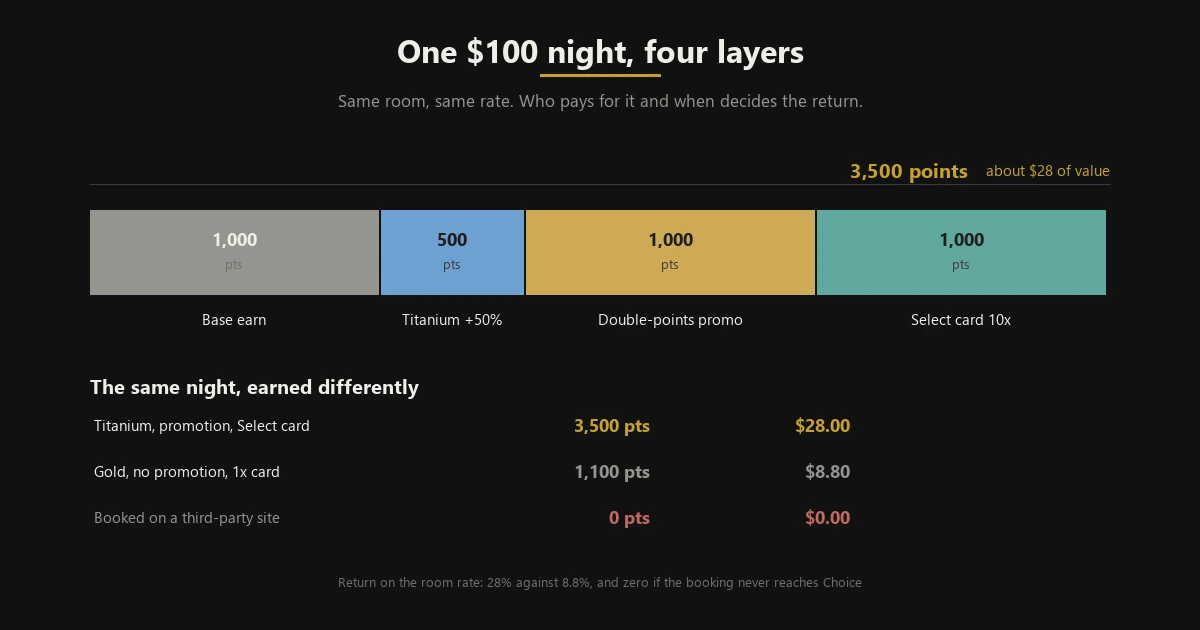
Total: 3,500 points, worth about $28 at 0.8 cents. That is a 28% return on the room rate, which is a different order of magnitude from the 8% most members see. The same night booked by a base member paying with a 1x card returns 1,100 points and $8.80.
The layers are not equally available. The elite bonus is a function of nights stayed, so it cannot be bought. The card multiplier is a function of which card is in your wallet, which is a decision you make once. The promotion layer is the only one that changes month to month, and it is the one most members miss because it requires registering before the stay rather than after. The current windows are collected in our list of every Choice Privileges promotion running in 2026.
One caveat on stacking: base points accrue on the room rate, while card points accrue on the amount charged. If you pay the room rate plus taxes plus a resort fee on the card, the card layer earns on the larger number. That is the only place where taxes help.
The two cards and how they divide the work
Both co-branded cards are issued by Wells Fargo and both earn on the same structure, at different rates. The no-fee version pays 5 points per dollar at Choice hotels and on points purchases, 3 points per dollar on fuel, groceries, home improvement and phone plans, and 1 point everywhere else. It also grants 10 elite night credits a year, which is enough for Gold without a single stay.
The Select version carries a $95 annual fee and doubles the hotel rate to 10 points per dollar, raises the everyday categories to 5, and pays a higher multiple on points purchases. Since 2026, qualifying card spend also counts toward elite qualifying credits and milestone credits, which changes the arithmetic for anyone who spends heavily but travels little.
The division of labour is straightforward. Use the Select card for Choice stays and for buying points, because 10 points per dollar on a points purchase is the cheapest points in the programme. Use the no-fee card as the card that keeps Gold alive in a year with no stays. Carrying both costs $95 and removes the need to think about either.
Because a points purchase is the cheapest way to add to a balance, the Select card’s higher multiplier on points purchases is worth more than the headline suggests: buy Choice points during the current bonus round and the card pays 10 points per dollar on the transaction, on top of the bonus points themselves.
Neither card is a good everyday spending card. At 0.8 cents a point, 5 points per dollar on groceries is a 4% return, which competes, but 1 point per dollar on everything else is 0.8%, which does not. Treat them as hotel cards and pair them with a cash-back card for everything that is not a hotel or a supermarket.
Promotions, packages and the app
Choice runs promotions almost continuously, and they are the cheapest points in the programme after a points sale. The structure is usually a stay-based bonus rather than a multiplier: two stays earning a fixed number of bonus points, or a per-night bonus over a defined window. Registration is required in advance and is the reason most members never receive them.
Bonus points packages are different: they are a paid add-on at booking, offering an extra 1,000, 2,000 or 5,000 points per night on top of the standard earn. Priced per night, they land near 0.8 cents a point, which is fair rather than good. Take them when the alternative is buying points at full price, and skip them when a bonus sale is running.
App bookings occasionally carry a flat bonus, usually 1,000 points, for booking inside the app rather than on the website. It is small, it stacks with everything else, and it takes one extra tap.
Point Accelerator is the one to avoid. It is offered at booking as a way to buy the points you are short of for the award, and the per-point price is well above what a bonus sale charges. If you are short of an award, topping up through a points purchase during a sale is the cheaper route by a wide margin: the price of Choice points right now is a published ladder, and it is almost always below the accelerator rate.
Buying and transferring: which one is cheaper
There are two ways to add a large block of points without staying: buy them, or move them in from a bank. Only one of them is priced sensibly.
Buying is capped at 180,000 base points per calendar year, with bonus points outside the cap. In a 40% bonus round the effective cost lands between 0.57 and 0.76 cents depending on how much you buy, because the bonus is tiered. That is the cheapest legitimate route to a Choice balance and it sets the floor for every redemption decision in the programme.
Transferring in is a different trade. Four banks move points to Choice, and every one of them takes a loss on the way.
| From | Ratio | Choice value received | Typical source value | Loss |
|---|---|---|---|---|
| Wells Fargo Rewards | 1 to 2 | 1.60 cents | 1.75 cents | About 9% |
| Citi ThankYou | 1 to 1.5 | 1.20 cents | 1.90 cents | About 37% |
| Capital One Miles | 1 to 1 | 0.80 cents | 1.85 cents | About 57% |
| American Express Membership Rewards | 1 to 1 | 0.80 cents | 2.00 cents | About 60% |
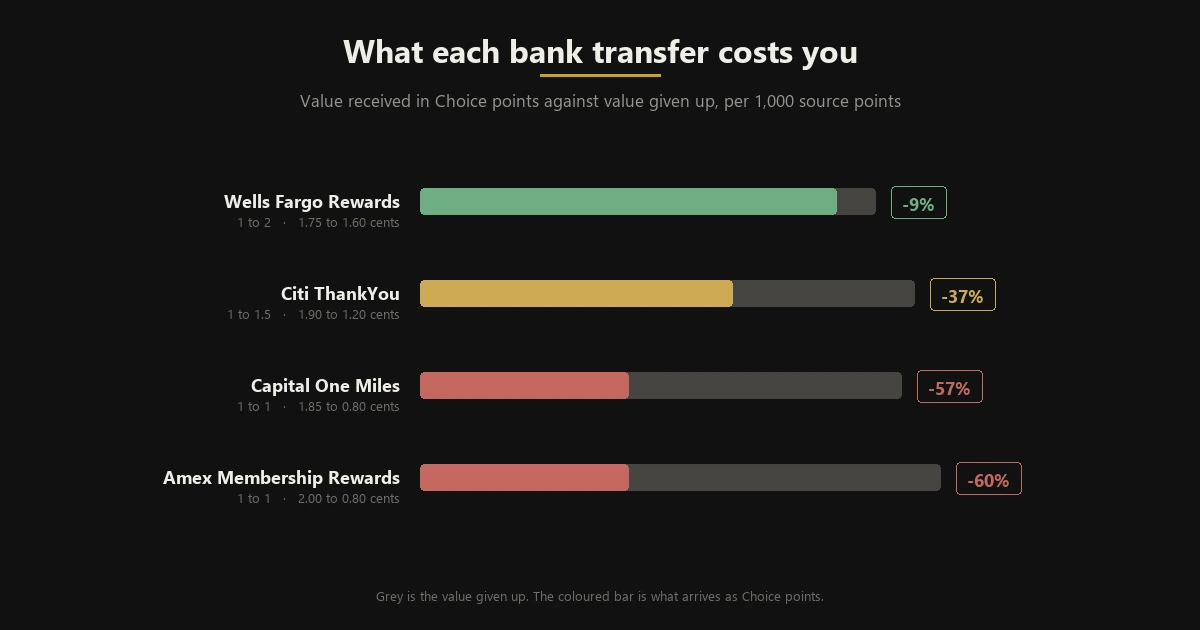
Amex is the worst of the four and the one most people reach for, because the transfer is instant and sits next to better-known partners on the same page. At 1:1 you hand over two cents of value to receive 0.8. The only scenario where that is rational is a specific award at 1.5 cents or better, booked immediately, where the alternative is paying cash. Anything vaguer than that is a donation.
If the goal is a bigger balance rather than a specific award, buying wins on every axis: cheaper per point, no loss of a more flexible currency, and a hard annual cap that stops the decision running away. Our price ladder for buying Choice Privileges points sets out the cost at each tier.
Partners, rental cars and sharing points
Partner earning is worth having and not worth engineering. Avis and Budget pay around 2,000 points per qualifying rental, which is roughly one award night for a booking you would have made anyway. Cruise bookings pay 5 points per dollar, the largest headline rate in the programme, and the reason to be careful: a 5-point rate on an overpriced cruise is still an overpriced cruise.
Points Sharing, launched in October 2026, is the more useful addition. Transfers between members are free, run from 5,000 to 100,000 points per transfer in multiples of 1,000, allow 200,000 points out and 100,000 in per member per calendar year, and land within about 24 hours.
The catch is the one that matters. A transfer is not qualifying activity. It does not extend the expiry clock, it does not count toward elite status, and it does not advance milestone progress. Moving points into an account that already has a forfeiture date does not save them; the recipient still needs independent activity before that date. Sharing is a way to consolidate a family balance before a booking, not a way to rescue points that are about to lapse.
For what the balance is then worth, the answer depends entirely on the night: what a Choice point is worth on a specific night is a division problem, not an average.
Six moves that waste the balance
1. Booking through an online travel agency. No points, no elite nights, no promotion credit, and no recourse when the hotel cannot find the reservation. The saving is rarely more than the points are worth.
2. Charging the room to a 1x card. On a $100 night that is 1,000 points left on the table, which is more than the stay itself earns at base rate.
3. Buying points outside a bonus window. The list price is around a cent a point against 0.57 to 0.76 in a sale. The difference on 50,000 points is roughly $150, which is more than the points are worth on a single award night. Check the official Choice points purchase page before you buy, because the tier you land in decides the price.
4. Using Point Accelerator to top up an award. Priced above every other route to the same points, and offered at the exact moment you are least inclined to compare.
5. Transferring Amex or Capital One points in. A 57% to 60% haircut for a currency that cannot do anything the original could not.
6. Paying for a bonus points package at a hotel you will never redeem at. Points earned at a property with no good award nights are points you will eventually spend badly.
Verdict
Earning Choice points well is not about finding a clever channel. It is about three decisions made once and one made every quarter. The three: hold the Select card for hotel spend, keep the no-fee card so Gold never lapses, and never book a Choice hotel through a third party. The one: register for every promotion before the stay, because that layer is worth more than the elite bonus and costs nothing but attention.
Do all four and a $100 night returns about 2,800 to 3,500 points depending on elite tier, worth $22 to $28. Skip them and the same night returns 1,100 points, or nothing at all if it was booked on the wrong site. That gap, roughly three to one, is the entire earning game in this programme.
What to do with the balance is a separate question, and a harder one. The answer is not the most expensive hotel on the list: it is the night where the cash rate has moved and the award level has not. That is covered in where Choice points return the most on a single night.
Frequently asked questions
How many Choice Privileges points do I earn per dollar?
Ten points per dollar of room rate on a qualifying stay, before taxes and fees. Elite members earn a bonus on top of that: 10% at Gold, 25% at Platinum, and 50% at Diamond and Titanium. A Titanium member therefore earns 15 points per dollar before any promotion or card multiplier.
Do I earn points booking through Expedia or Booking.com?
No. Third-party bookings earn no points, no elite night credits and no promotion credit, even when the rate is described as a Choice property. Book direct on the Choice website or app, or through a corporate channel that reports the stay to the programme.
Do all the rooms on one booking earn points?
Base points accrue on up to four rooms per night. Promotion bonuses and elite bonuses apply to one room only, so the second and third rooms earn at the base rate and nothing more. If several rooms are settled on a single master bill, none of them earn.
Can I earn points when my company pays for the room?
Yes, if you authorise the folio yourself at checkout. The exclusion is master billing, where multiple rooms are settled on one account, not corporate payment as such. A single room paid on a company card but checked out under your name earns normally.
Is it worth transferring Amex points to Choice Privileges?
Almost never. At 1:1 you give up points worth about 2 cents to receive points worth about 0.8 cents, a loss of roughly 60%. The only rational case is a specific award returning 1.5 cents or better that you book immediately, where cash is the alternative.
Does receiving shared points stop my points from expiring?
No. Points Sharing transfers are not qualifying activity, so they do not extend the expiry date, count toward elite status or advance milestone progress. The recipient needs independent activity, such as a stay, a redemption or a purchase, before the forfeiture date.
More Choice Privileges Guides
- Every Choice Privileges promotion live in 2026, with the registration deadline for each one.
- What Choice points cost at every bonus tier, and the price at which buying stops working.
- What a Choice point is worth on a specific night, rather than the industry average that answers nothing.
- Where Choice points return the most on a single night, and the four redemptions that quietly destroy value.
- Whether Choice elite status is worth chasing, tier by tier, with the bonus priced in dollars per night.
- how long earned points last, and the cheapest activity that keeps them alive.
- the partner channels that add to a stay, and the ones that replace the points entirely.
- the 22.5 points per dollar a card adds to a stay, on top of the base rate and the elite bonus.