Qatar Avios value is not one number, and the single figure most calculators publish — about 1.4 US cents — is the least useful one for deciding whether to redeem. It is a fine number for deciding whether to buy Avios. On the seat most people actually want, a Qsuite one-way between the United States and Doha, the same Avios return between 1.4 and 4.0 cents, and the difference is not the programme, the cabin or the date. It is the cash fare you would otherwise have paid.
The short version. 70,000 Avios plus about US$225 buys a US–Doha Qsuite seat off-peak, and 94,500 buys the same seat on a peak date. Against a published one-way business fare of US$3,000 that is 3.96 cents per Avios; against a consolidator fare of US$1,400 it is 1.68 cents. Qatar does not add a fuel surcharge to the award, but it does collect a carrier charge of roughly US$200 to US$250 on its own redemptions — and the same seat booked with AAdvantage miles carries about US$15 of tax instead. The Avios are identical. The desk is not.
Everything below is built from Qatar’s own award prices, its published route prices, the live carrier charges members report at checkout, and a set of cash fares measured on the same routes in November 2026.
At a glance
| Question | The number | What it means |
|---|---|---|
| Planning number | 1.4 US cents | What published valuations use; useful for deciding whether to buy |
| Floor | About 0.5 cents | Shopping, wine and gift cards — the redemptions nobody should make |
| Qsuite, US to Doha | 70,000 Avios off-peak, 94,500 peak | One way, plus about US$225 in carrier charges |
| What that returns | 1.4 to 4.0 cents | Set by the cash fare you would otherwise have paid |
| Best documented return | 3.1 cents | Cathay short-haul business, 22,000 Avios plus US$16 |
| Ceiling | Over 6 cents | First class, Doha to Sydney, against a US$6,000 cash fare |
A twelve-fold spread, by design
An Avios is not a currency with a rate. It is a discount voucher whose face value is set by whatever you point it at, and the range on Qatar is wide enough that any single average hides the decision. At the bottom, redeeming Avios for shopping, wine or gift cards returns about half a cent each. A short economy award on a cheap route returns around one cent. Long-haul economy sits near 1.3 to 1.9 cents, premium economy 1.9 to 3.2, long-haul business 3.2 to 5, and first class at the top of the range clears six. Doha to Sydney in first class is 95,000 Avios one way; against a US$6,000 cash fare that is (6,000 − 225) ÷ 95,000 × 100 = 6.08 cents, which is the arithmetic behind the ceiling.
The published estimates for November 2026 cluster between 1.0 and 1.45 cents. The Point Calculator uses 1 cent as its baseline and notes that premium cabins reach 2.2. Gast’s curated figure is 1.1. CreditPoints works at 1.4, InsideFlyer at 1.45. All of them are averaging the same thing: every redemption someone makes, including the bad ones. That is a reasonable thing to do when the question is “what is a point worth in general” and a misleading thing to do when the question is “is this seat worth 70,000 Avios”.
The twelve-fold spread is not a flaw in the programme. It is the entire business model. Qatar sells Avios to banks and to members at 1.44 to 2.80 cents, and buys them back at whatever a seat costs in Avios. The gap between those two numbers is why the programme exists, and why the value you get depends so heavily on which seat you take.
The formula, and the number everyone leaves out
There is only one honest way to price a redemption:
(cash fare you would have paid − cash fees on the award) ÷ Avios × 100
Take the US–Doha Qsuite seat. A published one-way business fare runs about US$3,000. The award costs 70,000 Avios and about US$225 in carrier charges at checkout. That is (3,000 − 225) ÷ 70,000 × 100 = 3.96 cents per Avios.
The subtraction is the step people skip, and it is not a rounding error. Qatar collects a carrier-imposed charge on its own awards that runs roughly US$200 to US$250 on a US–Doha business redemption, on top of government taxes. Ignore it and you overstate that seat by 0.3 cents per Avios. On a smaller award the same charge does far more damage: US$225 against 30,000 Avios is 0.75 cents of value gone before the flight.
Here is the part that has nothing to do with Avios. Qatar does not levy a fuel surcharge, and on a redemption booked with AAdvantage miles the cash outlay on the same seat is about US$15 on a US departure. Two programmes, one seat, one airline: US$225 against US$15. That US$210 is 0.3 cents per Avios on this redemption, and it is the single largest reason the same 70,000 points are worth more in one programme’s hands than the other’s.
Three prices for one seat
Qatar prices its own flights by route rather than by distance, with two levels and a flexible fare on top. Since 6 December 2023 those levels have been peak and off-peak, and the gap on the US–Doha route is 35%: 70,000 Avios off-peak, 94,500 at peak, with economy moving from 35,000 to 47,500 in step. The Flexi award, which allows changes the standard award does not, is priced at roughly double: 140,000 Avios off-peak on the same seat.
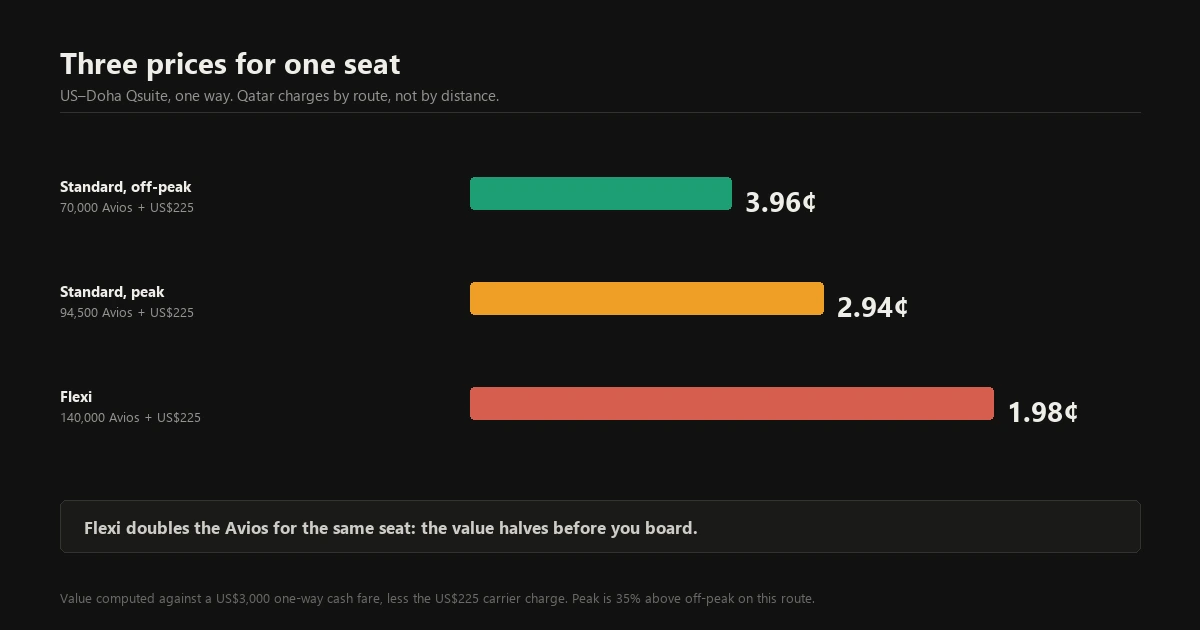
Put those three prices against the same US$3,000 fare and the value falls from 3.96 cents to 2.94 to 1.98 — halved, for a seat that is identical in the air. Nothing about the product changes between the three columns. The date does, and the change policy does.
This is where most “Qsuite for 70,000 Avios” advice quietly fails. The 70,000 price is real, but it is the off-peak price, and off-peak dates are the dates nobody else wanted. Award space opens 361 days ahead. If your travel is fixed to a school holiday or a December return, you are shopping at 94,500 and the value you were promised for the same Avios is roughly a quarter lower than advertised. Pricing the same route across a fortnight of dates is the fastest way to see which side of the line your trip falls on.
Qatar publishes no table, only a calculator that prices a specific date, which is why the numbers here are the ones observed on the routes rather than a chart you can read across.
The route prices matter for the same reason. From Doha, business class is 42,500 Avios to London, 42,500 to Bangkok, 50,000 to Singapore and 70,000 to Australia or New Zealand, with first class at 95,000 on the Australian routes. Per mile flown, the long sectors are the better buy: 70,000 Avios for 6,729 miles to New York is 10.4 Avios a mile, while 42,500 for the 3,240 miles to London is 13.1. The flat-looking long-haul price is where the value concentrates.
Your fallback fare sets the answer
Once the Avios price is fixed, the only remaining variable is the fare. And the fare is not one number either — it depends on who is buying.
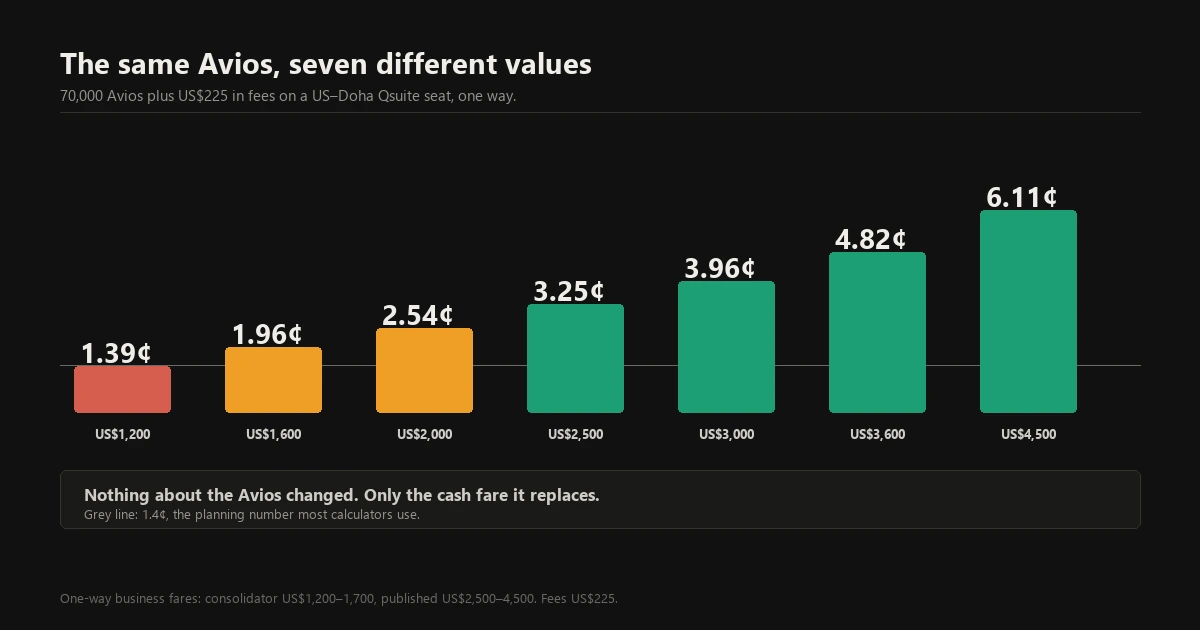
The published-fare buyer prices the seat at US$3,000 to US$4,500 one way and gets 3.96 to 6.11 cents. This is the number the miles blogs quote, and it is real, but it is the price of a fully flexible business ticket bought close to departure. Few of us were going to pay it.
The consolidator buyer pays US$2,400 to US$3,400 round trip from the East Coast, which is US$1,200 to US$1,700 one way, and gets 1.39 to 2.11 cents. That buyer is comparing 70,000 Avios and US$225 against a US$1,400 ticket, and the Avios are worth roughly what the calculators say — no more.
The buyer who would have flown economy gets neither number. If the alternative was a US$700 economy seat, the redemption does not save US$3,000; it upgrades a trip that was going to happen. The value is whatever the business cabin is worth to you over economy, which is a preference, not a price. This is the largest group of redeemers and the one best served by the 1.4-cent planning number.
So “is 70,000 Avios good for Qsuite” has no answer on its own. At a US$1,400 fallback it is fair value. At US$3,000 it is excellent. Against a trip you would not otherwise take, it is a discount on spending, not a return on an asset.
One currency, two price lists
Avios is one currency shared by Qatar, British Airways, Iberia and Finnair, and the balances move between them at 1:1 for nothing once the accounts are linked. What does not move is the price list. Each programme prices the same Qatar seat from its own chart, and adds its own cash charges.
Qatar’s own desk is usually the cheaper of the two that matter. In an AwardTool snapshot covering the 30 days to 22 November 2026, British Airways and Privilege Club both showed business-class space on 103 routes; Privilege Club needed fewer Avios on 53 of them, with a median advantage of 6,500 Avios. British Airways had the edge on dates, showing space on more departure dates on 65 of the 103 routes, and its booking window is the shorter of the two: 330 days against Qatar’s 361.
The cash side can be worse than the Avios side. British Airways applies carrier surcharges to partner awards, and Qatar does not. On a Cathay Pacific business seat between Seoul and Hong Kong, measured in May 2026 against a US$700 fare, the three desks looked like this:
| Booked with | Points | Cash at checkout | Value per point |
|---|---|---|---|
| Qatar Privilege Club | 22,000 Avios | US$16 | 3.1 cents |
| British Airways Club | 32,500 Avios | US$101.50 | 1.8 cents |
| Asia Miles | 27,000 miles | US$66 | 2.4 cents on the same fare |
Same seat, same day, same alliance. The Qatar desk charged 10,500 fewer Avios and US$85 less cash than the British Airways desk, which is the difference between a 3.1-cent redemption and a 1.8-cent one. Asia Miles is not Avios and cannot be pooled with it, but it is in the table because it is often the default suggestion for Cathay flights and it lands in the middle.
There is a practical catch. Not every bank programme can send points straight to Qatar. Amex Membership Rewards and Capital One transfer to both programmes; Chase Ultimate Rewards and Wells Fargo can only reach Avios through British Airways; Citi ThankYou transfers to Privilege Club but not to BA. If your points are at Chase, you are booking through the British Airways desk whether you like it or not, unless you first move the Avios from BA to Qatar after they land — which is allowed, free, and instant, but only helps if the seat is priced on Qatar’s chart rather than BA’s.
Where the best redemptions hide
Qatar’s partner awards are priced on the distance of the whole itinerary rather than by route, and they do not carry the carrier charge that Qatar’s own flights do. That combination produces the best cents-per-Avios figures in the programme, and the least availability.
Two bands are worth memorising. Under 650 miles, economy is 6,000 Avios and business 12,500. Between 1,152 and 2,000 miles, economy is 11,000 and business 22,000. On a US$700 business seat inside Asia, 22,000 Avios plus US$16 is 3.1 cents; on a US$350 regional business seat, 12,500 Avios plus tax is closer to 2.7. American Airlines, Alaska Airlines and Royal Jordanian are priced separately from the rest of the oneworld table, which is why some partner searches return a different number than the chart suggests.
One more lever sits between the two. Qatar runs monthly Privilege Deals that discount selected awards, reported at up to 25% off, on itineraries that begin or end in a chosen city. They do not change the chart; they discount the price on specific dates, and they are listed on the Privilege Deals page rather than in the award search.
Partner space is the constraint, not the price. Qatar releases its own seats generously, especially on new and restored routes — the Philadelphia–Doha restart in August 2026 put 70,000-Avios business seats into the market through spring 2027 — while partner cabins on Cathay, Japan Airlines and Qantas appear in smaller windows. A 3.1-cent redemption that only exists on two dates a month is worth less in practice than a 2-cent redemption you can actually book.
That asymmetry is the argument for booking early rather than shopping for value: day −360 on the right aircraft is where the 3-cent redemptions actually come from, and the calendar opens once.
Four things that quietly cut the number
Peak dates. The 35% uplift on US–Doha is the difference between 3.96 and 2.94 cents on an unchanged fare. Qatar does not publish a simple calendar, so the only way to see it is to price the same route across dates in the award search.
Flexi awards. Double the Avios for change flexibility, and 1.98 cents on a US$3,000 fare. Buy a refundable cash fare or accept the US$25 change fee on a standard award instead; the Flexi premium is more expensive than either.
The carrier charge, per segment. The US$200 to US$250 figure is for a nonstop. A connecting itinerary through Doha to the Maldives or Seychelles adds cash, and the same 70,000-Avios seat can carry US$350 of charges once there are two sectors. The charge is not proportional to the Avios, so it hurts short awards most.
Buying at 2.80 cents to redeem at 1.4. The standard purchase price is double the planning value of an Avios. Anyone who tops up at the standard price to reach an award is paying roughly two cents for something worth one and a half, and the loss is locked in the moment the Avios land.
When buying at 1.44 cents is a trade
Buying Avios is not a valuation question, it is a spread. Qatar’s sale price in a 60% round is 1.44 cents, and the same Avios return 3.96 cents on an off-peak Qsuite seat against a published fare. That is a positive trade of about 2.5 cents per Avios, and it is the only version of this arithmetic that works.
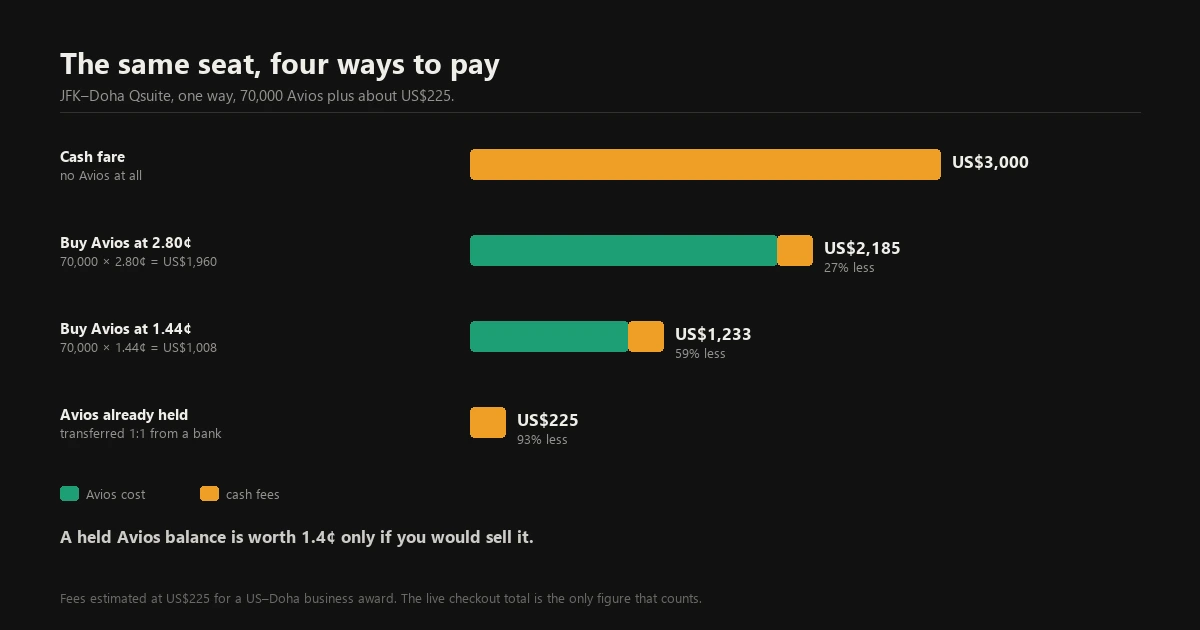
Three conditions have to hold at once. The seat has to be confirmed and bookable before you buy, because Avios purchases are non-refundable and the award space is the scarce part. The redemption has to clear roughly twice the purchase price, which means business class or better, not economy. And the purchase has to sit inside the 250,000-Avios annual cap, which is shared with gifting and transferring and resets on 1 January.
If the seat is at 1.4 cents — economy, a partner award, a short hop — buying Avios to reach it destroys value no matter how good the bonus looks. The full ladder, the cap and the sale history are in the buying guide linked below; the point here is that 1.44 cents is a cost, not a value, and the two should never be confused.
Verdict
Use 1.4 cents to decide whether to buy Avios and 3 cents to decide whether to redeem them. Anything below 2 cents is a redemption you make because you want the trip, not because the Avios are working. Qsuite off-peak against a published fare is the one place in this programme where the number is genuinely above 3.5, and it is available if you book early, travel in the off-peak windows, and accept that the seat is the scarce good rather than the Avios.
Three rules cover most of it. Price the seat in cash before you price it in Avios, because the cash fare is the only variable you control. Subtract the carrier charge every time, because on a US–Doha business award it is worth 0.3 cents per Avios and on a short award it is worth far more. And check both desks before you transfer, because the two desks differ by a median of 6,500 Avios on the routes they share.
What is not worth doing is holding Avios as an asset. They expire after 36 months of inactivity, they do not earn interest, and their value falls whenever Qatar reprices a route or a peak window widens. An Avios balance is a discount waiting to be spent, and the only number that matters is the one attached to a seat you are actually going to sit in.
How the number has moved
| Date | What changed | Effect on value |
|---|---|---|
| 6 December 2023 | Peak and off-peak pricing introduced on Qatar-operated awards | Peak dates cost 20–36% more Avios for the same seat |
| 2024–2025 | Published valuations settle between 1.0 and 1.45 cents | The planning number becomes 1.4 |
| December 2025 | British Airways raises its own award prices | Qatar-operated awards booked through Privilege Club are unaffected |
| June 2026 | Qatar route table verified at 70,000 off-peak to North America | No repricing announced through 2026 |
| November 2026 | Standard purchase price 2.80 cents; last 60% sale ended 19 October at 1.44 | The cost floor sits above the value of most redemptions |
Last updated: 28 November 2026. Award prices verified against Qatar Airways Privilege Club’s award search and route prices on that date; carrier charges vary by route, cabin and date and the checkout total is the only authoritative figure. Cash fares are one-way business fares observed on the same routes in November 2026.
Frequently asked questions
How much is one Qatar Avios worth?
About 1.4 US cents as a planning figure, but the range is 0.5 to over 6. On a US–Doha Qsuite seat at 70,000 Avios plus US$225, one Avios returns 3.96 cents against a US$3,000 one-way fare and 1.68 cents against a US$1,400 consolidator fare. The Avios do not change between those two answers; the fare does.
Are Qatar Avios worth more than British Airways Avios?
They are the same currency and transfer 1:1 for free, but the two programmes price the same Qatar seat differently. In a 30-day snapshot to 22 November 2026, Privilege Club needed fewer Avios on 53 of 103 shared business routes, with a median advantage of 6,500 Avios, and it does not add the carrier surcharge that British Airways applies to partner awards.
How many Avios is Qsuite from the United States?
70,000 Avios one way off-peak and 94,500 at peak, plus about US$225 in carrier charges on a Privilege Club redemption. The Flexi version of the same seat is 140,000 off-peak. Economy on the same route is 35,000 off-peak and 47,500 at peak.
What are 100,000 Avios worth?
At the 1.4-cent planning number, US$1,400. Spent on a Qsuite seat it is worth more: 100,000 Avios covers a 70,000-Avios off-peak award plus 30,000 toward a second, and against a US$3,000 fare the first seat alone returns about US$2,775 of value after fees. Spent on shopping or gift cards the same balance is worth about US$500.
Do Qatar Avios expire?
Yes. Avios expire 36 months after the last earning or spending activity, and any earn or redemption resets the clock. Platinum members are exempt. Buying Avios counts as activity, so a purchase resets the window like any other transaction.
Is it worth buying Avios to book Qsuite?
Only when the seat is confirmed first. At the 1.44-cent sale price, 70,000 Avios cost about US$1,008 and return roughly US$2,775 of fare value after fees — a trade worth making. At the 2.80-cent standard price the same Avios cost US$1,960, the margin shrinks to about US$800, and the purchase stops being obviously better than paying for the ticket.
More guides
- What bank transfers cost in points, and when the bonus actually helps
- Why unspent Avios disappear, and the second timer on bought balances
- Qpoints: the status meter that never converts to Avios
- Linking Qatar to British Airways, and the two-hop routes beyond it
- Buying Qatar Avios: the six-tier ladder and the 250,000 cap
- Qatar Airways Privilege Club promotions, ranked by what each one is worth
- Every bank and hotel transfer ratio, priced in cents per mile
- Buying miles and points: the official links and when the maths works
- Airline alliances explained, and why Avios moves between four programmes
- AAdvantage promotions and the partner awards they unlock
Next step
Price the seat, then the Avios. Price your own route in Qatar’s Avios calculator, open the booking flow to see the full cash total at checkout, and divide the fare you would have paid by the Avios it costs. If the answer is under 2 cents, book the cash fare and keep the balance.