The short version. Qatar Avios expiry is not a schedule, it is a silence: 36 consecutive months with no earning and no spending, and the entire balance goes at 00:01 Doha time on the anniversary of your last transaction. One Avios is enough to stop it — earned, spent, bought or gifted. Two complications sit underneath that rule. Bought and transferred Avios carry a fixed three-year life of their own, and Platinum members are told their Avios never expire, a promise that appears on the benefits page and nowhere in the terms.
At a glance
| Question | The answer |
|---|---|
| How long before Avios expire? | 36 consecutive months with no earning and no spending |
| What expires | The entire balance, not the older batches |
| The exact moment | 00:01 Doha time, 36 months after your last transaction |
| Minimum activity | One Avios, earned, spent, bought or gifted |
| Platinum members | No expiry, if the tier is held on the expiry date |
| Rescue route | Revalidate within 12 months at US$0.015 per Avios |
| The only warning | An email to the address on file, before the date |
The clock belongs to the account
Qatar runs two reward currencies on two completely different expiry models, and confusing them is the most expensive mistake in the programme. Qpoints — the status meter — die individually, 365 days after each one lands, whether or not you are active. Avios do the opposite: nothing expires while you are active, and then everything expires at once. We covered the Qpoint side in how Privilege Club status is priced in Qpoints.
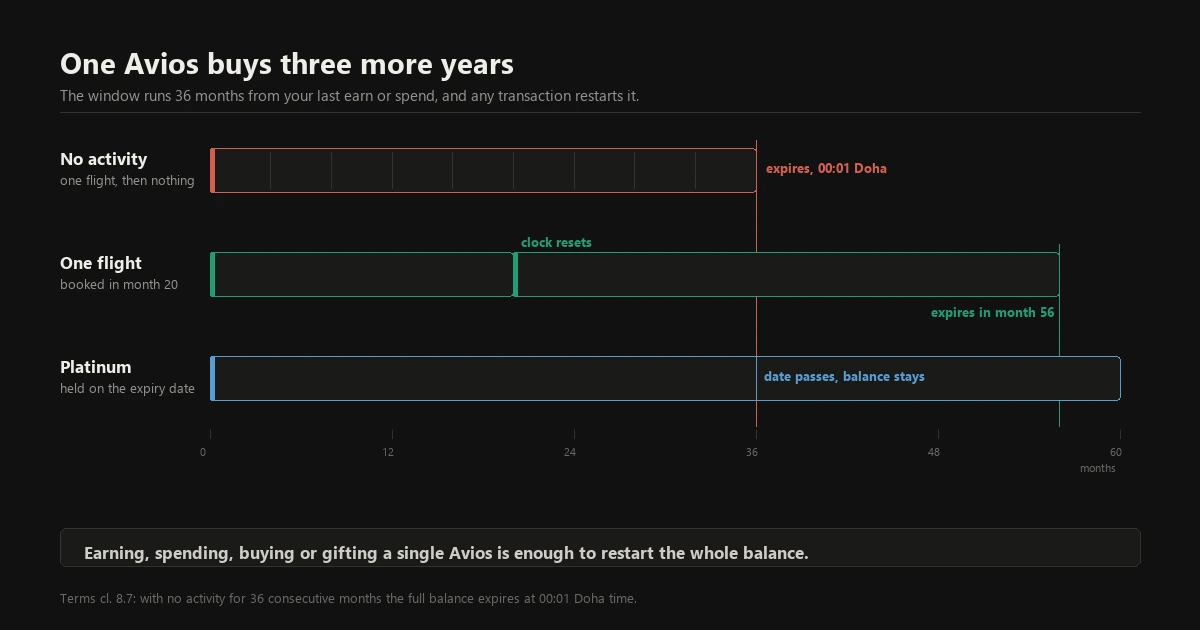
The terms define an Avios Expiry Date as thirty-six months from the last date of accrual or redemption activity by the member. Clause 8.7 then spells out what that means in practice: with no activity for 36 consecutive months, the whole balance expires as of that date. The worked example in the terms is worth reading twice, because it shows how the clock is anchored:
A member who performs an accrual or redemption activity on 2 January 2021, and does nothing further, has their Avios expire on 2 January 2024 at 00:01 Doha time.
So the date is not a fixed anniversary of joining, and it is not the date the Avios were earned. It moves every time you do anything that earns or spends Avios, and it stands still when you do nothing. A member with 240,000 Avios and no activity since 2023 does not have 240,000 Avios. They have an expiry date.
The worked example also shows how little room the final day leaves. Thirty-six months from 2 January 2021 is 2 January 2024, and the expiry is processed a minute after midnight on that date, so the last full day in which to act was 1 January. A flight booked for 2 January, or a partner transaction that posts on 3 January, arrives after the balance has already gone. This is why the deadline is better treated as the end of month 35 than the start of month 36.
What restarts it
Qatar states the rule in one sentence on its Avios page: your Avios will never expire if you collect, spend, buy or gift at least one Avios every 36 months. Four verbs, one Avios. That is a much lower bar than most members assume, and it is the single most useful fact in this guide — the cost of keeping a balance alive is close to zero, while the cost of losing it is the whole balance.
| Action | Restarts the clock | Notes |
|---|---|---|
| Flying Qatar Airways, oneworld or a partner airline | Yes | Credits at check-in, up to two hours before departure |
| Booking an award seat or an upgrade with Avios | Yes | Spending counts exactly like earning |
| Paying part of a fare with Cash + Avios | Yes | Any Avios component is a redemption |
| Paying for a seat or extra bag with Avios | Yes | The smallest genuine spend is enough |
| Shop and Pay with Avios at Qatar Duty Free | Yes | Paying cash there does not count |
| Hotel, car rental or shopping portal earning | Yes | One Avios is the threshold, not a spend level |
| Buying Avios | Yes | Qatar lists buying alongside earning |
| Gifting Avios to another member | Yes | Gifting out counts |
| Transferring Avios to British Airways | Yes | A transfer out is spending; BA’s rules take over on arrival |
| Revalidating previously expired Avios | Yes | The terms treat it as new activity |
Two details in that table matter more than the rest. The first is the check-in timing: Avios credit when you check in, not when you land, so checking in for a flight on the day before your balance is due to expire still saves it. The second is that the threshold is one Avios. A single hotel stay booked through a partner, a rounded-up portal purchase, a duty-free transaction part-paid with Avios — any of those resets a six-figure balance. Members who lose Avios almost never lose them because the rescue was expensive. They lose them because nobody looked for three years.
If your balance is large and your calendar is empty, the cheapest reset is a partner transaction rather than a purchase: the earn Avios page lists every partner that posts to an account, including the ones that credit in days rather than weeks.
What does not
The terms define a transaction as any activity that results in a member earning or spending Avios. Everything else is not activity, however much it feels like engagement with the programme.
Signing in and checking your balance. No. Neither is updating a profile, changing a password, or downloading the app. This trips up members who came from programmes where a login kept the account warm; Qatar’s definition is transactional, not behavioural.
Holding status. No, with the Platinum exception covered below. A Silver or Gold tier does not protect a balance, and letting Qpoints expire changes nothing about Avios.
Earning Qpoints without earning Avios. Rare, but it exists at the edges of the programme: an activity that posts status credit but no Avios does not reset an Avios clock. The test is always whether the Avios line in your statement moved.
Spending cash with Qatar. A duty-free purchase paid in cash, an extra bag bought with a card, a seat paid for in dollars — none of these earn Avios, so none of them count. The same transaction part-paid with Avios does count.
The Platinum exemption is tested on the last day
Qatar’s benefits comparison gives Platinum one entry that no other tier has. The row is labelled No Avios expiry, and the note behind it reads: your Avios will not expire as long as you retain the Platinum tier at the time of Avios expiry.
That is a genuine benefit and a narrowly worded one. The test is not whether you were Platinum for most of the three years. It is whether you are Platinum on the expiry date itself. A member who holds Platinum for 34 months and drops to Gold in month 35 has an ordinary, expiring balance in month 36.
There is a second oddity worth knowing before you rest a large balance on that sentence. The Privilege Club terms contain no tier exemption at all. Clause 8.7 opens with “by default, if a member has no activity for thirty-six consecutive months” and applies to every member; clause 8.8 then offers paid revalidation to any member who has lost Avios. Nowhere in the contract does Platinum appear as an exception. The promise lives on a marketing page, in one row of a comparison table.
Our reading is that the exemption is real but should be treated as a bonus rather than a plan. If you hold Platinum, keep one small transaction a year anyway: it costs almost nothing, it makes the argument moot, and it protects you against the month you drop a tier by accident — which is exactly the month the clause is tested.
The second clock: bought and transferred Avios
Everything above describes Avios you earned by flying. Avios you acquire are different, and this is the part most guides skip. Clause 9.4 says purchased, gifted and boosted Avios are valid for three years and will expire as set out in clause 8.7. Clause 10.2 says transferred Avios are valid for three years, with a single exception for transfers on the death of a main member.
Read plainly, that gives those Avios a fixed life measured from the transaction, with the inactivity rule layered on top. Two clocks then run at once, and the earlier date wins. Your account clock resets every time you fly. The batch clock does not: a purchase made in January has a January deadline three years later, and flying every month for those three years will not move it.
| Account clock | Batch clock | |
|---|---|---|
| Starts on | Your last earn or spend | The purchase, gift or transfer |
| Length | 36 months | 36 months |
| Restarted by activity | Yes, every time | No |
| Applies to | Avios you earned by flying or spending | Avios you bought, were gifted, boosted or were transferred |
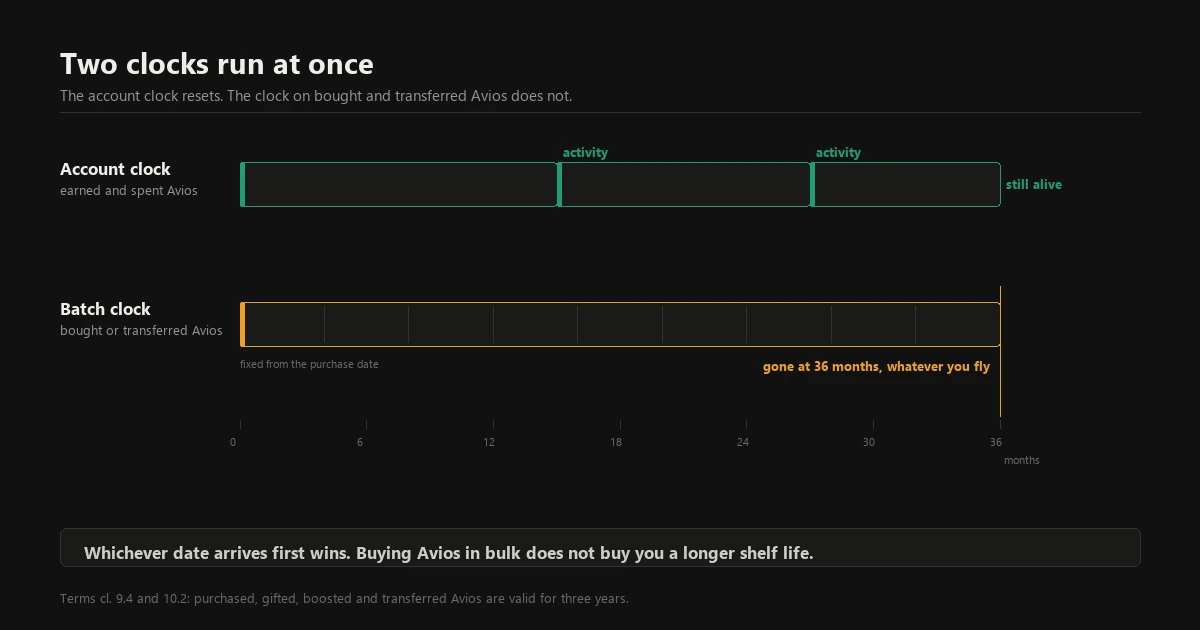
The practical consequence is about bulk buying. A member who buys 200,000 Avios in a sale for a trip two years out is fine. A member who buys the same balance and then waits five years has bought a deadline, not a balance — and the deadline is invisible, because the account shows a healthy number right up to the morning it shows zero.
Boosted Avios follow the same rule, which surprises people who assume a multiplier purchase behaves like a bonus. It does not: it is a batch with a three-year label. Transfers are the same, including Avios arriving from British Airways.
Family Programme: one clock for everyone
A Family & Friends group can hold up to nine members besides the main member, and everything those members earn pools into the main member’s account. That structure has an expiry consequence that is genuinely useful: the pooled balance has one expiry date, and it is the main account’s.
Because a group member’s flight posts into the main account, it counts as activity on that account. So one family flight every three years keeps the entire pooled balance alive — not just the Avios that flight earned. A household that spreads flying across four people, none of whom flies often, is in a stronger position than a solo member with the same total flying.
Two further details from the terms. Group members earn at the main member’s tier, so the family’s tier bonus is set by whoever holds the highest status. And if a group member dies, the Avios they earned remain in the main member’s account rather than being forfeited. What a group member does not have is an expiry date of their own, because their Avios are not sitting in their account to begin with.
Revalidation: US$0.015 a point
Expiry is not quite final. Clause 8.8 gives you one year after the Avios Expiry Date to revalidate expired Avios on payment of a non-refundable fee, and says revalidated Avios are valid for 36 months from the date of revalidation because the revalidation counts as new activity on the account. Qatar publishes the price on its Avios page: US$0.015 per Avios.
That is 1.5 US cents per Avios, which is above the 1.4 cents our Avios valuation treats as the buying line. Put differently: rescuing a balance costs slightly more than the balance is worth at the margin. Rescuing 100,000 Avios costs US$1,500 and returns about US$1,400 of value at our number, before you have found a seat.
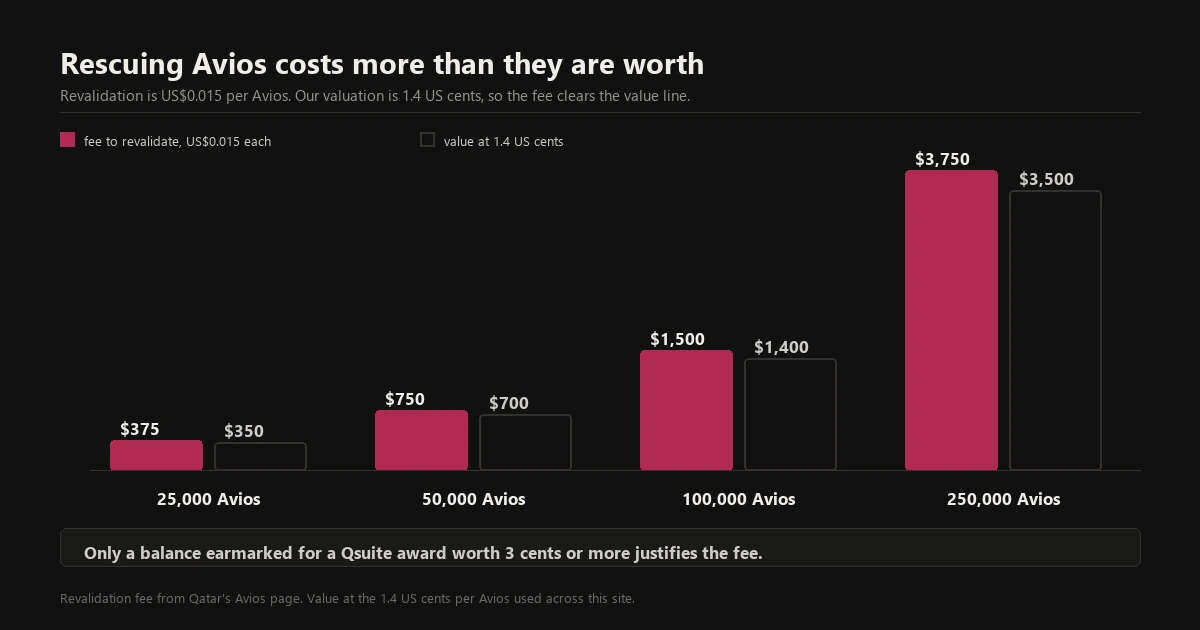
So revalidation is a tool for one situation only: a balance already earmarked for a specific award that returns well above 1.5 cents per Avios. A long-haul Qsuite redemption at three to four cents clears that bar comfortably. A vague intention to use the Avios eventually does not, and paying US$1,500 to keep US$1,400 of purchasing power is not a rescue, it is a purchase at a bad price.
The cheaper options come first, in this order. Make one partner transaction before the date and nothing expires at all. If you would rather pay than hunt for a partner, buying also counts — it is one of the four verbs — and the buy, gift and transfer page sells in small increments, so a token purchase resets the clock for far less than the rescue fee. The catch is the batch clock: what you buy starts its own three-year countdown, so buying to stay alive quietly builds a pile of expiring batches. If the date has already passed, check whether the balance is worth more than the fee for a redemption you can actually book, and only then pay.
Five ways people still lose them
The email went nowhere. Clause 8.7 promises reasonable steps to notify you at your registered address before the date, and that is the entire warning system. Members who changed email addresses, or filtered airline mail into a folder they never open, find out at the airport.
The account was closed at the same moment. Clause 6.4 allows Qatar to terminate a membership after 36 consecutive months of inactivity — the same 36 months that expires the Avios. The terms do not say the one-year revalidation window survives a closed account, so the paid rescue route is not something to count on if you have been silent for three years.
They were inherited. Avios transferred after the death of a main member keep their original expiry date; clause 6.5 is explicit that the transfer does not affect the Avios Expiry Date. An estate that takes a year to settle can hand over a balance with months left on it.
They watched the wrong clock. A member who flies monthly assumes nothing can expire. Then a batch of purchased Avios reaches its third birthday and disappears while the account is as active as ever.
They counted on Platinum and dropped a tier. The exemption is tested on the expiry date. Missing a renewal by a month, or letting a tier lapse while the balance was parked, converts a protected balance into an ordinary one overnight.
How to work out your date
The date is defined by the terms rather than set by a calendar, so it is worth working out yourself. Open the Avios statement, find the most recent line that earned or spent Avios, and add 36 months. The cut-off is 00:01 Doha time on that date — Arabian Standard Time, UTC+3, with no daylight saving — which lands on the previous calendar day for members in the Americas.
Then diarise month 30 rather than month 36. Six months of slack covers the slowest partner posting, which can take six weeks, and it leaves room to fix a mismatch in the name on a booking if a retro claim is needed. Members who act at month 35 discover that the cheapest fixes are all slower than the deadline.
If the balance is large and there is no travel planned, the honest answer is that the date should never be allowed to matter. Set a reminder two and a half years out, make one small partner transaction, and repeat.
Verdict
Avios expiry is the most forgiving rule in the programme and the most expensive one to discover late. Thirty-six months of silence wipes the whole balance, but a single Avios undoes it, and almost every member who loses Avios had a free fix available for three years.
Treat the balance as a deadline rather than an asset. Keep one transaction every 30 months, buy Avios only when the trip is inside two years, and assume the batch clock is running on everything you bought or received. If you hold Platinum, enjoy the exemption but do not build a plan on one line of a benefits table that the contract does not repeat.
And if the date has already passed, do the arithmetic before paying the fee. At 1.5 cents a point, revalidation only makes sense for a redemption you can name, price and book inside the next three years.
Last updated: 28 November 2026. Expiry rules, revalidation pricing and tier benefits checked against Qatar Airways Privilege Club pages and the Privilege Club terms and conditions on that date. Clause numbers refer to the terms as published then.
Frequently asked questions
Do Qatar Avios expire?
Yes. Thirty-six consecutive months with no earning and no spending expires the entire balance at 00:01 Doha time on the anniversary of your last transaction. The rule is in clause 8.7 of the Privilege Club terms, and the clock is anchored to your last activity rather than to when the Avios were earned.
How much do I need to earn to keep them alive?
One Avios. Qatar’s own wording is that Avios never expire if you collect, spend, buy or gift at least one Avios every 36 months. Flying, an award booking, a seat paid with Avios, a hotel stay through a partner, a purchase, a gift or a transfer all qualify.
Do purchased Avios expire after three years?
That is what the terms say. Purchased, gifted and boosted Avios are valid for three years, and transferred Avios likewise, with the inactivity rule layered on top. In practice the earlier of the two dates applies, so buying Avios does not extend the life of the batch you bought.
Does Platinum status stop Avios expiring?
Qatar’s benefits page says Avios will not expire as long as you retain Platinum at the time of Avios expiry, and the comparison table lists no Avios expiry for Platinum only. The terms themselves contain no tier exemption, so the test appears to be your tier on the expiry date rather than across the three years.
Can I get expired Avios back?
Within one year of the expiry date, yes, at US$0.015 per Avios. Revalidated Avios run for 36 months from the revalidation and count as new activity. At 1.5 cents a point the fee is above our 1.4-cent valuation, so it only pays for a redemption worth more than that.
Does transferring to British Airways reset the clock?
A transfer out is spending, so it resets your Qatar clock. The Avios then sit under BA’s rules, and any batch you transfer in is valid for three years under clause 10.2 regardless of how active your account is.
More guides
- Bank transfers reset the expiry clock and start a fresh three-year batch
- Qatar Airways Privilege Club promotions, ranked by what each one is worth
- Qpoints and status: what each Privilege Club tier costs
- What an Avios is worth, and the fare it has to beat
- Booking Qsuite with Avios: the seat, the window, the aircraft
- Moving Avios in and out of Qatar: what the transfer rules allow
- Buying Qatar Avios: the six-tier ladder and the 250,000 cap
- Every bank transfer ratio, priced in cents per mile
Next step
Check the date before you check the fare. If your statement shows no activity since 2023, spend a small slice now rather than rescue the whole balance later: an award seat booked with Avios resets the clock and uses the balance at the same time.