The short version. Qatar Privilege Club status runs on Qpoints, and Qatar sells them by the point: US$25 each, capped at half of every tier, with every Qpoint dead 365 days after it lands. That one sentence settles most of the questions people ask about the programme — whether to buy, when to buy, and which tier is worth chasing. Gold is the one that changes a trip, because it is the first tier that opens oneworld lounges. Silver is a Qatar-only product. Platinum is a better Gold with an Avios-expiry exemption most members never use.
At a glance
| Question | The answer |
|---|---|
| Tiers | Burgundy, Silver, Gold, Platinum |
| Upgrade targets from 19 December 2026 | 150, 300 and 600 Qpoints within 12 months |
| Retention from 19 December 2026 | 135, 270 and 540 over 12 months, or 270, 540 and 1,080 over 24 |
| Qatar-metal rule | 20% of your Qpoints, or four Qatar Airways flights in 12 months |
| Life of a Qpoint | 365 days from the date it is credited, to the minute |
| Price of a Qpoint | US$25, and no tier can be more than half bought |
The ladder: four tiers, two currencies
Privilege Club has four tiers and two currencies, and the split is the source of most confusion. Avios is money: you earn it, pool it, transfer it and spend it on seats. Qpoints are a meter: they exist only to decide which tier you hold, they cannot be spent, and they cannot be given away.
If you do not already hold an account, join Privilege Club before the next Qatar flight rather than after it: Qpoints only post to a membership number that was on the booking, and retro-claims are a separate fight. Burgundy is the joining tier and carries no alliance status at all. Silver is oneworld Ruby, which sounds grander than it is: Ruby buys priority check-in, priority boarding and priority standby, but it does not open a single oneworld lounge. The lounge a Silver member uses at Doha is Qatar’s own, and the 15kg baggage boost, the 25% Avios bonus and the 20% seat-selection discount all apply to Qatar-operated flights rather than to the alliance.
Gold is the hinge. It is oneworld Sapphire, which is the level that opens Business Class lounges across the alliance — British Airways, Cathay Pacific, Japan Airlines, Iberia, Qantas, the lot — with one guest. It also brings 40 Qcredits, a 75% Avios bonus and a 20kg baggage boost. Platinum is oneworld Emerald: First Class lounges where they exist, 60 Qcredits, 25kg, a 100% bonus, and the one genuinely unique perk in the programme, which is that Avios stop expiring while you hold the tier.
| Benefit | Silver | Gold | Platinum |
|---|---|---|---|
| Avios tier bonus | 25% | 75% | 100% |
| Extra baggage | 15kg or one piece | 20kg or one piece | 25kg or two pieces |
| Lounge at Hamad International | Member only | Member plus one guest | Member plus two guests |
| One-visit guest passes a year | 2 | 4 | 5 |
| Qcredits per tier year | None | 40 | 60 |
| oneworld status | Ruby | Sapphire | Emerald |
| Award change and cancellation fees | Standard | Waived | Waived |
| Avios expiry | 36 months of inactivity | 36 months of inactivity | Never, while Platinum |
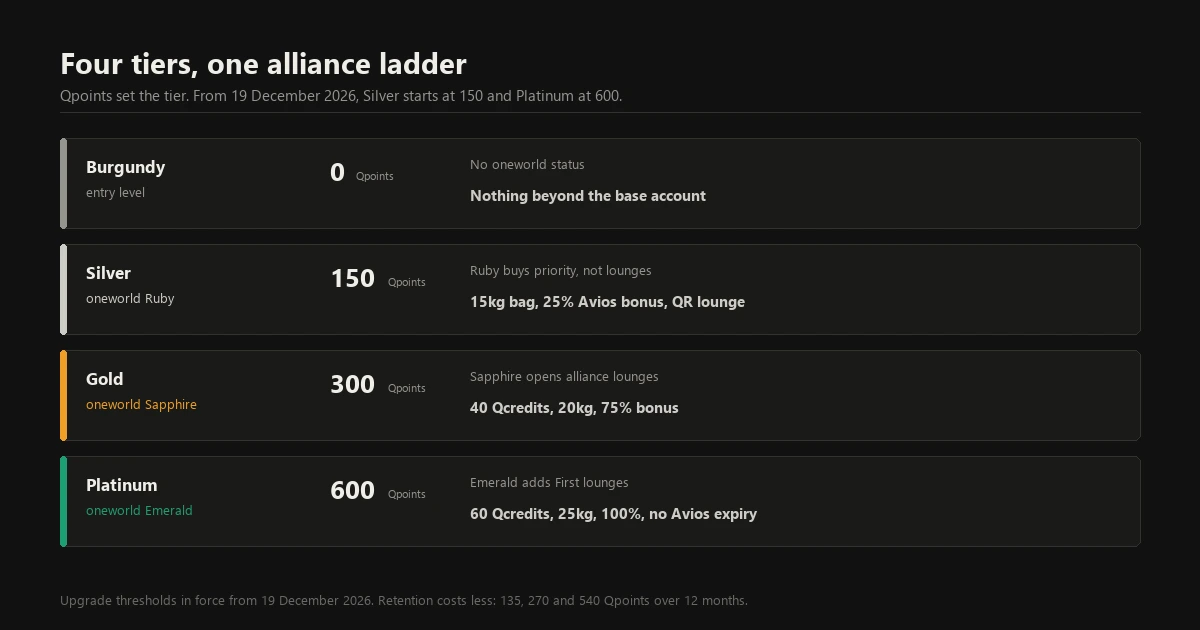
The tier bonus is worth understanding before you value any of this, because it is narrower than it reads. The 25%, 75% and 100% figures apply to Avios earned on flights marketed and operated by Qatar Airways, calculated on distance flown. They do not lift the Avios you earn on British Airways, and they do not touch Qpoints at all. A Platinum member flying BA earns exactly the same Qpoints as a Burgundy member on the same ticket.
The numbers move on 19 December
Qatar cut its qualification targets on 1 June 2026 and published an end date for the cut at the same time. From 19 December 2026 the standard numbers return: 150 Qpoints for Silver, 300 for Gold and 600 for Platinum, all measured over any 12-month window. Until 18 December the same tiers cost 135, 270 and 540.
Everything in this guide uses the numbers that apply from 19 December, because that is the schedule any qualification window closing after mid-December will be measured against. If your window closes before then, the lower figures still apply — the official page ties the reduced retention thresholds specifically to tiers expiring on or before 18 December 2026.
| Target | Until 18 December 2026 | From 19 December 2026 |
|---|---|---|
| Upgrade to Silver, 12 months | 135 | 150 |
| Upgrade to Gold, 12 months | 270 | 300 |
| Upgrade to Platinum, 12 months | 540 | 600 |
| Retain Silver, 12 months | 110 | 135 |
| Retain Gold, 12 months | 225 | 270 |
| Retain Platinum, 12 months | 450 | 540 |
| Retain any tier, 24 months | 270 / 540 / 1,080 | 270 / 540 / 1,080 |
The 24-month column did not move, which is convenient if your renewal falls in early 2027: the fallback route still asks for 270, 540 or 1,080 Qpoints depending on the tier.
Qpoints are not Avios
Four differences do the work, and each one has a practical consequence.
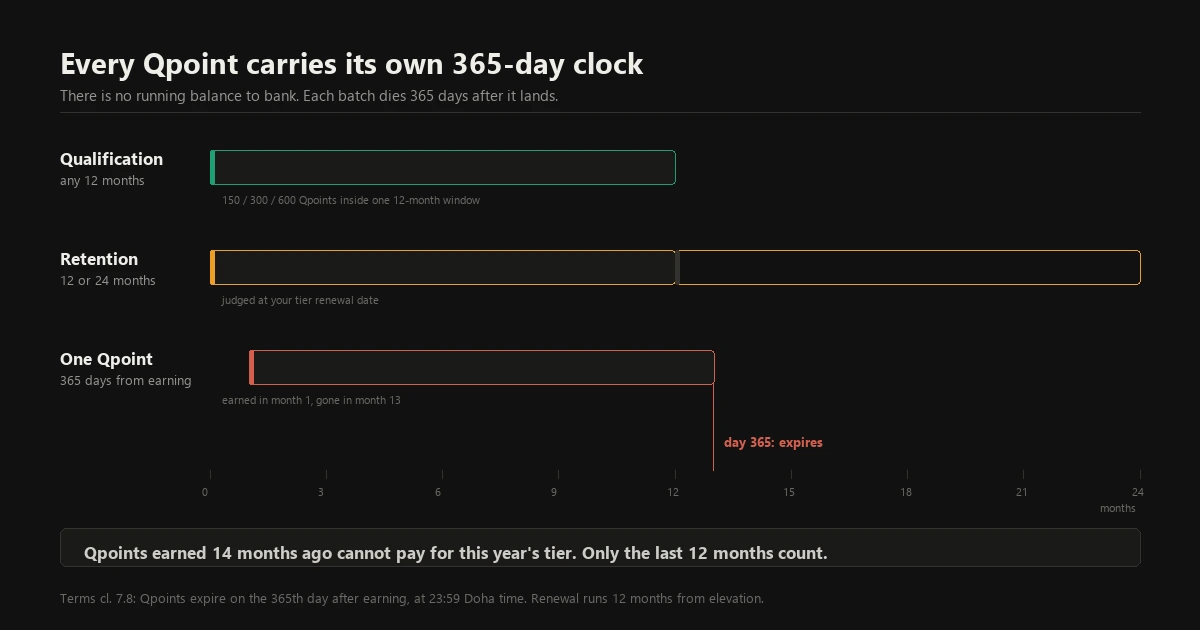
One: they expire on a clock, not a balance. Every Qpoint expires on the 365th day after it is credited, processed at 23:59 Doha time. There is no rolling balance you can bank. Fifteen months of flying does not add up to a tier; the last twelve months do. This is why a member can look at a healthy-looking Qpoints figure in the app and still fail a renewal: the older batches are already dead.
Two: they cannot move. Avios transfer to British Airways at 1:1 and pool inside a family. Qpoints are not transferable at all, and only the main member earns them, so a Family Programme member’s own flying does not build a tier of their own — and a Household Account member’s Qpoints stay with that individual.
Three: award tickets earn nothing. Flights booked with Avios, including Avios plus cash, credit zero Qpoints. A member who flies four long-haul business awards in a year has flown beautifully and qualified for nothing.
Four: they are not a currency. You cannot spend Qpoints on a seat, an upgrade or a bag. The only thing they buy is the tier, and the tier buys the benefits. Qcredits are the separate currency for upgrades, and they belong to Gold and Platinum only.
Where Qpoints actually come from
Flights are the only source that scales. Qpoints post on Qatar Airways and oneworld flights, and the number depends on the booking class of the marketing carrier and the fare you purchased rather than the cabin you sat in. That distinction is not academic: a discounted Business Lite fare can post fewer Qpoints than a flexible Economy fare on the same aircraft, because the meter reads the fare bucket, not the seat.
Qatar does not publish a static Qpoints-per-route table. Its own Qpoints calculator is the reference, and any chart you see elsewhere is either a screenshot of that calculator for one specific fare or an estimate dressed up as a rule. If a number matters — and it does when you are 20 Qpoints short of Gold — run the calculator on the exact fare class before you book, then check the statement after you fly.
The non-flight sources are real but small. Shopping at Qatar Duty Free earns 1 Qpoint per US$100 spent, and Qatar Airways Holidays packages earn the same rate on the package price. The Doha Bank co-brand card earns Qpoints on spending, though the rate depends on the card. None of these will carry a tier on their own, and the arithmetic explains why in the next section.
The 20% rule that decides everything
Hitting the number is necessary and not sufficient. At least 20% of the Qpoints in your qualifying window must come from flights marketed and operated by Qatar Airways, or you must have flown four such flights in the same 12 months. For retention the alternative is four Qatar flights in 12 months or eight in 24.
The wording matters more than it looks. The Privilege Club terms say “operated and marketed”, and that is the stricter reading: a Qatar flight number on a partner aircraft does not count, and a codeshare with a Qatar flight number operated by someone else does not count either. One Qatar page uses “marketed or operated” in a footnote, which would be more generous, but planning against the stricter version is the only safe approach.
The consequence is concrete. Three hundred Qpoints earned entirely on British Airways and American Airlines does not produce Gold. It produces 300 Qpoints and a refusal, until a Qatar flight or four is added. Members who live in a oneworld hub and route everything through a partner are the people this rule catches, and they usually discover it at the renewal date rather than at the booking screen.
The buy lever: half a tier, at most
Qatar sells Qpoints at US$25 each, on its own site and app, to main members only. The purchase is non-refundable and non-transferable, the limits reset each calendar year, and the caps are set so that buying alone can never complete a tier.
| Your tier | Purpose | Minimum balance to qualify | Maximum you can buy | Cost at US$25 |
|---|---|---|---|---|
| Burgundy | Upgrade | 0 | 75 | US$1,875 |
| Silver | Upgrade | 100 | 150 | US$3,750 |
| Gold | Upgrade | 200 | 300 | US$7,500 |
| Silver | Retention | Any | 75 | US$1,875 |
| Gold | Retention | Any | 150 | US$3,750 |
| Platinum | Retention | Any | 300 | US$7,500 |
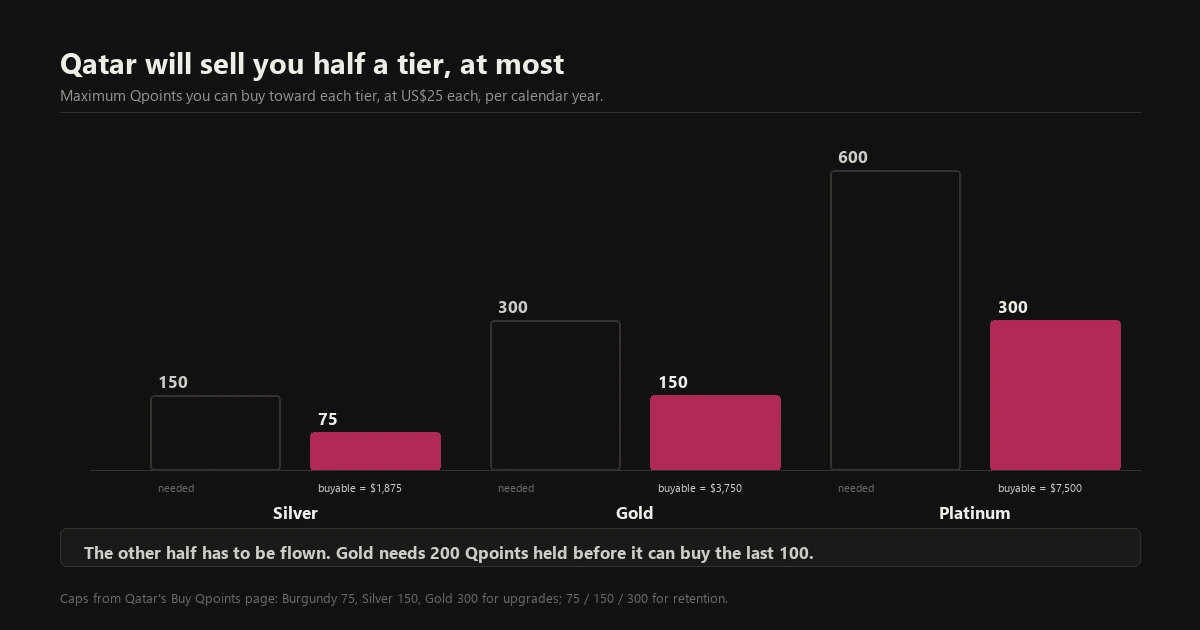
Every upgrade row works out to exactly half the target. Silver needs 150 and can buy 75. Gold needs 300 and can buy 150. Platinum needs 600 and can buy 300. The minimum-balance column is the sting in the tail: to buy 150 Qpoints as a Silver member you must already hold 100, so the purchase cannot be the first move. You have to be close before Qatar will sell you the rest.
Two practical readings follow. First, the buy lever is a gap-closer, not a shortcut: it is designed for the member who is 60 Qpoints short in November, not for the member who wants Gold in January. Second, buying early is a mistake on its own terms, because purchased Qpoints expire on the same 365-day clock as earned ones and the purchase cap is per calendar year, not per membership year.
If you are going to use it, use the calculator first to see what the missing flights would post, then price the gap. Buying 75 Qpoints costs US$1,875; four Qatar flights that would have posted the same 75 are almost certainly cheaper if you were flying anyway, and considerably more expensive if you were not.
What each tier is worth in Avios
The tier bonus is the only benefit that converts cleanly into money, so start there. Take a US East Coast return to Doha: roughly 13,400 miles flown. On a Business Classic fare, which earns 125% of distance, the base is about 16,750 Avios. Silver adds 25% — about 4,190 Avios. Gold adds 75% — about 12,560. Platinum adds 100% — about 16,750.
At the 1.4 US cents per Avios that our Avios valuation treats as the buying line, that bonus is worth roughly US$59 on Silver, US$176 on Gold and US$235 on Platinum for that one trip. Fly that route twice a year and Gold’s bonus alone is worth about US$350 annually — real money, but nowhere near the US$3,750 it costs to buy half of the tier.
That gap is the whole argument. Status is not worth buying for the Avios bonus. It is worth buying, if at all, for the things the bonus does not measure: lounge access on a long connection, a bag you did not have to pay for, a seat you could choose at booking, and the award change fee you did not pay when plans moved. Gold collects all four across the alliance, which is why Gold is the tier people should aim at and Platinum is the tier people should stop at.
Qcredits deserve a mention because they are frequently overvalued. Gold receives 40 and Platinum 60 when the tier is gained or retained, valid for 24 months as long as the tier is held. They can be spent on upgrades, extra baggage, award changes and lounge guest passes, and they are non-refundable except when used to upgrade an award flight. They are a genuine benefit and a poor reason to chase Platinum on their own.
Three levers: fly, buy, shop
Once you know the targets, every route to a tier runs through one of three levers, and they are not priced alike.
Flying is the only lever that pays you back. A fare that posts 60 Qpoints also posts Avios, tier bonus and the trip itself. It is also the least predictable, because the same route in a different fare bucket posts a different number of Qpoints and Qatar publishes no table to check in advance.
Buying is the most precise lever: US$25 a point, credited immediately, capped at half a tier. It also requires an existing balance for anything beyond the Burgundy batch, which makes it a November tool rather than a January one.
Shopping is the worst value of the three by a wide margin. Duty Free and holiday packages post 1 Qpoint per US$100 — US$100 per Qpoint against US$25 for a purchased one. To earn 75 Qpoints through Duty Free spending you would need to spend US$7,500. The same 75 Qpoints cost US$1,875 to buy. Unless the shopping was happening anyway, the shopping route is four times the price of the buying route.
That ranking is the practical answer to “how do I get status fastest”. Fly what you would have flown, buy the last slice if the tier will pay for itself inside 12 months, and never shop your way toward a tier you would not otherwise reach.
Retention is a separate sum
Keeping a tier is cheaper than earning it, and Qatar gives two routes to do it. The first is the 12-month figure: 135 Qpoints for Silver, 270 for Gold and 540 for Platinum from 19 December. The second is a 24-month figure: 270, 540 or 1,080. Either satisfies the requirement, measured backwards from your tier renewal date.
The renewal date is not a fixed calendar date. It is 12 months from the day you were elevated to the tier, or from the last renewal, and Qatar processes it at 23:59 Doha time on that date. A member who earned Gold in March renews in March; a member who earned it in September renews in September. This is why two people with identical flying can have completely different deadlines, and why the purchase window matters: Qpoints bought after the renewal date count toward the next year, not the one that just closed.
Missing the target is not a cliff. If you have earned or spent Avios in the previous 24 months, you drop one tier: Platinum to Gold, Gold to Silver. If there has been no account activity at all in 24 months, you drop to Burgundy. The soft landing is generous by industry standards, and it is the reason a member who stops flying for a year often keeps a usable tier for another twelve months.
Five ways people get this wrong
Buying too early. Purchased Qpoints expire 365 days after purchase and the cap is per calendar year. Buy in January for a November renewal and you have burned most of the life of the points and the whole year’s allowance.
Treating Qpoints as a balance. They are a rolling meter. A member who flew heavily 18 months ago and lightly since does not have “plenty of Qpoints”; they have expired batches and a thin last twelve months.
Assuming partner flying is enough. The 20% rule or four Qatar flights is a hard gate, and it is checked when the tier is upgraded or renewed rather than when the Qpoints are earned. All-partner flying is the most common reason a mathematically qualified member is refused.
Buying without checking the gate. Purchased Qpoints count toward the total, but they do not satisfy the Qatar-metal requirement. A member who buys 150 Qpoints as a Silver and never flies Qatar still fails the upgrade.
Chasing Platinum for the lounge. Gold already has oneworld Sapphire, which is the level that opens Business Class lounges across the alliance. Platinum adds First lounges where they exist, two guests instead of one, 20 more Qcredits and the Avios expiry exemption. Worth having if you use First Class lounges and long-haul awards; not worth US$7,500 of purchased Qpoints for most people.
Verdict
Aim at Gold, get there by flying, and use the buy lever only to close a gap you can see. Gold is where the programme stops being a Qatar-only product and starts being a oneworld one, and it is the last tier whose benefits most travellers will actually use in a year.
Buy nothing in advance. The purchase caps guarantee that money alone cannot finish a tier, the 365-day clock guarantees that early buying wastes the points, and the 20% rule guarantees that a member who does not fly Qatar cannot buy their way past the gate. The only sensible purchase is the last 75 to 150 Qpoints of a tier you will hold for twelve months and use.
And do the arithmetic before you do either. Half a tier costs between US$1,875 and US$7,500; the Avios bonus on a year of flying is worth a few hundred; the lounge access, bags and change fees are worth whatever your itinerary says they are. If that sum does not clear the price, the correct move is to fly what you fly and let the tier land where it lands.
Last updated: 28 November 2026. Thresholds, purchase caps and benefit levels checked against Qatar Airways Privilege Club pages and the Privilege Club terms and conditions on that date. The 19 December 2026 schedule is as published by Qatar Airways.
How the rules have moved
| Date | Change | What it did |
|---|---|---|
| 2022 | Avios replaces Qmiles as the spend currency | Spending changed; Qpoints stayed as the status meter |
| 1 June 2026 | Qualification cut to 135 / 270 / 540 | Made status cheaper for six months |
| 19 December 2026 | Targets return to 150 / 300 / 600 | The schedule this guide is built on |
Frequently asked questions
How many Qpoints do I need for Silver?
150 Qpoints within 12 months from 19 December 2026, or 135 if your window closes on or before 18 December. The same flight requirement applies: at least 20% of those Qpoints, or four Qatar Airways flights, must come from Qatar-marketed and operated flying.
Do Qpoints expire?
Yes. Each Qpoint expires on the 365th day after it is credited, at 23:59 Doha time. There is no way to extend them and no way to move them to another member, so a tier has to be earned inside a rolling 12-month window rather than accumulated over several years.
Can I buy my way to Gold?
Only halfway. A Silver member can buy a maximum of 150 Qpoints at US$25 each — US$3,750 — and must already hold 100 Qpoints to be allowed that purchase. The remaining 150 have to be flown, and the Qatar-metal rule still has to be met.
Do award flights earn Qpoints?
No. Flights booked with Avios, including Avios plus cash bookings, credit zero Qpoints. Only cash fares marketed by Qatar Airways or a oneworld carrier earn toward a tier, and the amount depends on the booking class of the marketing carrier.
Does Silver give oneworld lounge access?
Not across the alliance. Silver is oneworld Ruby, which carries priority check-in and boarding but no alliance lounge entitlement. The lounge a Silver member can use is Qatar’s own at Hamad International, plus two one-visit guest passes a year.
What happens if I miss a renewal target?
You drop one tier if you have earned or spent Avios in the previous 24 months, so Platinum becomes Gold and Gold becomes Silver. If there has been no account activity at all in that period, the account returns to Burgundy.
More guides
- Qpoints come from flying; Avios can come from four banks
- Avios expiry runs on a separate clock from Qpoints
- Qatar Airways Privilege Club promotions, ranked by what each one is worth
- What an Avios is worth, and the fare it has to beat
- Booking Qsuite with Avios: the seat, the window, the aircraft
- Moving Avios in and out of Qatar: what the transfer rules allow
- Airline alliances explained, and what oneworld status actually unlocks
- Avios are bought separately: the six-tier ladder and the 250,000 cap
- Avios are bought separately: the six-tier ladder and the 250,000 cap
Next step
Before you pay for a gap, price it. The Buy Qpoints page shows your cap for the current calendar year, which is the number that decides whether the tier is reachable at all.