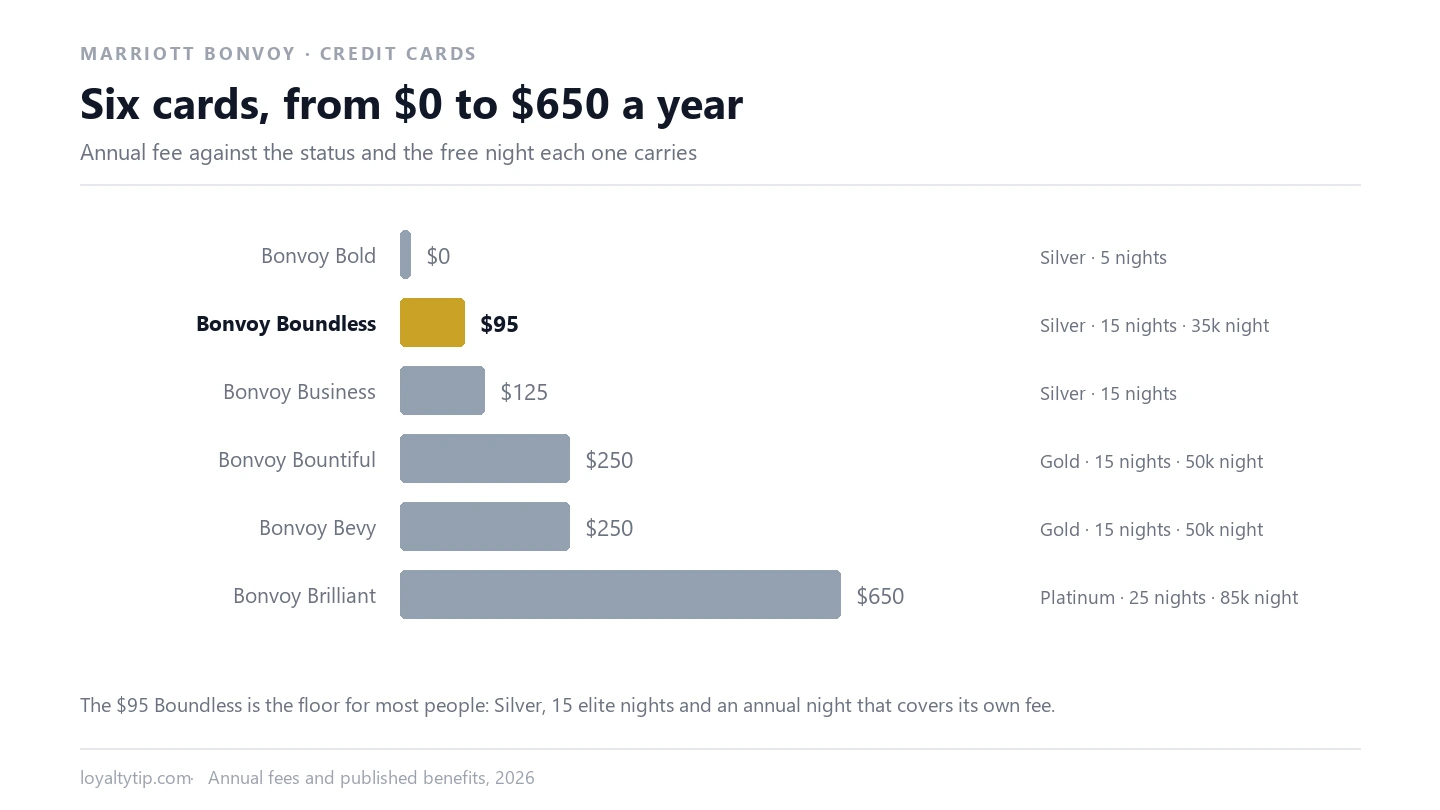
Marriott credit cards all earn the same currency, but they are not variations on a theme — they are six products with different jobs. Annual fees run from $0 to $650, automatic status ranges from Silver to Platinum, and the annual free night certificate can be worth 35,000 points or 85,000 depending on which one you hold.
Because the lineup changes every year, the useful approach is not memorizing offers but understanding the three numbers that actually separate the cards. Once you know those, picking between them takes about two minutes — and the answer for most people is not the most expensive card.
The Short Answer
| Card | Issuer | Annual fee | Automatic status | Elite nights/yr | Annual free night |
|---|---|---|---|---|---|
| Bonvoy Bold | Chase | $0 | Silver | 5 | None |
| Bonvoy Boundless | Chase | $95 | Silver | 15 | Up to 35,000 pts |
| Bonvoy Bountiful | Chase | $250 | Gold | 15 | Up to 50,000 pts |
| Bonvoy Bevy | Amex | $250 | Gold | 15 | Up to 50,000 pts |
| Bonvoy Brilliant | Amex | $650 | Platinum | 25 | Up to 85,000 pts |
| Bonvoy Business | Amex | $125 | Silver | 15 | Spend-based |
Offers, fees and bonus categories change annually and vary by market. Treat the table as the structure of the lineup and confirm current terms with the issuer before applying — the reasoning below is what stays constant.
The Three Numbers That Decide It
Elite Night Credits (ENCs). Every card deposits nights into your account each year without any spending requirement. Bold gives 5, the mid-tier cards give 15, Brilliant gives 25. Since Marriott Gold is 25 nights and Platinum is 50, 15 credits is the difference between Platinum being reachable and being theoretical.
The free night ceiling. This is the number people misjudge most. A 35,000-point certificate and an 85,000-point certificate are not the same benefit at different sizes — they access different tiers of the portfolio entirely. A 35,000-point night covers a Courtyard. An 85,000-point night covers a Ritz-Carlton city property.
Automatic status. Bold and Boundless give Silver, which is largely decorative. Bountiful and Bevy give Gold, which adds a 25% points bonus and 2pm checkout. Brilliant gives Platinum, which is the tier that actually changes a stay: lounge access, breakfast and 4pm checkout. How quickly a rival card delivers an equivalent tier is a separate question, covered in the Hilton side of the comparison.
Everything else — the points multipliers, the bonus categories, the statement credits — is secondary. Those three numbers determine what the card is for.
Card by Card
Bonvoy Bold: the $0 entry point
Five elite night credits, automatic Silver status, no annual fee, and no free night certificate. The value here is that it costs nothing to hold and it starts the clock on your Bonvoy account, which matters if you are testing whether the program fits your travel.
It is also the weakest card in the lineup for anyone who stays at Marriott properties more than a few nights a year. Five credits will not move you toward Gold, and Silver does not include breakfast, upgrades of consequence, or meaningful late checkout.
Bonvoy Boundless: the default choice
For most people this is the right card, and the arithmetic is unusually simple. At $95 a year it delivers 15 elite nights plus an annual free night certificate worth up to 35,000 points. If you use that certificate for a night that would have cost more than $95 in cash — which is most Marriott properties — the card has paid for itself before you count anything else. For scale, $95 buys roughly 12,000 points at typical points-sale pricing, so the certificate is returning about three times the fee in points alone.
There is a second layer: one additional elite night credit for every $5,000 of spending, with no cap. That puts Gold status within reach for someone spending $50,000 a year on the card, without a single extra hotel stay.
If you are going to hold one Marriott card and you are not certain which one, hold this.
Bountiful and Bevy: the Gold shortcut
These two are near-identical products from different issuers — Bountiful from Chase, Bevy from American Express — both at $250 with automatic Gold status and a free night certificate worth up to 50,000 points after $15,000 of annual spending.
The case for either one is straightforward: Gold status without staying 25 nights. Whether that is worth $155 more than the Boundless depends entirely on how much you value a 25% points bonus and 2pm checkout, since Gold still does not include breakfast.
For most travelers the honest answer is no. Gold is a modest tier, and the $155 difference buys roughly 20,000 purchased points — which is a more flexible asset than a status level that does not feed you.
Bonvoy Brilliant: the status card
At $650 this is the expensive one, and it is also the only Marriott card that delivers Platinum status automatically. That single benefit is the argument: Platinum is where lounge access, breakfast and 4pm checkout begin, and reaching it organically takes 50 nights.
On top of that you get 25 elite night credits — half of Platinum in one deposit — plus an annual free night certificate up to 85,000 points and a $300 annual dining credit issued monthly. The certificate alone, used at a Ritz-Carlton or St. Regis, can exceed the effective annual cost after the dining credit.
The break-even is roughly this: if you will use the 85,000-point certificate and the dining credit, the card costs about $250 net. If you will also stay enough nights to make Platinum’s breakfast and lounge access matter, it is clearly the best card in the lineup. If you travel six nights a year, it is an expensive way to feel loyal.
Bonvoy Business: the stacking play
The small business card adds 15 elite night credits and a free night certificate tied to spending. Its real purpose in a portfolio is stacking: business and personal cards issue their credits separately, so a Boundless plus a Business card can put 30 nights in your account before you check in anywhere.
That is the fastest legitimate route to Platinum without staying 50 nights, and it costs $220 a year combined. For anyone with even modest self-employment income and a reason to hold a business card, this is the highest-leverage combination in the program.
The 2026 Change That Matters: Bigger Top-Offs
Free night certificates have always carried a ceiling, and Marriott now allows up to 25,000 of your own points to be added to a certificate — up from 15,000 previously. That raises the effective reach of every card’s certificate substantially.
| Card | Certificate ceiling | With 25,000-point top-off |
|---|---|---|
| Boundless | 35,000 | 60,000 |
| Bountiful / Bevy | 50,000 | 75,000 |
| Brilliant | 85,000 | 110,000 |
This is more significant than it sounds. A 35,000-point certificate is close to useless at a resort; topped off to 60,000 it books real properties. The Brilliant’s certificate reaching 110,000 opens most Ritz-Carlton city hotels and a good number of resort nights — which is covered in our guide to what a certificate actually books at the top of the portfolio.

The top-off uses points you already hold, so the practical question is whether you would rather spend 20,000 points to upgrade a free night or save them. Usually the upgrade wins, because a certificate that goes unused is worth nothing.
The Stacking Rule You Need to Know
Annual elite night credits from consumer Marriott cards do not stack. If you hold two personal cards, you receive the credit from whichever one grants the higher number — not the sum.
Business and personal cards are counted separately, which is why the Boundless plus Business combination works. Two personal cards do not.
This catches people who apply for a second consumer card expecting 30 credits and discover they still have 15. Check the terms before assuming the arithmetic.
Which Card Fits Which Traveler

| Your situation | Best fit | Why |
|---|---|---|
| Curious, low commitment | Bold | Free, and it keeps a Bonvoy account active |
| A few Marriott stays a year | Boundless | One certificate typically exceeds the $95 fee |
| Want Gold without 25 nights | Bountiful or Bevy | Automatic Gold plus a 50,000-point certificate |
| Stay 12+ nights, want breakfast and lounges | Brilliant | Platinum status and the 85,000-point certificate |
| Chasing Platinum fast | Boundless + Business | 30 elite nights combined before any stays |
| Occasional business spender, no status ambition | Business | 15 credits and a certificate for $125 |
What Cards Do Not Fix
A Marriott card makes points easier to earn. It does not make them worth more.
This distinction gets blurred constantly in card marketing. A Platinum member and a base member redeeming 30,000 points for the same room receive identical value. The Platinum member simply earned those points 50% faster and gets breakfast on top. Status changes the earning rate and the stay experience, not the redemption rate — the mechanics are set out in our guide to how each tier is earned and what it unlocks.
Cards also do not solve the shortfall problem efficiently. If you need 40,000 points to complete a five-night award next month, putting spend on a card will not get you there in time; buying the points will. At roughly 0.8 cents each during a bonus, 40,000 points costs about $320 — often less than the cash rate of the night you are trying to book. The current points sale is the place to check the live price, and our guide to buying Bonvoy points covers the annual caps.
The right mental model: cards are for earning status and certificates. Points purchases are for closing specific gaps. Redemptions are where the value is actually created — see our ranking of the best ways to use Marriott points.
If You Are Outside the United States
The lineup above is the US market, which has the deepest set of co-brand products. Elsewhere the options are fewer and the benefits materially different — some markets issue a single card with no elite night credits at all, and others grant status tiers that the US cards do not offer.
Two things are worth checking wherever you are: whether the card grants elite night credits, and whether the free night certificate can be used globally or only in the issuing region. A certificate restricted to one country is worth far less than a global one, and that restriction is easy to miss in the summary terms.
Marriott Credit Cards: Common Questions
Which Marriott credit card is best?
For most travelers, the Boundless at $95 — the annual free night certificate usually exceeds the fee on its own. If you stay 12 or more nights a year and want breakfast and lounge access, the Brilliant’s automatic Platinum status is worth the $650.
Do Marriott credit card elite nights stack?
Consumer cards do not stack; you receive the highest single credit, not the sum. Business and personal cards are counted separately, so one of each can deliver 30 credits combined.
Can I combine a free night certificate with points?
Yes. Marriott allows up to 25,000 points to be added to a certificate, raising a 35,000-point award to 60,000, a 50,000-point award to 75,000, and an 85,000-point award to 110,000.
Does a Marriott card give me free breakfast?
Only indirectly. Breakfast comes from Platinum status, which the Brilliant grants automatically; the other cards top out at Gold, which does not include breakfast at most brands.
Is the $650 Brilliant card worth it?
If you will use the 85,000-point certificate and the $300 dining credit, the net cost falls to roughly $250 — and Platinum status covers breakfast and lounge access for two on every stay. For 12 or more nights a year it usually pays; for three nights it usually does not.
Can I hold both a Chase and an Amex Marriott card?
Yes. They are separate products from separate issuers and their benefits apply independently, subject to Marriott’s one-card-per-family rules and the non-stacking rule for consumer elite night credits.
Next step
If the card decision still feels close, the tiebreaker is what you would do with the points. The redemptions that clear 1.5 cents per point are the reason to hold a Bonvoy card at all — and when an award sits just out of range, buying the shortfall beats waiting for a sign-up bonus to post.
The Bottom Line
Marriott credit cards are best understood as status and certificate machines, not as spending tools. The three numbers that matter are elite night credits, the free night ceiling, and the status tier the card grants automatically — everything else is a tiebreaker.
For most people the Boundless is the sensible default and the Brilliant is the upgrade worth considering once Marriott becomes a regular part of your travel. The combination worth knowing about is a personal card plus a business card, which delivers 30 elite nights and puts Platinum within reach of a modest schedule.
And when a specific award is just out of range, buying the missing points is faster than waiting for spend to accumulate, though earning outside of card spend is often quicker still — provided the redemption itself clears 1.5 cents per point, which our the cents-per-point math behind every Bonvoy balance will tell you in one calculation.
More Marriott Bonvoy Guides
- the 24-month inactivity rule, and the cheap purchases that reset it.
- the fifth night free on award stays, which quietly discounts every five-night booking by 20%.
- the 3:1 airline transfer rate, and the exact point at which a transfer beats a hotel night.
- Bonvoy Escapes and its Sunday deadlines, the member sale that stacks with card earnings.
- Why a free night certificate cannot move to a spouse – certificates stay with the account holder, points do not.