Marriott vs Hilton points comes down to one uncomfortable asymmetry: a Bonvoy point is worth roughly 0.8 cents and a Hilton Honors point roughly 0.5 cents, and Hilton hands out points faster and stacks more benefits onto the same night thresholds. Neither program wins outright, and the right answer depends on which of those two advantages your travel pattern actually rewards.
Both programs abandoned fixed award charts years ago, both give a fifth award night free, and both sell points several times a year. So the differences are narrower than the marketing suggests — but they are real, and they are specific. This comparison runs the numbers that matter and ends with a plain rule for choosing.

The Short Answer
| Measure | Marriott Bonvoy | Hilton Honors |
|---|---|---|
| Typical point value | ≈0.8¢ | ≈0.5¢ |
| Base points per $1 | 10 | 10 |
| Base return on $1 spent | ≈8% | ≈5% |
| Top tier on nights alone | 75 nights (Titanium) | 50 nights (Diamond) |
| Mid-tier status threshold | 25 nights (Gold) | 25 nights (Gold) |
| Fifth night free | Yes, all members | Silver and above |
| Transfer to airlines | 38 partners at 3:1 | 26 partners at 10:1 |
| Buy points at best rate | ≈0.8¢ with a 50% bonus | ≈0.5¢ with a 100% bonus |
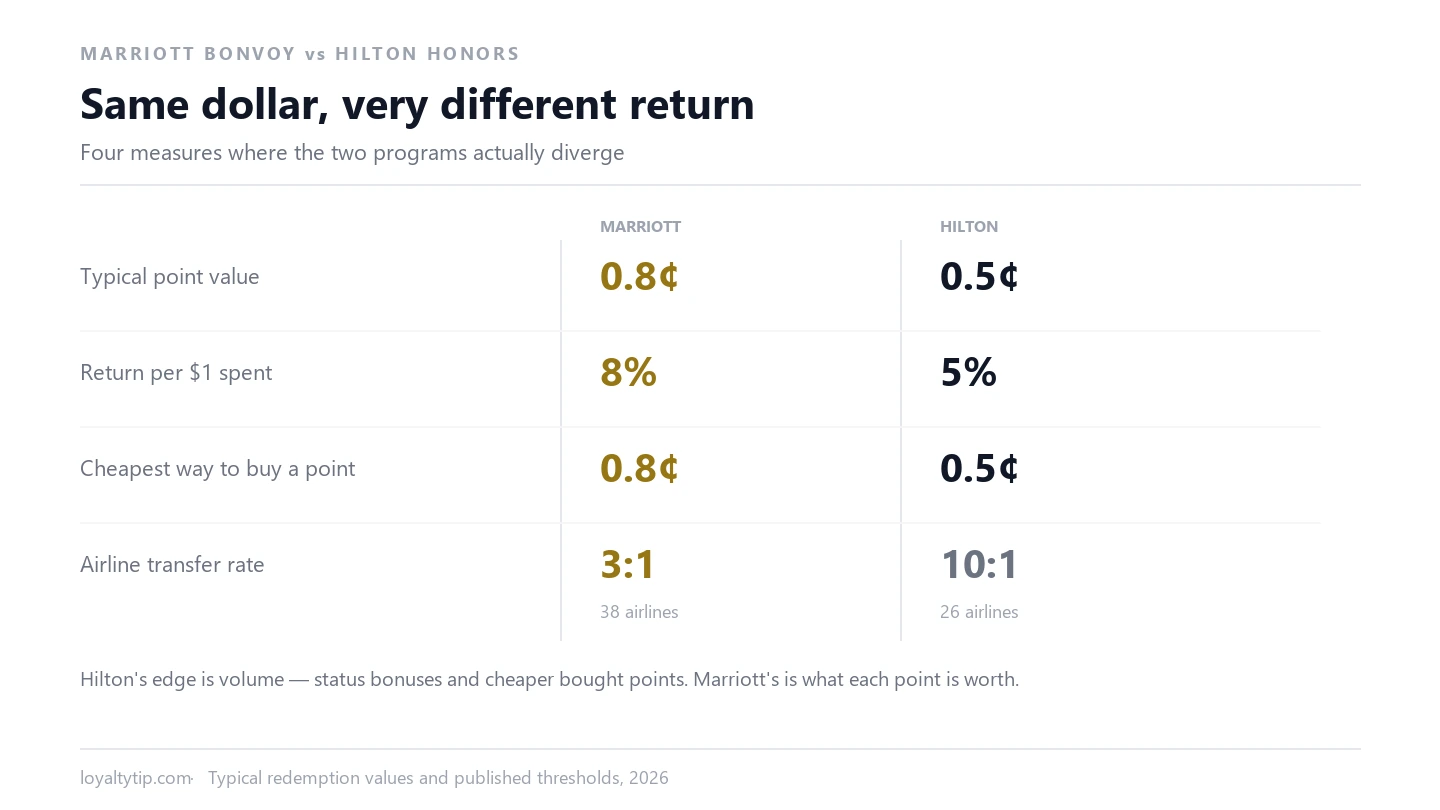
The pattern in that table is the whole argument. Marriott wins on value per point and on flexibility. Hilton wins on how quickly points accumulate and on what each status tier actually delivers.
What a Point Is Worth in Each Program
Independent valuations cluster tightly. Bonvoy points come in around 0.7 to 0.8 cents, Hilton Honors around 0.4 to 0.6 cents. That is a gap of roughly 60% per point, and it does not disappear at the top end of either program.
Why the gap exists is worth understanding, because it explains most of the downstream differences. Hilton issues points far more freely — bigger status bonuses, frequent promotional multipliers, co-brand cards that hand out 80,000-point sign-up bonuses. When a currency is easier to obtain, each unit buys less. Marriott issues more conservatively and each point holds more value.
For a traveler, the practical consequence is this: a 100,000-point Hilton balance and a 60,000-point Marriott balance are worth about the same. Comparing raw balances across programs is meaningless. The Marriott-side arithmetic, with a dollar chart covering any balance from 5,000 to 500,000 points, is in our a dollar chart for any balance from 5,000 to 500,000 points.
The Real Test: What the Same Night Costs
Point valuations are abstract. A better comparison is what each program charges for a room that would cost $200 in cash.
| Scenario | Marriott | Hilton |
|---|---|---|
| $180–220 room, mid-tier brand | 22,000–28,000 points | 36,000–44,000 points |
| $400–450 room, upscale city hotel | 45,000–55,000 points | 70,000–90,000 points |
| $900+ room, luxury resort | 90,000–120,000 points | 95,000–150,000 points |
| Cheapest award available | 5,000 points | 5,000 points |

Two things stand out. First, Marriott needs fewer points for the same cash value at nearly every level — that is the 0.8 versus 0.5 gap showing up in practice. Second, both programs have a genuinely cheap entry point around 5,000 points, which means neither is a luxury-only currency.
Where Hilton closes the gap is at the bottom of the market. Hampton Inn and Garden Inn properties are everywhere, they price awards low, and they are the kind of hotel you actually book for a one-night road stop. Marriott’s equivalent brands exist but are thinner in secondary markets.
Earning Speed: Where the 60% Gap Gets Recovered
Both programs pay 10 base points per dollar at most brands. The difference appears in elite bonuses.
| Status tier | Marriott bonus | Hilton bonus |
|---|---|---|
| Entry status | 10% (Silver, 10 nights) | 20% (Silver, 10 nights) |
| Mid status | 25% (Gold, 25 nights) | 80% (Gold, 25 nights) |
| Upper status | 50% (Platinum, 50 nights) | 100% (Diamond, 50 nights) |
| Top status | 75% (Titanium, 75 nights) | 120% (Diamond Reserve, 80 nights) |
Hilton’s multipliers are dramatically higher, and that is deliberate — it is how the program compensates for a weaker point. Run the arithmetic and the two land closer than the percentages suggest: a Hilton Diamond earning 20 points per dollar at 0.5 cents collects about 10% back, while a Marriott Titanium earning 17.5 points per dollar at 0.8 cents collects about 14%.
Marriott still edges it, but the difference is a few percentage points rather than the 60% the raw valuations imply. And Hilton Diamond requires 50 nights against Marriott Titanium’s 75, so the Hilton traveler reaches the higher multiplier 25 nights sooner.
Elite Status: Same Night Thresholds, More at Each Tier
This is where most comparisons are still quoting numbers that expired. In 2026 the night thresholds line up almost exactly, and the real difference is what each tier hands you once you arrive.
Hilton Gold and Marriott Gold both require 25 nights, but they are not the same product. Hilton Gold carries an 80% points bonus, space-available upgrades, and a daily food and beverage credit or continental breakfast. Marriott’s Gold at the same 25 nights gives a 25% bonus, an upgrade request and 2pm checkout — no breakfast. To get breakfast at Marriott you need Platinum, which takes 50 nights.
The pattern repeats one level up. Hilton Diamond and Marriott Platinum both land at 50 nights. Diamond brings a 100% bonus, executive lounge access and a guaranteed room on 48 hours’ notice; Platinum brings a 50% bonus and lounge access. Marriott’s genuinely generous tiers — Titanium at 75 nights, Ambassador at 100 nights plus $23,000 in spend — sit above that. Hilton’s new top tier, Diamond Reserve, asks for 80 nights plus $18,000 and buys confirmable upgrades and a guaranteed 4pm checkout.

Both programs sell status through credit cards, which changes the calculus entirely. In the United States, a Hilton card can hand you Gold or even Diamond on day one, and a Marriott card can hand you Platinum. For anyone willing to pay an annual fee, the nights-based comparison matters much less than which card you hold — the Marriott side is compared in our guide to which Marriott card grants Platinum outright.
The detail on how those thresholds work, including the annual choice benefits at 50 and 75 nights, is in our guide to the night thresholds and annual choice benefits.
Fifth Night Free: Both Have It, and They Differ
This is the most commonly missed point in comparisons, and the one most often described wrong. Marriott gives every member a fifth consecutive award night free — no status, no card. Hilton gives it from Silver status upward, which is 10 nights or an entry-level Hilton Amex. Below Silver, Hilton charges full points for all five nights.
The mechanics are not identical, though. Marriott removes the cheapest night from a five-night award booking. Hilton removes the fifth night in the sequence. On a stay that spans a rate change, Marriott’s version is mildly better because it strips out the lowest-value night rather than the last one.
Two exclusions apply in both programs and catch people out: the benefit needs a single five-night reservation on points, so splitting a stay into separate bookings forfeits it, and at Marriott it does not apply when a Free Night Award certificate covers one of the nights. Our breakdown of where the benefit breaks covers the exclusions in detail.
Because both programs have the benefit, it rarely decides the choice — unless you hold no Hilton status. It does mean that booking four nights instead of five is leaving value on the table in either program.
Buying Points: Hilton Is Cheaper per Point, Marriott Is Cheaper per Night
Both programs sell points regularly, and both run frequent bonus promotions. The headline rates look like a Hilton victory and are not.
Hilton sells points at a base of 1 cent each and routinely offers a 100% bonus, which halves the effective price to about 0.5 cents. That sounds excellent until you remember that 0.5 cents is roughly what a Hilton point is worth — buying at that rate is close to break-even, not a bargain.
Marriott sells at a base of 1.25 cents and commonly runs 40% to 50% bonuses, landing near 0.8 cents. Same story: about the value of the point, not below it.
The honest conclusion is that neither program sells points at a discount to their value in a normal promotion. Buying makes sense when it closes the gap to a specific high-value award, not as a way to accumulate cheaply. The current Marriott points sale and the Hilton buy points offer both publish their bonus tiers, and comparing the per-point cost against your target award is the only test that matters.
If the comparison lands you on Marriott, our guide to buying Marriott Bonvoy points covers the current pricing tiers, annual caps, and which promotions are worth waiting for.
Airline Transfers: Marriott Wins on Rate, Not on Presence
Marriott transfers to 38 airline programs at 3:1, with a 5,000-mile bonus per 60,000 points. Hilton does transfer, but at 10:1 across 26 airline partners — 10,000 Honors points buy 1,000 miles. At typical valuations that is about 5 cents per mile on the Hilton side against roughly 1.9 cents on the Marriott side, so the rates are not close even though both programs are there.
Whether that matters depends on whether you fly. For a traveler who occasionally converts hotel points into a premium cabin award, Marriott is the practical choice between the two, even though the conversion still returns less value than a hotel night. The math behind that trade-off is in our guide to the 3:1 rate priced against a hotel night.
For a traveler who never does, this advantage is worth nothing and should be ignored.
Footprint: Where Each Program Actually Wins
Marriott operates the larger portfolio and the deeper luxury bench: Ritz-Carlton, St. Regis, EDITION, The Luxury Collection, W and JW Marriott all sit under one account, along with Homes & Villas for group stays. If your travel includes high-end resorts where cash rates run $800 and up, Marriott gives you more places to convert points at a strong rate. Within that bench, award prices at the top of the luxury portfolio span the widest range of award prices, from about 60,000 at a city hotel to well past 150,000 at a resort.
Hilton’s strength is the middle and lower market. Hampton Inn, Garden Inn, Tru and Home2 Suites are ubiquitous along highways and in secondary cities, and their award prices are low enough that points cover real, unglamorous nights. For a traveler who drives, visits family, or books a lot of one-night stops, that coverage matters more than a Maldives overwater villa. The per-point math on the Hilton side is broken down separately in our Hilton points value guide.
So Which Should You Collect?
Collect Marriott if: you stay at upscale and luxury properties, you want a program that also converts to airline miles, or you value each point holding more purchasing power. Aim for Platinum at 50 nights, where breakfast and lounge access arrive.
Collect Hilton if: your stays cluster around midscale brands, you want status quickly, or you value free breakfast at a lower tier than Marriott offers it. At the same 25 nights, Hilton Gold beats Marriott Gold on actual benefits.
Collect both if you can. The optimal setup for most frequent travelers is holding a co-brand card in each program, which delivers mid-tier status and annual free night certificates in both without any stays at all. Points in each program go further where that program’s footprint is strong.
One practical note on allocation: do not split actual stays between the two. Elite status compounds, and fragmenting 50 nights into 25 and 25 leaves you with two mid-tier accounts instead of one meaningful one. Pick a primary program for stays and use the secondary one through its credit card.
Marriott vs Hilton Points: Common Questions
Are Marriott points worth more than Hilton points?
Yes, per point — about 0.8 cents against 0.5 cents. But Hilton issues points faster, so a 100,000-point Hilton balance and a 60,000-point Marriott balance are roughly equivalent in purchasing power.
Which program gives free breakfast at a lower tier?
Hilton. Gold status at 25 nights includes free breakfast. Marriott requires Platinum at 50 nights, though a mid-tier Marriott card can grant that status without any stays.
Does Hilton have a fifth night free like Marriott?
Yes, from Silver status upward — 10 nights, or an entry-level Hilton Amex. Marriott imposes no status requirement. The difference is mechanical: Marriott removes the cheapest night of the five, Hilton removes the fifth in sequence.
Can I transfer Hilton points to airlines?
Yes, but at 10:1 to 26 airlines, one of the weakest rates in the industry. Marriott transfers to 38 airlines at 3:1 and adds a 5,000-mile bonus per 60,000 points — close to four times the value per point.
Which is better for buying points?
Neither is a bargain at normal prices. Hilton points cost about 0.5 cents with a 100% bonus and are worth about 0.5 cents; Marriott points cost about 0.8 cents with a 50% bonus and are worth about 0.8 cents. Buy only to close the gap on a specific award.
Next step
If the comparison lands on Marriott, the next question is price. What buying Marriott points costs at each bonus tier is the number that settles it.
The Bottom Line
Marriott wins on point value, luxury footprint and airline flexibility. Hilton wins on the speed of earning, the usefulness of its mid-tier status, and coverage in the midscale market where most nights are actually spent.
If you want the single highest return per dollar of hotel spend, Marriott’s 0.8-cent point and its 50-night Platinum tier are the stronger package. If you want status that pays off quickly and breakfast without chasing 50 nights, Hilton is the more practical program.
Whichever you choose, the mechanics that create value are the same: book awards in five-night blocks, avoid transferring to airlines unless you are chasing a premium cabin, and treat point purchases as gap-closers rather than accumulation. For how both stack up against Hyatt and IHG as well, see our 2026 hotel points value comparison, and if you are topping up a Marriott balance specifically, buying Bonvoy points during a bonus window is usually cheaper than paying cash for the same night.
More Marriott Bonvoy Guides
- where each program’s points stretch furthest, ranked by cents per point rather than by hotel name.
- how quickly each program hands out points, which is the half of the comparison most people skip.
- the cash-rate sale Marriott runs every few weeks – the case where paying beats redeeming.
- each program’s inactivity rule, because the two are not the same length.