How to earn United miles comes down to five routes: flying United and its partners, using a United co-branded card, transferring flexible bank points, spending through MileagePlus Shopping and Dining, and buying miles. The best route for most people is a transfer from Chase Ultimate Rewards or Bilt at 1:1, or a United card’s sign-up bonus. This guide covers every method, the real 2026 earning rates, and the transfer traps that quietly cost you value.

At a glance
| Method | Typical rate | Best for |
|---|---|---|
| Flying United | 3–12 miles per dollar, by tier and card status | Frequent flyers |
| Chase Ultimate Rewards transfer | 1:1, usually instant | Most people |
| Bilt Rewards transfer | 1:1, usually instant | Rent payers |
| Marriott Bonvoy transfer | 3:1 plus 10,000 bonus per 60,000 points | Topping off |
| MileagePlus Shopping / Dining | Varies by merchant and restaurant | Everyday spend |
| Buying miles | 3.76 cents standard, ~1.88–1.98 on sale | Top-up only |
Earn by flying
The base way to earn is simply to fly United or United Express with your MileagePlus number on the booking, or a Star Alliance and partner airline credited to MileagePlus. You earn on the base fare and carrier-imposed surcharges, not on taxes or government fees.
Since April 2026 the rate depends on both your Premier tier and whether you hold a United credit card. Cardholders earn more at every level, and non-cardholders earn less than they used to.
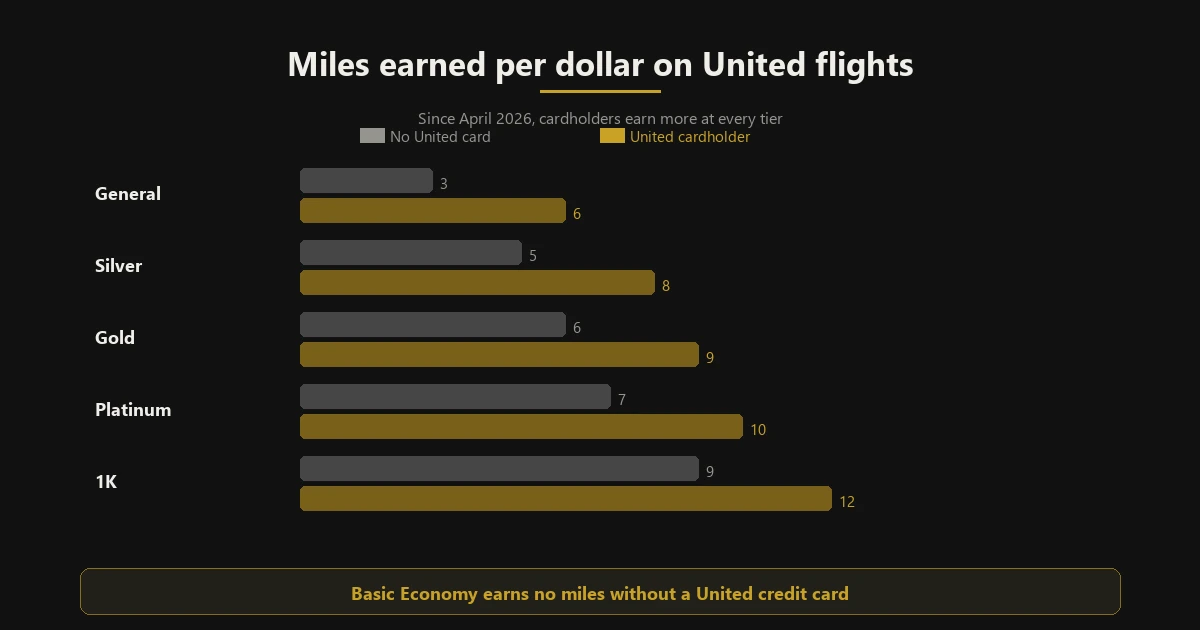
A general member without a card now earns 3 miles per dollar; the same member with a United card earns 6. Premier 1K tops out at 9 without a card and 12 with one. Basic Economy earns no redeemable miles at all unless you hold a United card.
Choose where to credit carefully. A United flight can be credited to any Star Alliance program, and a cheap long-haul can earn far more miles in a distance-based program such as Turkish Miles&Smiles or Aeroplan. Credit to MileagePlus when you want Premier qualifying credit, which only counts in MileagePlus, or when the fare is high relative to the distance. Check the fare class first — United’s cheapest codes earn little or nothing in many partner programs, and Basic Economy earns nothing in most of them.
United co-branded cards
United’s Chase cards — Explorer, Quest, Club and their business versions — earn miles on everyday and United spend, and their welcome bonuses are usually the fastest way to a large balance. They also unlock the higher earning rates shown above and, from April 2026, at least 10% off many United award flights.
The cards also matter for status. Primary cardholders earn Premier qualifying points on eligible spend: Club Infinite and Club Business earn 1 PQP per $15 up to 28,000 a year, while other eligible cards earn 1 per $20 with lower annual caps. Card-earned PQP counts toward every tier including 1K, but you still need four United or United Express flights. For the full tier breakdown, see our United MileagePlus elite status guide.
A card is not mandatory to earn miles, but in 2026 the earning structure clearly rewards holders. If you fly United even a few times a year, compare the value of the bonus and the higher rates against the annual fee.
Bank and hotel transfers
Transfers are the most flexible way to build a balance, because you can move points only when you have found an award you want to book. But United accepts far fewer transfer partners than most Star Alliance programs, and the ratios vary wildly.
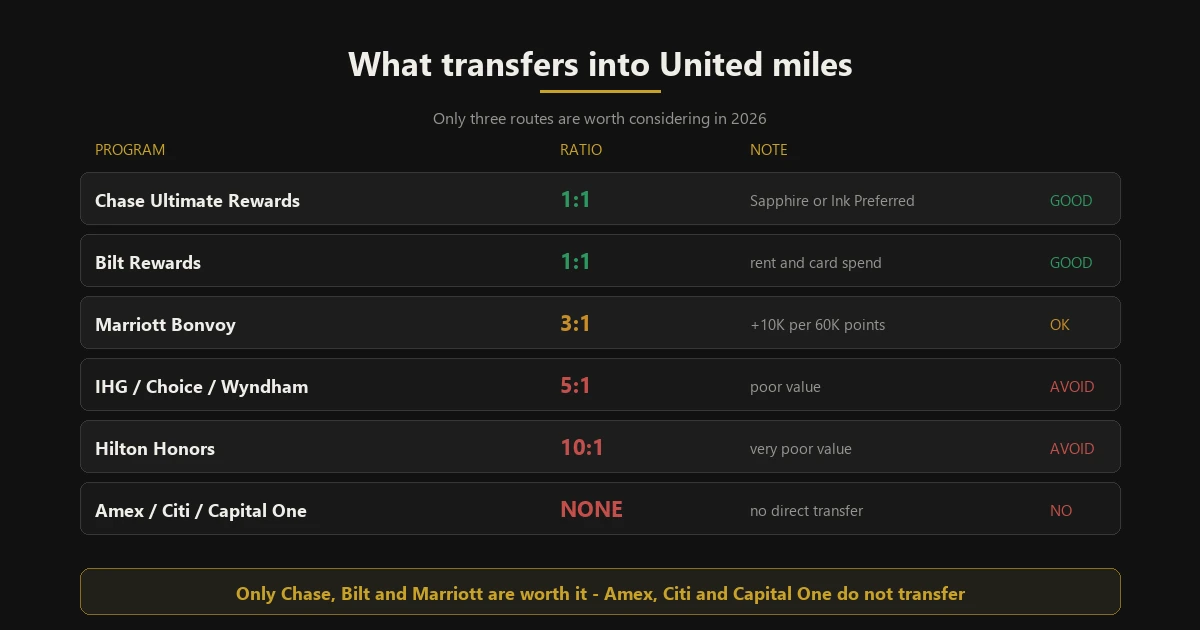
Chase Ultimate Rewards — 1:1. The main route for most people. You need a Sapphire Preferred, Sapphire Reserve or Ink Business Preferred to unlock transfers; Freedom points pool into those cards first. Transfers are usually instant, which matters when award space is scarce.
Bilt Rewards — 1:1. Earned from rent and card spend, and equally useful. Bilt transfers post quickly, but the same rule applies: do not move them until the seat is bookable.
Marriott Bonvoy — 3:1 with a bonus. Every 60,000 Marriott points sent in one transfer becomes 30,000 United miles, because United adds 10,000 bonus miles at that threshold. That is the only hotel transfer that makes reasonable sense, and it is best used to top up a balance for a specific award — not as a primary earning strategy, since Marriott points are usually worth more as hotel nights.
Hotel programs to avoid. IHG, Choice and Wyndham transfer at 5:1, Hyatt at 5:2, and Hilton at a brutal 10:1. You give up far more value than you receive. Only consider one of these if you are a few hundred miles short of a high-value redemption and have no better option.
Programs that do not transfer. American Express Membership Rewards, Citi ThankYou and Capital One miles have no direct path into United. If you hold those currencies, compare Aeroplan or Avianca LifeMiles instead — both are Star Alliance programs and often book the same partner seats. Australian Amex members have a separate 2:1 route, but it does not apply to US cards.
Transfer only after you find space. Bank transfers into MileagePlus are one-way and cannot be reversed. Award seats can disappear while a transfer is posting, so confirm the flight is bookable in your account before you move points. And remember that transferred miles are redeemable miles only — they do not count toward Premier status.
Everyday spending
Several smaller channels add up if you already spend in the right places:
MileagePlus Shopping. A portal that pays miles at hundreds of retailers. Rates vary, so compare against other portals before clicking through — it is easy to earn a lower rate than a competing portal offers.
MileagePlus Dining. Register a credit card and earn miles at participating restaurants and bars, typically up to 5 miles per dollar. It runs alongside whatever your card already earns.
Ride sharing and delivery. Link Lyft to earn miles on airport rides, and watch for Instacart promotions that offer bonus miles for new customers and orders. These are occasional boosts, not a steady strategy.
Car rentals and hotels. Avis and Budget bookings through MileagePlus Travel earn fixed mile amounts per rental, with more for cardholders and Premier members. Hotel partners pay miles per stay, but the rates are rarely better than booking direct with a hotel program.
MileagePlus X. The app lets you buy gift cards at participating merchants and earn miles on the purchase. Cardholders receive an extra bonus on these purchases.
Buying miles
United sells miles directly at a standard 3.76 cents each, with sales bringing the top tier to roughly 1.88 to 1.98 cents. That is above the 1.2-to-1.3-cent value most redemptions return, so buying is a top-up tool, not a way to build a balance cheaply. It works when you are a few thousand miles short of a Polaris or partner business award worth far more per mile.
Note that purchased miles do not count as airline spending, do not earn Premier qualifying credit, and are processed through Points.com. For the full price structure and both purchase caps, see our guide to buying United miles.
A sensible order of attack
If you are starting from zero, the order that usually makes sense is: take a United card for the welcome bonus and the higher earning rates; funnel everyday spending through Chase Ultimate Rewards or Bilt and transfer only when you find award space; use MileagePlus Shopping and Dining for spend you were already making; and buy miles only to finish a specific award.
If you already hold a large balance of Chase or Bilt points, resist the urge to move it speculatively. United miles never expire, but bank points can be used in several programs, and a partner such as Aeroplan may price the same Star Alliance seat lower. Keep the flexibility until you are ready to book. For what the miles are worth once you have them, read our United miles valuation guide, and for where to spend them, the best way to use United miles.
Verdict
How to earn United miles is mostly a question of using the right funnel. Flying earns the most per transaction, but a United card’s bonus plus the 2026 cardholder rates does more for most people. Chase and Bilt transfers at 1:1 are the best flexible top-up, Marriott at 3:1 with the 60,000-point bonus is acceptable, and every other hotel ratio is poor. Amex, Citi and Capital One cannot transfer at all.
Whatever route you use, wait for a real award before moving points or buying miles, and credit flights to MileagePlus only when you want United status. For the live offers running on the account now, see our United MileagePlus promotions tracker.
Last updated: 21 November 2026. Earning rates, transfer ratios and promotions change; confirm current figures before moving points or making spend decisions.
Frequently Asked Questions
What is the best way to earn United miles?
For most people, a United co-branded card welcome bonus followed by 1:1 transfers from Chase Ultimate Rewards or Bilt. Flying earns miles too, and since April 2026 cardholders earn roughly twice as much per dollar at every tier as non-cardholders.
Which credit card points transfer to United miles?
Chase Ultimate Rewards and Bilt Rewards transfer at 1:1, and Marriott Bonvoy at 3:1 with a 10,000-mile bonus per 60,000 points transferred. American Express Membership Rewards, Citi ThankYou and Capital One miles do not transfer to United.
Do United miles expire?
No. MileagePlus miles do not expire while your account stays open and in good standing, and there is no activity requirement. That lets you wait for a good award rather than rushing a redemption.
How many miles do I earn flying United?
It depends on tier and card status. Since April 2026, a general member earns 3 miles per dollar without a United card or 6 with one; Premier 1K earns 9 or 12. You earn on the base fare and carrier surcharges, not taxes, and Basic Economy earns nothing without a card.
Is it worth transferring hotel points to United?
Usually only Marriott, and only to top off an award. Marriott’s 3:1 ratio with a 10,000-mile bonus per 60,000 points is the best hotel option. IHG, Choice and Wyndham at 5:1, and Hilton at 10:1, destroy most of the value of your hotel points.
When should I transfer bank points into MileagePlus?
Only after you have found an award you can actually book. Transfers are one-way, usually instant, and award seats can vanish while points are posting. Transferred miles also do not count toward Premier status.
Can I earn United miles without a credit card?
Yes, by flying, through MileagePlus Shopping and Dining, car rentals and partner offers, or by transferring Chase or Bilt points. But without a card you earn fewer miles per dollar on flights and get no award discount, so the balance grows more slowly.
Does buying United miles help me earn status?
No. Purchased miles are redeemable miles only. They are handled through Points.com and do not count as airline spend or earn Premier qualifying points. Check a partner program before transferring if the same Star Alliance seat costs fewer points elsewhere.
More United MileagePlus Guides
- United credit cards ranked, the four Chase cards compared on fees, earning and PQP.
- Does United have an award chart, how dynamic pricing works and the partner Saver floor.
- Do United miles expire, why MileagePlus miles never lapse and the six forfeiture exceptions.
- How much United miles are worth, the independent baseline and how to value any award yourself.
- Best way to use United miles, the top redemptions ranked by value and current Saver levels.
- United MileagePlus elite status, all four tiers, 2026 thresholds and what changes in 2027.
- United MileagePlus promotions, every live offer and which accounts should act on it.
Check which flexible points you already hold. If it is Chase or Bilt, find an award first and transfer only when the seat is bookable — then use a United card or flying for the rest of the balance.