How much are Marriott points worth? About 0.8 cents each in 2026, which makes 100,000 points roughly $800 of hotel. That is the honest middle of the range. Spend them well and the same point returns 1.2 cents or more; spend them badly and it returns half that.
The number matters because Marriott no longer publishes an award chart. It dropped categories and fixed pricing in March 2022, and every property now floats with cash demand. That puts the burden on you: before you redeem, you have to work out whether 45,000 points for a $300 room is a good trade. This guide gives you the conversion table, the formula, and the specific redemption types that beat the average – plus when it is cheaper to buy Marriott points instead of transferring them.

The Short Answer: 0.8 Cents, With a Wide Range
Independent valuations converge tightly for 2026. FrequentMiler analysed roughly three million real Marriott redemptions and found a median of 0.77 cents per point. The Points Guy uses 0.8 cents. NerdWallet uses 0.7. WalletHub lands at 0.79.
The reason all four cluster between 0.7 and 0.8 is that most redemptions are unremarkable – a Courtyard on a Tuesday, a SpringHill Suites near an airport. That is the average, and the average is not where value lives.
Use 0.8 cents as your break-even line. Any redemption that clears 0.8 cents per point is a reasonable use of points. Anything below it means you would have been better off paying cash and keeping the points for later. When cash is the better call, start with Marriott’s official booking search and compare the member rate before you decide.
What Any Balance Is Worth in Dollars
This is the table most people are actually looking for. It converts a balance into cash at three rates: the low end of the realistic range, the typical value, and what a well-chosen luxury redemption returns.
| Points | Low (0.7¢) | Typical (0.8¢) | Sweet spot (1.2¢) | What it realistically covers |
|---|---|---|---|---|
| 5,000 | $35 | $40 | $60 | Part of a night at a budget property |
| 10,000 | $70 | $80 | $120 | One night at a Fairfield or Four Points in a low-demand market |
| 15,000 | $105 | $120 | $180 | One budget night, or points toward an upgrade |
| 25,000 | $175 | $200 | $300 | One night at a Courtyard or SpringHill Suites |
| 35,000 | $245 | $280 | $420 | One mid-tier night, or half of a luxury night |
| 50,000 | $350 | $400 | $600 | One night at a Sheraton, Westin or Le Méridien |
| 60,000 | $420 | $480 | $720 | One night at a W or JW Marriott, or a full Ritz-Carlton night at the low end of its range |
| 85,000 | $595 | $680 | $1,020 | One night at a St. Regis or Ritz-Carlton resort |
| 100,000 | $700 | $800 | $1,200 | One luxury night, or two solid mid-tier nights |
| 150,000 | $1,050 | $1,200 | $1,800 | Two luxury nights, or a five-night mid-tier stay with the free night |
| 250,000 | $1,750 | $2,000 | $3,000 | A five-night luxury stay using the fifth-night-free benefit |
| 500,000 | $3,500 | $4,000 | $6,000 | A week at a top-tier resort, or a long multi-city trip |
If you are looking for a specific balance — whether that is 6,000 points, 85,000 points, 100,000 points or 500,000 — the chart below converts the most common Bonvoy balances into dollars at the 0.8-cent baseline. Use it as a quick estimate, then check the actual cash and points price for your dates.
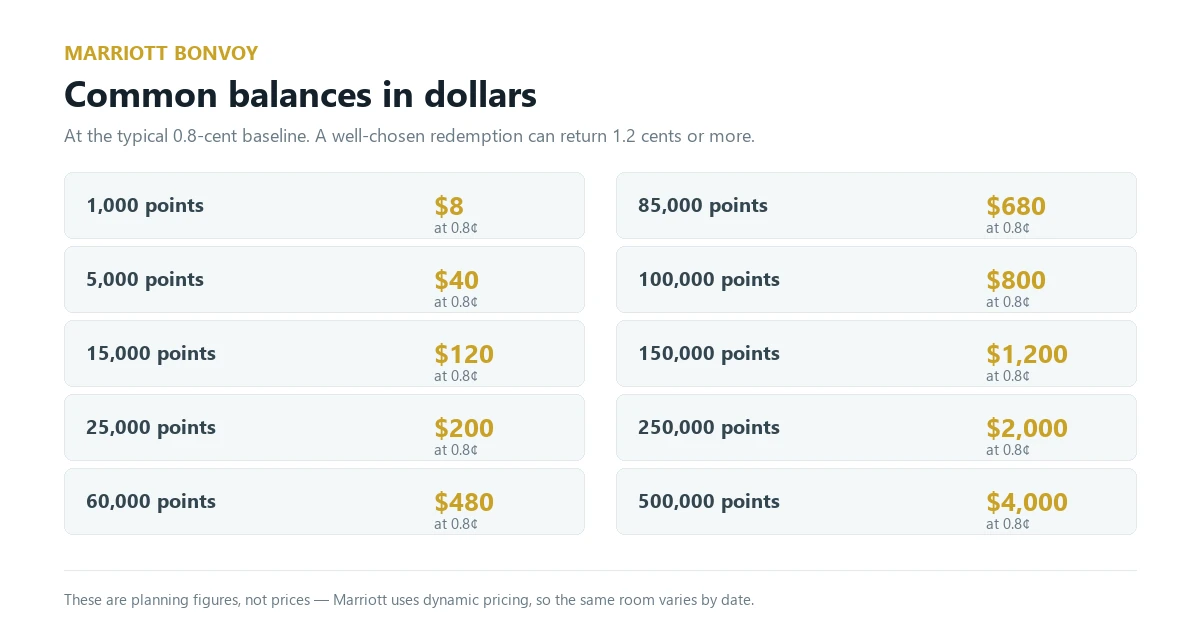
Read the third column as a ceiling, not a promise. Reaching 1.2 cents requires a property with a high cash rate relative to its award price – usually a luxury resort in shoulder season, not peak. The second column is what an ordinary, unplanned redemption returns.

Why the Range Is So Wide: Dynamic Pricing
Marriott eliminated its Category 1-8 award chart on March 29, 2022 and replaced it with flexible point redemption rates. The first year was deceptive – more than 97% of properties still priced inside the old bands, so most members noticed nothing. From 2023 the caps came off entirely.
What replaced the chart is a set of unpublished tiers that move with demand. Analysts have reverse-engineered the bands, and they are wide enough to explain why the same hotel can cost 40,000 points one week and 90,000 the next:
| Property tier | Typical points per night | Brands |
|---|---|---|
| Select service | 10,000 – 25,000 | Fairfield, Four Points Flex, City Express |
| Mid-tier | 20,000 – 45,000 | Courtyard, SpringHill Suites, Residence Inn |
| Lifestyle | 25,000 – 55,000 | AC Hotels, Aloft, Moxy, Delta Hotels |
| Full service | 35,000 – 75,000 | Marriott Hotels, Sheraton, Westin, Le Méridien |
| Upper upscale | 45,000 – 90,000 | Renaissance, Autograph Collection, Tribute Portfolio |
| Luxury | 60,000 – 120,000 | W Hotels, JW Marriott, Luxury Collection |
| Top luxury | 80,000 – 150,000+ | St. Regis, Ritz-Carlton, EDITION |
Two consequences follow. First, flexible dates are worth more under dynamic pricing than they ever were under a chart – the low end of each band is where the value sits. Second, a large Bonvoy balance is not a store of value. Because Marriott can reprice any property at any time, points held for years quietly lose purchasing power. Earn them with a redemption in mind rather than as savings — the channels that build a balance fastest matter far more than the size of the balance itself.
How to Calculate Cents per Point Yourself
One formula answers the question for any specific booking:
Cash rate ÷ points required × 100 = cents per point
Two real examples show how differently it lands.
Example 1 – a Courtyard at 0.72 cents. The room is $180 a night, or 25,000 points. 180 ÷ 25,000 × 100 = 0.72 cents. That is below the 0.8 cent line. Pay cash and keep the points. Check Marriott’s official room rates for your dates — the member rate often beats paying with points at properties like this.
Example 2 – a St. Regis at 1.2 cents. The room is $900 a night, or 75,000 points. 900 ÷ 75,000 × 100 = 1.2 cents. That clears the line comfortably. Redeem.
The pattern is counterintuitive if you came from airline programs: with Marriott, the cheaper and more ordinary the property, the more reliably you clear 1 cent, because budget properties keep low cash rates that points can still beat. Luxury properties dilute value unless you catch the low end of their award range.
Where Marriott Points Are Worth the Most
Four redemption types consistently beat the 0.8 cent average.

Fifth-night-free award stays
Book five consecutive award nights at one property on a single reservation and Marriott waives the cheapest night – no elite status needed. On a five-night stay that is roughly a 20% discount on the whole booking, which lifts an 0.9 cent redemption to about 1.1 cents and a 1.2 cent redemption past 1.5 cents. It is the most reliable value lever in the program, and it stacks on top of everything else. Our guide to how that one free night is calculated covers the rules and the exclusions.
Luxury resorts in shoulder season
St. Regis, Ritz-Carlton, EDITION and W properties at the bottom of their award range, on dates when the cash rate has not fallen with it, return 1.0 to 1.2 cents. This is where the ceiling lives. A five-night Ritz-Carlton Maui stay at $1,050 cash a night, priced at 84,000 points and reduced to 336,000 by the free night, returns 1.56 cents per point.
All-inclusive Marriott properties
The cash rate bundles food and drink; the award price does not. That asymmetry is worth 1.5 cents or more per point at the right property, and the fifth-night-free benefit applies.
Free Night Award certificates with a top-off
In March 2026 Marriott raised the top-off allowance to 25,000 points, up from 15,000. A 35,000-point certificate can now cover a night priced up to 60,000 points; an 85,000-point certificate reaches 110,000. Certificates sidestep per-point math entirely, which is why they routinely return more than a straight points booking.
Where Marriott Points Are Worth the Least
| Redemption | Typical value per point | Verdict |
|---|---|---|
| Mid-tier hotel, ordinary dates | 0.7 – 0.9¢ | Acceptable – the baseline |
| Upper-tier hotel at everyday pricing | 0.6 – 0.9¢ | Check the math before booking |
| Luxury resort at the low end of its range | 1.0 – 1.2¢ | Strong |
| Any award stay of 5+ nights | 20 – 25% better | Best structural win in the program |
| Cash + Points (points portion) | 0.5 – 0.8¢ | Weak – and it forfeits the free night |
| Airline transfer (3:1 ratio) | 0.4 – 0.5¢ | Poor – only for a specific award you cannot otherwise book |
| Merchandise and Bonvoy Marketplace | 0.5¢ or less | Avoid |
The airline transfer number surprises people. Marriott transfers to airlines at 3:1, and a 60,000-point transfer produces 20,000 airline miles. Those miles are worth roughly $240 – which works out to 0.4 cents per Marriott point. Never transfer to an airline unless a specific award seat is the whole point of the exercise.
Marriott vs Hilton vs Hyatt vs IHG
Value only means something relative to the alternatives. On a per-point basis Marriott sits in the middle of the major hotel programs – well ahead of Hilton and IHG, well behind Hyatt.
| Program | Typical value | Sweet spot | Pricing model |
|---|---|---|---|
| World of Hyatt | 1.7 – 1.8¢ | 3¢+ | Fixed award chart |
| Marriott Bonvoy | 0.7 – 0.9¢ | 1.0 – 1.2¢ | Dynamic |
| Wyndham Rewards | 0.7 – 0.9¢ | 1.5¢ | Mostly flat |
| IHG One Rewards | 0.5 – 0.6¢ | 0.7 – 1.0¢ | Dynamic |
| Hilton Honors | 0.4 – 0.5¢ | 0.8 – 1.2¢ | Dynamic |
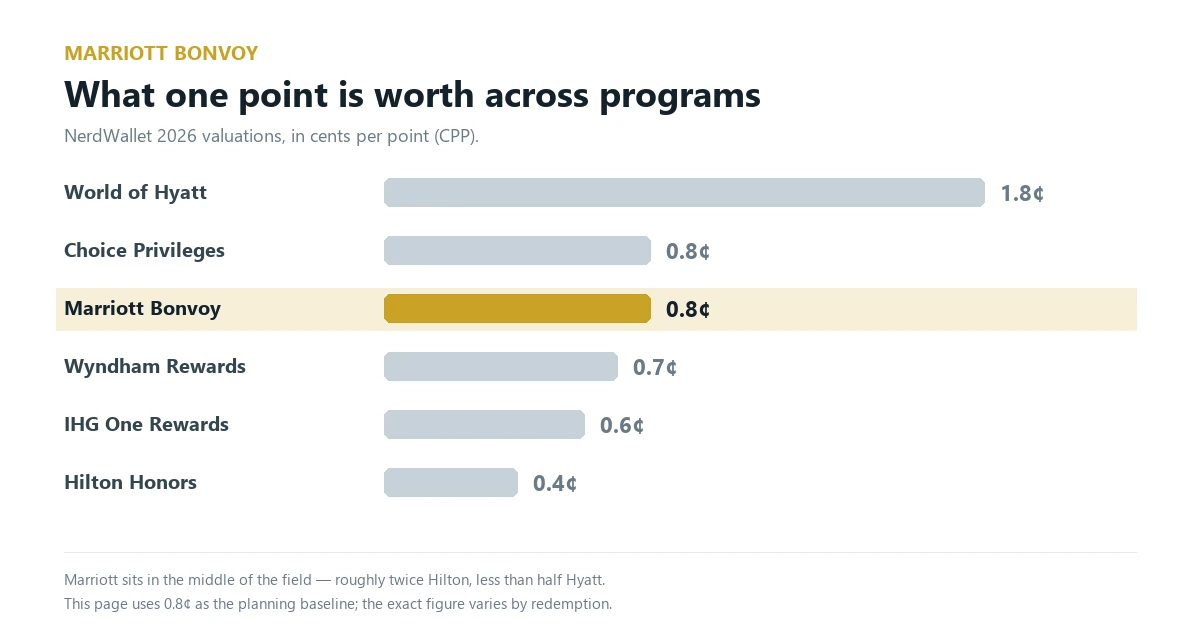
Hyatt wins on paper and loses on coverage – it has a fraction of Marriott’s 9,000-plus properties, so there are entire cities where the comparison does not apply. Marriott’s advantage is breadth: it is the only program with a plausible option almost anywhere. For the full cross-program chart, see our 2026 hotel points value comparison. Readers weighing Bonvoy against a rival program will find that head-to-head in Marriott vs Hilton points.
When Buying Points at 0.8 Cents Makes Sense
Marriott sells points at roughly 1.25 cents each at the base rate, which is above their value – buying with no promotion is a losing trade. During a bonus period the price drops: a 55% bonus brings the effective rate to about 0.81 cents, which is roughly break-even against the 0.8 cent average, and a clear win against any redemption clearing 1.2 cents.
That is the whole decision. Buying is neutral at 0.81 cents for an average stay and strongly positive when the points go somewhere specific – a luxury resort in shoulder season, an all-inclusive, or any five-night booking that triggers the free night. Check the current Marriott points sale before you assume the base rate is what you would pay. For the mechanics, purchase limits and annual caps, see our guide to Marriott buy-points caps and mechanics.
How Much Are Marriott Points Worth? Common Questions
How much are 10,000 Marriott points worth?
About $80 at the typical 0.8 cent rate, or $70 to $120 across the realistic range. In practice 10,000 points does not cover a full night at most properties – it is a top-up amount, useful for closing the gap on a certificate or a short award stay.
How much are 25,000 Marriott points worth?
Roughly $200, which is one night at a Courtyard or SpringHill Suites in most markets. It is the most common single-night award price in the program.
How much are 100,000 Marriott points worth?
About $800 typically, or up to $1,200 if spent on a luxury redemption at the low end of its award range. 100,000 points covers one St. Regis or Ritz-Carlton night in many destinations, or two to three solid mid-tier nights.
Are Marriott points worth more than Hilton points?
Yes – roughly twice as much. Marriott points average 0.7 to 0.9 cents against Hilton’s 0.4 to 0.5 cents. That does not mean Marriott is the better program for you; Hilton’s fifth-night benefit and its cheaper points purchases change the comparison. See our Hilton points value breakdown for the other side.
Are Marriott points worth more than Hyatt points?
No. Hyatt points average around 1.7 cents, more than double Marriott’s rate, because Hyatt still uses a fixed award chart. The trade-off is size: Hyatt has roughly 1,000 properties against Marriott’s 9,000-plus, so Marriott wins whenever Hyatt has no hotel where you are going.
Do Marriott points expire?
Yes, after 24 months without qualifying activity. That matters here because an expired balance is worth zero regardless of the rate you would have redeemed at – our guide to Marriott points expiration explains which activity counts and, more usefully, which activity quietly does not.
Next step
Now that you know a point is worth about 0.8 cents, the only number left is the purchase price. Our breakdown of Marriott’s buy-points pricing tracks where each bonus tier lands against that 0.8-cent line.
The Bottom Line
Marriott points are worth about 0.8 cents each in 2026, and that is the number to keep in your head. Any redemption clearing it is fine; anything well above it is worth planning around. The gap between 0.8 and 1.2 cents is not luck – it comes from booking five nights instead of four, choosing shoulder dates at luxury properties, and checking the cash rate before you commit.
For the nights you will pay for in cash, compare rates through Marriott’s hotel search before booking direct. If a specific award is within reach and the balance is the only obstacle, purchase Bonvoy points during a bonus period rather than watching the redemption slip away. At 0.81 cents they are close to neutral on an average stay and clearly ahead on a good one – and points you never spend are worth nothing at all.
More Marriott Bonvoy Guides
- the redemptions that clear 1.2 cents – the top of the range this page describes.
- what a point returns as an airline mile, which is roughly half its hotel value.
- Ritz-Carlton’s point requirements, the clearest example of a property with no fixed chart.
- the cash discount that competes with points, and when 20% off beats a redemption outright.
- how status changes what a stay earns, from 10 points per dollar to 17.5 at the top.
- How many points a spouse can send in a year – 100,000 out, 500,000 in, and two transfers a month.