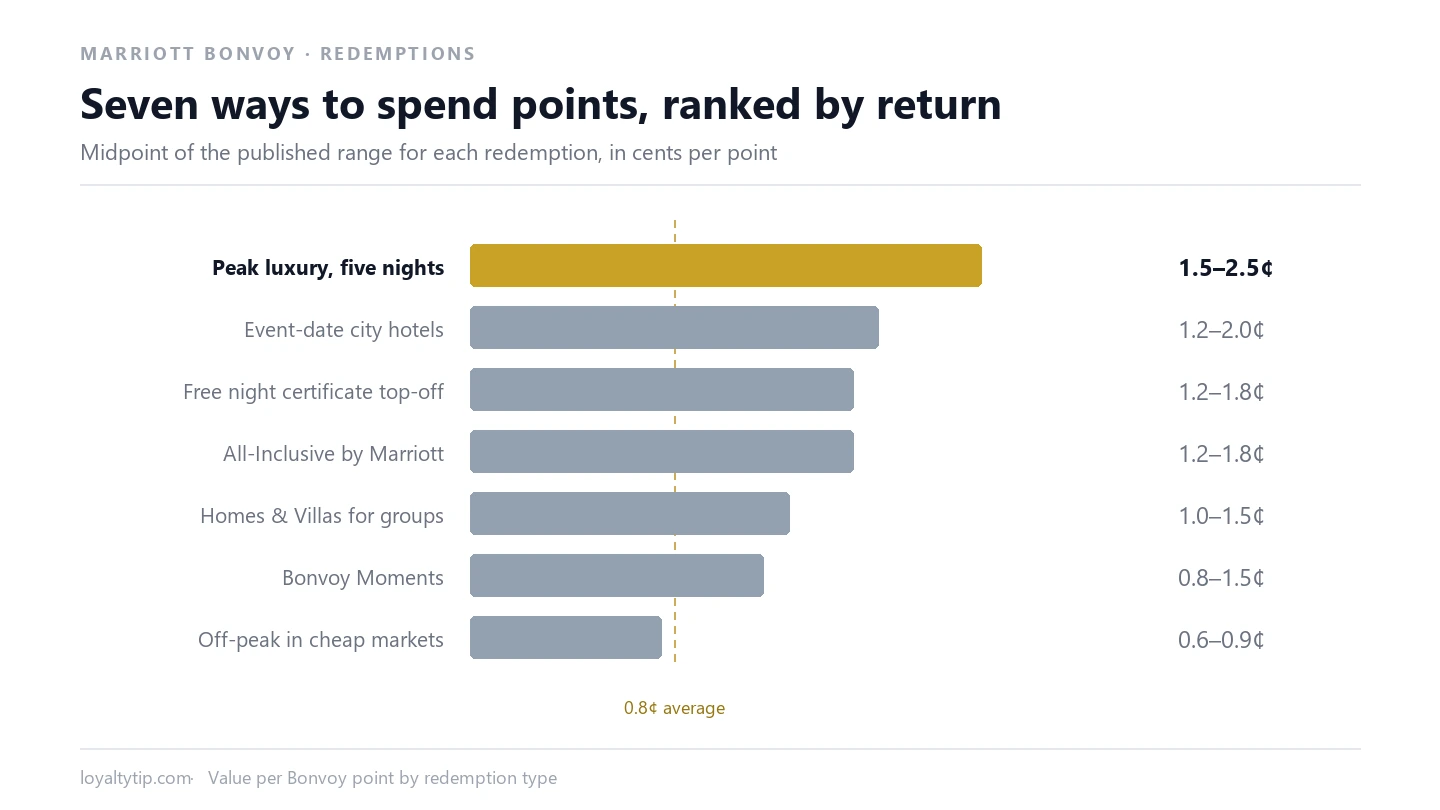
The best way to use Marriott points is a peak-season award at a luxury property, booked for five nights so the cheapest night comes free. That combination routinely returns 1.5 to 2.5 cents per point against a cash rate you would never have paid — roughly double the 0.8-cent baseline the program averages.
Everything else is a matter of degree. Some redemptions clear that baseline comfortably, some land right on it, and a few quietly destroy value. This guide ranks seven of them by what they actually return, gives you the ten-second formula for pricing any award yourself, and flags the three uses that are worse than paying cash.

The Short Answer: Seven Redemptions, Ranked
These are typical returns, not guarantees. Marriott prices awards dynamically, so the same hotel can swing 30% depending on the date — which is exactly why the ranking rewards flexibility rather than a fixed list of properties.
| Rank | Redemption | Typical return | Why it works |
|---|---|---|---|
| 1 | Peak-season luxury stay, five nights | 1.5–2.5¢ | Cash rates spike, award prices do not — and the fifth night is free |
| 2 | High-cash-rate city hotels on event dates | 1.2–2.0¢ | Award pricing ignores convention and festival surcharges |
| 3 | Free Night Award certificates, topped off | 1.2–1.8¢ | Expiring certificates convert into nights worth more than their face value |
| 4 | All-Inclusive by Marriott Bonvoy | 1.2–1.8¢ | The award covers meals and drinks that the cash rate bundles in |
| 5 | Homes & Villas for groups | 1.0–1.5¢ | One award replaces three or four hotel rooms |
| 6 | Marriott Bonvoy Moments | 0.8–1.5¢ | Highly variable, occasionally excellent, often average |
| 7 | Off-peak awards in cheap markets | 0.6–0.9¢ | Fine for using up a balance, poor for building one |
How to Price Any Redemption in Ten Seconds
Before the rankings, the formula. Every award decision reduces to one division:
Cash rate including taxes ÷ points required × 100 = cents per point.
A room priced at $312 all-in that costs 30,000 points returns 1.04 cents per point. The same room at $520 returns 1.73 cents. Nothing else about the property matters — not the brand, not the category, not how prestigious it feels. Only that ratio does.
Two rules make the number more honest. First, always use the all-in cash rate, taxes and resort fees included, because awards do not pay those. Second, use the rate you would actually have paid, not the rack rate posted on the website. If you would have booked the $180 option down the street, the $520 suite is not a real comparison.
Against that, hold the baseline: Bonvoy points average about 0.8 cents each. Accor is the exception worth knowing about, because its points are not valued that way at all: our guide to the best Accor redemptions explains the fixed 2-eurocent rate that replaces the whole calculation. Anything above 1.2 cents is a good use. Anything below 0.7 cents is a donation.
1. Peak-Season Luxury, Booked for Five Nights
This is the top of the list because two effects stack. Luxury properties raise cash rates hardest during their high season — December in the Maldives, February in Bora Bora, cherry blossom week in Kyoto — while award pricing moves in much smaller steps. That gap alone pushes value past 1.5 cents per point. The extreme version of this sits at the top of the luxury portfolio, where a single night can run past 100,000 points — the extreme case at the highest end are the clearest example.
Then the fifth night comes free, which effectively discounts the whole stay by about 20%. A five-night award that would have cost 400,000 points drops to 320,000, and the value per point climbs accordingly.
One detail that catches people out: Marriott removes the cheapest night, not the fifth night in sequence. If your five nights span a rate change, you get the least valuable night removed. Booking five nights at a single consistent rate maximizes the benefit — the mechanic is explained in full in our guide to why the cheapest night comes off, not the last one.
Two things break the stack: Cash + Points bookings do not trigger the free night, and neither do stays where one night is paid with a Free Night Award certificate. Keep it all-points and all-cash-free.
Peak-season luxury is also where status earns its keep — late checkout, lounge access and upgrades are worth most on exactly these nights, and Bonvoy elite status explains which tiers actually deliver them.
2. City Hotels on Dates When Cash Rates Explode
The second-best use has nothing to do with luxury. It is about timing. Hotel pricing in major cities is driven by compression — a convention, a football final, a music festival, a national holiday — and those dates can triple the cash rate while leaving the award price untouched.
A mid-tier Marriott that normally runs $160 a night at 20,000 points returns 0.8 cents, which is unremarkable. On a date where the same room sells for $420 because of a trade show, the identical 20,000 points return 2.1 cents. Same hotel, same award, 2.6 times the value.
This is the most repeatable edge in the program, because it does not require a special property or a lucky category. It requires knowing when your city is full — and booking the award before everyone else realizes the cash rate has moved.
3. Topping Off a Free Night Award Certificate
Free Night Award certificates from Marriott credit cards carry a point ceiling: a 35,000-point certificate cannot normally book a 45,000-point night. Marriott lets you bridge that gap with your own points, up to 15,000 per certificate.
Used well, this converts a certificate that would have gone unused into a night worth considerably more than its face value. A 35,000-point certificate topped with 10,000 points books a 45,000-point room that may sell for $450 in cash — and suddenly a piece of plastic you were about to let expire has returned 1 cent per point on the top-off plus full value on the certificate.
The trap is direction. Top-offs only work upward into a higher award price. Adding points to a certificate that already covers the night does nothing, and certificates expire — typically twelve months from issue, with no extension for most card products. Check the expiry date before you plan around one.
If the top-off amount is the only thing standing between you and a stay, it is worth pricing the alternative. Ten thousand points bought at 0.8 cents costs $80, which is usually far less than the cash difference between a 35,000-point room and a 45,000-point one — topping up your Bonvoy balance during a sale can be the cheapest part of the whole booking.

| Certificate | Face value | Maximum top-off | Highest award it can book |
|---|---|---|---|
| 35,000-point certificate | 35,000 points | 15,000 points | 50,000 points |
| 50,000-point certificate | 50,000 points | 15,000 points | 65,000 points |
| 85,000-point certificate | 85,000 points | 15,000 points | 100,000 points |
4. All-Inclusive Resorts
All-Inclusive by Marriott Bonvoy properties price awards on the room, while the cash rate covers food, drinks and activities for two people. That asymmetry is the whole appeal: you are converting points into a bundle worth meaningfully more than the room alone.
The value holds up best at properties where the all-inclusive component is genuinely expensive — beachfront resorts in the Caribbean and Mexico, where a comparable cash booking runs $500 to $700 a night for two. At 60,000 to 80,000 points, that lands around 1.2 to 1.8 cents per point, with the meals doing most of the work.

Where it falls apart is at all-inclusive properties that are cheap in cash. If the cash rate is $220 a night, the award is not a bargain no matter how the marketing describes it. Run the formula.
5. Homes & Villas for Groups
Marriott’s vacation rental arm accepts points, and the economics change when you are booking for six or eight people instead of two. One four-bedroom villa replaces three hotel rooms, and the award price does not triple to match.
This is a situational play rather than a headline redemption. It shines for family trips and group travel in destinations where hotel inventory is thin or expensive, and it is mediocre for couples who would have booked a single room anyway. Availability is also narrower than the hotel side of the program, so plan further out than you would for a standard award.
6. Marriott Bonvoy Moments
Moments is the program’s experience auction: concert access, sporting events, cooking classes, behind-the-scenes tours. Bids are placed in points and the value is entirely dependent on what the experience would cost you in cash — which is often nothing, because you would not have bought it.
That is the honest framing. Moments returns 0.8 to 1.5 cents per point on paper, but the high end only exists for someone who genuinely values the experience at its market price. For everyone else it is a way to spend points on something memorable rather than a way to maximize value. Neither is wrong — just do not confuse the two.
7. Off-Peak Awards in Cheap Markets
This lands last not because it is bad but because it is neutral. Booking a $95 roadside property for 15,000 points returns about 0.6 cents per point — worse than the program average, but perfectly reasonable if the alternative is letting a balance sit idle.
Use it as a release valve, not a strategy. If you are burning points to avoid a small cash outlay, you are not optimizing anything, and that is fine as long as you know it.
Three Uses That Destroy Value
Airline transfers at average mile values. Marriott converts to 38 airlines at 3:1 with a 5,000-mile bonus per 60,000 points, but the resulting miles are usually worth 0.47 to 0.70 cents each. It only works when you redeem those miles in a premium cabin. The full math is in our guide on how to transfer Marriott points to airlines.
Merchandise and gift cards. These consistently return 0.4 to 0.5 cents per point. There is no scenario where a tote bag is a better use of 40,000 points than a night in a hotel.
Cash + Points when it breaks the fifth night. Cash + Points can be useful, but the moment it prevents you from triggering a free fifth night, the effective value drops sharply — you have traded a 20% discount for a small cash saving.
| Use | Return per point | Verdict |
|---|---|---|
| Peak luxury, five nights | 1.5–2.5¢ | The reason to hold points |
| Event-date city hotels | 1.2–2.0¢ | Most repeatable edge |
| Airline transfer, average redemption | 0.47–0.70¢ | Only for premium cabins |
| Merchandise and gift cards | 0.4–0.5¢ | Avoid |
| Points + Cash that blocks the free night | Varies, usually worse | Avoid |
If the arithmetic says pay cash, that is not the end of the discount. Marriott Bonvoy Escapes takes 20% off prepaid member rates in rounds that open most months, and it is the one cash discount worth tracking alongside your points balance.
If You Are Short of Points for the Good Redemption
The awkward part of every ranking like this is that the best redemptions need large balances. A five-night luxury award can require 300,000 points or more, which is not a number most people accumulate quickly from stays alone — cards and quarterly promotions close that gap faster than nights do.
That is where buying becomes rational. If a purchase at 0.8 cents per point unlocks a redemption worth 1.8 cents, the spread is real even after the cost of the points. The current Marriott points sale is where to check the live per-point price, and our guide to buying Bonvoy points covers the annual caps and bonus tiers so you can time it properly.
The discipline is simple: only buy toward a redemption you have already priced at 1.5 cents or better. Buying points to sit on them is how a good strategy turns into an expensive hobby.
Best Way to Use Marriott Points: Common Questions
What is the single best use of Marriott points?
A five-night award stay at a luxury property during its high season. The cash rate peaks, the award price moves less, and the fifth night comes free — three effects that compound into the highest return the program offers.
Are Marriott points worth more than Hilton points?
Per point, yes — Bonvoy points average around 0.8 cents against roughly 0.5 for Hilton. But Hilton points are far easier to earn, so the useful comparison is return per dollar spent, not per point. Our 2026 hotel points value comparison runs that across every major program.
Should I use points or pay cash?
Divide the all-in cash rate by the points required and multiply by 100. Above 1.2 cents per point, use points. Below 0.7, pay cash. Between those, it depends on whether you have a specific plan for the balance.
Do Marriott points expire while I am saving for a big redemption?
They expire after 24 months of account inactivity, which is why large balances are rarely at risk — any stay, purchase or transfer resets the clock. The rules are set out in our guide to what resets the clock and what does not.
Is it better to book one long stay or several short ones?
One stay of five nights or more, every time. The fifth-night benefit only applies once you cross that threshold, and splitting a five-night trip into a three and a two forfeits roughly 20% of the value.
Next step
Every redemption on this list assumes you already have the balance. If you are short, the current price of Marriott points and the annual caps decide whether buying the difference beats a cash rate.
The Bottom Line
The best way to use Marriott points is not a secret property or a hidden category. It is a repeatable pattern: find a date when cash rates are high, book five nights so the cheapest one comes free, and confirm the math clears 1.5 cents before you commit.
Everything on the list above works from the same formula. Learn the division, apply it to the dates you actually want to travel, and the program stops being a lottery. For what your existing balance is worth in plain dollars, see our what your existing balance converts to in dollars — and if you are topping up to reach a specific award, buying Bonvoy points during a bonus window is usually the cheapest way to close the gap.
More Marriott Bonvoy Guides
- the two programs side by side on the identical redemption and the identical cash rate.
- the cards that supply the certificates, and the elite nights that make a five-night award reachable.
- Combining two balances before you redeem – the annual caps, and why the transfer is free but not unlimited.