United credit cards come in four consumer versions, and the right one depends less on the welcome bonus than on how you actually fly. Chase issues the Gateway, Explorer, Quest and Club Infinite cards, each with a different annual fee, a different United earning rate and a different ceiling on Premier Qualifying Points (PQP). This guide ranks all four on what they cost, what they earn and how far their status help really goes — including the 2026 cardholder award discount and the four-flight rule no card can bypass.
At a glance
| Card | Annual fee | United earning | PQP from spend |
|---|---|---|---|
| United Gateway | $0 | 2x United purchases | None |
| United Explorer | $0 year one, then $150 | 9x United flights | 1 per $20, up to 1,000 |
| United Quest | $350 | 10x United flights | 1 per $20, up to 18,000 |
| United Club Infinite | $695 | 11x United flights | 1 per $15, up to 28,000 |
The four cards compared
Chase refreshed the whole United card lineup in March 2025. Explorer went from $95 to $150, Quest from $250 to $350, and the Club card from $525 to $695. In exchange, the paid cards picked up a bundle of merchant credits and, from 2026, the two premium cards began handing over a small annual block of status points. The figures below are Chase’s published terms as of September 2026.
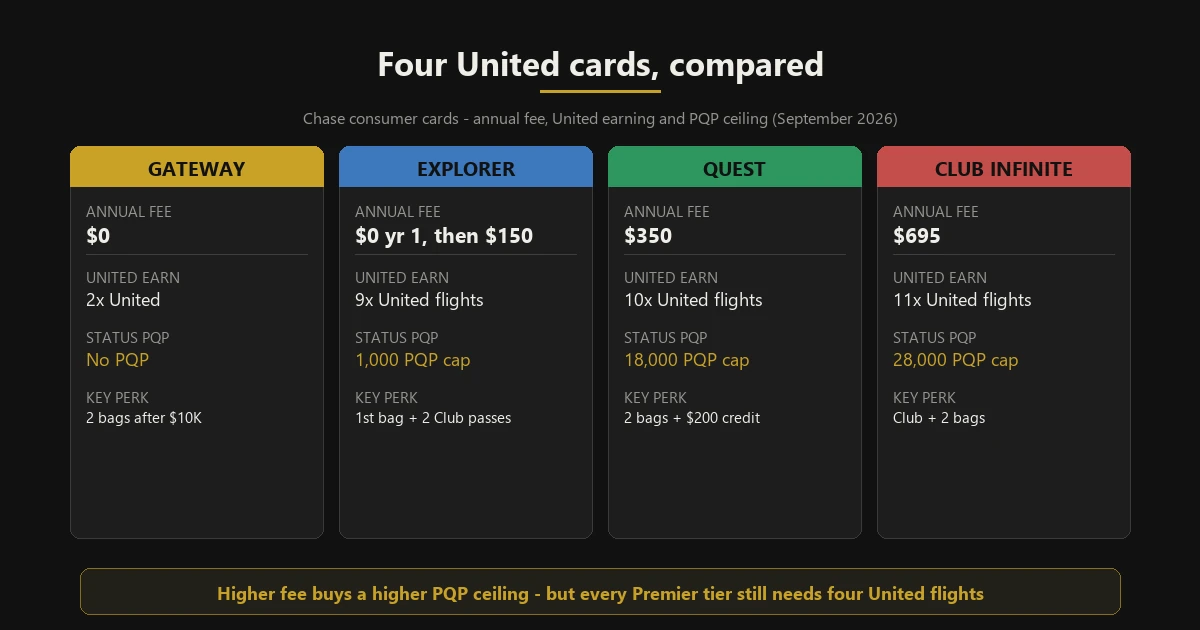
Gateway is the no-fee floor. It earns 2x on United purchases (5x total on United flights once you count the miles United credits the primary cardmember) and nothing toward status. Its only meaningful travel perk is a second free checked bag after $10,000 of spending in a calendar year. It is worth holding for the higher cardmember earning rate and the award discount, not for benefits.
Explorer is the volume pick. For $150 after a free first year it returns 9x on United flights, a free first checked bag, two United Club passes a year, priority boarding and a $100 travel credit after $10,000 of spend. It also puts up to 1,000 PQP toward status — useful as a top-up, nowhere near enough on its own.
Quest is the middle paid card. At $350 it earns 10x on United flights, gives you both checked bags free, a $200 annual United travel credit and up to 18,000 PQP from spend plus a 1,000 PQP annual bonus. If you fly United several times a year and check bags, the bag savings and the travel credit can cover much of the fee.
Club Infinite is the premium card at $695. It earns 11x on United flights, bundles a full United Club membership, both bags free and Premier Access, and offers the strongest status path at 28,000 PQP from spend plus 1,500 bonus PQP. It only makes sense if you would buy a Club membership anyway — that membership alone costs about $750 separately, and the card folds it in.
Chase also issues two business versions, the United Business Card and United Club Business Card, which mirror Explorer and Club Infinite with different fee credits. They are not covered here.
How card PQP really works
PQP is one of the two things United counts for Premier status, alongside the four qualifying flights. Cards earn it on ordinary purchases at a fixed rate, capped per calendar year: Explorer and Quest give 1 PQP per $20, Club Infinite 1 PQP per $15. Quest and Club Infinite also deposit a bonus PQP block — 1,000 and 1,500 respectively — each February if the card was open the previous December.
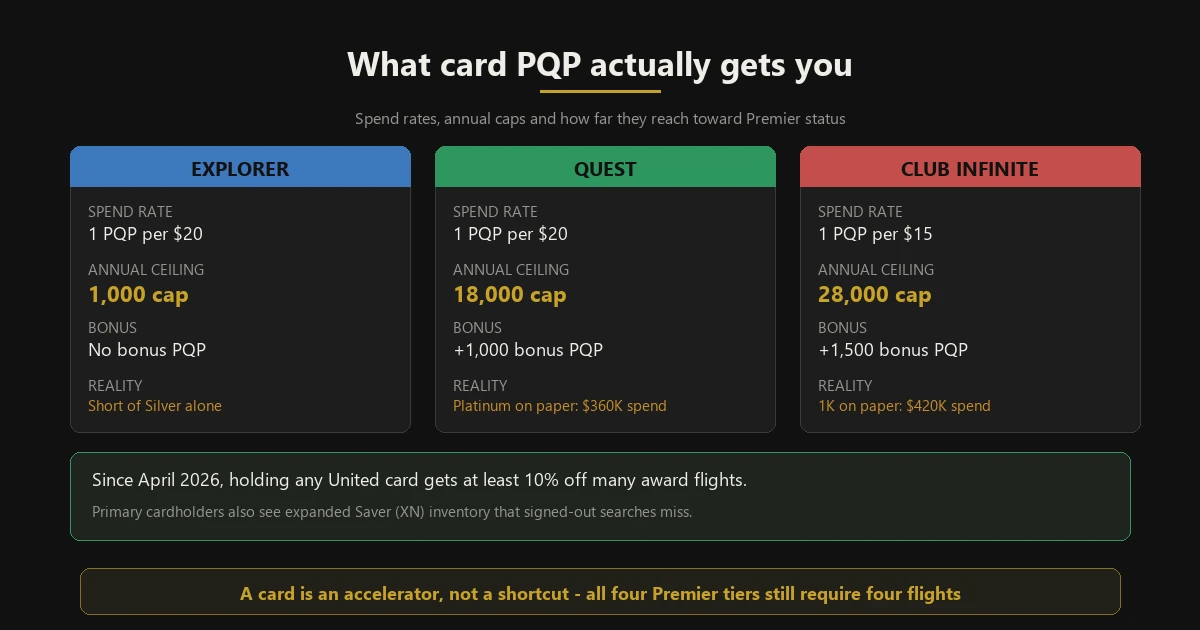
The caps sound generous until you price them. Hitting Quest’s 18,000 ceiling at $20 per point takes $360,000 of annual spending; Club Infinite’s 28,000 ceiling at $15 per point takes $420,000. Realistically most cardholders generate a few thousand PQP from everyday spend, which is enough to close a small gap to the next tier, not to reach one from scratch. For the full tier thresholds, see our United MileagePlus elite status guide.
And the hard limit stands: every Premier tier still requires at least four United or United Express flights. No amount of card spending substitutes for those segments. Treat card PQP as an accelerator on top of flying, not a status shortcut. Note also that from 2027 the Club card’s spending cap rises to 32,000 PQP, while the four-flight requirement stays.
The cardholder award discount
The strongest everyday reason to carry a United card is not the earn rate — it is the discount on award tickets. Since April 2026, United cardholders see “Cardmember pay” prices that are at least 10% lower on many award flights. On a long-haul business award that can be tens of thousands of miles off, and even economy and premium-economy redemptions typically drop 4,000 to 5,000 miles.
Primary cardholders also see expanded Saver inventory (booking class XN) that a signed-out search will not show. That is why a friend can sometimes find an award seat you cannot: their account, not the website, is showing a wider bucket. Holding even the no-fee Gateway card unlocks the cardmember rate and the discount. We explain how to use those lower prices in the best ways to use United miles.
Which card fits your flying
Fly once or twice a year, carry-on only. Get the Gateway. It costs nothing, lifts your earning rate and unlocks the cardmember award price without an annual fee. Do not burn a Chase 5/24 slot on a paid card at this frequency.
Fly a few times a year and check a bag. Explorer is the answer. One free bag per direction saves roughly $70 on a single round trip, plus two Club passes and the larger award discount. If you have business income, the United Business Card makes the same math work without a 5/24 slot.
Fly often, check two bags or chase status. Quest. The $200 travel credit plus the second free bag and the 1,000 bonus PQP justify the $350 fee for a frequent flyer, and the $10,000 award-flight discount after $20,000 of spend adds more.
Live in United hubs and already buy lounge access. Club Infinite. Only count its value if you would genuinely pay for a Club membership; if you would not, Quest delivers most of the travel value for half the fee.
The traps to watch
Credits are not cash. The premium cards advertise large credit totals, but most are small monthly drops (Instacart, rideshare) or locked to specific merchants (Avis, Budget, Renowned Hotels, JSX). Count only what you would spend anyway and treat the rest as zero.
The earn multipliers are combined figures. When Chase says 11x on Club Infinite, six of those miles come from United as a MileagePlus member and five from the card. The headline number assumes you are flying and holding the card at the same time.
Basic Economy earns less. Since the 2026 earning overhaul, miles per dollar depend on your status and whether you hold a card; a general member without a card earns nothing on Basic Economy. See how to earn United miles for the full table.
Rates move. Fees, credits and welcome bonuses change often. The figures here reflect Chase’s published terms in September 2026; check the application page before you apply.
Verdict
For most people the ranking is simple: Gateway if you want the award discount for free, Explorer if you check a bag, Quest if you fly several times a year or want a real status boost, and Club Infinite only if you were buying a United Club membership regardless. The card PQP is a genuine 2026 upgrade, but its spending caps are far out of reach for typical budgets and the four-flight rule is unchanged. Judge these cards on bags, credits and the award discount first — status points are a bonus, not the reason to apply.
Last updated: 21 November 2026. Annual fees, credits and PQP terms can change without notice; confirm the current offer on Chase’s application page before applying.
Frequently Asked Questions
How many United credit cards are there?
Chase issues four consumer United cards — Gateway, Explorer, Quest and Club Infinite — plus two business versions. This guide covers the four personal cards.
Which United credit card is best for most people?
The Explorer Card for anyone who checks a bag, thanks to its free first bag, two Club passes and the cardmember award discount. Occasional carry-on travellers should take the no-fee Gateway instead.
Do United credit cards give you elite status?
No. They earn Premier Qualifying Points on spend and some pay an annual bonus, but every Premier tier still requires at least four qualifying United flights. The card PQP closes a gap; it does not replace flying.
How much PQP do United cards earn?
Explorer earns 1 PQP per $20 up to 1,000 a year. Quest earns 1 per $20 up to 18,000 plus 1,000 bonus PQP. Club Infinite earns 1 per $15 up to 28,000 plus 1,500 bonus PQP. Gateway earns none.
Is the United Club Infinite card worth $695?
Only if you would buy a United Club membership anyway. That membership costs about $750 on its own, so the card is close to a wash for regular lounge users. If you would not pay for a Club membership, the Quest card is better value.
Do United cardholders get award discounts?
Yes. Since April 2026, United cardholders get at least 10% off many award flights and can see expanded Saver inventory. Even the no-fee Gateway card qualifies.
Do United cards charge foreign transaction fees?
No. None of the four consumer United cards charges a foreign transaction fee, which makes them reasonable to use abroad for the mileage earn.
Can you reach United 1K with card spending alone?
No. Club Infinite’s 28,000 PQP spending ceiling could theoretically cover the 1K points requirement, but it would take about $420,000 of annual spend and you would still need four qualifying flights. In practice card PQP is a supplement to flying.
More United MileagePlus Guides
- United MileagePlus promotions, every live offer and which accounts should act on it.
- How to earn United miles, the 2026 flight rates and which transfers actually work.
- How much United miles are worth, the baseline value and how to price any award.
- Do United miles expire, why MileagePlus miles never lapse and the six exceptions.
Pick on bags and the award discount, not the headline miles. If you check a bag a few times a year, start with Explorer; if you carry on, take the free Gateway for the cardmember price. Compare the current welcome offers on Chase’s site before you apply.