How to earn Marriott Bonvoy points comes down to four channels: hotel stays, co-branded credit cards, transfers from bank programs, and promotions. Everything else — dining, shopping, car rentals, meeting rooms — is a smaller version of one of those four.
Most members only ever use the first one. That is why two travellers can sleep the same number of nights and finish the year with balances that differ by six figures.
The eight routes below are ranked by how fast they actually produce points, not by how often they are mentioned. Each one carries a cost, and the cost is rarely cash.
| Route | What it pays | Typical annual yield | The real cost |
|---|---|---|---|
| Credit card sign-up bonus | 30,000–100,000+ per card | 60,000–150,000 | One application, one credit pull |
| Everyday card spending | 2–6 points per $1 | 20,000–60,000 | Nothing beyond normal spending |
| Hotel stays | 10 points per $1, plus elite bonus | Depends entirely on nights | You are paying for a room |
| Elite status bonus | +10% to +75% on base points | A multiplier, not a route | 40–75 nights a year |
| Quarterly promotions | 1,500–4,500 per qualifying stay | 5,000–20,000 | Registering, then routing stays |
| Transfers from Amex, Chase, Bilt | 1:1 | Whatever you choose to move | Giving up more valuable points |
| Buying points | 0.8–1.0 cents each | Capped at 150,000 a year | Cash, at a break-even price |
| Dining, shopping and partners | 2–10 points per $1 | 2,000–10,000 | Attention, and slow accumulation |
Sign-Up Bonuses Are the Fastest Route to a Large Balance
Nothing else on this list produces points at this speed. A single welcome offer on a Marriott co-branded card has historically landed between 30,000 and 100,000+ points, delivered after a spending requirement that most people clear in three months.
Put that next to the alternative. A member paying cash for rooms at a 10-point brand has to spend $3,000 before earning 30,000 base points — and that is $3,000 of hotel nights, not $3,000 of groceries and fuel.
Three Marriott cards are worth knowing about, each attached to a different status tier. Our comparison of Marriott’s co-branded cards covers the annual fees and current offers, but the structural difference is simple: the no-fee card earns 3 points per $1 at Marriott and carries Silver status; the mid-tier cards earn 6 and most carry Gold, though the Chase-issued Boundless stops at Silver; and the top card earns 6 and carries Platinum along with 25 elite night credits a year.
That last detail is the one people miss. A card that bundles 15 or 25 elite nights is not just a points engine — it is the head start that makes Platinum reachable on 50 nights instead of 75.
Everyday Card Spending Is the Only Channel You Control Every Day
Stays depend on travel. Promotions depend on Marriott’s calendar. Card spending depends on nothing but where you tap.
The Bonvoy cards pay 6 points per $1 at Marriott properties, 3 on dining and groceries, and 2 on everything else — with the no-fee Bold dropping to 3 at Marriott. On a year of ordinary spending routed through one card, 30,000 to 50,000 points is a realistic outcome without changing a single purchase.
Two mechanics matter more than the headline rate:
**Card points stack on top of hotel points.** They are paid by the bank, not the hotel, so both arrive on the same stay. A $200 night at a 10-point brand earns 2,000 from Marriott and another 1,200 from a 6-point card — before any elite bonus.
**Card points are earned on the tax-inclusive total.** Hotel points exclude tax and fees. Card points do not. On a stay with 15% tax, that difference is worth about 15% more points than the room rate alone suggests.
What card points do not do is count toward elite status. Status comes from nights and from the credits a card hands you at the start of the year — not from spending on it.
Stays Pay 10 Points per Dollar, Before Any Bonus
This is the rate everyone knows and the one most people apply to the wrong charges.
| Brand group | Points per $1 | Which brands |
|---|---|---|
| Most brands | 10 | Ritz-Carlton, St. Regis, W, JW Marriott, Westin, Sheraton, Le Méridien, Renaissance, Autograph, Courtyard, Fairfield, AC, Aloft, Moxy and most others |
| Longer-stay and apartment brands | 5 | Residence Inn, TownePlace Suites, Element, Marriott Executive Apartments, Homes & Villas, Apartments by Marriott Bonvoy |
| StudioRes | 4 | StudioRes only |
Three rules decide whether those points actually arrive:
**Tax and fees do not earn.** Neither do tips, service charges, parking, or anything billed by a third party. A $200 room with 15% tax earns on $200, not $230.
**Third-party bookings earn nothing.** Expedia, Priceline and the rest of them return zero points and zero elite nights. Bank travel portals behave the same way, with one narrow exception: Amex Fine Hotels + Resorts bookings still earn hotel points and nights.
**You can earn on up to three rooms.** All three must be on your member number, paid by you, with matching dates. Elite nights, though, only count for the room you personally occupy.
Hotel dining, spa and golf charges billed to the room earn at the same 10-per-dollar rate, which is why a resort stay can out-earn a city stay at an identical room rate.
Elite Status Adds 10% to 75% on the Same Room
The bonus is calculated on base points only. It is not a discount on your rate and it does not compound with card points.
| Status | Bonus on base points | Points per $1 at a 10-point brand |
|---|---|---|
| Member | None | 10 |
| Silver Elite | +10% | 11 |
| Gold Elite | +25% | 12.5 |
| Platinum Elite | +50% | 15 |
| Titanium Elite | +75% | 17.5 |
| Ambassador Elite | +75% | 17.5 |
Titanium and Ambassador sit on the same rate, which is the clearest evidence that Ambassador is not sold as a points tier — it is sold on the service. If points are your goal, Titanium is the top of the ladder that matters.
Getting there is a separate problem. The thresholds, the credit card head start and the fast-track routes are covered in our guide to how the Bonvoy tiers are earned. The short version: a card that hands you 25 elite nights changes the arithmetic more than any amount of extra spending.
Quarterly Promotions Are the Cheapest Points If You Register
Marriott runs a global promotion most quarters, and the structure has been stable for years: register first, then earn a bonus on qualifying paid stays inside a fixed window. The autumn 2026 round paid 1,500 bonus points per stay of two or more consecutive nights, plus another 3,000 at participating resorts.
Three things decide whether you actually collect:
**Registration is the whole gate.** Stays completed before you register do not count, no matter where they fall in the window. A 60-second sign-up done before booking is worth more than any other action on this page.
**Most rounds require two consecutive nights.** A single night at a Courtyard pays nothing under that structure. Two nights at the same hotel, same reservation, pay 1,500.
**Only paid stays count.** Award nights and free night certificates are excluded, so a points stay does not trigger the bonus.
Promotions are also the easiest channel to ignore by accident, because the email arrives when you are not planning travel and the window closes before the next trip.
Transfers Work, but the Math Rarely Does
Marriott is a 1:1 transfer partner of Amex Membership Rewards, Chase Ultimate Rewards and Bilt Rewards. That sentence is true and, on its own, misleading.
| From | Ratio | Transfer time | What that point is worth elsewhere |
|---|---|---|---|
| Amex Membership Rewards | 1,000 : 1,000 | Instant | About 1.3 cents |
| Chase Ultimate Rewards | 1,000 : 1,000 | 1–5 business days | About 1.8 cents |
| Bilt Rewards | 1,000 : 1,000 | Instant | Comparable to Amex |
Move 60,000 Chase points into Marriott and you hold 60,000 Bonvoy points, worth roughly $480 of hotel at the 0.8-cent baseline. Those same 60,000 Chase points moved to Hyatt routinely return more than twice that. The transfer is not a scam; it is simply a bad trade at the average.
Which leaves two legitimate uses. The first is topping off: you have 42,000 points, the award costs 45,000, and moving 3,000 is cheaper than paying cash. The second is a transfer bonus, historically 20% to 50%, which changes the arithmetic enough to reconsider.
Confirm the award is bookable before you transfer. Transfers are one-way, and Marriott award space has a habit of vanishing between the search and the click.
If neither case applies, buying the shortfall is almost always the cheaper fix. A transfer sacrifices points that are worth more elsewhere; a purchase costs cash at a known price. Marriott’s current points price sits near 0.81 cents while the 55% bonus runs, which is a smaller loss than giving up Chase points worth twice that.
Buying Points Is a Top-Up Tool With a Hard Cap
Marriott sells points directly, and the price swings with the promotion cycle. The current offer runs a bonus of up to 55% through November 23, 2026, which brings the effective price to about 0.81 cents per point.
That number is just above the 0.8 cents a Bonvoy point is typically worth. Buying at 0.81 and redeeming at 0.8 is a rounding error, not a strategy — the case for buying only opens up when the specific award you want returns more than a cent per point.
The cap is the other constraint. Marriott limits annual purchases to 150,000 points, raised to 200,000 during the current bonus window, and your account has to be at least 30 days old before it can buy at all.
When the maths works, it works well. Check what Marriott charges for points this month before you assume the price — the difference between 0.81 and 1.25 cents is the difference between a good top-up and a waste. Our breakdown of the purchase tiers and annual cap has the full pricing table.
Dining and Partner Activity Add Up Slower Than You Think
These channels are real, and they are consistently oversold. Here is what each one actually pays.
**Hotel dining without a room.** Eat at a participating Marriott restaurant, give your member number, pay the bill yourself, and you earn 5 points per $1 — no stay required.
**Marriott Bonvoy Dining.** Link a card and earn 4 points per $1 as a member, 6 as an elite, at participating restaurants. The US version runs as Eat Around Town.
**The shopping portal.** Retailers pay anywhere from 2 to 15 points per $1 depending on the store and the week. Stack it with a Bonvoy card for the best combined rate.
**Car rentals.** Hertz pays a flat 500 points per rental, Dollar and Thrifty 250 — flat, not per dollar, which makes short rentals the better value.
**Meeting and event spend.** Eligible charges earn 2 points per $1, with a per-event cap that rises with your status.
A year of diligent dining and portal shopping might produce 5,000 to 10,000 points. That is a useful supplement to a stay-based balance. It is not a substitute for a sign-up bonus, and it never will be.
One caution that applies to all of these: Bonvoy points expire after 24 months of account inactivity, and dining or portal activity counts as activity. If your balance is at risk, the 24-month expiry rule explains the four ways to reset the clock.
Stacking All Four Channels: One Stay, Four Layers
The reason these routes are worth learning separately is that they all fire on the same transaction.
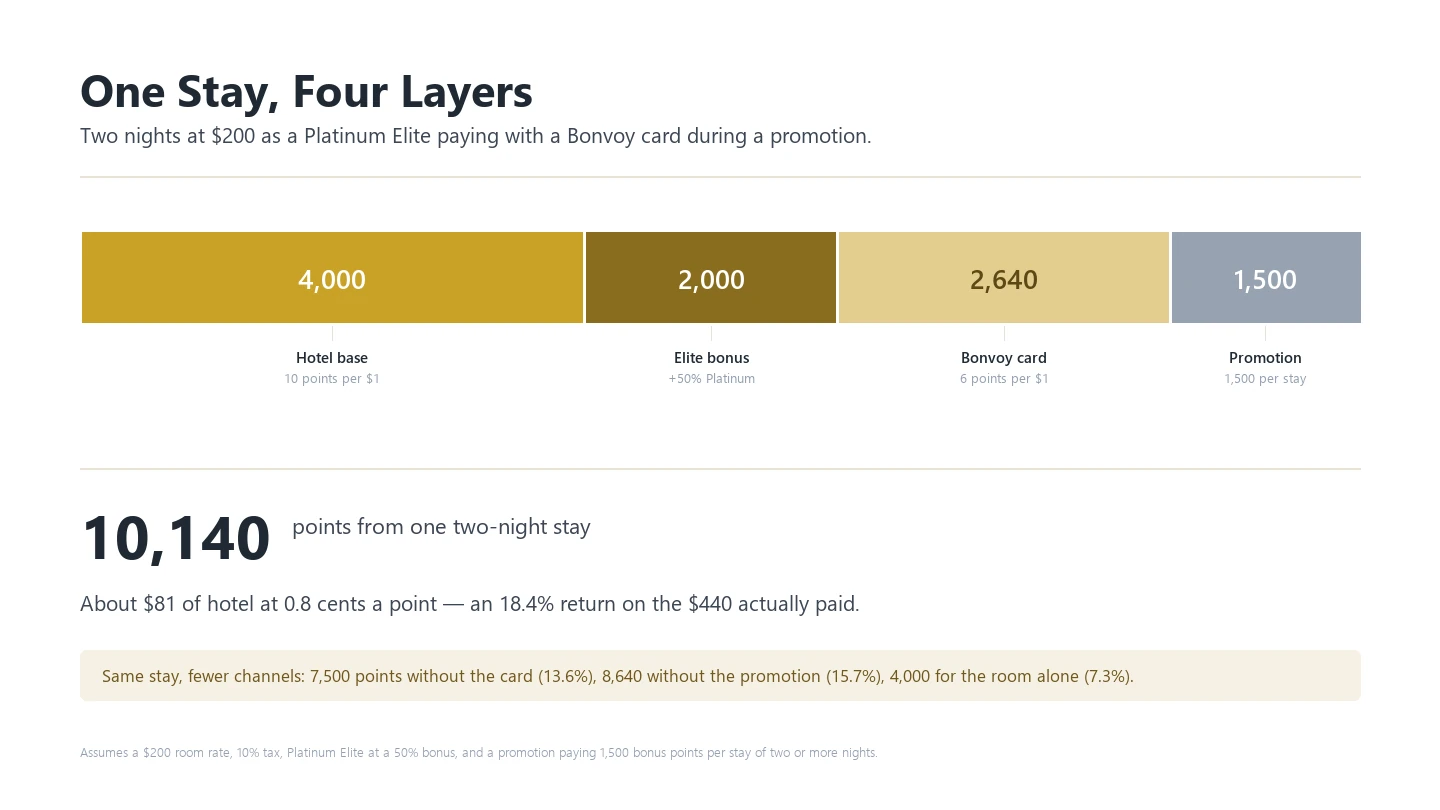
Take two nights at $200, booked direct, paid with a 6-point Bonvoy card, by a Platinum Elite, during a promotion that pays 1,500 per stay:
| Layer | Calculation | Points |
|---|---|---|
| Hotel base | $400 × 10 | 4,000 |
| Elite bonus | 4,000 × 50% | 2,000 |
| Bonvoy card | $440 × 6 | 2,640 |
| Promotion | 2+ night stay | 1,500 |
| Total | 10,140 |
At 0.8 cents, that is about $81 of hotel against $440 paid — an 18.4% return. Remove the card and the same stay returns 7,500 points, or 13.6%. Remove the promotion too and it drops to 4,000, or 7.3%. Book the identical room through a third-party site and it returns nothing at all.
The gap between 7.3% and 18.4% is not a matter of travelling more. It is the same two nights, booked and paid differently.
What a Realistic Year Looks Like
A member who travels moderately — say 25 paid nights, mostly at 10-point brands — earns roughly 30,000 points from stays with no status bonus, or 37,500 at Gold.
Add one card. Twelve months of ordinary spending at 2 to 6 points per dollar contributes 30,000 to 50,000 more, and the sign-up bonus on that card contributes another 30,000 to 100,000 in the first year.
Register for four quarterly promotions and route your stays inside the windows, and 10,000 to 20,000 more arrive without a single extra night booked.
That is 70,000 to 200,000 points in a year, and the difference between the low and high ends is almost entirely about which channels were switched on — not about how much was spent.
One mechanism removes the timing problem entirely. Points Advance lets you book an award before the balance exists, with a deadline shortly before arrival to earn or transfer the shortfall. That means a good redemption does not have to wait for the balance to catch up — you hold the room, then earn the points on your own schedule.
The other side of the ledger matters just as much. A balance that large is only useful if it is redeemed well, and Marriott’s dynamic pricing means the same points buy wildly different amounts of hotel depending on where and when you spend them. Our guide to what a Bonvoy point is actually worth covers the redemption side, and the fifth night free benefit is the single largest discount available on any award stay of five nights or more.
Marriott Bonvoy Points: Common Questions
How many Bonvoy points do you earn per dollar at Marriott?
Ten points per $1 at most brands, five at longer-stay and apartment brands such as Residence Inn, TownePlace Suites, Element and Homes & Villas, and four at StudioRes. Elite status adds 10% to 75% on top of those base points, and a co-branded card adds 2 to 6 more per dollar on the card side.
Do you earn points on taxes and fees?
No. Hotel points are calculated on the qualifying room charge before tax, and tips, service charges, parking and third-party services earn nothing. Credit card points are the exception — they are earned on the full amount charged to the card, including tax.
Can you earn Marriott points without staying at a hotel?
Yes. Hotel dining (5 points per $1), the Bonvoy dining program (4 to 6), the shopping portal (2 to 15), car rentals, meeting spend and co-branded credit cards all earn without a room. None of them match the rate of a stay or a sign-up bonus.
Do credit card points count toward Marriott elite status?
No. Points earned from card spending do not build status. What cards do provide is a block of elite night credits each year — from 5 on the no-fee card up to 25 on the top tier — and a status tier attached to the card itself.
Is it worth transferring Chase points to Marriott?
Usually not. Both programs transfer at 1:1, but a Chase point is worth roughly 1.8 cents against Marriott’s 0.8. Transfer only to top off a specific redemption you have already confirmed, or during a transfer bonus of 20% or more.
What is the fastest way to earn Marriott Bonvoy points?
A credit card sign-up bonus. One welcome offer can produce more points than a year of hotel stays, and it arrives in the time it takes to meet a spending requirement rather than the time it takes to sleep 25 nights.
Do Marriott Bonvoy points expire?
Yes, after 24 months without qualifying activity. Any earning or redemption activity resets the clock, including a small points purchase, a dining transaction or a redemption booking.
Can you earn points for more than one room?
Up to three rooms per stay, all booked on your member number, all paid by you, with matching dates. Elite nights are only credited for the room you personally occupy.
Next step
Earning is only half the equation. If you are short of a specific award rather than building a balance, buying the missing points is faster than waiting for card spend to accumulate — and the redemptions that clear 1.5 cents are where that purchase pays itself back.
The Bottom Line
The honest answer to how to earn Marriott Bonvoy points is that the fastest routes are the ones that require the least travel. A sign-up bonus and a year of ordinary card spending will out-earn 25 nights of stays, and both of them compound with everything else on the list.
Stays remain the foundation — 10 points per dollar plus up to 75% from status is not a rounding error. Promotions are the cheapest marginal points Marriott offers, and they cost nothing but a registration. Transfers and purchases are top-up tools, useful in narrow situations and expensive outside them.
What separates a 70,000-point year from a 200,000-point year is rarely the number of nights. It is whether the card, the promotion registration and the direct booking were all switched on for the same stay.
If you are short of a specific award rather than building a balance, Marriott’s own points sale is the more direct route — and at the current 55% bonus it prices points below a cent each. Just check the award is bookable first, because buying points you cannot spend is the one mistake on this page that costs real money.
Before you spend them, it is worth knowing what they are worth. Our guide to where Marriott points return the most covers the redemptions that clear 1.2 cents and the ones that quietly return half that.
More Marriott Bonvoy Guides
- Marriott Bonvoy promotions this month, every live offer with a straight verdict on whether it beats the member rate.
- Vacations by Marriott, a cash-only package route that still earns points and elite nights.
- Earning on Homes & Villas, the whole-home option that credits 5 points per dollar plus status nights.
- what a Ritz-Carlton night costs in points, and why the top properties have no published ceiling.
- turning a Bonvoy balance into airline miles, at 3:1 with a 5,000-mile bonus per 60,000 points.
- the recurring member rate that undercuts cash prices, released in two-week rounds every month or so.
- how Bonvoy stacks up against Hilton Honors on earning speed, status and free nights.
- Passing points to a spouse after they are earned – the annual caps and the account-age rule that blocks new accounts.