Marriott Bonvoy elite status comes in six levels, from Silver at 10 qualifying nights to Ambassador at 100 nights plus $23,000 of annual spend. Each tier adds bonus points, and a few of them add benefits that change how a stay feels — late checkout you can rely on, breakfast that is actually covered, and upgrades that are more than a nicer view.
The gap between the tiers is not evenly distributed. Two of the six are worth actively chasing, two are worth taking if they arrive, and one exists mostly so the top tier has something beneath it. This guide sets out every threshold, the four benefits that carry real value, and the honest answer to whether chasing the next level is worth the nights.

Marriott Bonvoy Status Levels and Tiers
Qualification is based on a calendar year. Nights earned between January and December count toward status that applies for the following year, plus whatever soft-landing arrangement Marriott is running — the program has historically dropped members one tier rather than all the way to base.
Marriott Bonvoy status levels: all six tiers at a glance
There are six Marriott Bonvoy status levels. In order, they are Member, Silver Elite (10 nights), Gold Elite (25), Platinum Elite (50), Titanium Elite (75) and Ambassador Elite (100 nights plus $23,000 of annual spend). The table below adds the bonus earning rate and the benefit that actually changes a stay at each level.
| Tier | Nights required | Bonus points on stays | Defining benefit |
|---|---|---|---|
| Member | 0 | 0% | Member rates and free Wi-Fi |
| Silver Elite | 10 | 10% | Priority late checkout on request |
| Gold Elite | 25 | 25% | 2pm late checkout and a welcome gift |
| Platinum Elite | 50 | 50% | Lounge access, breakfast and 4pm checkout |
| Titanium Elite | 75 | 75% | United Silver status and a second choice benefit |
| Ambassador Elite | 100 + $23,000 spend | 75% | Dedicated ambassador and 48-hour guaranteed availability |
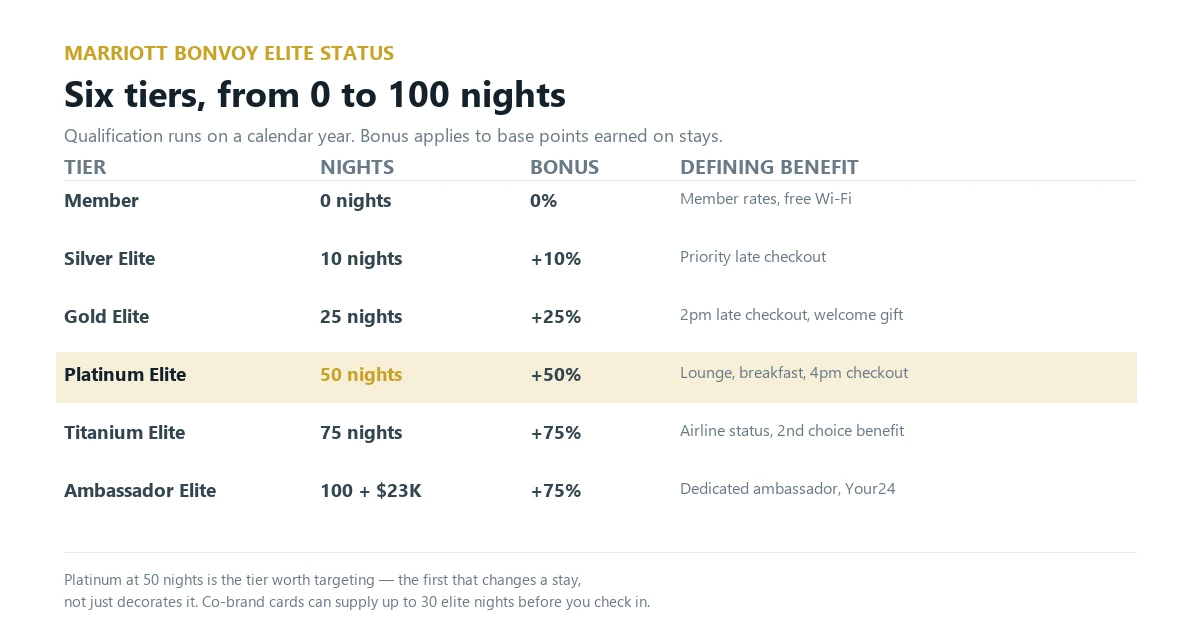
Two notes on that table. Ambassador is the only tier with a spend requirement, and it is the one that catches high-frequency, low-rate travelers — 100 nights in budget properties will not get you there. And the bonus points column applies to base points earned on stays, so the difference between Gold and Platinum is worth more than it looks on a single booking but less than most people assume across a year.
The Four Benefits That Actually Carry Value
Most of the tier benefits are decorative. These four are not.
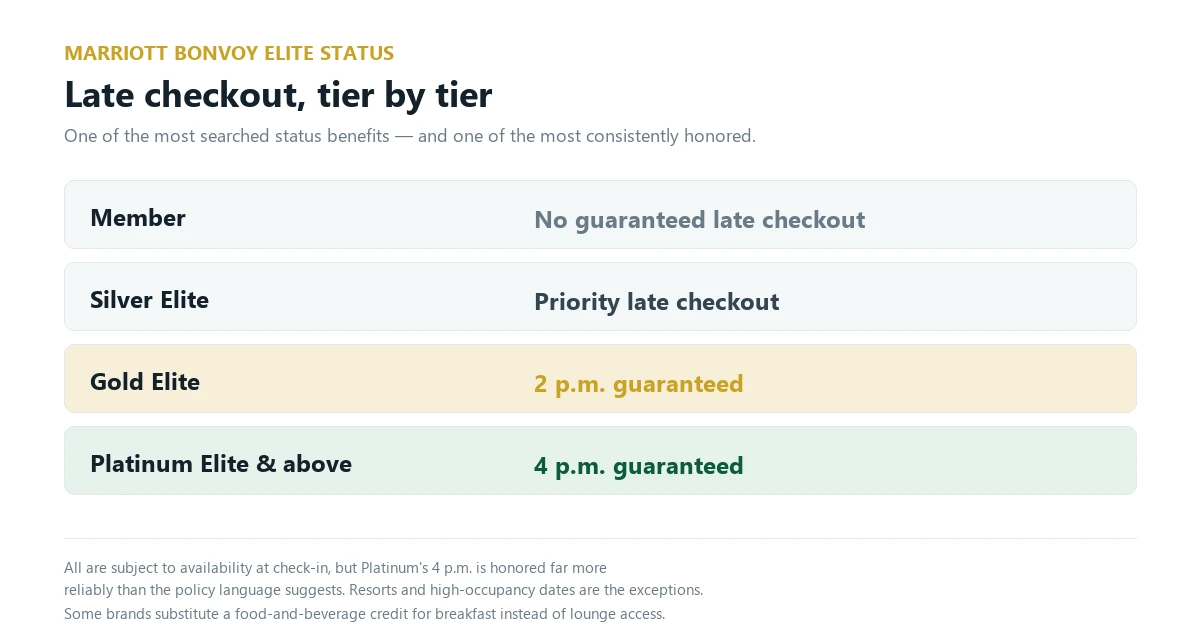
Late checkout. Gold gets 2pm, Platinum and above get 4pm, both subject to availability but honored far more consistently than at most competing programs. For anyone who works on the road or takes afternoon flights, a guaranteed 4pm checkout is worth more than the points bonus — it eliminates a whole category of planning friction.
Lounge access and breakfast. This is the real dividing line in the program, and it starts at Platinum. Lounge access covers breakfast, evening snacks and drinks, which at a full-service hotel is easily $40 to $80 a day for two people. Some brands substitute a food and beverage credit for breakfast rather than a lounge, and resorts frequently exclude both. One exception worth knowing before you count on it: Ritz-Carlton sells Club Level as a room type rather than granting it to elites, so Platinum and Titanium members do not walk into the Club for free.

Room upgrades. Upgrades are offered at every tier above Member but only become meaningful at Platinum, where suite upgrades enter the picture. They remain subject to availability at check-in, which in practice means they are common at quiet properties and rare at the ones you most want.
Annual Choice Benefits. Reaching 50 nights and again at 75 unlocks a menu that includes Suite Night Awards, free night certificates, elite night credits and gifting status to someone else. These are the most underused part of the program — many members hit the threshold and never make a selection.
| Milestone | Typical options | Best pick for most people |
|---|---|---|
| 50 nights (Platinum) | Suite Night Awards, elite night credits, mattress discount | Suite Night Awards |
| 75 nights (Titanium) | Free night award, additional Suite Night Awards, elite night credits, gift status | Free night award, unless you are chasing lifetime status |
Which Tiers Are Actually Worth Chasing
Platinum is the target. Fifty nights is a real commitment, but it is the first tier that changes a stay rather than decorating it: lounge access, breakfast, 4pm checkout and suite upgrades all arrive together. If you are going to chase anything in this program, chase this.
Gold is the reasonable floor. Twenty-five nights is reachable for most people who travel for work a few times a quarter, and 2pm checkout plus a welcome gift and 25% bonus points is a fair return. It will not transform your trips, but it costs nothing extra beyond the stays you were taking anyway.
Titanium is a status-matching play. The Marriott–United RewardsPlus partnership grants United Silver elite status to Titanium members, which carries its own perks in a different program. If you fly United regularly, that single benefit can justify the extra 25 nights. If you do not, Titanium is Platinum with a bigger points multiplier.

Ambassador is for a specific traveler. One hundred nights plus $23,000 in qualifying spend describes someone living in hotels on someone else’s budget. The dedicated ambassador and the 48-hour guaranteed room availability are genuinely useful at that volume and largely irrelevant below it.
Silver is a participation badge. Ten nights gets you a 10% points bonus and a late checkout request that will be honored when the hotel is empty. Worth having, not worth planning around.
The Shortcut: Credit Card Elite Night Credits
The most efficient path into the upper tiers is not more stays. It is cards. Marriott co-branded credit cards in the United States grant elite night credits every year without any spending requirement — typically 15 from a personal card and 15 from a small business card, for up to 30 nights before you check in anywhere.
That means a personal card plus a business card puts Platinum within 20 stays of a hotel room, and Gold within reach of a single trip. The cards also carry annual Free Night Awards, which is a separate benefit worth calculating on its own.
This is the single highest-leverage move in the program, and it is why the effective cost of Platinum for a US-based traveler is far lower than the 50-night headline suggests. Card benefits change annually, so confirm the current elite night allowance before applying — the number is printed on every issuer’s page. Our Marriott credit cards comparison sets out which cards grant elite nights, what each costs and how their free night certificates differ.
A note for readers outside the United States: co-brand cards in your market vary widely in what they grant, and some issue no elite nights at all. Check the local terms rather than assuming the US structure applies.
Lifetime Status: The Long Game
Marriott offers three lifetime tiers, and they are the only status that cannot be lost to a quiet year.
| Lifetime tier | Nights required | Years at that level or above |
|---|---|---|
| Lifetime Silver Elite | 250 | 5 |
| Lifetime Gold Elite | 400 | 7 |
| Lifetime Platinum Elite | 600 | 10 |
Only Lifetime Platinum carries benefits that survive a change in travel patterns, and 600 nights is roughly fifteen years of steady business travel. Treat it as a by-product of a career rather than a goal you set — chasing it from a standing start rarely pays back.
Does Status Change What Your Points Are Worth?
Not directly, and this is the most common misconception in the program. Elite status affects how fast you earn points and how comfortable the stay is. It does not make a point worth more when you redeem it.
A Platinum member and a base member spending the same 30,000 points on the same room get the same value. The difference is that the Platinum member earned those points 50% faster — which is a real advantage, just a different one. If that gap is the part you care about, the full set of earning channels beyond stays is where it compounds.
That distinction matters when you are deciding whether to buy points. Purchased points behave identically at every tier, so the calculation is purely about the redemption. Whatever your tier, the night itself starts with a rate — compare Marriott’s official booking rates before you commit. Shopping a bonus window is a straightforward economics question: check the live Marriott points price against the cash rate you would otherwise pay, and buy only when the spread is in your favour.
The mechanics — annual caps, bonus tiers, minimum purchase sizes — are set out in our guide to buying Marriott Bonvoy points, and the valuation side of the comparison lives in our what those points are worth in cash.
Where status does tip a purchase decision is at the margin: a Platinum member who needs 20,000 more points to reach a five-night award will extract more from that stay than a base member would, because breakfast and lounge access come free on top of the room. That is worth something, and it is easy to forget when you are staring at a points balance.
Where the balance gets spent matters more than the tier it was earned at — our ranking of the best ways to use Marriott points covers that side of the equation.
Is It Worth Chasing the Next Tier?
The test is straightforward. Add up what the next tier’s benefits would have delivered on your actual stays last year, then divide by the extra nights required.
Moving from Gold to Platinum typically means 25 more nights. If those nights are stays you were taking anyway, the answer is obviously yes. If you would need to book paid nights specifically to qualify, compare the benefit — lounge access and breakfast for two, call it $60 a stay — against the cost of those rooms. Twenty-five manufactured nights at $150 is $3,750 spent to unlock perhaps $1,500 of value. That trade only works if you were going to book the rooms regardless.
If the room is one you were going to book anyway, start from Marriott’s hotel search and let the qualifying nights come to you. Status runs are almost always a bad purchase. Status earned in the course of real travel is one of the better deals in the loyalty industry.
If what you actually want is a specific award rather than a tier, separate the two questions. Manufacturing 25 nights to unlock benefits you may not use is expensive; buying the points you are short of is usually cheaper and delivers the room immediately.
Marriott Bonvoy Elite Status: Common Questions
How many nights do you need for Marriott Platinum?
Fifty qualifying nights in a calendar year. With a personal and a business Marriott credit card, up to 30 of those can come from card benefits rather than stays.
Does Marriott status expire?
Status is earned annually and applies for the following calendar year. Marriott has generally offered a soft landing, dropping members one tier rather than to base, but that is a policy decision rather than a guarantee. Lifetime status never expires.
What is the difference between Platinum and Titanium?
Twenty-five nights, a higher points multiplier, a second annual choice benefit, and United Silver status through RewardsPlus. The day-to-day hotel experience is broadly similar.
Do award stays count toward elite status?
Yes. Nights stayed on points count as qualifying nights, and the points you earn on incidental spending count too. This is one of the reasons burning points does not slow your progress.
Nights stayed on points count as qualifying nights. Just note that a balance with no activity at all expires after 24 months — see the 24-month inactivity rule.
Is Marriott status worth it compared to Hilton or Hyatt?
Marriott is the middle ground: easier to reach than Hyatt’s top tiers, more consistently valuable than Hilton’s. Platinum is the closest thing the industry has to a guaranteed breakfast and lounge package at a mid-tier threshold.
Next step
If the next tier is still 20 nights away, buying the points for an award stay usually costs less than paying cash to close the gap. Our walkthrough of how Marriott sells its own points covers the annual cap, the bonus windows and what a point costs at each purchase size.
The Bottom Line
Marriott Bonvoy elite status rewards a specific kind of traveler: someone who stays 25 to 75 nights a year, usually for work, and values predictable perks over occasional spectacular ones. Gold is achievable, Platinum is worth the effort, and everything above that is a professional by-product.
The fastest route up is not more nights — it is the elite night credits that come with co-brand cards, which can put Platinum within reach of a modest travel schedule. And once the status is in place, the points you earn are worth exactly what anyone else’s are worth, which is why the redemption side deserves as much attention as the qualification side.
The nights you pay for in cash still earn your tier bonus — check current Marriott room rates when you book. If you are building a balance toward a five-night award, stack the fifth night free on top of your tier benefits, and check whether buying the shortfall in points costs less than the extra nights you would otherwise book to get there.
If you are chasing elite nights rather than points, note that cash bookings through Homes & Villas earn one elite night per night stayed, while Vacations by Marriott packages credit nights for the hotel portion only.
More Marriott Bonvoy Guides
- trading points for airline miles instead, and why the 3:1 rate rarely clears a hotel redemption.
- Marriott against Hilton on the same night, with both currencies priced at the same cash rate.
- the member rate that stacks with points, for the nights status alone will not cover.