Transfer Marriott points to airlines and the rate is fixed before you start. Three Bonvoy points become one mile at 37 of the 38 partner airlines, and every 60,000 points you move in a single request picks up 5,000 bonus miles. United adds 10,000 instead of 5,000. That part is simple, and it is where most guides stop.
The part that actually decides whether you should do it is the value. A Bonvoy point and an airline mile do not trade at par, and the direction of the trade matters far more than the 3:1 headline suggests. This guide runs the real numbers, names the three airlines that quietly skip the bonus altogether, and marks the exact break-even where moving points to an airline beats spending them on a hotel bed.

The Short Answer: 3:1, Plus a Bonus You Have to Earn Deliberately
Marriott Bonvoy transfers to 38 airline programs. Almost every one takes points at 3:1, meaning 3,000 Bonvoy points become 1,000 airline miles. On top of the base rate, Marriott adds 5,000 bonus miles for every 60,000 points transferred in a single transaction — and 10,000 bonus miles if the partner is United MileagePlus.
The bonus is not automatic per point. It is calculated per request, so the whole 60,000 has to move at once. Send 30,000 points twice and you collect nothing extra either time. This single mechanical detail is worth about $70 in airline miles on a typical transfer, and it is the most common way people leave value on the table.
| Transfer | Miles received | How the math works |
|---|---|---|
| 60,000 points → United MileagePlus | 30,000 miles | 20,000 base + 10,000 bonus |
| 60,000 points → most partners | 25,000 miles | 20,000 base + 5,000 bonus |
| 60,000 points → American, Delta or Avianca | 20,000 miles | 20,000 base, no bonus |
| 60,000 points → Air New Zealand Airpoints | 375 Airpoints Dollars | 200:1 ratio, small flat bonus |
If you are working from a smaller balance, the same 3:1 rate still applies from 3,000 points upward — you simply lose the bonus tier. And if you are short of points entirely, it is usually cheaper to buy Marriott Bonvoy points during a transfer-friendly sale than to pay cash for the flights you were going to book anyway.
The Real Math: What One Transferred Point Is Worth
Start with what the points are worth if you never transfer them. Bonvoy points return roughly 0.8 cents each on hotel stays, which makes 60,000 points about $480 of room. That is the number a transfer has to beat.
Now price the miles. Airline miles are worth somewhere between 1.2 and 1.6 cents each depending on how you spend them, with 1.4 cents a fair middle. At that rate, here is what the same 60,000 points turn into.
| Transfer route | Miles | Cash value at 1.4¢/mile | Value per Bonvoy point | Against a hotel night (0.8¢) |
|---|---|---|---|---|
| United MileagePlus | 30,000 | $420 | 0.70¢ | −12% |
| Standard partner with bonus | 25,000 | $350 | 0.58¢ | −27% |
| American, Delta or Avianca | 20,000 | $280 | 0.47¢ | −42% |
| Air New Zealand Airpoints | 375 Airpoints | ≈$218 | 0.36¢ | −55% |
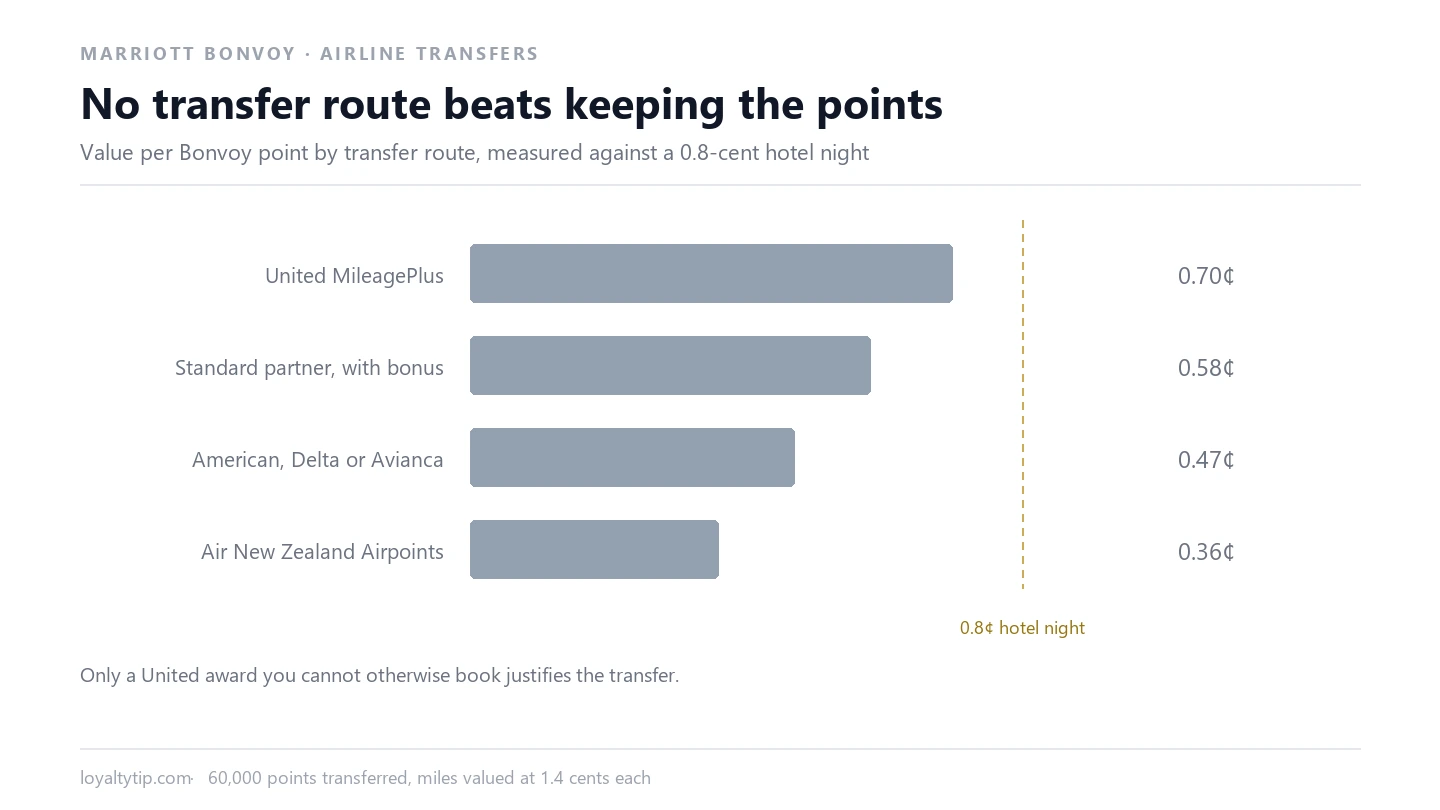
Read that table honestly and the conclusion is uncomfortable: at average mile values, every transfer route returns less than leaving the points in the hotel program. That is not an argument against transferring. It is an argument against transferring for an average redemption.
The Break-Even Mile Value: The One Number That Decides It
Instead of asking whether transfers are “good,” ask what each mile has to be worth for the trade to pay off. That turns a vague debate into arithmetic you can run in ten seconds.
| Route | Miles from 60,000 points | Mile value needed to match $480 in hotel value |
|---|---|---|
| United MileagePlus | 30,000 | 1.60¢ per mile |
| Standard partner with bonus | 25,000 | 1.92¢ per mile |
| American, Delta or Avianca | 20,000 | 2.40¢ per mile |
Those thresholds are high, but they are not fantasy. They are simply the price of admission — and they are reachable, but only in specific cabins and specific situations. Anything below 1.6 cents per mile and you were better off booking a hotel.
United is the easiest route to justify for a structural reason: the 10,000-mile bonus is worth about 25% more miles than any other partner gets. If you have no strong preference between airlines, the United path clears the bar at the lowest mile value.
Where 1.6 to 2 Cents per Mile Still Happens
A mile is worth 1.6 to 2.4 cents in fewer places than it used to, but those places are predictable. Long-haul international premium cabins are the reliable one: a business class seat across an ocean routinely prices at $2,500 to $6,000 in cash while costing 60,000 to 90,000 miles, which pushes the per-mile value to 3 cents or beyond. Transfer 60,000 Bonvoy points into 25,000 miles, stack it against a premium cabin redemption, and the trade finally makes sense.

The second reliable pocket is expensive short-haul flying. A one-way business class hop within Europe or between Doha and a regional destination can cost $600 in cash for 90 minutes in the air, which prices the miles at 2 cents or more. Avios partners — British Airways, Iberia, Qatar, Aer Lingus — are where those redemptions live, and they all take Marriott points at 3:1 with the bonus.
The third is last-minute pricing distortion. When a cash fare spikes because you are booking seven days out, the award price usually does not move. That gap is where a transfer earns its keep, and it is the one scenario where you can decide on a Thursday and fly on a Saturday.
What does not work is the default: domestic economy in the United States. Those awards hover around 1 to 1.3 cents per mile, which lands below every break-even line in the table above. If that is your plan, keep the points for a room and pay cash for the flight.
The Three Airlines That Skip the Bonus
Marriott’s terms quietly exclude three partners from the 5,000-mile bonus: American Airlines AAdvantage, Delta SkyMiles, and Avianca LifeMiles. You still get the base 3:1 conversion, but 60,000 points produce 20,000 miles instead of 25,000 — a 20% haircut on the same transaction.
This matters because those three are not obscure. AAdvantage and SkyMiles are the two most commonly requested transfers among US-based travelers, and plenty of people move points without noticing they received less than expected. If your plan depends on one of them, run the numbers against the 2.4-cent break-even first; at that threshold, only a strong premium-cabin redemption justifies the move.
Air New Zealand is a separate case. It converts at 200:1 rather than 3:1, so 60,000 points become 300 Airpoints Dollars plus a small flat bonus. That works out to roughly 0.36 cents per Bonvoy point — the weakest conversion on the entire partner list. Treat it as a last resort rather than a strategy.

How to Transfer, Step by Step
The mechanics take about five minutes and there is no fee at any stage.
1. Confirm the name match. For most partners, the first and last name on your airline account must match the name on your Bonvoy account. A middle name or a maiden name that differs between the two will block the transfer, and fixing it after the fact is a support ticket, not a click.
2. Check the minimum and the daily cap. Transfers start at 3,000 points, which produces 1,000 miles. The cap is 240,000 points per member per day, so large moves may need to be split across two days.
3. Send 60,000 at a time. This is the bonus trigger. If you are moving 120,000 points, submit it as two separate requests of 60,000 rather than one request of 120,000 — you get the bonus applied cleanly to each block, and splitting costs you nothing.
4. Accept that it is one-way. Marriott transfers are irreversible. Miles cannot be converted back to Bonvoy points, and the airline will not reverse the transaction either. Decide before you click.
5. Wait for the miles to land. Most partners post within a few business days, though a first-time transfer to a given airline occasionally takes longer while the accounts are linked. Do not book a redemption in the same hour you initiate the transfer if the award inventory is thin.
One useful side effect: a transfer counts as account activity on your Bonvoy account, which is one of the ways to keep a balance from expiring. If you are sitting on points you rarely use, this is covered in more detail in our guide to the activities that keep an account open.
Transfer or Buy? Two Different Problems
Transfers and purchases get lumped together, but they solve opposite problems. A transfer converts points you already have into a currency you need. A purchase fills a gap when you are close to an award and short on points.
Those do not mix well. Buying Bonvoy points at 0.8 cents and then transferring them to an airline produces miles at 1.9 cents each, which is the wrong side of every break-even in this guide. Buying points to manufacture airline miles is one of the few genuinely bad uses of a points purchase.
Where a purchase does make sense is the original use case: you are a few thousand points short of a five-night stay that would otherwise cost cash. That is when the arithmetic flips, especially during a sale. The current Marriott points promotion is the place to check the per-point cost before you commit, and our every bonus tier and what it does to the per-point cost covers the pricing tiers in detail.
There is one edge case worth knowing. If you are buying points specifically to reach 60,000 for a United transfer, the effective cost is around 1.6 cents per mile — which only clears the bar if you are booking a premium cabin worth 2.5 cents per mile or more. That is a narrow window, and worth calculating rather than assuming.
Marriott Transfers vs. the Hotel Alternative
The comparison that matters most is not airline versus airline. It is airline versus the stay you did not book. Three Marriott redemptions make the point better than any general statement.
A 60,000-point transfer to United buys 30,000 miles, worth about $420 at 1.4 cents. The same 60,000 points buy two nights at a mid-tier Marriott where cash rates run $240 a night, or roughly $480 of room. The hotel wins by a small margin — but that margin disappears the moment you use those 30,000 miles for a $900 business class seat.
Add the fifth-night-free benefit and the hotel side gets stronger still, since a five-night award stay only charges for four nights. We break that mechanic down separately in a 20% discount on every five-night award, and it is the single biggest reason to think twice before draining a balance into airline miles.
For a full picture of what a point is worth across every major hotel program — and how Bonvoy compares to Hilton, Hyatt and IHG on a per-point basis — see our 2026 hotel points value comparison. If the real choice is between Bonvoy and a rival program rather than between hotels and miles, the same arithmetic is worked through in how Bonvoy compares with Hilton Honors.
Transfer Marriott Points to Airlines: Common Questions
How long does a Marriott points transfer to airlines take?
Most transfers post within one to five business days. The first transfer to a given airline can take longer because the accounts need to be linked, so leave a buffer before booking an award with thin availability.
Can I transfer Marriott points to someone else’s airline account?
No. For most partners the name on the airline account must match the name on your Bonvoy account. Marriott does allow you to transfer points to another member’s Bonvoy account, and that member can then convert them — but the airline side still has to match their name.
Is there a fee to transfer Marriott points to airlines?
No. Marriott charges nothing to convert points to miles, and the airline does not charge a receiving fee either. The only cost is the value you give up by not spending the points on a hotel.
Can I reverse a transfer if I change my mind?
No. Transfers are final in both directions — Marriott will not convert miles back to points, and the airline will not return them. Confirm the partner and the amount before you submit the request.
Which airline is the best to transfer Marriott points to?
United MileagePlus, on pure mechanics: it pays 30,000 miles per 60,000 points instead of 25,000. Beyond that, the best partner is whichever one you can redeem at 1.9 cents per mile or better — usually through a long-haul premium cabin or an expensive short-haul route.
Do transferred miles count toward airline elite status?
Generally no. Miles received from a hotel transfer are redeemable miles, not elite qualifying miles, so they do not move you toward status in most programs. They are still fully usable for award tickets.
Does transferring points affect my Bonvoy elite status?
No. Converting points to miles does not touch your tier, your elite night credits, or your lifetime totals. It only reduces your point balance.
Next step
Before you move points to an airline, price the transfer against the 0.8-cent baseline. What a Marriott point is actually worth gives you the number any transfer has to beat. If the balance itself is the problem rather than the destination, how to earn Marriott Bonvoy points covers the routes that build it fastest.
The Bottom Line
Marriott’s 3:1 transfer rate with a 5,000-mile bonus is one of the more generous hotel-to-airline pipelines in the industry, and United’s 10,000-mile version is better still. But generous relative to other programs is not the same as generous relative to a hotel stay.
The working rule: transfer when each mile will be redeemed at 1.9 cents or better, and prefer United when you have no other loyalty. Skip American, Delta and Avianca unless the redemption is exceptional, since the missing bonus cuts your return by a fifth. And when you are simply short of points for a room rather than chasing a flight, purchasing Bonvoy points during a bonus period is the cheaper route — the points pricing tiers and the break-even against cash rates are covered in our the 0.8-cent baseline and every tier above it.
For most balances, the answer is not “never transfer.” It is “transfer deliberately” — 60,000 at a time, to the right partner, for a redemption you have already priced.
More Marriott Bonvoy Guides
- the redemptions that beat a transfer – which is most of them, at current hotel rates.
- the status tiers and their bonus points, the part of earning that happens after the stay.
- what a Ritz-Carlton award costs instead, for the same points you were about to convert.
- cards that earn the points you would move, and how fast they produce 60,000.
- paying cash at a discount instead, when the transfer value does not clear the bar.
- Consolidating points under one name first – the airline account has to match the Bonvoy account making the conversion.